T2:Particles and radiation
 Call Kai
 Learn
 Practice Test
 Spaced Repetition
 Match
 Flashcards
 Knowt Play
1/27

There's no tags or description
Looks like no tags are added yet.
28 Terms
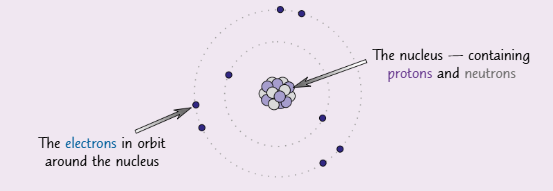
What does the simple model of the atom look like?
What is a nucleon?
What is the relative mass of an electron?
[Image]
A nucleon is a proton or neutron.
0.0005

1.What does the A-Z notation stand for?
2.What defines the element?
3.What makes an atom neutral?
4.What does an atom’s chemical behaviour depend on?
A-Nucleon number-the total number of protons and neutrons, Z-Proton number-number of protons.
The proton number.
The number of protons equals the number of electrons.
The number of electrons.
What is an isotope?
What are the three isotopes of hydrogen?(include the number of protobns and neutrons)
What does changing the number of neutrons in antom affect?
An isotope of an atom has the same number of protons but a different nunmber of neutrons.
Protium (1 proton and 0 neutrons),Deuterium(1 proton and 1 neutron),Tritium(1 proton and 2 neutrons).
The number of neutrons affects the stability of nucleus.
How can radioactive isotopes be used to find out how old stuff is?
All living things contain same perxcentage of radioactiev carbon-14 taken from atmosphere.
After they die, the amount of carbon 14 inside them decreases over time as it decays to form stable elements
Scientists can calcuklate the approx age of archaelogival finds made from organic matter by using the isotopic data(amount of each isotope presnet) to fidn the % of carbon-14 left in the object.
What is specific charge?
What is the formula for specific charge?
Specific charge is the ratio of charge to mass.
[Image]

What are the two classes of Hadrons?
What force are all Hadrons subject to(but other particles such as leptons are not)?
Baryons (proton, neutron) and atnibaryons(antiproton and antineutron) and Mesons ( pion and kaon)
The strong nuclear force(the strong interaction)
Why are Hadrons not fundamental particles?
What are Quarks?
They are made up of Quarks.
The building blocks of all Hadrons.
What is the only stable Baryon?
Why do all the other Baryons decay to become other particles?
What do all Baryons, except for protons, decay to form?
The proton.
They are unstable.
A proton.
What are the different baryon numbers you can have?
Baryon= +1
Anti-baryon=-1
Other particle=0
What are Baryons and Antibaryons made out of?
Baryons= 3 quarks
Antibaryon= 3 anti-quarks
Note:Everything reverses on an antibaryon.
What is the quark structure of a proton and a neutron?
Proton=uud
Neutron=ddu
What are the two different types of meson?
What are all mesons made out of?
Are all mesons unstable?
What are the lighest mesons?
Kaons and Pions.
1 quark+ 1 antiquark.
Yes.
Pions.
What is the difference in strangeness between kaons and pions?
Pions=no strangeness
Kaons= 1 strange quark and 1 antiquark.
What are the three versions of pions and their quark configurations?
π⁺ =ud̄
π⁻=ūd
π⁰=uū,dd̄,ss̄
Note:π⁰ is truly neutral because it is its own antiparticle.
What are four key facts about Kaons?
Heavier and more unstable than pions.
Kaons have a very short life time.
Kaons decay into pions.
What are the four versions of kaons and their quark configurations?
K⁺=us̄
K⁻=ūs
K⁰=ds̄
K̄⁰=d̄s
Note:K̄⁰ (anti-neutral kaon) is the antiparticle of the neutral kaon.
Where were kaons and pions discovered?
How do mesons interact with barons?
They were discovered in cosmic rays.
Via the Strong force.
What are Leptons?
Do leptons feel the strong force?
How do leptons interact with other particles?
Leptons are fundamental particles (not made up of quarks).
No.
Via the weak interaction
What are all the leptons?(×5)
The electron
The electron neutrino
The muon
The muon neutrino
All of the antiparticles of the above.
Are electrons stable?
What is a muon?
What type of interaction are neutrino a part of ?
What particle does a muon decay into?
Yes.
They are like heavy electrons.
The weak interaction.
An electron
What are the different lepton numbers you can have?
Lepton=+1
Anti-lepton=-1
Other particle=0
What are strange particles?
When is Strangeness conserved?
When is strangeness not conserved?
Are strange particles always created in pairs?
Strange particles as particles that are produced through the strong interaction and decay through the weak interaction.
In a strong interaction.
In a weak interaction→ can chnage by 0,+1 or -1.
Yes.
What does the weak interaction do?
Changes the quark type.
What is the change in quark character in β− decay?
In β− decay, a neutron turns into a proton—> a d quark changes into an up quark.

What is the change in quark character in β+ decay?
In β+ decay, a proton chnages into a neutron—> an u quark changes to a d quark.

What are the four things conserved in particle Interactions? + Extra note
Energy and momentum are also always conserved.
