ansc314 - lipids
 Call Kai
 Learn
 Practice Test
 Spaced Repetition
 Match
 Flashcards
 Knowt Play
1/35

There's no tags or description
Looks like no tags are added yet.
36 Terms
lipids
physical - compounds soluble in organic non-polar solvents, but insoluble in water
ether, benzene, chloroform
chemical - ESTERS of fatty acids and glycerol (or some other alcohol), and waxes, terpenes, etc
lipid functions
stored energy in body
components in plasma membrane of all cells
has vitamin A, D, E, K
insulation & lubrication
lipid classifications

plant lipid functions
structural - leaves 7% of DM
surface lipids are waxes
plasma membranes are mostly glycolipids (40-50%)
storage in seeds - oils (simple lipids)
animal lipid functions
store energy → 97% of adipose tissue (triglycerides)
structural lipids → phospholipids
blood plasma → free or non-esterified FA (NEFA), triglycerides (esterified)
hormones & vitamins
simple lipids
triacylglycerols
triglycerides
di & monoglycerides - smaller quantities in nature
triacylglycerols
triglycerides
most nutritionally significant of lipid groups esters of FA w/ alcohol (glycerol)
tri - acyl esters of glycerol
form bulk of animal & plant fats & oils
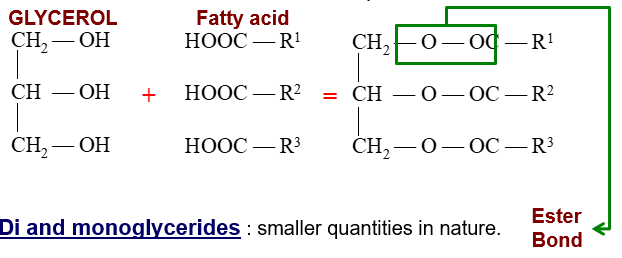
tripalmitin
3 molecules of palmitic acids combine w/ one molecule of glycerol
formation of triglyceride as simple lipid

butterfat

fatty acids
(FA) - determine the properties of fats
classification:
saturated (no double bonds)
unsaturated (w/ double bonds)
animal FA
even # carbon atoms (2-24)
straight chain
carboxyl group (-COOH) at end
odd chain but only from absorption of microbial derived FA
FA structure
all FA have 3 components
carboxylic acid (alpha) end
methyl (or omega) end
fatty acid back bone
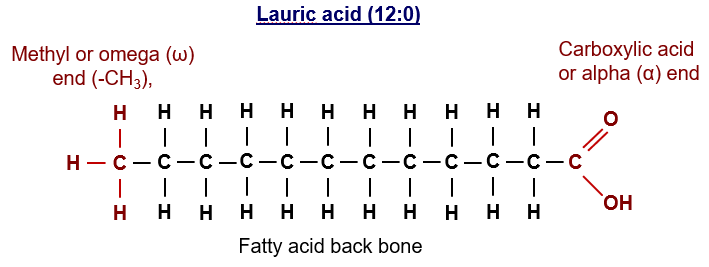
saturated FA
FA w/ no double bonds

volatile FA
acetic
propionic
butyric
descending order → ↑ # carbon
unsaturated FA
FA that have double bonds
mono-unsaturated
poly-unsaturated
monounsaturated FA
only 1 double bond
mono-enes
Oleic acid, 1 double bond (olive oil)
CH3(CH2)7CH = CH(CH2)7COOH (18:1 cis-9)
polyunsaturated FA
more than 1 double bond
polyenes
Linoleic acid, two double bonds (Di-ene)
CH3(CH2)4CH = CHCH2CH = CH(CH2)7COOH
(18:2 cis-9,12)
Linolenic acid, three double bonds (Tri-ene)
CH3CH2CH = CHCH2CH = CHCH2CH = CH(CH2)7COOH
(18:3 cis-9,12,15)
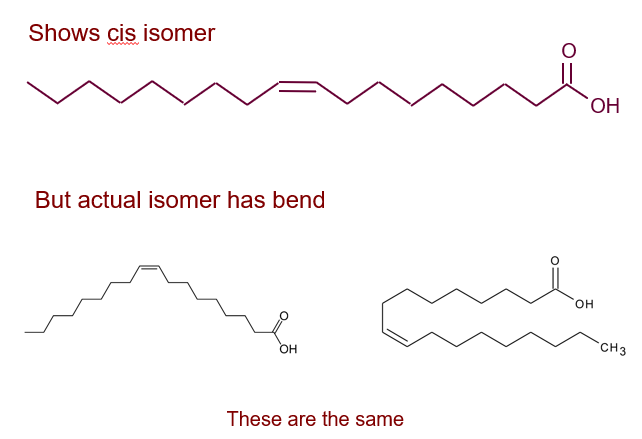
geometric isomerism
cis configuration
trans configuration

cis configuration
functional groups are on the same side of the C=C bond
most FA are in cis configuration

trans configuration
functional groups on opposite sides of C=C bond
formed by rumen bacteria & during processing of vegetable oils
milk have small amts of trans fatty acids

oleic acid

naming unsaturated fatty acids
counting carbons:
start from carbox. acid as 1st carbon → down chain
IUPAC Name
1st → cis or trans
2nd → positions of double bonds from carboxyl end
3rd: # of carbons
4th: # of double bonds

FA properties
melting point
degree of unsaturation
melting point
determined by:
carbon chain length
↑ chain length → ↑ MP
↓ chain length → ↓ MP
< 10 C chain = liquid (oil) @ room temp
> 10 C chain = solid (fat) @ room temp
more DB
ex
butyric acid (4C) - rumen VFA → MP -8 °C (liquid)
stearic acid (18C) - beef tallow → MP +70 °C (solid)
arachidic acid (20C) - margarine/peanut butter → MP +76 °C (solid)
degree of unsaturation
#C=C
overrides chain length
↑ DB → ↓ MP
composition of triacylglycerol FA determine phys nature
high proportion of short chain & saturated FA have low MP
ex
oleic acid (18:1) - palm & rapeseed oil → MP +13 °C (liquid)
𝛼-linolenic acid (18:3) - linseed oil - MP -15 °C (liquid)
FA list
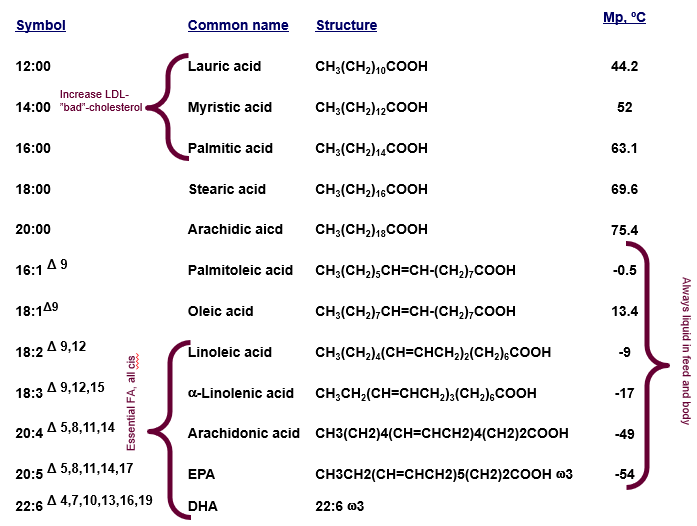
saturated vs unsaturated FA
More saturated fat makes fat firmer, more solid.
plants, marine oils (fish)
linoleic, linolenic, oleic (soft fats)
tropical oils (coconut, palm)
mammals
palmitic, stearic acids - firm/hard fat
subcutaneous fat - high unsaturated (soft)
deep body fat (kidney) - saturated - firm/harder
ruminants
fat deposit more saturated & fat firmer
hydrogenated in rumen
monogastrics
tissue fat resembles fats in diet
marine fishes
longer chain & PUFA - liquid soft
foods

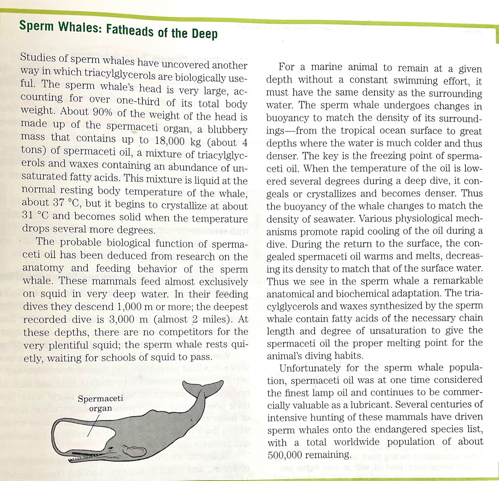
story line: sperm whales
18,000kg of spermaceti oil in the head (mix of triacylglycerols and waxes with lots of unsaturated fatty acids
Liquid at 37⁰C, begins to crystalize at lower temps at deeper levels of the ocean
Buoyancy of the whale changes to match the density of the sea water while feeding, by the lipids crystalizing at lower temps.
Endangered due to widespread hunting
elongation & ω-groups metabolic scheme
only FA animal’s CAN”T make are linoleic & 𝛼-linolenic acid
linolenic (C 18:3)
oleic made from steric w/ Δ9 desaturase past last 9 C from methyl end

elongation & ω-groups metabolic scheme
linoleic can be desaturated → linolenic = gamma-linolenic (not essential)
omega-6 not omega-3 linolenic
arachidonate made w/ acetate added → carboxyl end of linoleic
acetate always added/removed from carboxyl end
domestic cats can’t convert linoleic acid → arachidonate b/c don’t have Δ6 desaturase to perform conversion
eicosapentanoic (EPA) made by desaturating 𝛼-linolenic & elongating to C20
DHA made by furthering desaturating EPA
steps are slow so EPA & DHA (fish oils) required in diet
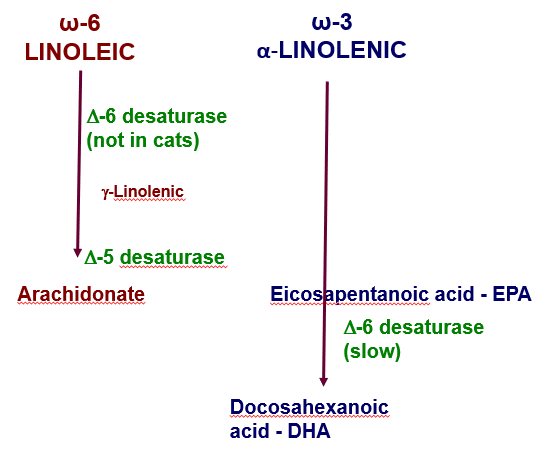
desaturase
enzyme that removes 2 H atoms form fatty acid
creates C=C DB
Δ9 desaturase used to synthesize oleic acid, ubiquitous component of all cells in human body
essential FA
linoleic & 𝛼-linolenic acid
must be obtained from diet
animals can’t introduce C=C between 9th C from methyl end
arachidonic acid & γ-Linolenic synthesized from linoleic (ω-6)
cats can’t convert linoleic → arachidonic so need in diet
Δ-6 desaturase & Δ-5 desaturase activity rate-limiting for synthesis of EPA & DHA for humans
↑ amts omega 6 (corn oil) competes for enzyme w/ omega 3

polyunsaturated FA (PUFA)
3 PUFA classes
linoleic family (ω-6) - growth, fertility, maintaining skin & RBC structure
linolenic family (ω-3) - eye structure & function & central nervous system (CNS)
oleic family (ω-9)
more double bonds, closer to omega end
Animals can make omega-9 oleic family, but not omega 6 & omega 3
PUFA functions
phospholipid - structural components - linoleic & arachidonic acids
fat transport - deficiency characterized by fatty livers
cholesterol transport - FA form lipoproteins, HDL, LDL, VLDL
deficiency ↓ HDL → ↑ VLDL & LDL
precursor of eicosanoids
prostaglandins - blood pressure & clotting
thromboxane - platelet aggregation, vaso constrictors
prostacyclins - oppose actions of thromboxanes
dietary FA balance (ω-3/ω-6) affects actions/activity of Eicosanoids (ω-3 more anti-inflammatory)
Corn oil has much more Ω-6 than Ω-3, therefore Americans get more Ω-6
essential FA deficiency
