HBI Unit 7 Matter and Energy
 Call Kai
 Learn
 Practice Test
 Spaced Repetition
 Match
 Flashcards
 Knowt Play
1/56

There's no tags or description
Looks like no tags are added yet.
57 Terms
Active Transport
Energy-requiring process that moves material across a cell membrane against a concentration gradient

ADP
adenosine diphosphate; molecule that ATP becomes when it gives up one of its three phosphate groups, releasing energy

Aerobic Respiration
Respiration in which oxygen is consumed and glucose is broken down entirely; water, carbon dioxide, and large amounts of ATP are the final products
Anaerobic Respiration
cellular respiration in the absence of oxygen.
ATP
A molecule used to store energy temporarily in organisms. The molecule is broken down to release energy to drive metabolic processes.

ATP synthase
enzyme responsible for using the flow of protons to actually produce ATP from ADP

Calvin Cycle
The second of two major stages in photosynthesis (following the light reactions), involving fixation of atmospheric CO2 and the production of a carbohydrate. Inputs, carbon dioxide, ATP, and NADPH
Outputs, Glucose, ADP, P and NADP+

Carbon Dioxide
a colorless, odorless gas produced by burning carbon and organic compounds and by respiration. It is naturally present in air (about 0.03 percent) and is absorbed by plants in photosynthesis.

Carbon Fixation
The conversion of inorganic carbon (for example, CO2) into organic forms (for example, sugars).
Cellular Respiration
A complex set of chemical reactions involving an energy transformation where potential energy in "food" molecules is released and partially captured in the bonds of adenosine triphosphate (ATP) molecules.
Chemical Energy
A form of potential energy that is stored in chemical bonds between atoms.
Chemiosmosis
The process by which ATP is produces from the flow of protons through an ATP-sythase channel in the thylakoid membrane of the chloroplast during the light reactions of photosynthesis and in the inner membrane if the mitochondria during cell respiration

Chlorophyll
A green pigment found in the chloroplasts.
Chloroplast
An organelle found in plant and algae cells where photosynthesis occurs

Citric Acid Cycle
Process in the mitochondria that converts pyruvate into usable energy (ATP), fills electron carriers, and releases CO2 as a waste.

Cytoplasm
Gel-like fluid where the organelles are found

Electron Carrier
molecules that can carry high energy electrons to the electron transport chain
Electrons
Negatively charged subatomic particles
ETC
series of proteins that will harness the energy of electrons moving through them to actively transport H+ across a membrane

Ethanol
produced in yeast during anaerobic respiration
Facilitated diffusion
A process in which substances are transported across a plasma membrane with the concentration gradient with the aid of carrier (transport) proteins; does not require the use of energy.

Fermentation
Occurs after glycolysis in the presence of low oxygen; when the body cannot keep up with the increased demand for oxygen, pyruvic acid converts to lactic acid (in humans)
The purpose is to recycle the electron carrier allowing glycolysis to continue..
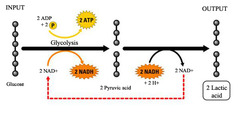
Final Electron Acceptor
what is the actual job of the oxygen you breathe?

Glucose (C6H12O6)
simple 6 carbon sugar used during the process of glycolysis.
Glycolysis
A series of reactions that ultimately splits glucose into 2 pyruvate, serving as the starting point for fermentation or aerobic cellular respiration in the mitochondria.
Gradient
High concentration and low concentration separated by a membrane

Inner Membrane space
the space between the 2 membranes of the mitochondria where H+ are pumped into a high concentration.

Krebs Cycle / Citric Acid Cycle
second stage of cellular respiration in which Pyruvate is further broken down filling electron carriers and producing ATP and carbon dioxide in a series of energy-extracting reactions.

Lactic Acid
Occurs after glycolysis in the presence of low oxygen; when our body cannot keep up with the increased cellular demand for oxygen, pyruvic acid goes through the fermentation pathway and is converted to _______________
.

Light Dependent Rx
solar energy is absorbed by chloroplast to split H2O, release O2 (Oxygen Gas) as a byproduct. Produce ATP & NADPH (full electron carrier). On/in the thylakoid membrane

Light Independent Rx
Takes in CO2, occurs in the stroma. Uses the ATP and NADPH (full electron carrier) produced during the light dependent reactions to make glucose.

Mitochondria
An organelle containing its own DNA found in eukaryotic cells, in which aerobic respiration occurs. It has a double membrane.

Oxidative Phosphorylation
The production of ATP using energy derived from the electron transport chains ability to produce a concentration gradient.

Oxygen
Cellular respiration is called an aerobic process because it requires _____________ to act as a final electron acceptor.
Passive Transport
Requires no cellular energy, Movement of molecules from high to low concentration, Moves with the concentration gradient

Phosphorylation
The transfer of a phosphate group to a molecule.

Photosynthesis
Conversion of light energy into chemical energy.

Photosystems I & II
Absorb light. Excited electrons provide the energy to pump hydrogen ions across the electron transport chain. The excited electrons then fill electron carriers
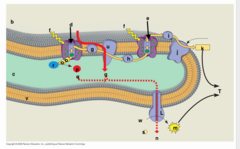
Pigment
A colored chemical compound that absorbs or reflects light, resulting in color.

Proton
A subatomic particle that has a positive charge and that is found in the nucleus of an atom

Proton Pump
This protein is able make a concentration gradient of protons across a membrane

Pyruvate
Three-carbon compound that forms as one of the end products of glycolysis.
Stroma
The site of the light-independent (Calvin) reactions in chloroplasts
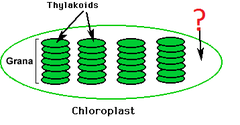
Thylakoid
Flattened membranes in the chloroplast where the light reactions take place.

Water
Reactant in photosynthesis that is the source of the Oxygen that you are currently breathing in.

Energy Flow
the transfer of energy through the ecosystem
Nutrient Cycling
referring to the continual reuse of the physical matter that makes up the ecosystem
Trophic Level
Each step in a food chain or food web
Bioaccumulation
the gradual build-up of synthetic and organic chemicals in living organisms
Nitrogen Cycle
process in which nitrogen is cycled between the atmosphere, bacteria, and other organisms
Carbon Cycle
The organic circulation of carbon from the atmosphere into organisms and back again
Phosphorous Cycle
the movement of phosphorous around the biosphere
Water Cycle
The continuous movement of water between the atmosphere, the land, and the oceans
Decomposer
An organism that feeds on detritus
Producer
Organisms that produce their own food, typically with the direct use of solar energy.
Consumer
An organism that obtains energy by feeding on other organisms
Food Web
A community of organisms where there are several interrelated food chains