Non-current assets and depreciation
 Call Kai
 Learn
Learn Practice Test
 Spaced Repetition
 Match
Match Flashcards
 Knowt Play
1/42

There's no tags or description
Looks like no tags are added yet.
Name | Mastery | Learn | Test | Matching | Spaced | Call with Kai | Chat |
|---|
No analytics yet
Send a link to your students to track their progress
43 Terms
capital expenditure + what is it + definition
Creates or improves a non-current asset.
Examples:
✅ Purchase of machinery
✅ Purchase of building
✅ Delivery of machinery
✅ Legal fees on purchase
✅ Extension to building
what is revenue expenditure + examples
Day-to-day running costs.
Examples:
✅ Repairs
✅ Wages
✅ Electricity
✅ Repainting
✅ Road licence fee
what is included/ excluded in the cost of ppe
Include Anything needed to get the asset ready for use. ✅ Purchase price ✅ Delivery ✅ Legal fees ✅ Installation ✅ Number plates |
|
An asset costs £3,800, has a residual value of £50, and a useful life of 15 years. Calculate the annual depreciation charge using the straight‑line method. If the asset is owned for only 6 months in the first year, calculate the depreciation for that period.
1) annual depreciation: (3800-50)/15 = 250
owned for 6 months: 150 × 6/12 = £125
A machine costs £20,000 and is depreciated using the reducing balance method at 20% per year. Calculate the depreciation charge and carrying amount for Years 1, 2 and 3.
1) Year 1
20,000 × 20% = 4000
20000 - 4000 = 16000
2) Year 2
16000 × 20% = 3200
16000 - 3200 = 12,800
Year 3)
12,800 × 20% = 2560
12.800 - 2560 = 10,420 carrying amount
An asset with a carrying amount of £15,000 is sold for £12,000. Calculate the profit or loss on disposal.
12,000 - 15,000 = 3000 loss
Cost = £15,000 Accumulated depreciation = £9,000 Proceeds = £12,000
Dr 15,000 (cost)
Cr 9,000 (acc dep)
Cr 12,000 (proceeds)
Cr = 9000 + 12000 = 21,000
21,000 = 15000 = 6,000 of credit so 6000 profit
An asset costing £30,000 has a useful life of 20 years and is depreciated using the straight‑line method. After 3 years, the useful life is revised to 12 years remaining and the residual value is estimated to be £1,500. Calculate the new annual depreciation charge.
cost = 30,000
life = 20 years
residual value = 1500
Original depreciation:
30,000/20=1,500
Carrying amount after 3 years:
30,000−(1,500×3)=25,500
New depreciation going forward:
(25,500−1,500)/12=2,000
what are intangible assets
✅ Licence
✅ Patent
✅ Copyright
software
NOT : brand, loyalty or reputation
what is the depreciation of intangible assets
amortisation

cash paid = 23,000
list price = 28,000 cost of car
so trade-in value of 5000 for the old machine
28000 - (28000 × 10%) = £25,200

1) Total cost: 15,000 (machine purchase) + 1300 (transportation) + 2500 (installation) = 18,800
18,800 - (18,800 × 10%) = £16,920

cost = 22,000
accumulated depreciation = 11,500
- Carrying amount: 22,000 - 11,500 = 10,500
Proceeds = 9000
so profit/loss = 9000 - 10,500 = (1500) so 1500 loss
IN Question: bank transaction already records
dr bank 9000
cr suspense 9000
SHOULD BE:
dr suspense account 9000
dr accumulated depreciation 11,500
dr loss on disposal 1,500
cr machine cost 22,000

1) Depreciable amount: 6000 - 300 = 5700
2) annual depreciation: 5700/ 5 = 1140
3) Appropriate:
purchased April 20×1 - September 20×1: 6 months
so 6/12 × 1140 = 570 depreciation charge
dr depreciation expense 570
cr accumulated depreciation 570

23,500 - (10% x 23,500) = 21,250

D

1) 5000 - 1000/ 4 = £1000 annual depreciation
2) bought Jan 20×1 , sold Dec 20×3: so 20×1, 20×2, 20×3 = 3 years
3 × 1000 = £3000 total accumulated depreciation
3) 5000 - 3000 = 2000 carrying amount
4) sale proceeds (1600) - 2000 ( carrying amount = (400) so loss
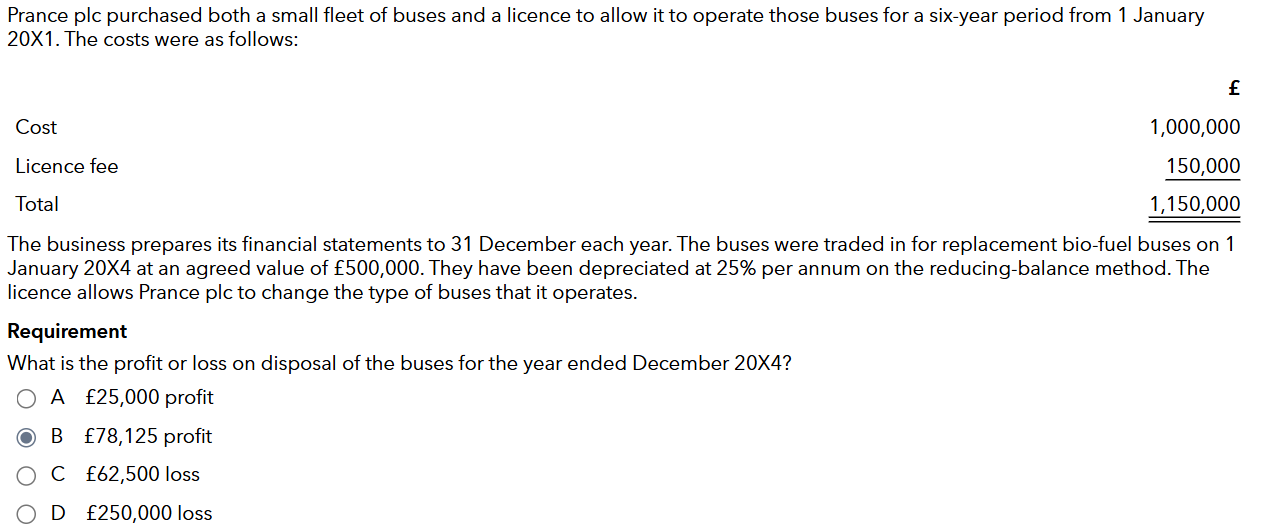
license is separate - ignore £150,000
20×1: 1,000,000 - (25% x 1,000,000) = 750,000
20×2: 750,000 - (25% x 750,000) = 562,500
20×3: 562,500 - (25% x 562,500) = 421,875, buses disposed of on 1 jan 20×4 so don’t need to 20×4
proceeds (500,000) - carrying amount (421,875) = 78,125

1) profit/loss = proceeds - carrying amount
-1250 = 4000 - CA
so CA = 5250
2) 67,460 - 5250 = 62,210

capital expenditure: 48000 + 400 + 2200 = 50,600

1) depreciation on opening assets: £381,200
asset costing £36,000 sold June 20×2 so only owned for 8 months of the year (31oct 20×1 - 31 may 20×2)
36,000 × 20% x 8/12 = 4800
so opening PPE: 381,200 - 4800 = 345,200
depreciation for full year: 345,200 × 20% = 69,040
2) depreciation on new asset:
purchases dec 20×1 - year end 30 sep 20×2: 10 months
18000 × 20% x 10/12 = 3000
3) TOTAL DEPRECIATION: 69,040+4,800+3,000=76,840
dr depreciation expense 76,840
cr accumulated depreciation 76,840

1) carrying amount: 200,000
2) asset disposed: profit/loss = CA - proceeds → CA = loss + proceeds
sold for 25,000
loss on disposal 5000
5000 + 25000 = 30,000
3) 200,000 - 30,000 = 170,000 (removed disposed asset)
4) deduct depreciation: 170,000 - 20,000 = 150,00
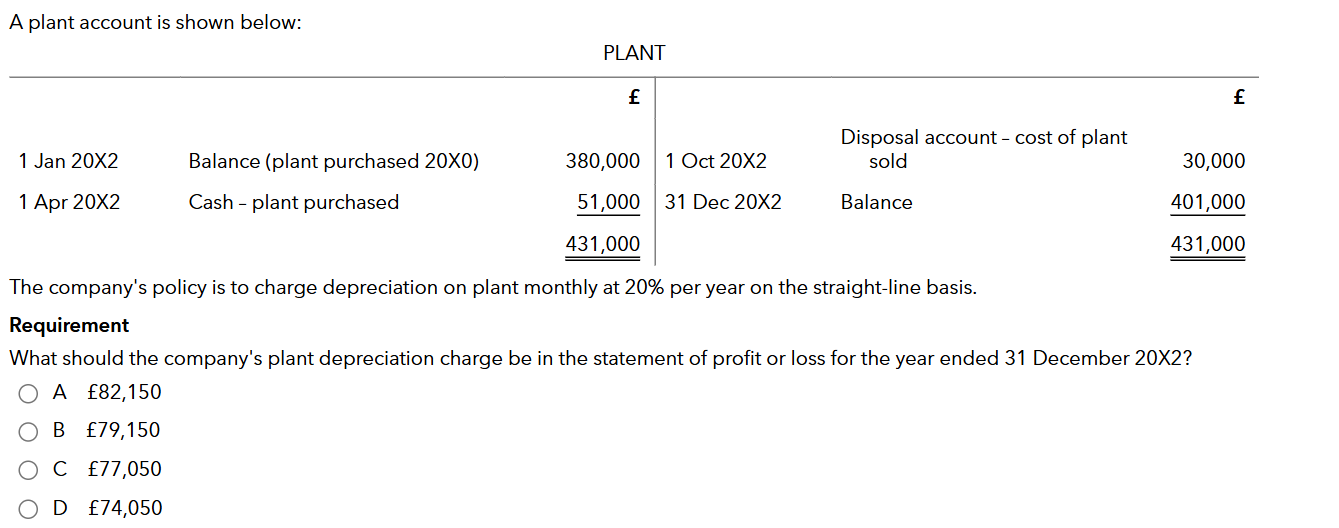
Depreciation = cost x 20% x months owed/12
plant held all year: (380000 - 30,000) x 20%
new plant: 51000 × 20% x 9/12
plant disposed: 30000 × 20% x 9/12

1) LAND NOT DEPRECIATED
total cost - 420,000
land = 60,000
so 420,000 - 60,000 = 360,00 building depreciated
2) straight-line:
360,000 / 50 = 7200
3) Time appropiation
Dec 20×0 - Sep 20×1 = 10 months
7200 × 10/12 = 6000
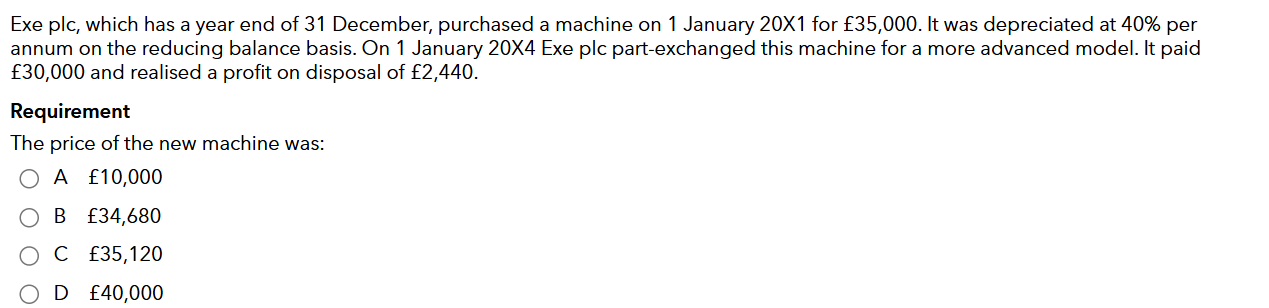
1) 20×1:
35000 × 0.4 = 14,0000
35,000 - 14,000 = 21,000 carrying amount
2) 20×2
21000 × 40% = 8400
21000 - 8400 = 12,600
3) 20×3
12600 × 40% = 5040
12600 - 5040 = 7650
4) profit on disposal = 2440
profit = proceeds - carrying amount
proceeds = profit + carrying amount : 2440 + 7560 = 10,000
trade in allowance 10,000
5) they paid 30,000
so cash + trade-in : 30,000 + 10,000 = 40,000
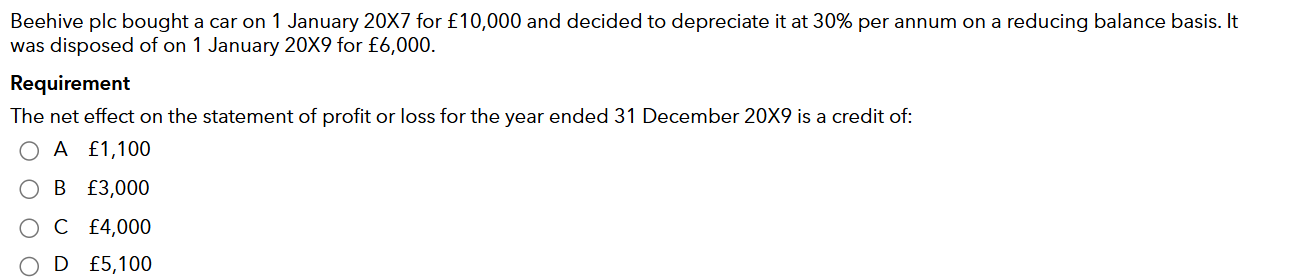
1) 20×7
10,000 × 30% = 3000
10,000 - 3,000 = 7,000 carring amount
2) 20×8
7000 × 30% = 2100
7000 - 2100 = 4900 = carrying on amount for Jan 20×9
3) pofit
solf for 6000
6000 - 4900 = 1,100 profit on disosal so credit

1) annual depreciation
120,000 - 4000/ 4 = 29,000
2) time appropriation
1 oct - 31 dec = 3 months
29,000 × 3/12 = 7250 depreciation expense
3) draft profit - depreciation: 56,780 - 7250 = 49,350

profit + wrong expense - correct depreciation
83600 + 18000 - 4500 = 97,100
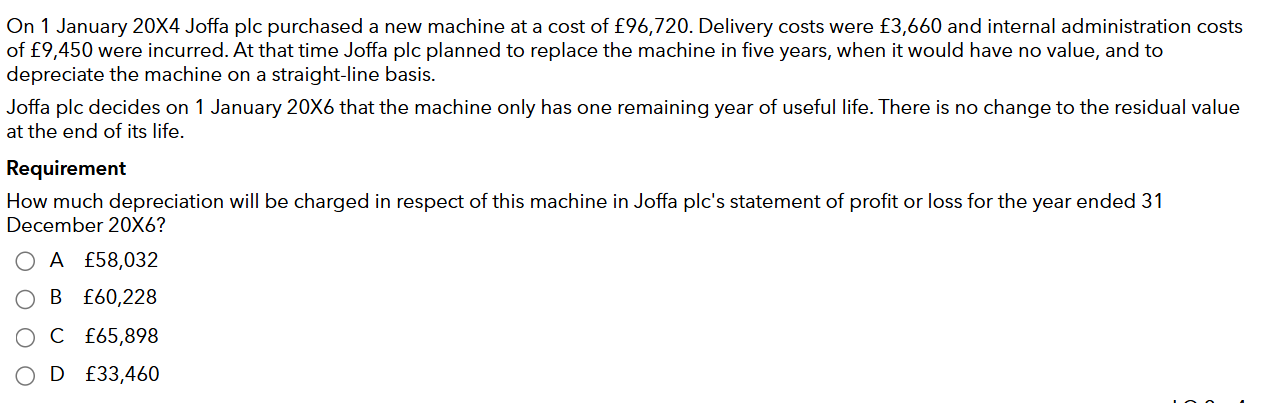
1) find original cost - don’t include admin cost as not capitalised
96720 (machine) + (3660) delivery = 100,380 cost
2) annual depreciation: 100380/ 5 = 20,076
3) carryin amount at change date
estimate changes on 1 jan 20×6: so depreciation charged for 20×4, 20×5
20,076 × 2 = 40,152 = accumulated depreciation
100,380 - 40152 = 60,228
4) 20×6: one year remaning : 60228 - 0/ 1 = 60 228

(38000 - 2000)/5 = 6000 per year
500 per month, Augx4 - March x5 = 8 months
8 × 500 = 4000

1) Depreciation: 614,500 × 0.25 = 153,625
2) new asset = +11,500
3) closing amount: 399,960 (opening carrying amount) + 11,500 - (153,625) = 257,835

Opening Carrying Amount + Additions − Depreciation − Carrying Amount of Asset Sold=Closing Carrying Amount
1) opening carrying amount: 92000 (cost) - 51,000 (accumulated depreciation) = 41,000
2) closing carrying amount: 110,000 (cost) - 72000 (accumulated depceciation) = 38.000
3) substiture
- opening CA: 41,000
additions: 39,000
depreciation: (27000)
closing CA: 38,000
so carrying amount disposed = 15,000
4) loss = carrying amount - proceeds
proceeds = carrying amount - loss: 15,000 - 2000 = 13,000

1) remove VAT
price includes VAT at 20%
net cost: 99,900 / 120 × 100 = 83,250 asset costs
2) 1 july 20×4 - 31 Dec 20×4 = 6 months
83250 × 20% (annual depreciation) x 6/12 months = 8325 depreciation
3) carrying amount:
83250 - 8325 = 74,925

1) Monthly depreciation:
16800 / (12 × 5) as montly over 5 years = 280
Accumulated depreciation = 280 × 28 (1 July 20×7 - 31 Oct 20×9) = 7840
16800 - 7840 =8690 carrying amount
profit/loss= proceeds - carrying amount = 7650 - 8690 = -1310 so £1310 loss

1) Depreciation rate: - everything bought 1 jan 20×2
cost = 1,004,408, life = 4 years
1004408/4 = 251,102 straight-line depreciation
2) asset sold cost = 6800, disposed 20×4
6800/ 4 = 1700
Depreciation for remaining assets: 251,102 - 1700 = 249,402
3) loss on disposal
1700 × 2 = 3400 (accumulated depreciation for 20×2, 20×3)
6800 - 3400 = 3400 carrying amount
4) profit/loss
proceeds is 1800
1800 (proceeds) - 3400 (carrying amount) = -1600 loss on disposal
5) Administrative expenses
684,000 (starting admin expense) + 249,402 (depreciation) + 1600 (loss on disposal) = 935,002

1) cost of license:
180,000 (license cost) + 2000 (legal fees) = 182,000
NOT general administrative costs
2)
license lasts 6 years, but directors only expect to use for 5 years - so 5 years useful NOT lgela
182,000/5= 36,400
3) carrying amount
bought July 20×2 - year-end june 20×3 = 12 months so
182,000 (toal cost ) - 36,400 ( one year amortisation) = 145,000

1) original amorisation
cost = 200,00, life = 4 years
200,000/ 4 = 50,000 annual amortisation
2) Carrying amount on 1 June 20×5
estimate changes on 1 June 20×5, so that’s two years (jun 20×3 - may 20×5)
50,000 × 2 = 100,00
200,000 - 100,00 = 100,000
3) new estimate
from 1 june 20×5, another 4 years
100,000 (carrying from step 2) / 4 = 25,000
4) for 31 May 20×6 - that’s one year since the estimate so:
100,000 - 25,000 = 75,000

b

£259,700
£263,900
£265,100
273,800
cost of premises + initial adaptation + legal costs + air conditioning unit
*machinery not part of premises
On 1 Jan 20X1 Fleet Ltd. bought a non-current asset for £225,000 which had an estimated useful life of 20 years and a residual value of £25,000. Assets are depreciated on a straight line basis. Fleet's year end is 31 December. On 1 January 20X4 the asset's total useful life is revised to 15 years in total with no residual value.
What is the total deprecation charge in 20X4?
£10,000
£12,750
£13,000
£16,250
1) ( (225000 - 25000)/20 ) 3 = 30,000 depreciation for 3 years (20×1 - 20×3)
225000 - 30,000 = 195,000 carrying amount
2) new useful life is 15 years, but 3 years already elapses so 12 years
195000/12 = 16,250
At 1 January 20X4 a business owned motor vehicles which had cost a total of £40,000.
On 1 April 20X4 the business disposed of a motor vehicle which had cost £10,000 and on 1 September 20X4 the business acquired a motor vehicle which cost £15,000.
The business charges depreciation on motor vehicles at the rate of 25% per annum on the straight line basis with proportionate amounts being charged in the year of acquisition or disposal based on the number of months ownership.
What is the depreciation charge in respect of motor vehicles for the year ended 31 December 20X4?
£9,375
£10,000
£11,250
£13,750
1) depreciation: (40,000 - 10,000) x 25% = 7500
2) disposal: 10,000 × 25% x 3/12 = 625 ( 3 months as vehicle was owned for jan, feb, march)
3) acquisition: 15000 × 25% x 4/12 = 1250
= TOTAL DEPRECIATION = 9375
Mario bought a van for his business on 30 June 20X1 for £13,750, including £150 for a road fund licence.
Mario depreciates motor vehicles at 20% per annum on cost, charging depreciation on a monthly basis. His year end is 31 December. On 1 January 20X4 Mario traded in the van for a new one, receiving a part-exchange allowance of £7,250.
What was the profit on disposal of the van?
£375
£450
£1,750
£1,810
1) cost of van = 13,750 - 150 = 13,600
2) 13,600 × 20% = 2720 annual depreciation
3)
bought 30 june 20×1, traded in jan 20×4
months owned: july x1 - dec x3 = 30 months (as bought 30 june meets july)
30/12 × 2720 = 6800 depreciation
4) carrying amount = 13,600 - 6800 = 6800
5) proceeds - carrying amount: 7250 - 6800 = 450 profit on disposal
ow are research costs treated in financial statements?
Capitalised as an asset
Amortised over their useful life
Charged to the statement of profit or loss
Deferred until future periods
Incorrect Answers:
A (Capitalised as an asset): Research costs are not capitalised.
B (Amortised over their useful life): Research costs are not amortised.
D (Deferred until future periods): Research costs are not deferred.
so C - charged to statement of profit or loss