Lab: Chest tubes
 Call Kai
 Learn
 Practice Test
 Spaced Repetition
 Match
 Flashcards
 Knowt Play
1/12

There's no tags or description
Looks like no tags are added yet.
13 Terms
purpose of chest tubes
• Remove air, blood and/or fluid
• Restore negative intrapleural pressure, allowing the lung to re-expand
where can the chest tube be placed
May be inserted into any of the three thoracic compartments
right pleural space
left pleural space
mediastinum
how does the placement matter
higher/anterior for air removal (air rises) commonly through 2nd intercostal space
lower/posterior for fluid removal (fluid settles) commonly Posterior through 8 or 9th intercostal space in mid-axillary line
Indications for chest tube
• Peumothorax
• Hemothorax
• Pleural effusion
• Empyema
• Post thoracic surgery
The Pleural Space is ?
Space between ribs and lungs
Filled with small amount of fluid
Air or fluid in pleural space inhibits expansion and breathing
how are chest tube placed ?
where
meds?
secured how
what kind of dressing
must take ?
in OR/ ER/ PACU or bedside
local anesthesia or sedation
sutured to chest wall
Occlusive dressing (saturated with petroleum to prevent air from passing through) over insertion site
must take pre and post vitals and pain assessment
what kind of drainage system is used
dry vs wet?
water seal mechanism - one way valve allowing air/fluid out of the pleural space but preventing air from moving back in
dry - no water in suction chamber, but still water in water seal chamber
wet - water in suction chamber & water seal chamber
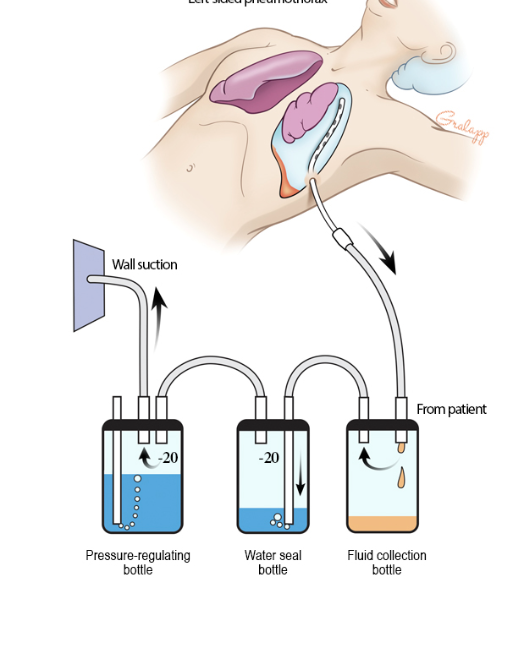
what are the 3 chambers
what controls suction
farthest R: collection chamber - collects fluid/ air from pt
middle: water seal chamber - creates seal (must have 2cm of water filled up)
farthest L: suction chamber - attached to suction and regulates amount of suction
wall suction does not determine suction pressure, the suction chamber does
either dial (dry system) or column (amount) of water (wet system)

what are we looking for in the water seal chamber
good or bad
what is normal in the suction chamber
we want to see tidaling (rise & fall of water) - indicating intake and exhale
if we do not see tidling, could be an obstruction or the lung re-expanded and ready to be taken out
we do not want to see bubbling - indicates leak
bubbling is normal to see in the suction chamber of a wet system
managing a chest tube
where do we keep
ensure line is ?
never?
monitor and document ?
always keep below the level of the chest to drain effectively
ensure line is not kinked or occluded
never clamp without an order
monitor and document drainage - amount , color, consistency
report any increase or cessation in drainage
what should always be at the bedside
extra drainage set up
oxygen
suction
sterile occlusive dressing
2 enclosed hemostats (clamps)
bottle of sterile water
complications of a chest tube
infection
pnuemothorax
subcutaneous emphysema
when do we remove chest tube
how do we confirm chest re-expansion?
vitals ?
for pain?
pace when removing
what kind of dressing
pleura and chest wound healing ?
when tidaling stops & chest x-ray confirms re-exapansion of the lung
vitals improve - RR normal easy breathing, normal O2 sat, symmetrical chest expansion
pre-medicate for pain
breathe in & hum out (tell to to practice)
removed quickly
oclusive dressing over insertion site
pleura seals itself off & chest wound heals in a week