1.3 Features of Organisms Part 1
 Call Kai
 Learn
 Practice Test
 Spaced Repetition
 Match
 Flashcards
 Knowt Play
1/15

There's no tags or description
Looks like no tags are added yet.
16 Terms
What are the 5 Kingdoms
Animals
Plants
Fungi
Protoctists
Prokaryotes
Eukaryotic vs Prokaryotic
Eukaryotic: Organisms have a nucleus and membrane-bound orgenelles. Animals, plants, fungi and protoctists are all eukaryotic
Prokaryotic: Organisms do not have a nucleus or membrane-bound organelles. Prokaryotes are prokaryotic.
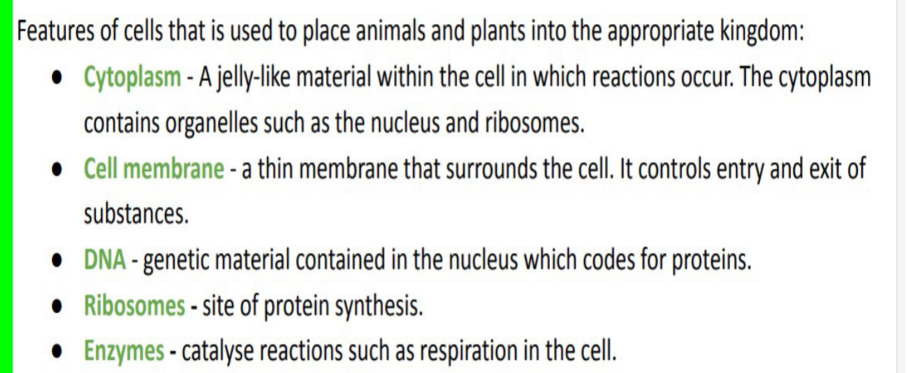
Features of cells that all living organisms have
Cytoplasm
Cell Membrane
Ribosomes- site for protein synthesis
DNA- Genetic material contained in the nucleus (not for prokaryotes) which codes for proteins.
Enzymes
The Animal Kingdom
They are multicellular.
They are heterotrophs, which means they feed on organic substances made by other living organisms and cannot make their own food, they must rely on other organisms for food.
They are capable of movement from one place to another.
They have nervous coordination.
They have no cell wall or chloroplasts and therefore do not photosynthesise.
Store carbohydrates as glycogen which is a store of glucose, which is stored in liver.
An example for animals is Cats or dogs or birds or worms
The Plant Kingdom
They are multicellular.
Cells contain chloroplasts (which contain chlorophyll to absorb light for Photosynthises) and cell walls made from cellulose.(A carbohydrate that forms long fibres, and makes up the cell wall of plants) Cellulose belongs to a group of substances called polysaccarides.
Carry out photosynthesis and therefore make their own food (autotrophic). Autotrophic: An organism that can produce its own food, turning inorganic compounds (e.g. Carbon Dioxide) into organic compounds (e.g. glucose)
Store carbohydrates as starch (stores extra glucose as starch granules) which can be converted to sucrose which can then be tranported around the plant
Many kinds of plant have roots, stems and leaves, some also have flowers.
Examples for plants are; Roses, Apple Trees and Cherry Blossom
Why do plant cells have a cell wall?
Because the cell will burst without it due to the water pressure from the water in the large permenant vacuole.
Formula of Photosynthises
6CO2 + 6H2O —> C6H12O6 + 6O2
Carbon Dioxide + Water —> Glucose + Oxygen
On the arrow is light energy and chlorophyll
The Fungi Kingdom and their structure
They are mostly multicellular but some are unicellular like yeast. They have a nucleus and a cell wall made up of chitin, no chlroplasts. Their bodies are usually organised into a mycelium which is an interconnected network formed when multiple hyphae join together which are microscopic threads which is made up of many cells joined end to end.
-Some hyphae are continuous
-Others are divided by septa
How do fungi reproduce and a diagram of the fungus cell
Fungi reproduce by forming spores. These are tiny groups of cells with a tough, protective outer covering. They can be spread by the wind or animals and grow to form a new fungus.

Saptrophic Nutrition
Fungi digest food externally. The hypae release digestive enzymes (extracellular enzymes) after breaking the food into simple nutrients, it’s absorbed by the hypae and used to release energy.
How do fungi feed?
They feed saprophytically, or parasitically, on organic material such as faeces, human foods and dead plants or animals.
Many fungi are decomposers, breaking down waste material from other organisms and dead organisms. This helps ro return nutrients to the soil that other organisms can use.
Saprotrophs vs Parasites vs Decomposers
saprotrophs feed on dead and decaying matter, they are part of decomposers.
Parasites obtain nutrients from a live host, they benefit themselves and harm their (unwilling) hosts.
The Protist Kingdom
They are mostly unicellular but some are multicellular such as seaweed. Some have plant like cells with chloroplast and cellulose cell walls, called plant-like protists. like chloroplasts in chlorella.
Some have animal-like cells, called Animal-like protists. like amoeba
Some feed by photosynthises and others feed on organic substances made by other organisms. (Some are heterotrophs and others are autotrophs.
Some can cause diseases like plasmodium which causes malaria.
The Prokaryote Kingdom
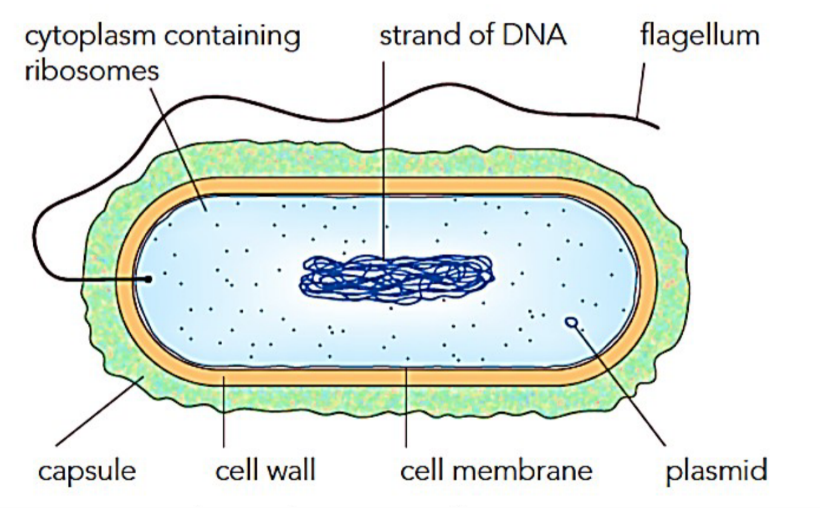
They are 10 to 100x smaller than eukaryotic organisms they are mostly unicelullar. The have no nucleus, and no mitochondria, they have a circular strand of DNA which is free in the cytoplasm. and they often have plasmids and have cell walls not made from cellulose. Bacteria is a prokaryote.
Parts of a Bacteria
Bacterium is singular bacteria is plural Bacteria is a prokaryote Bacteria are only a few thousanths of an mm long
Plasmid: An antibiotic resistance
Capsule: For attachement and Protection (Not present in all bacteria)
Cytoplasm: Large bumbers of ribosomes float freely in the cytoplasm. May contain granules of glycogen lipids
Strand of DNA is nucluoid
Flagellum for movement (Not present in all bacteria)
The cell wall is made up of peptidoglycan (pepti from proteins and glycan from glucose.
No mitochondria.
Individual bacteria may be spherical, rod-shape or spiral
Functions of orgenelles
Mitochondria: Where aerobic respiration takes place and releases energy
Nucleus: Controls cell activities and contains genetic material
Cell wall: To prevent cell from bursting under the prssure of the vacuole which as water, keeps the cell firm, and also for protection
Large permemant vacuole, contains cell sap and helps to maintain cell’s firmness.