MGMT 340 Exam 1 (9/29/26)
 Call Kai
 Learn
Learn Practice Test
 Spaced Repetition
 Match
Match Flashcards
 Knowt Play
1/51

There's no tags or description
Looks like no tags are added yet.
Name | Mastery | Learn | Test | Matching | Spaced | Call with Kai | Chat |
|---|
No analytics yet
Send a link to your students to track their progress
52 Terms
What are manager’s and what are their functions?
Managers are people who achieve goals through other people…they
make decisions
direct activities of other people to attain goals
allocate resources
Functions INCLUDE: planning, organizing, controlling, and leading
What are some manager roles?

Manager skills include?
Technical skills: ability to apply specialized knowledge or expertise
Human skills: ability to work with, understand, and motivate other people, both individually and in groups
conceptual skills: Mental ability to analyze and diagnose complex situations
What is Intuition?
gut feelings, individual observation and commonsense
What are the contributing disciplines to the OB Field?
psychology, social psychology, sociology, and anthropology
what is psychology?
The science that seeks to measure, explain and sometimes change the behavior of humans and other animals

what is sociology?
The study of people in relation to their fellow human beings

what is social psychology?
an area within psychology that blends concepts from psychology and sociology and that focuses on the influence of people on one another

What is anthropology?
the study of societies to learn about human beings and their activities

How to manage workplace diversity?
embracing diversity
changing U.S
recognizing and responding to differences
Diversity categories include: gender, disability, age, race, national origin, non-Christian, domestic partners
OB Model?
A model is OB is an abstraction of reality, a simplified representation of some real-world phenomenon

What is surface level diversity?
Difference in easily perceived characteristics (gender, age, ethinicity, etc.) that do NOT necessarily reflect the ways people think or feel but that may activate certain stereotypes
what is deep-level diversity?
Difference in values, personality, and work preferences that become progressively more important for determining similarity as people to know one another better
what are some forms of discrimination?

What are biographical characteristics?
personal characteristics-age, gender, race/ethnicity, disabilities, and tenure-that are objective and easily obtained from personnel records
what are the dimensions of intellectual ability?
number aptitude
verbal comprehension
perceptual speed
inductive reasoning
deductive reasoning
spatial visualization
memory

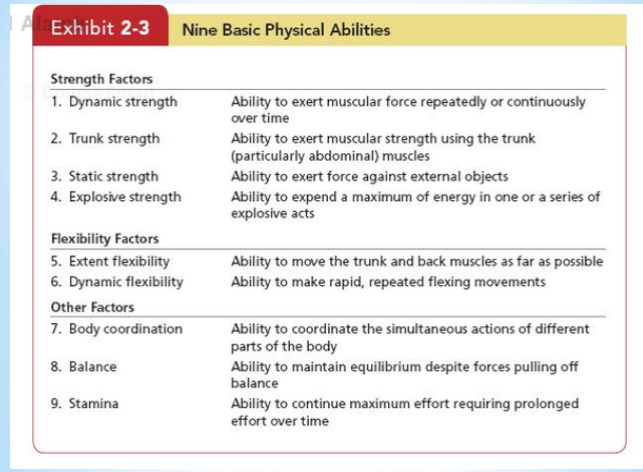
what are the 9 physical abilities?
what are attitudes?
eveluative statements or judgements (either favorable or unfavorable) concerning objects, people, or events.
Attitude components include: cognitive, affective ,and behavioral
what is the cognitive component of attitudes?
the opinion or belief segment of an attitude (evaluation)
what is the affective component of attitudes?
the emotional or feeling segment of an attitude (feeling)
what is the behavioral component of attitudes?
an intention to behave in a certain way toward someone or something (action)
what is cognitive dissonance?
any incompatibility between two or more attitudes or between behavior and attitudes
ppl want to reduce this gap or “dissonance”…desire to reduce dissonance depends on
importance of elements creating dissonance
degree of individual influence over elements
rewards involved in dissonance
what are the different type of attitudes?
job satisfaction
job involvement: THE JOB ITSELF…identifying with the job, actively participating in it and considering performance important to self-worth
organizational commitment (EX: loyalty to Costco)
perceived organizational support (POS): degree to which employees feel the organization cares about their well-being
employee engagement: individual involvement with, satisfaction with, and enthusiasm for the ORG
how do employees express their dissatisfaction within a company?
exit
voice: active and constructive attempts to improve conditions
loyalty: passively waiting for conditions to improve
neglect": allowing conditions to worsen
What are emotions?
Affect: a broad range of emotions that people experience
Emotions: intense feelings that are directed at someone or something
Moods: feelings that tend to be less intense than emotions and that lack a contextual stimulus

What days of the week affect your mood?
Positive moods = highest at end of the week and in the middle part of the day
Negative moods = at the beginning of the week and show little variation throughout the day
What is emotional labor?
a situation in which an employee expresses organizationally desired emotions during interpersonal transactions (EX: a server at a restaurant)
what is the difference between felt and displayed emotions?
Felt: an individuals actual emotions
displayed: emotions that are organizationally required and considered appropriate in a given job
What is personality?
personality = a dynamic concept describing the growth and development a persons whole psychological system
the sum total of ways in which an individual reacts to and interacts with others
Myer-Briggs Type Indicator (MBTI)
extrovert or introvert ( E or I)
sensing or intuitive (S or N)
thinking or Feeling (T or F)
Perceiving or judging (P or J)
INTJs are visionaries
ESTJs are organizers
ENTPs are conceptualizers
The Big Five Model of Personality Dimensions
Extroversion: sociable, gregarious, and assertive
Agreeableness: good-natured, cooperative, and trusting
conscientiousness: responsible, dependable, persistent, and organized
Emotional Stability: calm, self-confident, secure under stress (+) VS nervous, depressed, and insecure under stress (-)
Openness to Experience: curious, imaginative, artistic and sensitive
Major personality attributes influencing OB

What are values? Terminal and instrumental value?
Values= mode of conduct of end state is personally or socially preferable
Terminal values: desirable end states of existence (goals that a person would like to achieve during their lifetime)
Instrumental values: preferable ways/means for achieving ones terminal values
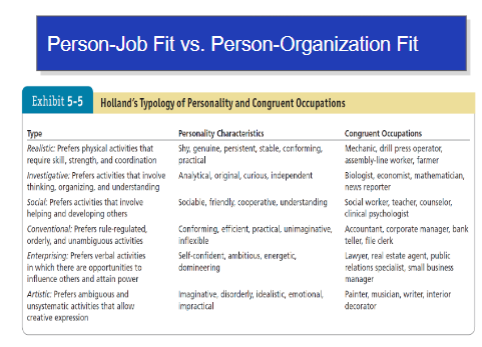
What is the personality-job fit theory?
Identifies six personality types and proposes that
the fit between personality type and occupational
environment determines satisfaction and turnover.
Personality types
realistic
investigative
social
conventional
enterprising
artistic
Hofstede’s 5 cultural dimensions
Power distance: extent to which a society accepts that power in institutions and organizations is distributed equally
low distance: relatively equal power….HIGH distance: extremely unequal power distribution
Individualism V. Collectivism
masculinity v feminity
Uncertainty avoidance: extent to which a society feels threatened by uncertain and ambigous situations and tries to avoid them
Long-term orentation V short term orientation
LT = national culture attribute that emphasizes the future, thrift and persistence
ST= national culture attribute that emphasizes the present and the here and now
what is perception?
process by which individuals organize and interpret their sensory impressions in order to give meaning to their environment
what is the attribution theory?
our perception and judgment of others is significantly influenced by our assumptions of the other persons internal state.
causation judged through
distinctiveness
consenus
consistency

what are some frequently used shortcuts in judging others?
Contrast effects: evaluation of a person’s characteristics
that are affected by comparisons with
other people recently encountered who
rank higher or lower on the same
characteristi
Halo Effect: Drawing a general impression about an individual on the basis of a single
characteristic
Stereotyping: judging someone on the basis of ones perception of the group to which that person belongs - a prevalent and often useful, if not always accurate, generalization
what are the rational decision-making steps?

what are the 3 components of creativity?
Intrinsic task motivation = desire to do the job
expertise = foundationg
creative thinking skills = personality characteristics

what are the key elements of motivation?
direction: toward a benefitical goal
intensity: how hard a person tries
persistence: how long a person tries
Maslow’s hierarchy of needs
hierarchy of 5 needs
physiological
safety
social
esteem
self-actualization
As each need is satisfied, the next becomes more dominant
Lower-order Needs: needs that are satisfied externally; physiologial and safety needs
Higher-order needs: Needs that are satisfied internally; social,esteem, and self-actualization needs

McGregor’s Theory X and Theory Y
Theory X: managers see workers as having little ambition, disliking work, avoiding responsibility
Theory Y: managers see workers as self-directed, enjoying work, and accepting responsibility
Herzberg’s 2 factor theory
Hygiene factors (extrinsic and related to DISSATISFACTION)
salary
work conditions
company policies
Motivators (Intrinsic and related to Satisfaction)
achievement
responsibilities
Growth
McClelland’s Theory of Needs
need for ACHIEVEMENT
need for AFFILIATION
need for POWER
Bottom line: individuals have different levels of needs in each of these areas, and those levels will drive their behavior
what is the self-determination/cognitive evaluation theory?
Providing an extrinsic reward for behavior that
had been previously only intrinsically rewarding
tends to decrease the overall level of motivation.
EX: reading in the summer for fun but when reading is assignment for a grade you don’t want to do it!!
what is the goal setting theory
specific and difficult goals with self-generated feedback, lead to higher performance
what is the equity theory?
Individuals compare their job inputs and outcomes
with those of others and then respond to eliminate
any inequities.
Employees compare their ratios of outcomes-to-
inputs of relevant others.
Choices for dealing with inequity:
change inputs (slack off)
Change outcomes (increase output)
distort/change perceptions of self
distort/change perceptions of others
choose a different referent person
leave the field (quit the job)

Job characteristics model :)
Identifies 5 job characteristics and their relationship to personal and work outcomes
skill variety
task identity
task significance
autonomy
feedback

What is telecommuting
employees do their work at home at least 2 days a week on a computer that is linked to their office
what is employee involvement?
a participative process that uses the input of employees to increase their commitment to the organizations success
Participative management: subordinates share a significant degree of decision making power with their immediate superiors
Representative Participation:
Works councils
• Groups of nominated or elected employees who must be
consulted for any personnel decisions
Board representative
• An employee sits on a company’s board of directors and
represents the interests of the firm’s employees
what are the diff types of pay programs?
Piece Rate:
• Workers are paid a fixed sum for each unit of production
completed
Merit-Based:
• Based on performance appraisal ratings
• Gap increasing between average and top-performers
Bonuses:
• Rewards employees for recent performance
Profit Sharing:
• Organization-wide programs that distribute compensation
based on some established formula designed around a
company’s profitability
Gain Sharing:
• An incentive plan in which improvements in group
productivity determine the total amount of money that is
allocated
Employee Stock Ownership Plans (ESOPs)
• Company-established benefit plans in which employees
acquire stock as part of their benefits