Anatomy Final Exam Objectives
 Call Kai
 Learn
 Practice Test
 Spaced Repetition
 Match
 Flashcards
 Knowt Play
1/78

There's no tags or description
Looks like no tags are added yet.
79 Terms
What are the components of the female reproductive system?
ovaries, uterine tube, uterine horn, uterine body, cervix, vagina, urethra, urethra tubercle, vestible, and vulva
What is the function of the ovaries?
producing ova (eggs) and hormones (estrogen and progesterone)
What is the function of the uterine tube?
transport ova from ovaries to the uterus
What is the function of the uterus?
where embryo and fetus develop
What is the function of the vagina?
copulatory organ and birth canal; connects the cervix and vulva
What is the function of the urethra?
urine excretion
What is the vulva?
entrance into the female genital tract
What are the supporting structures of the female reproductive tract?
broad ligament, suspensory ligament, ovarian bursa, infundibulum, round ligament of the uterus and cervix
What is the broad ligament?
mesovarium, mesometrium, and mesosalpinx
What is the suspensory ligament?
peritoneal fold that attaches diaphragm to ovary
What is the ovarian bursa?
protects ovary
What is the cervix?
caudal part of the uterus connecting it to the vagina and protects uterus from infections
What is the infundibulum?
funnel shaped opening that captures the egg released from ovary
What is the vestibule?
part of reproductive tract that plays a role in urinary and genital systems
What are the parts of the reproductive tract an unfertilized ova would encounter?
What structure would have to be torn and cut to remove the female reproductive tract from ovaries to cervix?
You break down the suspensory ligament of ovary on both sides and come down through the ovary. You tie off the ovarian artery and cut it on both sides. You break down the mesovarium, mesometrium, and round ligament of the uterus. You then cut the uterine artery and the area around the cervix to get it out.
What are the components of the male reproductive system?
testicle, epididymis, ductus deferens, prostate gland, and penis
What are the organs normally located within the pelvic cavity?
rectum, ilium, prostate, os penis, urethra, bulbus glandis, and caudal abdominal muscles
What is the caudal most extent of the peritoneal cavity?
pararectal fossa, rectogenital pouch, vesicogenital pouch, and pubovesical pouch
What is the pararectal fossa?
peritoneal cavity found dorsal to the rectum
What is the rectogenital pouch?
peritoneal cavity found between the rectum and uterus (female) or rectum and prostate (male)
What is the vesicogenital pouch?
peritoneal cavity found between urinary bladder and uterus (female) or urinary bladder and genital fold (male)
What is the pubovesical pouch?
peritoneal cavity found between the urinary bladder and ventral body wall and pubis
What are the terminal branches of the abdominal aorta?
external iliac artery (left and right), internal iliac artery (left and right), and median sacral artery
What are the branches of the external iliac artery?
deep femoral artery and femoral artery
What does the iliac artery supply?
pelvis and pelvic limbs
What are the branches of the internal iliac artery ?
umbilical artery (round ligament of bladder), internal pudendal artery, and caudal gluteal artery
What does the internal pudendal branch off to?
vaginal artery (females) or prostatic artery (males)
What does the vaginal artery give off in females?
uterine artery
What does the prostatic artery give off in males?
rise of the artery of ductus deferens
What is the role of the os penis in urinary tract obstruction due to stones?
Due to the size of the os penis it is common for stones to easily pass into the penis and get obstructed right behind the urethra
Where is the anal sac in relation to the external sphincter muscle?
external sphincter muscle surrounds the anal sac laterally
What are the three muscles associated with the penis?
ischiocavernosus, bulbospongiosus, and retractor penis
What is the difference between anal sacs and anal glands?
anal sacs house anal glands before they are excreted
What is the function of the bulbus glandis during coitus?
fills with blood, swells, and works with vestibular bulbs to lock in place
What are the main branches of the external iliac artery?
femoral artery, popliteal artery, cranial tibial artery, and dorsal pedal artery
When does the external iliac become the femoral?
when it passes through the vascular lacuna
When does the femoral artery become the popliteal artery?
when the distal caudal femoral artery branches
When does the popliteal artery become the cranial tibial artery?
When does the cranial tibial artery become the dorsal pedal artery?
when crossing the tarsocrural joint
What is the main arterial supply of the thigh?
femoral artery and lies medially to the thigh
What is the main arterial supply of the genual joint?
popliteal artery and it lies caudally to it
What is the main arterial supply of the crus?
cranial tibial and it lies cranial
What is the main arterial supply of the foot?
dorsal pedal artery and it lies dorsally
What is the venous supply of the hindlimb?
lateral saphenous (cranial and caudal branch) and medial saphenous (cranial and caudal branch)
What are the cranial branches of the medial and lateral saphenous draining?
dorsal paw
What are the caudal branches of the lateral and medial saphenous veins draining?
palmar paw
What are the spinal cord segments of the lumbar sacral plexus?
L4,5,6,7,S1,2,3
What are the spinal cord segments of the sciatic nerve?
L6,7,S1,2
What does the femoral nerve innervate?
cranial Sartorius (flex coxal and extend genual), caudal Sartorius (flex coxal and flex genual), iliopsoas (flex the coxal), and quadriceps muscles (extend genual)
What is the saphenous nerve?
cutaneous branch of the femoral nerve
What does the obturator nerve innervate?
medial muscles of the thigh: gracilis, pectineus, and adductor
What does the obturator nerve control?
abduction of limb at the coxal joint
What does cranial gluteal nerve innervate?
lateral muscles of the hip: tensor fasciae latae, glutes and piriformis
Where is the cranial gluteal nerve?
between middle and deep gluteal muscle
What does the cranial gluteal muscle control?
extension of the coxal joint?
What does the sciatic nerve innervate?
caudal muscles of thigh: biceps femoris, semitendinosus, and semimembranosus
What does the sciatic nerve control?
extention of coxal joint, variable action on genual joint, and extend the tarsocrural joint (semi mem is coxal and genual only)
What does the common fibular nerve innervate?
craniolateral muscles of the crus: cranial tibial, long digital flexor, lateral digital flexor, and fibularis longus
What does the common fibular nerve control?
Extension of genual joint ( LDE), Flexion of tarsocrural joint (cranial tibial, LDE+ LADE, fibularis longus), and extension of digits (LDE + LADE)
What does the tibial nerve innervate?
caudal muscles of the crus: gastrocnemius, SDF, DDF, and Popliteus
What does the tibial nerve control?
flexion of genual joint (gastro, SDF, Pop), extension of tarsocrural (gastro, SDF, DDF) and flexion of digital joints (SDF + DDF)
How would a dog present for a sciatic nerve injury?
no extension but can weight bare become femoral nerve is intact
How would a dog present for obturator nerve injury?
fine with friction present but throws back leg out when quick turning on slippery surface
What part of the pelvis is most likely to fracture?
pubis
What is the dental formula of an adult dog?

Identify number 1
Incisive

Identify number 2
Nasal

Identify number 3
Maxilla
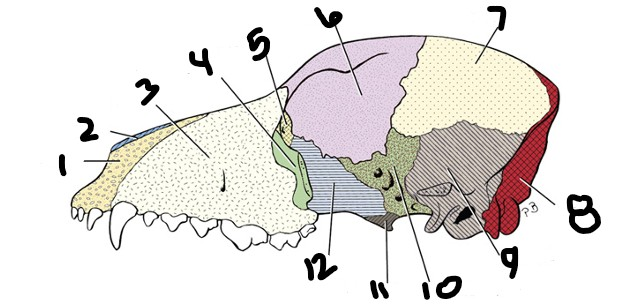
Identify number 4
Zygomatic

Identify number 4
Lacrimal

Identify number 6
Frontal

Identify number 7
Parietal

Identify number 8
Occipital

Identify number 9
Temporal

Identify number 10
Sphenoid complex
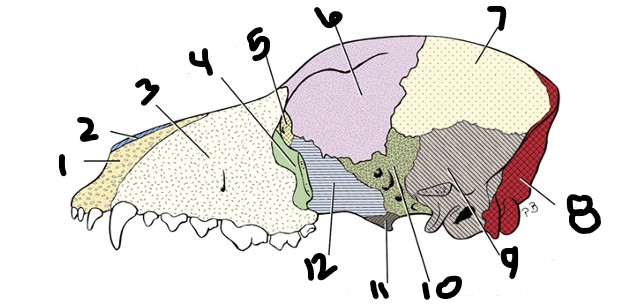
Identify number 11
Pterygoid
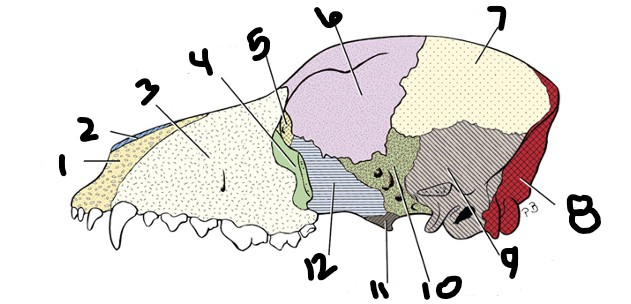
Identify number 12
Palatine