5 - Liquid Chromatography (LC/HPLC/UPLC)
 Call Kai
 Learn
 Practice Test
 Spaced Repetition
 Match
 Flashcards
 Knowt Play
1/50

There's no tags or description
Looks like no tags are added yet.
51 Terms
Basic Workflow of Spectrophotometric Methods
Light source hits a cuvette with analyte inside
Detector response is proportional to concentration of analyte
%T calculation
%T = Is/Io x 100%
Absorbance calculation
2-log(%T)
History of modern chromatography
1906 - Michael S Tswett detailed chlorophyl separation using a column of calcium carbonate. The publication contained a discussion of the physiochemical basis of chromatography, and included nomenclature now applied to chromatography
Basoc components of the chromatographic system
Mobile phase solvents/buffers
Delivery system (pump)
Sample + Injector
Column
Detectors
Data system
Waste
How does the liquid mobile phase get moved through the column
A pump pushes the liquid through
Isocratic mode pump operation
Mobile phase composition remains constant throughout the chromatographic run
Gradient mode pump operation
Mobile phase composition is either changed in a stepwise or continuous fashion throughout the run
What results in the separation of analytes between the mobile an stationary phase
Differential equilibrium
Theory of partition chromatography separation
Solubility between the mobile and stationary phases for the analyte
What is Liquid Chromatography
A separation technique causing mixtures of compounds to be resolved by exploiting differences in their physical and chemical properties
Rate of migration is dependent on…
The differing affinities that the measured compound has for the mobile phase and the stationary phase
What are the 4 categories of liquid chromatography
Adsorption chromatography
Ion exchange
Size exclusion
Partition chromatography (liquid/liquid)
Classified as normal phase or reverse phase
Makeup of a stationary phase
Covalently bonded stationary phases of some organic moiety are bonded to a support particle, usually silica
What are some examples of polar groups that you can bond to a stationary phase
Cyanopropyl (CN)
Aminopropyl (NH2)
Glycidoxypropyl (diol) silanes
These can be used for normal phase (L/L) chromatography
What are some examples of non-polar organic groups you can bond to a stationary phase
Octadecylsilane (ODS or C-18)
Octylsilane (S8)
These can be used in reverse phase (L/L) chromatography
Normal phase liquid chromatography
Partition system where the stationary phase is more polar than the mobile phase. Non-polar analytes would elute first
Reverse phase liquid chromatography
Partition system in which the mobile phase is more polar than the stationary phase. Polar analytes would elute first
Is normal phase or reverse phase more used in Biological LC?
Reverse phase - as many biological compounds are polar
Composition of a mobile phase
Solvents
Buffers
Mobile phase modifiers (maybe) - ex. Triethylamine
What is the importance of choosing the correct solvent for LC?
It affects compound retention and selectivity
Examples of solvents used in LC
Methanol
DMSO
Ethanol
Acetonitrile
Tetrahydrofuran
Dioxane
Isopropanol
Use of Acetonitrile buffer in LC-MS/MS
Increases ionization efficiency (compared to methanol) - lower sample viscosity means fine droplets are produced
Use of buffers in LC
Controls pH, reduces peak tailing, and gives well-shaped narrow peaks
pH of buffer affects selectivity (separation of compounds)
Optimum pH range of buffer in LC
± 1 pH unit of the buffers pKa
What has better retention - ion suppressed or ionized analytes?
Ion suppressed
What type of buffer would you want to use for LC-MS/MS
A volatile buffer that minimizes suppression and maintains sensitivity. Examples include:
Ammonium formate/formic acid
Ammonium acetate/acetic acid
What happens if a non-volatile buffer (like phosphate used in HPLC) is sued for LC-MS/MS
Leads to contamination of ion source
What is back pressure
Unwanted pressure created by the force necessary to push a liquid mobile phase through a tightly packed bed of tiny particles
What causes back pressure in LC
Sample, mobile phase, or instrument wear or tear.
To troubleshoot, start at the detector and work backwards up the flow path
Use of detectors in LC
Responsible for detecting compounds as they elute from the column
Criteria considered when choosing a detector for LC
Sensitivity
Detectability
Linearity
Reproducibility
Peak shape
Flow and temperature
Examples of detectors used in LC
UV
Fluorescence
Electrochemical
Mass spec
Light scatter
Radiochemical
NMR
IR
How do UV detectors work for LC
Ultraviolet and visible photometers are used in the same manner as other photometers, with quantation based on Beer’s Law (A = ebc).
Main differences is that an intense light source is required to ger reasonable light through the cell
How doe Fluorescence detectors work for LC
Molecules make a signal based on the ability to emit light after being excited by light radiation. Since many molecules do not fluoresce, numerous methods for derivatizing compounds have been developed
How does an amperometric detector work (electrochemical)
Column effluent flows past an electrode to which a voltage is applied. if the voltage is large, the analyte molecules at the interface between the electrode and solution can be oxidized or reduced.
Net movement of electrons causes current to flow, and current is proportional to surface analyte concentration
What is retention time tR
The time that has elapsed from the injection of the sample into the chromatographic system to the recording of the peak maximum of the coponent of the chromatogram
What is void time t0
Time required to elute an unretained substance
What is resolution R
The degree of separation between two components by chromatography
Resolution calculation
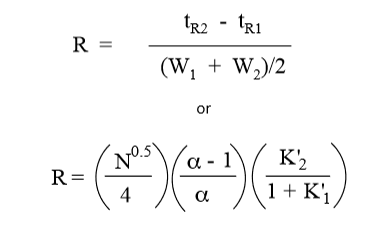
What resolution value is considered necessary for good chromatographic analysis
1.25 or greater
What factors control resolution in chromatography
Peak retention
Capacity factor (k’)
Selectivity (alpha)
Peak width
Efficiency (N)
What is the most cost and time effective approach to improve LC resolution
Adjust capacity factor
What is capacity factor
A measure of retention time
k’ = (tR-t0) / t0
What is selectivity factor (alpha)
Measurement of the retention time of two peaks compared to each other
alpha = k’2/k’1
What is effeiciency factor
Measure of peak width (how many “plates”) there are
N = 16(tR/W)²
How to easily adjust retention time (k’)
Changing amount of organic solvent
10% change in fraction of organic solvent causes 2-or-3 trheshold change
How to manipulate selectivity factor (alpha)
Selectivity is a function of column packing, mobile phase, and solute chemistry. Therefore, we can change
Composition of mobile phase (organic solvent, buffer, pH0
Stationary phase
Sample chemistry through derivatization
Separation temp
What does the effiiciecny number indicate
It calculates the theoretical plates for a column (a microscopic segment of a column where a perfect equilibrium exists between solute + phases)
Large N means narrow peaks, and an efficient column

Different ways to maximize efficiency in a column
Well-packed column that contains a stationary phase that is small and uniform with respect to size distribution of particles
Increase column length
Increasing mobile phase flow rate
Volume of injection (less is better)
What are some reasons to extract a sample before injection?
Prolongs the life of the column
To see only peaks of interest
Improve sensitivity