Geography 2nd Half
 Call Kai
 Learn
 Practice Test
 Spaced Repetition
 Match
 Flashcards
 Knowt Play
1/92

There's no tags or description
Looks like no tags are added yet.
93 Terms
Crust
The thin, solid outer layer. It includes continental crust and thinner, denser oceanic crust.
Regolith - the layer of loose, fragmented rock, dust, and minerals that covers solid bedrock on Earth
Outcrop - a visible exposure of bedrock or ancient rock formations on the surface of the Earth
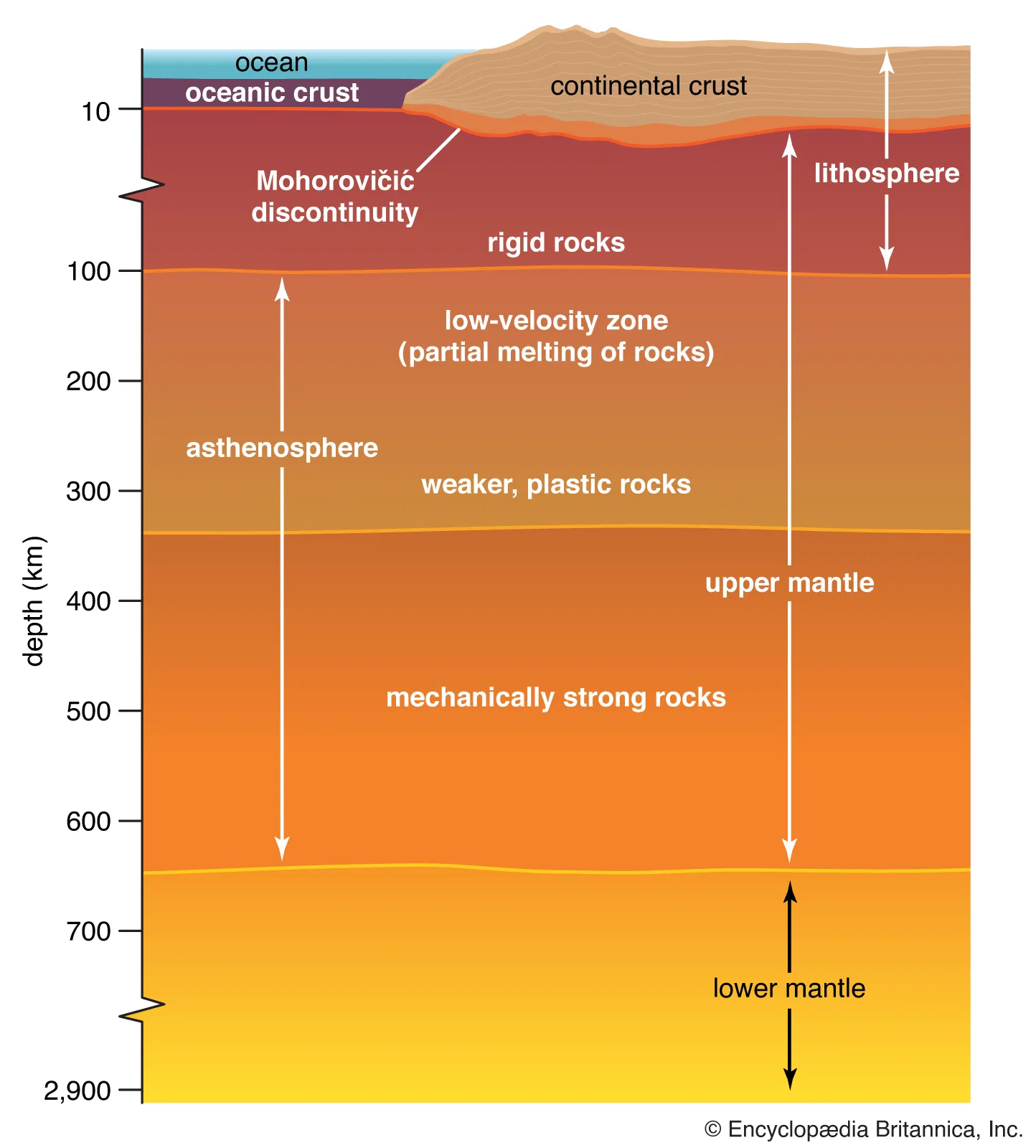
Moho (Mohorvovicic discontiunity)
The Moho is the boundary between Earth's crust and mantle. It is identified by a sudden increase in the speed of seismic waves because mantle rocks are denser and compositionally different from crustal rocks.

Mantle
A very thick layer of hot, solid rock beneath the crust. It can slowly flow over geologic time.
largest of the four shells
three sublayers total
two layers of upper mantle
lithosphere (ridgid)
asthenosphere (partial melting)
lower mantle (rigid)
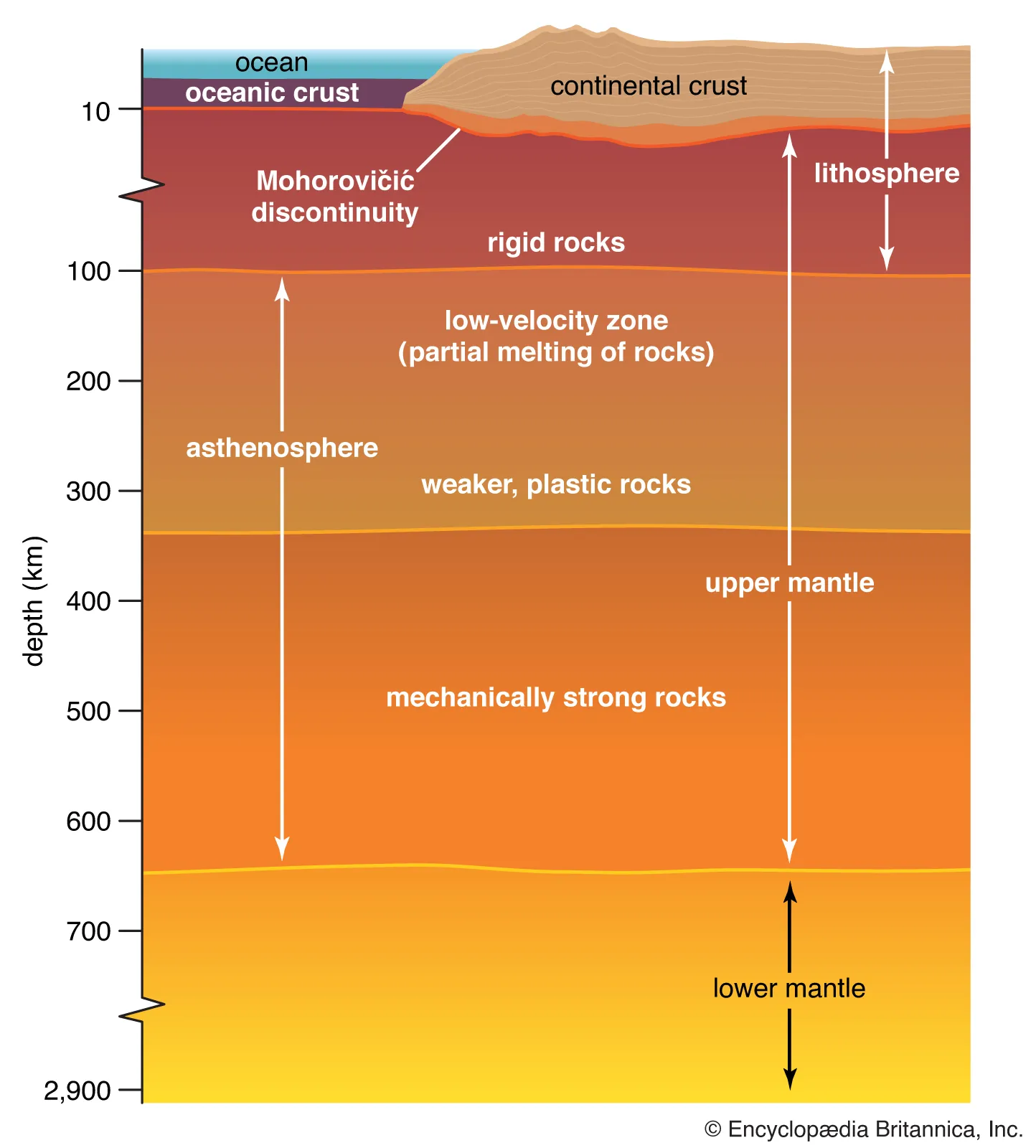
Lithosphere
The rigid brittle outer shell consisting of the crust plus the rigid rocked uppermost mantle. It is broken into tectonic plates that move.

Asthenosphere
A hotter, weaker, more ductile zone beneath the lithosphere, still part of upper mantle. It can slowly deform and flow, allowing the lithospheric plates to move over it.

Outer Core
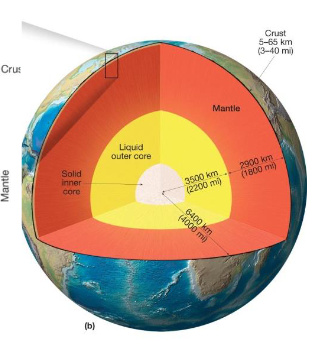
A liquid layer composed mainly of iron and nickel. Movement within it produces Earth's magnetic field.
Inner Core
A solid, extremely hot iron-nickel sphere at Earth's center. It remains solid because of the enormous pressure.

Mineral
is a naturally occurring, inorganic, crystalline solid with a definite chemical composition and a definite atomic structure- the atomic structure, how the atoms are bonded, give it its shape.
technically lab grown diamonds aren't minerals
When minerals have time and space they can grow quite large
A mineral is a naturally occurring, inorganic solid with a relatively definite chemical composition and an ordered crystal structure.
Mineral characteristics
-solid: no liquid or gases
-found in nature
-inorganic
-specific chemical comp
-crystalline: contains atoms that arrange repetitive patterns to form crystals
Rock
defined as any sample that has more than one mineral in it
A rock is a naturally occurring solid mixture or aggregate of one or more minerals (and sometimes other materials).
composed of many minerals
- fewer than 20 minerals make up 95% of the composition of crustal rocks
- bedrock- rock that hasn't really moved since deposited
- soil is a combination of broken down rock and organic matter
- Outcrops - a visible exposure of bedrock or ancient rock formations on the surface of the Earth
- Regolith: the layer of loose, fragmented rock, dust, and minerals that covers solid bedrock on Earth
Protons
Number of protons in the nucleus tells you the element
Neutrons
also found in nucleus, change the mass
Electrons
in the outer shell determine stability and the ability to bond/share electrons of other atoms.
Compounds
-atoms join together, or bond, with other atoms to form compounds
-different compounds have different types of atoms
Important Minerals
Silicates combines oxygen and silicon, the most common elements in the lithosphere . They make up most of Earth's crust and mantle. Common silicates include quartz, feldspar, mica, and olivine.
Oxides- elements that are combined with oxygen t
Sulfides- combo of sulfur and another element
Sulfates- contains sulfur and oxygen
Carbonates- light colored minerals that contain a combination of carbon and oxygen and another element ( limestone)
Halides- derived from the word salt, salty minerals
Native elements- gold and siler
Igneous Rocks
Igneous means “fiery inception”
Magma - molten rock beneath earth's surface. We can sometimes see rocks that are from cool magma, that are millions years old
Lava- molten rock when it flows onto earth’s surface
Pyroclastics- lava ejected from volcano and cools to form rock
Classification based on mineral composition and texture
Texture based on how rocks cool
Plutonic/Intrusive Rocks
rocks formed from magma, cool slowly, giving atoms time to bond together, creating large crystals we can see with our naked eye. Granite is an example.
Volcanic/Extrusive rocks
rocks cool quickly from lava, creating small/ not visible to naked eye crystals. Basalt is an example.
Pyroclastics
lava ejected from volcano and cools to form rock
How to classify igneous rocks
Coarse or Fine?: Can I see crystals (different colors) with my naked eye (where it cooled)
Mostly light or dark?: light colors indicate more quartz, dark colors have more ?
(mineral content)
For something to be granite it has to be light and coarse grained

Granite vs. basalt
Granite: Usually light-colored, coarse-grained, and rich in silica; it is generally associated with continental crust.
Basalt: Usually dark-colored, fine-grained, and lower in silica; it is the dominant rock of oceanic crust.
Granite is generally less dense and more silica-rich than basalt.
Sedimentary rocks
Forms through lithification
External process cause rock breakdown
Material transported by water as sediment
-over time large amounts of sediment build to large thickness
Exerting enormous pressure which causes particles in sediment to interlock
Chemical cementation takes places
This is lithification- forms sedimentary rock
Strata- horizontal layers of sedimentary rock; sometimes tilted by earth processes
Some sedimentary rocks form when seawater is evaporatedSeawater has dissolved solids in it
When seawater is evaporated those solids recombines
Where we have limestone, there one was ocean. Limestone reacts with acid, left behind when ocean water evaporates and recedes
Some rocks form from the skeletons of animals
Animals take in calcium and other minerals from the water into their shells
When those animals die, their skeletal material can be preserved in rocks
Creating fossils !
Some rocks form from sediment deposits ( lithification)
Rocks exposed at the surface of the earth break apart into smaller
Bedding Plane
A bedding plane is a surface separating one sedimentary layer (bed) from another. It represents a change or pause in the conditions under which sediment was deposite
Types of sedimentary rocks
Instead of looking at crystal or mineral content we look at how the rock formed, clastic vs non clastic
Clastic: composed of fragments of preexisting rocks
Shale (hard to see the little pieces with the naked eye, but they are still there.)
Conglomerate; composed of pebble sized fragments
Chert is a hard, fine-grained sedimentary rock composed almost entirely of microcrystalline or cryptocrystalline quartz (silicon dioxide, SiO₂)
- Non clastic: chemical and organic sedimentary rocks
Formed by precipitation of soluble materials or complicated chemical reactions
Limestone and coal
Organic sedimentary rocks such as coal form front he remains of dead plants and animals
Organic material falling into shallow water with little oxygen, like a swamp, it cant decomposed, theres pressure, heat, and it creates coal
Some rocks form when seawater is evaporated
Seawater has dissolved solids i nit
When seawater is evaporate
Limestone = used to be an ocean
Funky (horizontal) distribution of strata indicates windy desert area
Sendimentary rock on mars, what does it mean?
We see evidence of layering created through sedimentary processes through crumbling, layered butte on mars.
Mars loosing magnetic field from cooling quicker since its smaller, no magnetic field no atmospheric protectin
Metamorphic Rocks
When rocks are buried deep within the earth, they are subjected to elevated temperature and pressure that changes the properties. When rocks are cooked, alot of times, minerals align themselves with each other
The ‘cooking’ rearranged the crystal structure of the original rock
Foliation in metamorphic rocks is a striped or layered texture caused by the parallel alignment of flat, platy, or elongated mineral grains under directed pressure
Under high heat and pressure, different minerals segregate into alternating light and dark layers
As you move down the shoreline of america you will see more igneous and metamorphic rocks
you are witnessing the effects of glaical and bedrocklongshore drift and ancient mountain erosion.made
Are the bands of color crystallized? Prob cooked
When sandstone gets cooked, a quartzite, it looks like melted sugar, like the sands melted together
Schist- metamorphic rocks with small/edium foliation
Gneiss- broad, banded foliations
foliation
Foliation in metamorphic rocks is a striped or layered texture caused by the parallel alignment of flat, platy, or elongated mineral grains under directed pressure
Under high heat and pressure, different minerals segregate into alternating light and dark layers
When limestone is exposed to heat in pressure, it becomes marble. Marble is not folliated, those grey streaks are not aligned and not considered banded.
Types of metamorphism
Contact metamorphism: Rock is altered primarily by heat from a nearby magma body. It generally affects a relatively small area.
Regional metamorphism: Large areas of rock are altered by intense heat and pressure, commonly during mountain building and plate collisions.
Hydrothermal metamorphism: Hot, chemically active fluids circulate through rock and alter its minerals and chemical composition.
The rock cycle
We start with igneous rocks- the birth of new crust, rising body of magma creating intrusive igneous rocks, and extrusive when magma reaches the surface. Solar energy then weathers, erodes, and deposits sediment, which turns into sedimentary rock during compaction, cementation, evaporation. Forming sedimentary rocks, which become metamorphic rocks due to heat and pressure. These metamorphic rocks can melt and start the cycle again
Balancing act of internal and external geomorphic processes
The study of landforms
Topography- surface configuration of earth
Landform- individual topographic feature of any size
Elements of landform study
Structure
Process
Slope
Drainage
Relief
Uniformitarianism
The present is the key to the past
Processes which shaped the landscape of the past are the same that will shape the future
Granite
granite is an igneous intrustive (plutonic) rock. big coarse crystals.
its light color indicates the magma is cooled from is high in silica
it is generally associated with continental crust
Granite is generally less dense and more silica-rich than basalt.
Basalt
basalt is an igneous extrusive (volcanic) rock. fine grained
its dark color indicates the lava it cooled from is low in silica
it is generally associated with oceanic crust
Limestone
A non-clastic sedimentary rock made mostly of calcium carbonate.
It can form from the buildup of shells and skeletons of marine organisms or from chemical precipitation.
It is generally associated with warm, shallow marine environments.
It often contains fossils and reacts with acid by fizzing.
Coal
A non-clastic organic sedimentary rock formed from the remains of ancient plants.
It forms when plant material is buried, compressed, and heated over millions of years.
It is generally associated with ancient swamps and wetlands.
It is dark in color and is commonly used as a fossil fuel.
Shale
A clastic sedimentary rock made of very fine-grained clay and mud particles.
It forms when mud and clay settle in calm water and become compacted over time.
It is generally associated with quiet environments such as lakes, river deltas, and deep ocean floors.
It splits easily into thin layers.
Conglomerate
A clastic sedimentary rock made of rounded rock fragments and pebbles cemented together.
It forms when rounded sediments are deposited and cemented over time.
It is generally associated with high-energy environments such as fast-flowing rivers and beaches.
Its rounded fragments indicate that the sediments were transported and worn down by water or other forces.
Chert
A sedimentary rock made mostly of microcrystalline quartz (silica).
It forms through the accumulation of silica from marine organisms or through chemical precipitation.
It is often associated with marine environments.
It is very hard, usually has a smooth texture, and breaks with curved, sharp edges.
Scheiss
A metamorphic rock with medium- to coarse-grained crystals arranged in layers or parallel patterns.
It forms when existing rocks are subjected to heat and pressure.
It is generally associated with mountain-building regions and areas of regional metamorphism.
It often contains visible mica crystals, which give it a shiny appearance and allow it to split along its layers.
Gneiss
A metamorphic rock with distinct alternating bands of light and dark minerals.
It forms when existing rocks are exposed to intense heat and pressure.
It is generally associated with continental crust and deep, high-grade metamorphic environments.
Its mineral bands distinguish it from schist, which typically has a more flaky or layered appearance.
Silica
Silica, or silicon dioxide (SiO₂), is a natural chemical compound made of silicon and oxygen, therefore a mineral. It is the main component of sand, quartz, and many rocks, making up a large part of Earth’s crust. It appears in crystalline and amorphous forms used in glass, building materials, and electronics.
Quartz
mineral composed of silicon dioxide (SiO₂), containing approximately 46.74% silicon and 53.26% oxygen by weight
Alfred wegener
rmeteorologist and polar explorer
Koppen is a mentor and father in law to alfred (koppen climate chart)
Wrote the origins of oceans and continents in 1915
Suggested the land masses slowly move over time (continental drift)
Supercontinent pangaea
This hypothesis has been tested to be objectively true theory
Evidence for continental drift and a previous super continent (pangea):
'“Fit” of the continents
Glacial deposits far from polar regions
Paleoclimatic belts
Distribution of fossils
Matching geologic units between shorelines
He died not being very believed
He argued that the fit could not be coincidental
Present shorelines make a rough fit
The continental shelf edges make a better fit and led to (Bullard, 1965)
The oceanic crust
By 1950, much had been learned about oceanic crust
• Oceanic crust is covered by sediment
• Thickest near the continents, thinnest (or absent) at the mid- ocean ridges
• Oceanic crust is more dense than continental crust
• Heat flow is much greater at the mid-ocean ridges.rust
• Heat flow is much greater at the mid-ocean ridges.

Sub-marine earthquakes
Submarine earthquakes are concentrated in specific areas. Submarine earthquakes happen mostly along tectonic plate boundaries under the ocean. The primary global zones are the Pacific Ring of Fire, the Mid-Atlantic Ridge, and the Alpide belt (including the Mediterranean and Aegean seas)
• Parts of oceanic Fracture Zones (Inside a Plate): The inactive extension of a transform fault that continues past the ridge-spreading center. Beyond the ridge, the crust on both sides belongs to the same tectonic plate and moves in the same direction. [
Transform Faults (Where Plates Meet): The active part of the fault located between two offset segments of a mid-ocean ridge. Here, two different tectonic plates slide past each other in opposite directions, causing earthquakes
• Mid-ocean ridge axes (divergent boundaries of ocean plates)
• Deep ocean trenches (convergent boundaries of ocean plates

Mantle Convection
Mantle Convection • There is evidence that suggests mantle material moves by convection • Hot material moves outward, cool material moves inward
Plate tectonics
Plate movement is driven by heat from Earth's interior, gravity, and forces associated with the mantle.
Slab pull: Cold, dense oceanic lithosphere sinks into the mantle at subduction zones, pulling the rest of the plate behind it. This is considered a major driving force.
Ridge push: Newly formed lithosphere slides away from the elevated mid-ocean ridge under the influence of gravity.
Mantle convection and traction: Heat causes slow movement within the mantle, which can help move plates through drag and interaction with the mantle.
Lithospheric plates move over the weaker, slowly deforming asthenosphere. These forces work together to move plates.
Describe at least two lines of evidence Alfred Wegener used to support continental drift and Pangaea.
Continental fit: The coastlines of South America and Africa appear to fit together like puzzle pieces, suggesting that the continents were once joined.
Fossil evidence: Identical fossils, such as Mesosaurus and Glossopteris, have been found on continents now separated by oceans. This suggests those continents were once connected.
Rock and mountain evidence: Matching rock layers and mountain ranges occur on continents now far apart, such as mountain belts in eastern North America and western Europe.
Climate evidence: Glacial deposits and scratches from ancient glaciers occur in places that are now warm, while evidence of tropical climates appears in regions that are now cold.
Why was Wegener’s theory rejected for so long?
Wegener could not provide a convincing physical mechanism explaining how continents could move through the solid ocean floor. Scientists believed the continents were too large to move through the Earth's crust. His evidence was persuasive, but the explanation for continental movement was incomplete. Later discoveries of seafloor spreading and plate tectonics provided the missing explanation.
What evidence confirms that seafloor spreading has taken place?
Paleomagnetism: Earth's magnetic field has reversed many times. As basalt cools at a mid-ocean ridge, iron-bearing minerals align with the current magnetic field and preserve its direction. The ocean floor contains alternating bands of normal and reversed magnetism that are symmetrical on both sides of the ridge. This shows that new crust forms at the ridge and spreads outward.
Ocean floor cores: Samples drilled from the ocean floor show that rocks and sediments are youngest near mid-ocean ridges and become progressively older farther away. Sediment layers are also generally thinner near ridges and thicker farther away because older ocean crust has had more time to accumulate sediment.
-These observations confirm that new oceanic crust forms at ridges and moves outward.
What drives plate tectonics?
Plate movement is driven by heat from Earth's interior, gravity, and forces associated with the mantle.
Slab pull: Cold, dense oceanic lithosphere sinks into the mantle at subduction zones, pulling the rest of the plate behind it. This is considered a major driving force.
Ridge push: Newly formed lithosphere slides away from the elevated mid-ocean ridge under the influence of gravity.
Mantle convection and traction: Heat causes slow movement within the mantle, which can help move plates through drag and interaction with the mantle.
Lithospheric plates move over the weaker, slowly deforming asthenosphere. These forces work together to move plates.
What are the differences among divergent, convergent, and transform boundaries?
Divergent boundaries — plates move apart
Magma rises and creates new crust. These boundaries produce seafloor spreading, rift valleys, volcanoes, and shallow earthquakes.
Convergent boundaries — plates move together
Plates collide. One may sink beneath the other through subduction, or two continents may collide and form mountains. These boundaries can produce powerful earthquakes and volcanoes.
Transform boundaries — plates slide past each other
Crust is neither created nor destroyed overall. Friction and sudden fault movement produce earthquakes, but volcanism is generally absent.
Divergent boundaries, the 2 types
Mid-ocean ridges
Formation: Two oceanic plates move apart, allowing magma to rise and cool into new oceanic crust.
Tectonic activity: Seafloor spreading and shallow earthquakes.
Volcanic activity: Usually basaltic lava eruptions, which are commonly effusive.
Topography: Long underwater mountain chains, often with a central rift valley.
Example: The Mid-Atlantic Ridge.
Continental rift valleys
Formation: Continental crust stretches, thins, and breaks along normal faults.
Tectonic activity: Faulting, crustal thinning, and shallow earthquakes.
Volcanic activity: Magma may rise through the thinning crust, producing volcanoes and lava flows.
Topography: Long, low valleys bordered by steep fault scarps and elevated blocks.
Example: The East African Rift Valley.
What is subduction?
Subduction occurs when one tectonic plate, usually cold oceanic lithosphere, sinks beneath another plate into the mantle. It produces deep ocean trenches, earthquakes, and often volcanic arcs.
3 types of convergent boundaries
Oceanic–continental convergence
oceanic plate sinks since more dense; subduction Forms oceanic trench and continental mountains (i.e., Cascades, Andes) Earthquakes occur along margin. Volcano formation along the plates— continental volcanic arc. Forms metamorphic rocks—blueschist (above)
The denser oceanic plate sinks beneath the continental plate.
Earthquakes occur from shallow to deep along the descending plate.
Water released from the sinking plate helps generate magma, which rises and forms volcanoes.
Landforms: Ocean trench, coastal mountain range, and volcanic arc on the continent.
Example: The Andes Mountains of South America. the andes are partially volcanic
Oceanic–oceanic convergence
Subduction results in undersea trench formation. Deep and shallow earthquakes. Creates Island volcanic arc
The older, colder, denser oceanic plate generally subducts beneath the other.
Earthquakes occur at many depths, and magma forms volcanic islands.
Landforms: Deep ocean trench and a curved chain of volcanic islands called an island arc.
Example: The Mariana Islands and Mariana Trench.
Continental–continental convergence
No subduction since two plates are highly buoyant. Builds huge mountain ranges. Volcanoes are rare. Shallow earthquakes are relatively common
Two continental plates collide after the oceanic crust between them is consumed.
Neither continent easily sinks because continental crust is relatively buoyant.
Crust compresses, folds, thickens, and is pushed upward.
Landforms: High mountain ranges and broad elevated plateaus.
Earthquakes: Common, mostly shallow to intermediate in depth; major volcanic arcs are generally absent.
Example: The Himalayas, formed by the collision of India and Eurasia.
What is the difference between an oceanic trench and a mid-ocean ridge?
Oceanic trench | Mid-ocean ridge |
|---|---|
A long, deep depression in the ocean floor. | A long underwater mountain chain. |
Usually forms at a convergent boundary. | Forms at a divergent boundary. |
Associated with subduction and destruction of oceanic lithosphere. | Associated with seafloor spreading and creation of oceanic lithosphere. |
Can have deep earthquakes and volcanic arcs nearby. | Typically has shallow earthquakes and basaltic volcanism. |
Transform boundaries
Two boundaries slip past each other laterally • Transform faults • Neither creates nor destroys crust • Commonly produce shallow focus earthquakes • San Andreas fault
How does the San Andreas Fault system fit into plate tectonics?
The San Andreas Fault system is a transform plate boundary between the Pacific Plate and the North American Plate. The plates slide horizontally past one another. Friction causes stress to build until it is released in earthquakes. The fault system produces little direct volcanism because it does not generally involve subduction or significant creation of new crust.
Why are volcanoes and earthquakes concentrated around the Pacific Ring of Fire?
The Pacific Ring of Fire follows the margins of the Pacific Ocean, where many tectonic plates meet. Much of this region consists of subduction zones, where oceanic plates sink beneath other plates.
Subduction causes earthquakes along the descending plates and generates magma that feeds volcanic arcs. Transform boundaries and other active plate boundaries also produce earthquakes around the Pacific. Together, these processes create a belt of intense seismic and volcanic activity.
4.AdditionstoPlateTectonicTheory
What causes volcanos?
What causes hot spots?
What causes earthquakes?
What causes rift valleys?
What casuses mid ocean ridges?
What causes mountain ranges?
What causes oceanic trenchs?
What causes fault lines?
What is a hot spot? Give an example.
A hot spot is a region where unusually hot mantle material generates magma that rises through a tectonic plate, often away from a plate boundary.
Examples include the Hawaiian hot spot beneath the Pacific Plate and the Yellowstone hot spot beneath western North America.
How is a hot spot trail different from a volcanic island arc?
Hot spot trail: Forms as a tectonic plate moves over a relatively stationary hot spot. The volcano above the hot spot is active or youngest, while older volcanoes are carried away and become extinct. Example: the Hawaiian–Emperor seamount chain.
Volcanic island arc: Forms above a subduction zone, where one oceanic plate sinks beneath another. The volcanoes form a curved chain roughly parallel to an ocean trench. Example: the Aleutian Islands.
The main difference is that hot spot trails result from plate movement over a localized magma source, whereas island arcs result from subduction.
How does the mantle plume model explain hot spots and then volcanic activity?
The mantle plume model proposes that narrow columns of unusually hot mantle rise from deep within the mantle. As the hot material rises and pressure decreases, melting can occur and magma can reach the surface. A plate moving over the plume produces a chain of volcanoes, with older volcanoes farther from the active hot spot.
What is a terrane, and how does one form?
A terrane is a block of crust with a geological history that differs from that of the surrounding region.
Terranes can form as volcanic island arcs, fragments of continents, or pieces of oceanic crust. Plate movement transports them to a continental margin, where they become attached through collision and accretion. This process can add new rock types and geological structures to a contin
Plate Tectonics: the rearrangement
450 million years ago, one supercontinent existed • Broke up 200 million years ago • Shifting to the current continental configuration
What is volcanism?
Volcanism is the movement of magma and the release of volcanic material from Earth's interior to or toward the surface. It includes eruptions of lava, gases, and fragmented volcanic material, as well as the intrusion of magma into existing rocks.
Define magma, lava, and pyroclastics.
Magma: Molten or partially molten rock beneath Earth's surface, often containing dissolved gases and crystals.
Lava: Magma that has erupted onto Earth's surface.
Pyroclastics: Fragments of volcanic material produced during explosive eruptions, including ash, pumice, and larger rock fragments.
How do basaltic, andesitic, and rhyolitic magmas differ?
Magma type | Silica content | Viscosity | Typical eruption style |
|---|---|---|---|
Basaltic | Low | Low; flows easily | Usually effusive, producing extensive lava flows and lava fountains |
Andesitic | Intermediate | Intermediate to high | Can alternate between lava flows and explosive eruptions |
Rhyolitic | High | Very high; flows poorly | Often explosive, producing ash, pumice, and pyroclastic flows Why? Higher silica generally makes magma more viscous. Viscous magma traps gas more readily, allowing pressure to build and increasing the potential for explosive eruptions. Basaltic magma usually allows gases to escape more easily, although basaltic eruptions can also be explosive. |
What is flood basalt?
Flood basalt is an enormous volume of basaltic lava erupted over a wide region, often through long fissures rather than a single central volcano. Repeated eruptions create thick, extensive layers of basalt.
An example is the Columbia River Basalt Group in the northwestern United States.
Describe the four main kinds of volcanic peaks.

Shield volcanoes (above)
Broad volcanoes with gentle slopes, built by repeated flows of low-viscosity basaltic lava. Eruptions are usually effusive. Example: Mauna Loa in Hawaii.

Composite volcanoes (stratovolcanoes) (above)
Tall, steep-sided cones built from alternating layers of lava and pyroclastic material. Their magmas are commonly andesitic or otherwise intermediate to felsic, and eruptions may be explosive. Example: Mount Fuji in Japan.

Lava domes (plug domes) (above)
Rounded, steep-sided mounds formed when very viscous lava slowly accumulates near a vent instead of flowing far. Domes can grow unstable and collapse, generating dangerous pyroclastic flows.

Cinder cones (above)
Small, steep-sided cones made mainly of loose volcanic fragments, such as cinders and scoria, that fall around a vent. They often have a bowl-shaped crater at the summit. Example: Parícutin in Mexico.
How does a caldera such as Crater Lake form?
A caldera forms when a major eruption removes large amounts of magma from a magma chamber beneath a volcano. The chamber's roof then collapses, creating a large depression. Later, rainwater, snowmelt, or new volcanic activity may fill the depression.
Crater Lake in Oregon formed when Mount Mazama erupted and collapsed about 7,700 years ago. The resulting caldera eventually filled with water.
What are pyroclastic flows and lahars?
Pyroclastic flows are fast-moving, extremely hot mixtures of volcanic gas, ash, and rock fragments that rush down a volcano's slopes. They can form when an explosive eruption ejects material or when an unstable lava dome collapses. They are extremely dangerous because of their heat, speed, and destructive force.
Lahars are volcanic mudflows made of water mixed with ash, soil, and rock debris. They may form when volcanic heat melts snow or ice, when heavy rain washes loose ash downhill, or when water mixes with volcanic deposits. Lahars can travel far down river valleys, burying comm
Define igneous intrusion, pluton, batholith, and dike.
Igneous intrusion: Magma that enters existing rock and cools below Earth's surface.
Pluton: A body of intrusive igneous rock that crystallized underground.
Batholith: A very large intrusive igneous body, commonly composed of granitic rock, that covers at least 100 square kilometers of exposed area.
Dike: A sheet-like intrusion that cuts across existing rock layers or structures, often filling a crack.
Tectonism: Folding How is folding different from faulting?
Folding: Rock layers bend due to stress, usually compression, without breaking apart along a fault surface.
Faulting: Rock breaks and moves along a fracture called a fault.
Folding commonly occurs where rocks deform under pressure, while faulting occurs when rocks fracture and undergo displacement.
What is a syncline? What is an anticline?

Syncline
A downward-curving fold, shaped like a trough. In a simple, upright fold, the youngest rocks are usually found near its center.

Anticline
An upward-arching fold, shaped like an upside-down U. In a simple, upright fold, the oldest rocks are usually found near its center.
Faulting: What are the four basic kinds of faults?
Fault type | Main stress | Relative movement |
|---|---|---|
Normal | Tension (pulling apart) | Hanging wall moves down relative to footwall |
Reverse | Compression (pushing together) | Hanging wall moves up relative to footwall |
Thrust | Compression | A low-angle reverse fault where the hanging wall moves up and over the footwall |
Strike-slip | Shear | Blocks move horizontally past one another |
A thrust fault is a special type of reverse fault with a relatively low-angle fault plane.
What is a fault scarp?
A fault scarp is a steep slope or cliff formed when movement along a fault creates vertical displacement between two blocks of Earth's crust. It may appear as a sharp step in the landscape.
What landforms result from normal faulting?
Grabens: Down-dropped blocks between two normal faults, creating valleys or basins.
Horsts: Blocks left relatively high between normal faults, forming ridges or uplands.
Tilted fault-block mountains: Large blocks that are uplifted and tilted as normal faulting stretches the crust, creating steep fault-facing slopes and gentler slopes on the opposite side.
These features form when the crust is pulled apart and blocks move vertically relative to one another.
What landforms result from strike-slip faulting?
Linear fault troughs: Long, straight depressions created by erosion along a fault zone or by local extension between fault segments.
Sag ponds: Small ponds that form in depressions created by local extension or subsidence along a strike-slip fault.
Offset streams: Streams whose courses are displaced sideways as fault movement shifts the land on either side.
These features develop because strike-slip faults move blocks horizontally, although bends or irregularities in the fault can also cause local uplift or subsidence.
What is an earthquake?
An earthquake is the shaking of the ground caused by a sudden release of energy within Earth, commonly when rocks slip along a fault. The released energy travels through the ground as seismic waves.
What is the difference between the focus and the epicenter?
Focus (hypocenter): The location inside Earth where the earthquake begins and seismic energy is first released.
Epicenter: The point on Earth's surface directly above the focus.
What is the difference between earthquake magnitude and intensity?
Magnitude measures the size of the earthquake based on the energy released. A single earthquake generally has one reported magnitude.
Intensity describes the strength of shaking and the effects experienced at a particular location. It varies with distance, local ground conditions, and other factors.
What does the Modified Mercalli Intensity Scale convey?
The Modified Mercalli Intensity (MMI) Scale describes earthquake effects using Roman numerals from I to XII.
I: Not felt by most people.
VI: Felt by everyone; some objects or plaster may be damaged.
XII: Extreme destruction, with effects such as widespread ground deformation.
It describes observed shaking and damage rather than measuring the earthquake's energy directly.
What are P waves, S waves, and surface waves?
Wave type | Motion | Key characteristics |
|---|---|---|
P waves (primary) | Compressional; particles move parallel to the wave's direction | Fastest seismic waves; travel through solids and liquids |
S waves (secondary) | Shear; particles move perpendicular to the wave's direction | Slower than P waves; travel through solids but not liquids |
Surface waves | Rolling or side-to-side motion along Earth's surface | Usually slower than body waves, but often cause the greatest damage near the surface |
Under what conditions does liquefaction occur?
Liquefaction occurs when loose, water-saturated sediment is shaken strongly during an earthquake. Shaking increases the water pressure between sediment grains, reducing the friction and effective stress that hold the grains together. The sediment can temporarily behave like a liquid, causing buildings to settle or tilt and the ground to spread or sink.
It is especially common in loose sandy or silty deposits with a high water table.
How can faulting leave older rocks resting over younger rocks?
Faulting leaves older rocks resting over younger rocks through thrust faults (low-angle reverse faults) caused by crustal compression. When tectonic plates collide, the hanging wall block moves upward and over the footwall block, pushing deep, older strata on top of shallow, younger strata. [1, 2, 3, 4]