Lecture 3 - Schedules of Reinforcement + Extinction
 Call Kai
 Learn
 Practice Test
 Spaced Repetition
 Match
 Flashcards
 Knowt Play
1/38

There's no tags or description
Looks like no tags are added yet.
39 Terms
Schedules of Reinforcement
Specifies which responses will be followed by the reinforcer
Continuous reinforcement -
Each response is followed by the reinforcer
Intermittent reinforcement -
Not every response is followed by a reinforcer
Fixed Ratio Schedules
Reinforcer is delivered after X number of responses - the number does not change (the number is fixed)
Produces high rate of responding, but there’s often a post reinforcement pause
Fixed Ratio Schedules examples
• Examples: piece rate pay
• classroom uses
every 10 pages you read you get candy
what does FR5 mean
• FR5 schedule means reinforcer is given after every 5th response
Fixed Ratio Schedules: ferster and skinner
descrease in responses after reinforcer
post reinforment pause

Variable Ratio Schedules
Reinforcer after X number of responses on the average
Produces high rate / no post-reinforcement pause (response rate doenst drop)
Variable Ratio Schedules example
• Examples: work and classroom uses
• slot machine
what does VR10 mean
• Ex. VR 10
trial 1: 7 responses → reinforcer
trial 2: 15 responses → reinforcer
trial 3: 3 responses → reinforcer
trial 4: 15 responses → reinforcer
7 + 15 + 3 + 15 = 40 responses
40 responses/4 reinforcers = 10 responses per reinforcer → VR 10

Fixed Interval Schedules
• Reinforcer for the first response after X amount of time - time interval does not change
• Produces low rate of responding that increases at the end of the interval • Rarely used in training programs
Fixed Interval Schedules examples
• mail delivery every 24h
• hourly supervisor checks on a worker
Variable Interval Schedules
• Reinforcer for the first response after X amount of time on the average
• Produces low but steady rate of behavior • Rarely used in training programs
Variable Interval Schedules example
• unpredictable supervisor checks
• checking for phone or e-mail messages
Concurrent Schedules of Reinforcement
Schedules of reinforcement that exist at the same time for two or more different behaviors
• Concurrent operants: different behaviors to choose from
• Concurrent schedules of reinforcement: each behavior has its own schedule
Matching law:
we often choose the behavior that gives us greater reinforcement
Factors influencing choice of concurrent operants
- schedule of reinforcement
- magnitude of reinforcement
- immediacy of reinforcement
- response effort
Combined schedules
= when we put 2 or more reinforcement schedules together
• Ex: FR10+ FI 5min
Concurrent schedules
= each behaviour has it’s own schedule and available at the same (person has to choose)
• Ex: You can study or play video games → both options are available simultaneously
Multiple schedules of Reinforcement
happening ONE AFTER ANOTHER
• reinforcement schedule changes over time, and different discriminative stimuli (SD) signal which schedule is currently active
• Ex: Teacher shows green card for ”participation time” on FR-1, and red card for “quiet, attentive time” VR-5
Extinction:
• Is a basic principle of behavior
• Is supported by years of basic and applied research
• Is a component of many behavior modification procedures
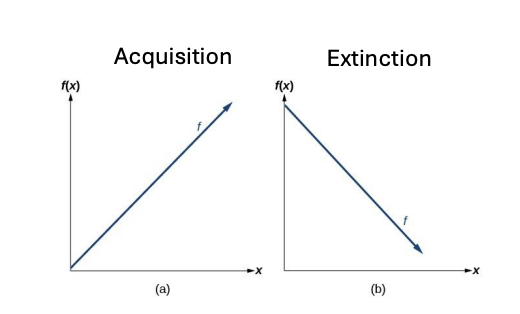
Defining Operant Extinction
1. A previously reinforced behavior
2. Is no longer followed by the reinforcing consequence
3. The behavior is weakened (decreases and stops occurring in the future)
Operant Extinction present vs future
• Present: The behavior is no longer reinforced
• Future : The behavior stops occurring
Push the button in a broken garage door opener – garage door does not open. **In the future……
dont push broken button
Drinking from an empty water bottle – do not get any water** In the future……
not gunna be drinking from that water bottle in the future
Telling unfunny jokes – get no laughs** In the future……
less likely to tell jokes
Trying to use a flashlight with dead batteries – get no light** In the future……
less likely to use those batteries
Calling someone who never answers her phone – do not get any response** In the future……
not call them
Parent stops reacting to child misbehavior – child gets no attention** In the future……
child stops misbehvaing
Look at your wrist when you no longer wear your watch – get no time** In the future……
stop looking at your wrist
Extinction Burst
When the reinforcer no longer follows a particular behavior, three things may happen initially:
1. Increase in frequency, duration, or intensity of the unreinforced behavior
2. Occurrence of novel behaviors
3. Occurrence of emotional and/or aggressive behaviors

Extinction Burst example
when rae does not get her coffee from the vending machine, she pushes the buttons repeatedly and shakes the machine
Spontaneous Recovery
• The behavior occurs again sometime later after it was eliminated with extinction
• Behavior occurs in situations where it was reinforced in the past
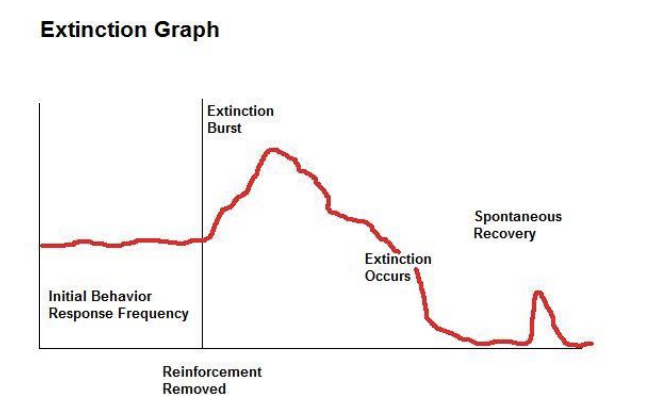
Evidence of spontaneous recovery suggests that extinction learning is
a new and separate process from acquisition/learning

Procedural Variations of Extinction
Extinction of positively reinforced behavior
Extinction of negatively reinforced behavior
In both cases behavior is weakened
Extinction of positively reinforced behavior
The positive reinforcer is no longer delivered following the behavior
Extinction of negatively reinforced behavior
The aversive stimulus is no longer removed following the behavior
Factors Influencing Extinction
• The schedule of reinforcement prior to extinction
• The occurrence of reinforcement following the initiation of extinction
• Reinforcement of functionally-equivalent behaviors (shared reinforcer)
Extinction learning in humans
• Exposure therapy (classical Pavlovian extinction)
• Substance-use in specific settings