social psychology
 Call Kai
 Learn
Learn Practice Test
 Spaced Repetition
 Match
Match Flashcards
 Knowt Play
1/32

There's no tags or description
Looks like no tags are added yet.
Name | Mastery | Learn | Test | Matching | Spaced | Call with Kai | Chat |
|---|
No analytics yet
Send a link to your students to track their progress
33 Terms
Auguste Comte
father of sociology and positivism. proposed that society and social issues could be studied scientifically.

positivism
the application of the scientific approach to the social world. we should come to know things through reason, logic, or observation, and knowledge about the world can be objectively true.
Gustave Le Bon
the psychology of crowd behavior originated in the work of this French physician; wrote Psychology of Crowds. He proposed that when people gather in large numbers, they form a collective unconscious or "group mind". This "group mind" could carry out behaviours that they wouldn't on their own, and he applied these theories to governance and democracy.

Norman Triplett
Conducted the first social psychology experiment. Found that cyclists tend to be faster in races that were paced. He replicated these findings in a lab, and had participants reel in fishing line. He found that people were faster in the competition trials
LaPiere
showed that the beliefs we hold are not always consistent with our behaviours

Sherif
Wrote "The Psychology of Social Norms", and how we get influenced by others
Solomon Asch + Asch Line Experiment
Ran studies on conformity, had individuals look at line lengths with actors, to test if they would trust their eyes or other peoples opinions more.

Milgrim
Ran studies on obedience to authority. Conducted the Milgrim Shock Experiment, where electric shocks were administered from an instructor to a learner (actor), until they were almost fatal.

Zimbardo
Stanford Prison Experiment, how social roles influence behaviour
The scientific method
A series of steps followed to solve problems including collecting data, formulating a hypothesis, testing the hypothesis, and stating conclusions.
quantitative social psychology
takes a positivist approach, and focuses on the fact that the world can be understood objectively. Data takes the form of numbers, and can include statistics or mathematical modelling. Uses a top down, theory driven approach

qualitative social psychology
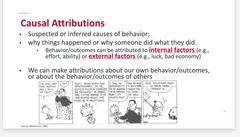
causal attributions
inferring causes for observed behavior.
Fritz Heider
proposed the attribution theory. was a gestalt psychologist focused on visual processing, and wanted to study the rules underlying how people form impressions of others

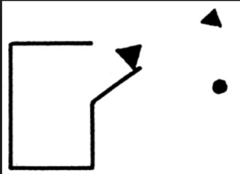
Simmel and Heider (1944)
* Investigating "naive scientists"
Participants watched a video of traingles moving and were then asked to explain their behavior and intentions
= Participants attributed an observed behavior to internal factors (dispositional attribution)
internal locus of causality
person as "origin" of own behavior (personality traits, mood, innnate ability, effort. Also called dispositional attributions.

external locus of causality
Experience of behavior as caused by the environment or outside forces (the situation, luck, social pressures.) Also called situational attributions.
stable
the attribute causing the event isn't going to change (e.g personality)
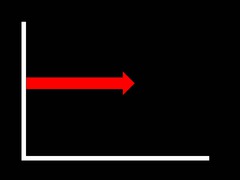
unstable
the attribute causing the even could change over time (ie. luck)
dimensions of causal attribution
internal/external, stable/unstable, controllable/uncontrollable
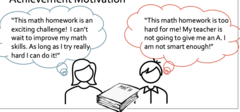
Dweck's Theory of Self-Attributions and Achievement Motivation
Found that boys tend to attribute struggles in school to external or unstable internal factors (bad teachers, lack of effort). Girls tended to attribute same struggles to stable internal factors (not being smart enough).
Dweck, Chiu, & Hong, 1995
Proposed malleability of personal traits.
Fixed or entity mindset: traits are stable and can't be changed.
Growth or incremental mindset: traits can be improved over time.

Robin & Pals (2002)
Entity (fixed) theorists tend to feel distressed, ashamed, and upset about poor academic performance. Incremental (growth) mindsets tend to feel determined and enthusiastic about poor academic performance.
Correspondent Inference Theory
A theory that states that people pay closer attention to intentional behavior than accidental behavior when making attributions, especially if the behavior is unexpected. When the behaviour does not align with societal norms, and is freely chosen, with an unusual or distinctive outcome, it is most likely to be internally attributed.
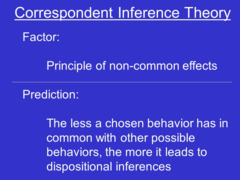
Noncommon Effects
Internal attributions are more likely when the behaviour has an unusual or distinctive outcome. These unusual outcomes are seen less likely to have alternative, situational explanations.
Co-variation model
3 cues of Kelley's co-variation model: consistency (time), distinctiveness (situation), consensus (people)
o Ex. Take flaky friend, friend forever cancels on us. Consistent behavior over time. High level of consistent behavior over time, we are more likely related to them as a person as opposed to the world working against them in this situation.
§ When consistency is high = attribution to internal factors
o Ex. Very nice friend Jim, but one day he gets so mad at the pizza place. Out of character and distinctive. So much more likely to be related to the environment. Distinctiveness = situational.
§ Distinctiveness of a situation = attribution to external factors
o Third factor in co-variation model - "group lateness" - if you arrive late at meeting but if you are with 20 other people are late too, high degree of consensus. When a lot of people demonstrate same behavior, we are more likely
to attribute behavior to situational cause.
§ Consensus of people = attribution of external factors
drawbacks of the co-variation model
it is idealized, and assumes people are naive scientists who collect information and weigh evidence before drawing conclusions. we tend to actually weigh 3 types of information unequally, and pay more attention to distinctiveness and consistency rather than consensus.
fundamental attribution error
the tendency for observers, when analyzing another's behavior, to underestimate the impact of the situation and to overestimate the impact of personal disposition.
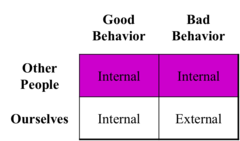
Jones & Harris (1967)
A: investigate making the FAE even when told roles are assigned
P: participants read either pro or anti Castro essays; half the participants were told the positions were assigned, half were told free choice
R: people made the FAE even when they knew the positions were assigned
perceptual salience
the seeming importance of information that is the focus of people's attention, how something stands out from the surrounding environment. Makes it more likely for us to make internal attributions

actor-observer bias
the tendency to blame our actions on the situation (situational/external) and blame the actions of others on their personalities (internal attributions/dispositional)

self-serving bias
a readiness to perceive oneself favorably. making internal attributions for their successes and external attributions for failures.
-pass driving exam: "I'm a great driver!"
-fail: "the route was bad and the examiner gave bad directions."
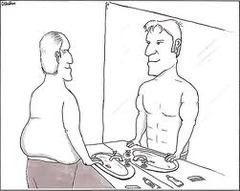
Intergroup attributions
Process of assigning the cause of one's own or others' behaviour to group membership. We make self-serving attributions about the groups we belong to
-your team wins: "our team is the best!"
-your team loses: "the refs made bad calls!"
This can contribute to prejudice and intergroup conflict.