CRDA - DEC 2026
 Call Kai
 Learn
 Practice Test
 Spaced Repetition
 Match
 Flashcards
 Knowt Play
1/66

Earn XP
Description and Tags
CRDA
67 Terms
IFRS 10 Definition of control
An investor controls an investee and only if the investor has all of the following:
-Power over the investee*
-Exposure or rights to variable returns from its involvement with the investee
-Ability to use its power over the investee to affect the amount of the investors returns
Power = current ability to direct the activities that significantly affect investee’s returns
When do you presume a parent has control in a sub
When the parent owns >50% of the voting rights of an entity
What is non controlling interest
Portion of subsidiary’s net assets and results belonging to external owners rather than the parent.
What does goodwill represent
Premium paid by the parent to acquire a subsidiary above its fair market value
Accounting equation
Assets = Equity + Liabilities
Assets - Liabilities = Equity = Net assets
How to calculate goodwill
Cost of investment (consideration) X
NCI @ Acquisition X
LESS
Fair value of sub’s net assets (X)
@ acquisition
Goodwill @ Acquisition X
LESS Impairment (X) - W5
Goodwill @ Reporting date X
How to record movement in fair value of contingent cash consideration between the acquisition date and the year end
Increase in FV of contingent cash:
Dr SPL, Cr Liabilities
Decrease in FV of contingent cash:
Dr Liabilities Cr SPL
**As SPL is impacted this also impacts W5 group retained earnings
Double entry for deferred cash
Dr investments
Cr liabilities (PV)* (Discounting rate provided in exam)
*Unwind each year = Dr Finance costs Cr Liabilities
Contingent cash double entry
Dr Investments
Cr Liabilities (FV)
Liabilities recognised in accordance with prudence concept
Double entry for 3 types of shares
1) Shares issued immediately
Dr Investments
Cr Share cap
Cr Share premium
2) Deferred/ Contingent shares
Dr Investments
Cr Shares to be issued
**CR should be included at the fair value at acquisition date
Types of fair value adjustments

Fair value adjustment proforma

Per IFRS 3, how is contingent cash recognised when calculating consideration for goodwill
Contingent consideration is recognised at fair value at acquisition
What is a associate and what % is required for control and significant influence
Where a investor does not have control but it does have significant influence
Significant influence is presumed if investor has 20-50%. Even if 50% would be associate.
To Control a entity, need >50%
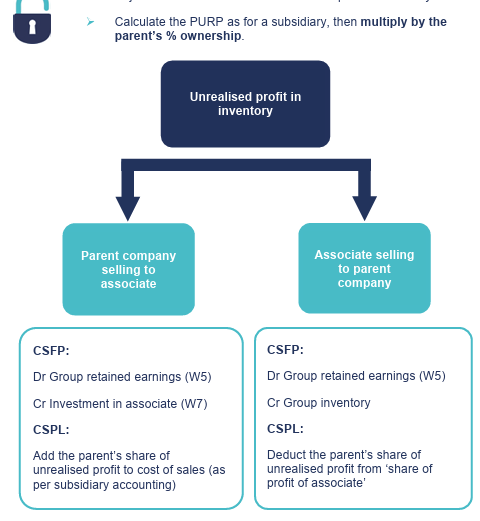
How to account for PURP in associates (Parent selling to associate and Associate selling to parent)
How to account for disposal of a subdidiary in the parents individual accounts
Dr Cash/receivables (proceeds)
Cr Investment
Cr SPL (If profit) Dr SPL (if loss)
*P/L is reported as a exceptional item and should be disclosed separately on the face of the parent’s statement of P/L after operating profit.
What are group auditors expected to do
Not expected to re perform the audits of the individual parent or subsidiary financial statements, but focus on auditing the balances included in the consolidated financial statements, including consolidation adjustments.
What is aggregation risk
The probability that the aggregate of uncorrected and undetected misstatements exceeds materiality for the financial statements as a whole.
What is component peformance materiality
Amount set by the group auditor to reduce aggregation risk to an appropriately low level for purposes of planning and performing audit procedures in relation to a component
What are the 6 assertions for the P/L
O - Occurrence
C - Completeness
A - Accuracy
C - Cut off
C - Classification
P - Presentation
What are balance sheet assertions?
E - Existence
R - Right and obligations
C - Completeness
A - Accuracy, valuation & allocation
C - Classification
P - Presentation
How are changes to accounting policies and accounting estimates applied
Accounting policy - Applied retrospectively, prior year figures would be restated. E.G. change from avco to fifco inventory measurement
Estimates - Applied prospectively, prior financial periods are not restated. E.G. Depreciation method change
Criteria for asset held for sale
-Available for immediate sale / highly probable
-Marketed at reasonable price
-Sale expected within 1y
-Unlikely plan will be changed/cancelled
-Active programme to locate a buyer
-Management committed to selling
How are variable and fixed overheads allocated
Variable = Actual level of production.
Fixed = Fixed level of production
How to calculate earnings per share
Profit/(loss) company made during the year
Weighted average number of shares during the period
Sale and leaseback right of use asset formula
Carrying amount @ disposal * ( Lease liability preent value / Fair value or sale proceeds )
When to recognise a contingent asset and liability

Disposal of a subsidiary pro forma
Proceeds
+NCI at disposal (depends on proportionate or FV method)
-Net assets at disposal
-Goodwill at disposal
=Group profit or loss on disposal
PARENT GETS = PROCEEDS + RETAINED INTEREST
NCI + GOODWILL LEAVES THE GROUP
NCI OWNED PART OF WHATS LEFT HENCE ADDED
What is the difference between audit plan and strategy
Audit strategy focuses on the big picture: e.g. agreeing a approach to audit inventory
Audit plan is the detailed work auditors are going to perform :e.g agree 10 sales invoices
Pro forma for goodwill
Consideration X
NCI @ Acquisition X
FV of assets @ Acquisition (X)
Goodwill @ Acquisition X
Impairment (X)
Goodwill @ Reporting date
If a parent sells a subsidiary, how should the results be shown in the consolidated SPL
Entity will be a discontinued operation under IFRS 5, as it represents a separate major line of business which is ceasing to exist.
The results should be shown in a single line called ‘ discontinued operations ‘ below the profit from continuing operations.
Per IFRS 16 sale and leaseback where sale occurs at fair value:
% Retained = PV lease payments / FV asset value.
% Transferred out of entity = 100% - % retained
Gain recognised = total gain * % transferred.
(Don’t recognise asset portion still held in business as a sale)
When can an intangible be revalued?
When there is a active market. Rare for an active market to exist:
-items need to be traded within the market which are identical
-willing buyers and sellers can be found at any time
-prices are available to the public.
Per IAS 10 when should a event be a adjusting event
When evidence of a condition exists at reporting date alreaadu
Fee thresholds for audits
Non listed - regularly must not exceed 15% of firms income
Listed - 5%
What do you capitalise as part of a right of use asset
-Future payments discounted to present value
-Any up front payments, e.g. deposits or payments in advance
-Costs directly attributable to leasing asset
-Costs to dismantle and restore land (e.g. proision)
Note: deduct any lease incentives payments from lessor
How is impairment on NCI on fair value basis accounted for, and on proportionate basis
Proportionate - recognise impairment just in SUb.
Fair value - Goodwill calculated relates to both the parent and NCI. So if impairment is recognised then it is suffered by both the parent and nci.
How to calculate NCI on proportionate basis
NCI on net assets @ acquisition X
Add: NCI share of post acquisition reserves X
NCI @ Reporting date X
How is unrealised profit treated from the selling company (SPL)
Added to COS and decreases RE/
How do you treat the original cost of purchasing the subsidiary on a CSOFP
Deduct original cost from investments
Difference between impairment on proportionate and fair value method
Impairment: proportionate goodwill fully allocated
Fair value method: only deduct group share of impairment.
NCI% * Goodwill impairment ( FV METHOD ONLY)
How to calculate profit or loss on disposal of a subsidiary
Sale proceeds
Add back: attributable to non controlling interest X
Less: carrying amount of good will at disposal
Less: Carrying amount of net assets at disposal
Profit on disposal
How to treat a PURP adjustment in consolidated SPL
Add to COS of the company what sold the goods
ISA 240 Appendix 3
-Useful reference for examples of circumstances that indicate possibility of fraud
IAS 38 Intangible recognition criteria
Probable Future Economic Benefits: It is probable that the expected future economic benefits (such as revenues or cost savings) attributable to the asset will flow to the entity
Reliable Measurement: The cost of the asset can be measured reliably
A active market is required if they wish to revalue
How to structure a audit procedure in the exam
Action - verb
Source - document/person/object
Objective - purpose of procedure/assertion(s) tested
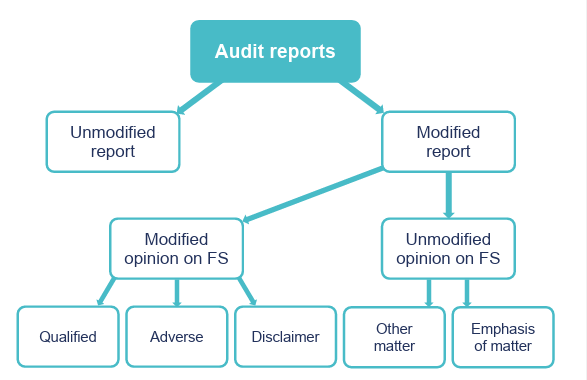
Types of modified audit opinions
Disclaimer - not enough info to draw a conclusion
Qualified - material but not pervasive
Adverse - material & pervasive
Report to those charged with governance
3 Columns
1) Control deficiency found 2) Outline possible consequences 3) Provide recommendations
4th column for manager response.
Ensure to contain a disclaimer that it only covers deficiencies identified during the audit not all possible deficiencies
Types of auditors report
Explicit opinion - true and fair view
Implicit opinion - required if:
Returns not received from branches
Accounts not in agreement with underlying records
Proper/adequate accounting records not kept
Information/explanations not received
Directors remuneration disclosures ommitted
Summary of audit report
Management V Auditors responsibility in relation to reporting on going concern
Management responsibility: Prepare the financial statements on the going concern basis and conduct a GC assessment covering 12 months from approval date.
Auditors responsibility: Obtain evidence to evaluate if a material uncertainty exists surrounding the going concern status and if managements use of GC basis is appropriate.
What needs to be disclosed relating to a RPT
-Nature of transaction
-Amount
-Who it’s wish
-Outstanding balance @ YE
Difference between other matters and emphasis of matter
Emphasis of matter highlights something already disclosed in accounts
Other matter addresses external context, e.g. not paying suppliers early
Matters on which we are required to report by exception
-Inadequate accounting records
-Discrepancy in FS
-Missing remuneration/Info/Explanations
Consolidated statement of cash flows
Acquisition of sub → ADD to bf CSOFP
Disposal of sub → DEDUCT from b/f CSOFP
Add / deduct all assets, liabilities and NCI at date of acquisition / disposal - EXCEPT CASH.
Gearing ratio
Debt/Equity*100%
-Shows proportion of company’s total finance which is in the form of debt compared to equity, assesses insolvency risk
-Debt = NCL
ROCE
Profitability ratio, measures how effectively capital employed generates profits.
ROCE = Operating profit/Capital employed*100%
Capital employed = total assets - current liabilities
Alternative = Operating profit/NCL + EQUITY
Differences in assurance provided in a statutory audit report compared to prospective financial information (PFI)
PFI based on projected info from future, stat audit based on retrospective information
PFI provides limited assurance due to being based on forecasts, statutory audits provide reasonable
PFI engagements focus on the appropriateness of assumptions, stat audits obtain evidence over historical figures
PFI audit reports do not give a audit opinion but will assure prospective info is based on accurate assumptions etc, whereas stat audits provide a opinion on whether info give a true and fair view
Stat audit addressed to shareholders, PFI addressed to specific party for whom the engagement is prepared for.
Stat audit is legally required that are subject to audit requirements, PFI is a separate assurance engagement undertook for a particular purpose.
What is the treatment for excess depreciation on a revalued asset
Excess depreciation can be transferred the excess out of equity, to prevent retained earnings for being penalised by the higher charge.
Dr - Revaluation surplus Cr Retained Earnings.
This reduces revaluation surplus and increases distributable profits.
PIRATE criteria to capitalize internal development costs (IAS 38)
P - Probably future economic benefits
I - Intention to complete
R - Resources available
A - Ability to use or sell
T - Technical feasibility
E - Expenditure reliably measured
where does share of associate profit go into consolidated spl
Multiply controlling % associate by profit for year.
Input ‘share of associate profit’ between operating profit and profit before tax (below finance costs)
Where does goodwill impairment go in the CSPL
Operating expenses
*Proportionate method = parent column, fair value method = subsidiary.
How do you consolidate a joint venture
Equity method = Investment is recorded as a single line item on the balance sheet.
Recognize the share of joint ventures profit or loss on income statement also.
IFRS 11 prohibits consolidating joint ventures.
Goodwill in relation to the joint venture is bundled into the same line.
PPE Purp Adjustment
What depreciation is being charged by the buyer?
Compare against depreciation if the sale never happened
Difference = excess depreciation adjsutment.
How is ‘investment in associate’ line in accordance with equity accounting shown in a SFP.
-Recording the investment initially at cost
-Adjust each period for share of retained profit or losses for the period
-Shown as a single line as part of non current assets in sfp
spl = single line for venturers share of joint venture results for the period.
Goodwill is included within the carrying amount of the joint venture, and total investment tested for impairment anually. (don’t apportion this)
AEIOU Audit procedures
A - Analytical review
E - Enquire
I - Inspect
O - Observe
U - Recalculate
Definition for faithful representation
Information is complete, neutral and accurate.
Complete = disclosure contains necessary info for a user to understand it.
Neutral = without bias and not manipulated
Accuracy = depends on nature of info. Factual info should be fee from error, descriptions are precise etc.