Psych of Sport Exam 4
 Call Kai
 Learn
 Practice Test
 Spaced Repetition
 Match
 Flashcards
 Knowt Play
1/94

Earn XP
Description and Tags
UNT KINE 4000
95 Terms
Communication: Sending and Reciving Information
PURPOSE:
Persuasion
Evaluation
Watching someone and getting a score or feedback based on what you did
All negative – affects self-esteem, confidence, etc.
Positive -> want to build up, focus on the good stuff
When to apply pressure, serious vs how to go with the flow, etc.
Information
Motivating
Trying to get athletes motivated to get them to have full effort at practice
Problem Solving
Everyone is going to have different solutions for the problems, but you have to be able to solve them
Most places – the quickest way to get it done efficiently
Communication Process (1-2 questions on Exam)
1 -> You need to decide that you are sending a message to someone (witness, thought, etc.) - have to process it; need to make sure that it is appropriate to say something (sometimes things don’t need a response)
The “know it all” - ‘Actually”
2. Encoding the message: avoid ambiguity so the person knows what we are trying to send, aka “I think it would be....”.
You need to be direct: “you should do this...” -> it needs to make sense
Interfering with the encoding -> EMOTIONS (blurs decision making)
3. Channeling through which the message is transmitted to receiver -> sending the message
Yelling vs. soft-spoken
Agitated and you come up with your hands up, etc.
Coaching examples -> Hands up, thumbs up, handshake, benching a player after working on the play all week
4. Decoding the message by the receiver – athlete decoding the message
Should be simple for them to understand (why they got benched)
Youth – simpler, clear, and to the point
5. Internal response by the receiver to the message
Receiver can decode it improperly and could be seen as negative
Breakdowns of communication -> ALL OF THEM!!!! HAPPEN ANYWHERE!!!!
Too much feedback, too much communication
Can break down at any stage! -> exam question

Methods of Communcation in a Typical Day
Little structured training on listening, even though there are courses on how to speak, write, and read
Listening vs. hearing someone
Listening is just listening
Hearing someone is understanding what they are saying and why they are saying it

Types of Communication (3 types)
Interpersonal
Intrapersonal
Nonverbal
1 → Interpersonal
Two or more people in a meaningful exchange!
Message perceived by:
1. Intended Party
2. Unintended Party
Can have consequences for someone overhearing the message….
Messages can become distorted:
Have to make sure people cannot always hear you (coach on coach) - be careful what is being said
What may cause this? How to fix? Prevent it?
Interpersonal communication INFLUENCES intrapersonal communication!!!!
If you’re getting yelled at, it can make it worse.
Some shut down or can respond to it
Ruin people’s motivation, confidence, etc.
2 → Intrapersonal
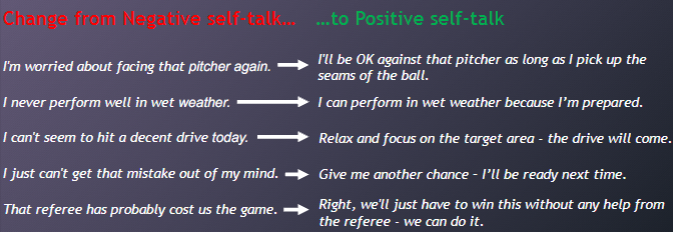
Communication we have with ourself (i.e., self-talk)
Inner dialog helps:
Shape how we act
Negative – carrying yourself a different way
Predict how we perform
Negative – predict poor outcomes
Competition – always positive or attempt to get the player in that headspace, also trying to get the motivated for that “1” opportunity.
Can also affect → Motivation & Behavior
Living in your head → turn negative = could turn into depression
3 → Nonverbal
Communication without words
Critical for:
Conveying and receiving information
Important component of interpersonal communication!!!
Meet in the middle to help in situations
Don’t have to kiss ass or be too shy to move up – have effective communication (positive body language)
Nonverbal Message Characteristics → on pic
PA – look good, feel good or doctor in shorts vs suit and tie
Voice Characteristics – public speaking – nervous people speak quicker compared to people who speak in public often
Gestures – hand motions, etc.
Posture – slouchy and down compared to someone who normally sits up
Body Position – open, square facing the person, then slowly stepping aside to open up their body to let the other person know that they need to leave or end the conversation. Same with slowly backing up.
Nonverbal Communication
→ The percentage of understanding that is gained from the spoken word is considered less than the meaning that people gain from listening to a person’s tone of voice or nonverbal communication!
Research Example:
→ Participants watching a tennis match saw only the players between points - NEVER saw the players actually hit a ball or play a point → around 75% of the time, the participant could pick out who was winning

Breakdowns in Communication
Sender Failure → poorly transmitted message (ambiguity, inconsistency, etc.)
Receiver Failure → Failure to listen (misinterpretation)
BREAKDOWNS CAN OCCUR AT ANY STAGE OF THE COMMUNICATION PROCESS!!!!!!
→ Examples:
Giving unsolicited advice or solutions
-> You have to let people struggle; let them learn (good communication)
Preaching or moralizing
Giving orders
Put downs
Critism
-> not always bad but some people cannot receive criticism well
-> Need a reason or context
Ridicule
Confrontation: Dealing with Breakdowns
Face-to-face discussing among people in conflict
Useful for:
1. Understanding issues clearly without stress, guilt, or inadequacy
2. Clearing the air, especially with minor conflicts
When to Confront:
In control
Thinking clearly
Striving to understand
How to Confront:
Be empathetic
Be cautious
Proceed gradually
Being Assertive
DESC Formula
Describe situation
Express feelings
Specifiy changes
Consequences that will occur
Assertive -> not all jerks -> direct
For performance reviews, individual development plans, etc.

Being Critical: The “Sandwich Approach”
→ Positive, sincere remark
→ Corrective information (future-oriented instruction)
→ Compliment and/or positive encouraging remark
Sending Messages Effectively
Clear and Consistent
Complete and specific
State feelings or thoughts
Seperate fact from opinion
Focus on one thing at a time
Be supportive
Reinforce with repetition
Look from feedback
Effective communication often makes the differences between success and failure!!!!!
examples → Fact based communication – yds per carry, less touches, no fumbles, etc. -> explaining why someone is starting (most athletes handle this a lot better compared to opinion-based communication)
Receiving Messages Effectively (EXAM)
Active Listening
Attending, asking questions, and paraphrasing
Requires you to hear someone
Supportive Listening
Communication that shows you are “with” the speaker and value his/her messages
Aware Listening
Realizing that people react differently to the way you communicate
Great out in public
Ex: conference – networking event with students and faculty (know when to put the phone down and engage – paid money to go and actually listen)
The ________ approach is best used when being critical of others.
a) hot dog
b) burrito
C) pita
D) sandwich
D
Non-verbal cues can be transmitted via:
a) Discussion of problems
b) The color of the eyes
c) Texting a friend
d) Body position
e) Calling someone to talk on the phone
D
________ makes up approximately 40% of communication in a typical day. Interestingly, there is little structured training on this form of communication.
a) Listening
b) Writing
c) Zooming
d) Reading
e) Speaking
A
Breakdowns in communication can occur at any stage within the communication process.
True or False?
TRUE!!!!
Supportive listening is defined as attending, asking questions, and paraphrasing during a conversation.
True or False?
False!
_______ is the face-to-face discussing among people in conflict.
a) Assertiveness
b) Critique
c) Negativity
d) Confrontation
D
Which of the following is NOT an element of the communication process?
a) Deciding to send a message
b) Paraphrasing a message
c) Interpreting a message
d) Encoding a message
e) Receiving a message
B
Intrapersonal communication involves two or more people in a meaningful exchange.
True or False?
False!
Self-talk, otherwise known as ______ communication, is the communication we have with ourselves.
a) telepathic
b) intrapersonal
c) interpersonal
d) individual
e) nonverbal
B
Communication can be used for which of the following (select ALL that apply)?
a) Persuading
b) Informing
c) Motivating
d) Evaluating
e) Problem solving
ALL OF THE ABOVE!!!!
Performance = Physical preparation + Technical Skill + Mental Readiness
Mental Training is the foundation of performance!

Psychological Skills Training (PST)
The systematic, consistent practice of mental or psycholigical skills for the purpose of:
Enhancing performance
Increasing enjoyment
Achieving greater sport/physical activity self-satisfaction
Requires practice (trainable, similar to physical skills)
PST Methods/Techniques
Behavioral modifications
Cognitive theory and therapy
Rational emotive therapy
Goal Setting
Attentional control
Progressive Muscle relaxation
Systematic desensitization
Imagery
Mental Toughness
Focusing → is key for mental toughness
Ex: Scared of going to the job market, but they weren’t doing their grad work; had to refocus the grad student
Rebounding from failure
Persisting in the face of adversity
Coping with pressure
Coping mechanisms is important to learn
Mental resilience
Military/navy seal training
ex: Navy seal training
“Four C” Model of Mental Toughness
Control
Handling many things at once
Remaining influential rather than controlled
[over your body and mind] - be logical when having an attack [to show yourself that you have control over the situation]
Commitment
Being deeply involved in pursuing goals despite difficulties
[you have to fully commit to the thing you are doing, perfecting your craft]
Challenge
Perceiving potential threats as opportunities for personal growth
Thriving in constantly changing environments
[making it challenging for people/being uncomfortable] - pushing yourself – exercise or nutrition-wise (you might be hungry but you’re making a change -> mental and physical)
Confidence
Maintaining self-belief in spite of setbacks
[small goals but they don’t just always fail]
example → (military for psychologist – out mental resistance training-> for both personnel and families)
Building Mental Toughness - NOT a quick fix!!! (exam - know which things fall into which category)
Deliberately taught examples:
Positive motivational practice environment
Intense competitive practices
Simulations (pressure)
Specific goals
Challenges, but they are difficult (SMART goals)
Instructional and supportive feedback
Confidence
Attentional control
NOT deliberately taught examples: (employers want this… testing resilience) - also depends on how you were raised
Sibling rivalries
Supportive parents
Letting the kids fail and fix it
Coach expectations
Have expectations - players know, and if they don’t do it, the coach will let you know
Motivational training environment
Teammate encouragement
Coping with failure
Why Psychological Skills are Neglected
Lack of knowledge (myths)
Psycholigcal skills are viewed as unchangeable
Lack of time
PST Myths
PST is for “problem” athletes only
PST is for “elite” athletes only
PST provides quick-fix solutions
PST is not useful
MUST BE realistic WITH expectations!!!
Research on PST Programs
85% of studies found positive performance effects (N=45)
Athletes from the Olympic level down report that mental training and discipline play a huge part in their success
No ready-made solutions on how coaches and sport psychologists can integrate and implement a PST program
PST Knowledge Base
Research on elite athletes shows that most successful athletes differ from less successful ones in the following ways:
Higher confidence
Greater self-regulation of arousal
Better communication
More positive thoughts and images
More determination or commitment
Three Phases of Mental Training
Educational Phase
Learn the importance of the skill and how the skill affects performance
Lectures and science and outcomes
Demos... rock the boat example – string in front of face example (imagining rocking a boat vs standing on the boat)
Acquisition Phase
Strategies and techniques to perform the skill
Learning how to do it and report it
Practice Phase
The repeated performance of a skill
Going home and trying it – checking in, etc.
Goals of a PST Program
Primary goal = self-regulation
Manage own behaviors that are directed towards specific goals
Having control over the situation and thoughts
Long-term goal = generalization
Maintain behavior change over time and across different situations
Apply these skills to your everyday life (past the athlete portion of their life)
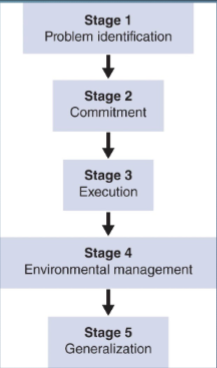
Kirschenbaum’s five-stage model of self-regulation
The person/athlete must:
recognize the problem
want to change
Example → free throws during critical moments
model is used for healthy self-regulation
1. HAVE TO KNOW HOW TO EXPLAIN
2. SMART goals – get them to commit to a change plan
NEEDS TO BE WILLING TO CHANGE
3. after the lectures and techniques -> doing it on their own
4. Home games could make the anxiety worse -> know what/more training on those days to help bring down the increased level of anxiety
WE WANT STABILITY IN THE ATHLETES! - want them performing at the same level all the time
5. out of practice – game passed – made a mistake (costed the game) - people are trolling you online – apply those techniques/skills to help – apply off the field
Apply to everyday life
When to Implement a PST Program
Best time = during the offseason or preseason
Make it part of practice–before the season–so it slowly becomes part of their day (built in, etc.)
Worst time = after starting the competitive season
Athletes are not going to be interested since they have other things to do, since most of this work is take-home work
Continue PST as long as the athlete competes
Become more focused and clear their head
Better performance due to being able to focus on form
Establish a mental training schedule
Evaluate the program: (select all that apply?)
Provide feedback
Verbal feedback – show statistics – scales to measure mindfulness – see if they are becoming more aware/descriptive with what you ask them to do (like drinking water, etc.)
Determine effectiveness
Ask them if they are feeling better or if they are recovering (can feel better than how you sound) - do you think you are becoming more mindful, etc.
Implement modifications
If you notice anything, you can adjust; for example, an athlete doing better in the mornings, shift everything to the morning.
(aka night or morning person) - can change the athlete to switch sides when you need to; it just takes time
Time Spent on PST Program
First Formal Exposure = 3-6 months
Ideally 3 months
New mental skills often need: (on average, 30 minutes)
15-30 minute intervals
3-5 times per week
Multiple skills – split up in brackets – 2 15-minute sessions or every other day for each skill, etc.
Integrate PST with psycial/technical skills training as soon as possible!!!
Who Should Administer PST Programs?
Ideally: planned, implemented, and supervised by a qualified CMPC
(not that feasible)
Coach’s responsibility to provide PST and to reinforce optimal psychologcal states
tell athlete’s its important
CMPCs can’t be at all practices/competitions
Ethical dilemma
How to Design A Mental Training Program
Assess the situation (e.g., need, politics, level of support, are you qualified?)
“Needs” assessment
Evaluate the person’s (athlete or coach) mental skills
Run a sociogram, find a hierarchy, skills that are good/weak (imagery) [quarterback visualizing the play]
Determine psychological skills to include
Groups or individual – understand the athletes’ mental profile
Establish a mental training schedule (e.g., time allocation)
Timer – to the minute – precision – how much time is wasted on other things vs. how much time you can use during the day
Time allocation schedule
Evaluate the program (e.g., feedback, effectiveness, modifications)
Monitoring from the side
Intial Assessment
Individual or group setting?
Questionnarie
Test of Performance Strategies (TOPS), etc.
Interview
Structured, Semi-structured, etc.
Make sure that they are the same throughout the whole team (allows for a direct comparison)
Semi-structured/unstructured -> good for check-ins, specialized clients, trust, struggling and immediately needs help
Profiling
Hierarchical, Circular, etc.
Profiling - getting certain ads, etc.
Observation
Performance evaluation rating
Practice/games, film
Questionnarie - Motivation and Goal Setting
Framework = SMART goals!!!!!

Interview
Best vs. Worst Performance:
Who were you competing against?
What was the setting?
How did you prepare for that competition?
What were you thinking or saying to yourself?
What did you feel like?
Prior to comp?
During comp?
Following the comp?
Compare Performance → Picture

Profiling
Circular Model
Hierarchial Model
Profile Graph
Important Factors in Facilitating the Development of Profiling
Recognize there are no “Right” or “Wrong” answers
There is no limit to the number of responses
Use the labels or descriptions given by the athlete
Do not spend too long deliberating or analyzing
Encourage the athlete to maximize the range of the scale
Profiling - Circular Model (EXAM)
Examples:
Determination
Stress Management
Goal-setting
Leadership
Communication
Imagery
Consistent Effort
Self-Talk
Self-Confidence
Mental Preparation
Concentration
etc.
KNOW THIS →
Most comprehensive, most changeable, etc.
Can change the characteristics on the model; not set in stone
Could ask a coach what is the top 10 attributes they want to see.
Can compare the athlete rating of themselves to the coach rating of the athlete.
Can do averages on the team vs. individuals

Profiling - Hierarchial Model
Listing the types of qualities in a top-down fashion and then rating the individual, team, or coach on those qualities
Rank order - highest to lowest (can compare athlete vs coach ratings)

Profiling - Profile Graph
Emotions During Performance
Comparing two groups
Light blue – high-performing athletes
Dark blue – low-performing athletes
(could also be the same athlete – pre- and post-season)

Evaluating of Programs Effectiveness
Provides consultants and coaches with information needed to modify their programs
Allows athletes and coaches to give their input
The only way to objectively judge whether the program achieved its goal!!!!
→ Get some data and see if things are actually working – if not, figure what to fix and change it!
Evaluating Effectives
Part 1
Determine strengths and weaknesses
Content of sessions
(make sure it's age-appropriate) - for the group
Delivery of materials
Examples:
Did you accomplish your objective? What techniques worked best? were athlete/coaches responsive?
Part 2
Total evaluation at the end (continuous process)
team and individual discussions
written evaluations by athletes and coaches
Sample athlete questions:
How often did you actually practice the skills? What exercises were most helpful? Any suggestions to make the program better in the future?
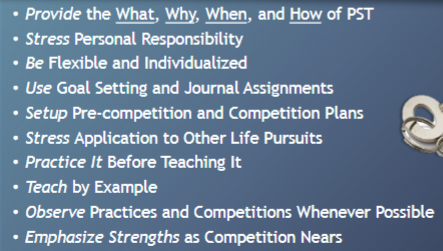
Keys for Success in Teaching Mental Skills
EXAM QUESTION → Which quarterback was discussed in Class?
→ Ryan Leaf!!!!!
Identify the commonly used psychological skills training methods and techniques (select ALL that apply).
a) Behavior modifications
b) Goal-setting
c) Imagery
d) Attentional control
e) Systematic desensitization
ALL OF THE ABOVE!
Mental toughness is comprised of which of the following (select ALL that apply)?
a) Clarity
b) Confidence
c) Commitment
d) Challenge
e) Control
B, C, D, E
This assessment is used when generating an athlete profile of dysfunctional and optimal emotions during performance.
a) Best vs. worst performance
b) Profile graph
c) Circular model
d) Hierarchical order
e) Test of Performance Strategies (TOPS)
B
Strategies and techniques to perform a mental skill are taught during this phase of a PST program.
a) Practice phase
b) Teaching phase
c) Acquisition phase
d) Educational phase
e) Performance phase
C
Mental resilience is another term used to describe mental toughness.
True or False?
True!
The long-term goal of a psychological skills training program is self-regulation.
True or False?
False!
___________ is the systematic, consistent practice of mental or psychological skills for the purpose of enhancing performance, increasing enjoyment, and achieving greater sport/physical activity self-satisfaction.
a) Mental rehearsal
b) Psychological skills training
c) Psychophysiology
d) Visualization
e) Sport psychology
B
Identify the psychological skills training (PST) myth.
a) PST enhances performance when practiced consistently
b) 85% of studies find increases in performance following PST programs
c) PST programs are only for elite athletes
d) PST programs can increase enjoyment and self-satisfaction
e) PST programs require realistic expectations
C
The best time to implement a psychological skills training program is during the offseason or preseason.
True or False?
True!
A sibling rivalry is an example of a deliberatively taught method to increase mental toughness.
True or False?
False!
Kerri Strug, 1996 Gymnastics
Never deviate from your routine
Positive self-talk, focus on breathing, etc.
-> watch her breath, watch the quiet eye – reduce sensory input - focus on that one spot, terms in the head to focus on what they are doing – helps with reaction
Arousal vs. Anxiety
Arousal
A blend of physiological and psychological activity in a person
The intensity dimension of motivation
NUMBER ONE REASON ATHLETES GO IN FOR HELP
SIMPLE!!!!!!
Anxiety
A negative emotional state
COMPLEX!!!!
nervousness, worry and apprehension
Cognitive vs. Somatic
Reaction to Stress
Types of Anxiety
State
one’s ever-changing mood
“Right now” feelings
influence VERY quickly
Trait
Part of the personality (stable)
A predisposition to perceive things as threatening or stressful
Stress
A substantial imbalance between demand (physical or psychological) placed on a performer and his/her response capability where failure to meet the demand has important consequences.
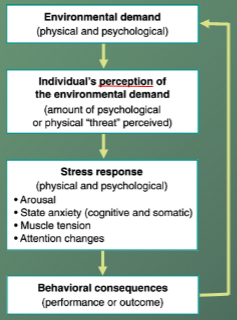
The Stress Process
Examples of environmental demands:
Execution of newly required skills
Pressure from parents/coaches
A sport psychologist focuses on the perception of the athlete; they can try to shit/change the athlete’s perception
If they can’t help with the perception, they focus on how they can modify the stress response
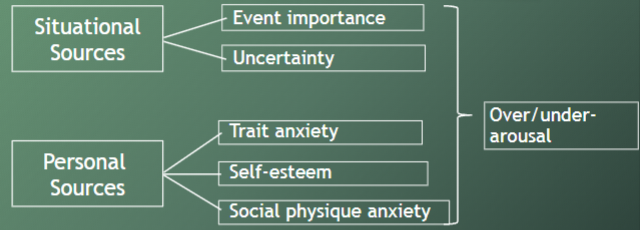
Sources of Stress and Anxiety in Sport
INTERACTIONAL APPROACH!!!! (internal and external)
Stress Evaluation Techniques
Stressor Library
Downscaling Your Life
Time Management “Am I having Fun Yet?” Example
Stressor Library/Journal - Stress Eval Techniques
Log how you respond in different situation (note what was going on and how you felt, give intensity rating, how did I cope/what I did, and then see what you could do to manage them in the moment.

Downscaling Your Life - Stress Eval Techniques
Being productive requires working within your limits
Asserting yourself
Learning how to say “No”
Setting boundaries
Communicating effectively to reduce stress
Time Management - Stress Eval Techniques
“To do” lists and scheduling
Prioritize tasks
Avoid procastination
Delegate work
Take breaks
Set deadlines
Stay organized

“Am I Having Fun Yet?” Example - Stress Eval Techniques
Example:
List your top 10 favorite activities and number how many times per week you do them.
What is the total # of times you have had fun this week?
Arousal-Performance Relationship
Proposed Explanations
Drive Theory
Inverted-U Hypothesis
Zones of Optimal Functioning
Multidimension Anxiety Theory
Catastrophe Model
Reversal Theory
Drive Theory
The higher the arousal/state anxiety, the better the performance is
Social Facilitation Theory
The presence of others…
…helps performance on well-learned or simple skills
…inhibits performance on unlearned or complex tasks
ex: coaching a youth baseball team. Audeince detrimental or facilitative?
detrimental - parents yelling “coaching” from the stands
facilitatiev - cheering their kid on

Inverted-U Hypothesis
50% is optimal for everyone
once the athlete gets to a certain level of arousal, theyll peak in performance. Then after, if they become more aroused, their performance will tank

Zones of Optimal Functioning
Different athletes have different levels/zones of optimal performance. No one athlete is the same
athlete a - needs a low state/low arousal level to succeed
athlete b - needs mod state anxiety/aroual to succeed
athelte c - needs high amounts of state anxiety/arousal to succeed

Multidimensional Anxiety Theory
Somatic - Physical
Cognitive - brain/mental
Left graph
Cognitive Anxiety (worry)
Negatively related to performance
Right gragh
Somatic Anxiety (physical)
Related to performance in an inverted-U pattern
examples
Cognitive Anxiety: Has a rigid, negative linear relationship with performance. As your mental worry goes up, your performance automatically goes down—no matter what your body is doing.
Somatic Anxiety: Has a classic Inverted-U relationship with performance. A little bit of physical arousal helps you warm up, but too much physical tension hurts performance.

Catastrophe Model
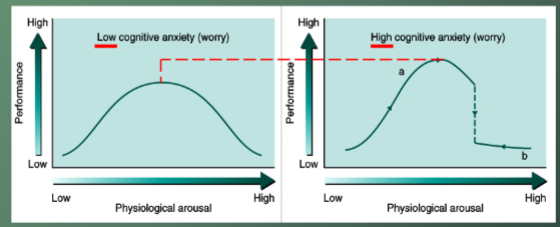
More likely to perform better at the high cognitive level but a higher chance of failing
Good for regular season, second graph – all or nothing game
Interaction A (Low Worry): If your cognitive anxiety is low, your somatic arousal behaves normally, following a safe, gentle Inverted-U curve.
Interaction B (High Worry): If your cognitive anxiety is high, your somatic arousal becomes highly dangerous. As your physical symptoms rise, they will push you to a peak, but crossing that threshold triggers an immediate, catastrophic crash in performance.
Reversal Theory
Arousal can affect performance depending on how individual interprets his or her arousal level
low arousal = relaxation or boredom?
high arousal = excitement or anxiety?
Arousal can be interpreted as pleasant (excitement) or unpleasant (anxiety)
Interpretation can change between positive and negative!!!!
graph
paratelic (playful) → welcomes arousal
Telic (serious) → avoids arousal

Facilitative vs. Debilitative Anxiety
How to increase control:
Enahnce confidence
Psychological skills training (e.g., imagery, self-talk, goal setting, etc)
Arousal and anxiety = excitement, NOT fear

Controlling Arousal
Be more aware during practice/competition
Self-monitoring
Right here, right now, “how am I feeling, thinking, and what is my body doing?”
Reflection
Once aware, employ arousal regulation strategies
Key: How individuals cope with anxiety is more important than how much anxiety they experience!
As long as you understand that it’s real and you can feel it. That's good. Don’t try to ignore it. You can have responses; it’s normal – deal with it healthily.
Anxiety Reduction Strategies
Somatic
Cognitive
Multimodal
1 → Somactic - Anxiety Reduction Strategies
Breath Control
One of the easiest, effective ways to control anxiety
Control breathing in stressful situations
When calm: breathing is smooth, deep, and rhythmical
When tense: breathing is short, shallow, and irregular
→ MOST CLASSIC = 6 breathes per minute
Progressive Muscle Relaxation
Feel tension in the muscles and then let go of it
Squeezing fingers into a fist for 30 seconds, then letting go, etc.
Assumptions: (picture)
1. It is possible to learn the difference between tension and relaxation
2. Tension and relaxation are mutually exclusive
3. Relaxation of the body through decreased muscle tension will decrease mental tension
Biofeedback:
Helps people become more aware of their physiological and autonomic nervous system reactions
Increases control of these responses

2 → Cognitive - Anxiety Reduction Strategies
Systematic Desensitization
People have learned through classical conditioning to experience anxiety in certain situations
Stressful situations are imagined
Relaxation is paired with the scene until anxiety is no longer produced
Relaxation Response (Mental Relaxation)
Teaches you to quiet the mind, concentrate, and reduce muscle tension by focusing attention on a mental device or thought
Requires:
quiet environment
comfortable position
mental device (focus on single thought/word)
Passive attitude (learn to let things happen)
Autogenic Training
a series of exercises designed to produce two physical sensations: warmth and heaviness
“Being in the Womb”
Attention is focused on the sensations you are trying to produce
Stages:
1. Heaviness in the extremities
2. Warmth in the extremities
3. Regulation of cardiac activity
4. Regulation of breathing
5. Abdominal warmth
6. Cooling of the forehead
3 → Multimodal - Anxiety Reduction Strategies
Can alleviate both cognitive and somatic anxiety
Provides systematic strategies for rehearsing coping skills under simulated stressful conditions
Help control dysfunctional emotions by:
Producing more adaptive appraisals
Improving coping responses
Increasing confidence in using skills to mamage sources of stress
3 → Multimodal cont.
Cognitive-Affective Stress Management
Teaches coping responses using relaxation and cognitive components to control emotional arousal
Phases:
1. Pretreatment assessment (assess skills and deficits)
2. Treatment rationale (help athlete understand stress response)
3. Skill acquisition (muscular relaxation, cognitive restructuring, and self-instruction)
4. Skill rehearsal (induce arousal, evaluate responses)
5. Post-training evaluation (self-monitoring, performance measures, and feedback)
Stress-Inoculation Training (SIT)
Teaches a person to cope with increasing amounts of stress, thereby enhancing the person’s immunity to stress
1. Prepare the stressor → “it’s going to be rought; keep your cool”
2. Control and handle the stressor → “Keep your cool; just stay focused on the task.”
3. Cope with feelings of being overwhelmed → “Stay focused; what’s next?”
4. Evaluate coping efforts → “You handled yourself well.”
Techniques include: imagery, role-playing, and homework assignments
Hypnosis (efficacy a major issue)
Alter state of consciousness that can be induced by a putting subject in a relaxed state while having them respond to suggestions form making alterations in perception, feelings, thoughts, or actions.
Stages:
1. Induction: relaxed and peaceful; place in trance via imagery or attentional focus
2. Hypnotic: physiological responses similar to relaxation; asked to respond to specific suggestions
3. Waking: Awake from trance through a suggestion of a signal
4. Posthypnotic: suggestions during hypnosis are thought to influence behaviors/feelings
Breath control is a common cognitive anxiety reduction strategy.
True or False?
False!
______ is the most important factor for determining whether anxiety will be facilitative or debilitative.
a) Awareness
b) Control
c) Confidence
d) Self-efficacy
e) Self-esteem
B
Which of the following statements about arousal are true (select ALL that apply)?
a) It's a blend of physiological and psychological activity.
b) It can be state dependent.
c) It is the intensity dimension of motivation.
d) It is a reaction to stress.
e) It always results in worry.
A, B, & C
How individuals cope with anxiety is more important than how much anxiety they experience.
True or False?
True!
The matching hypothesis suggests that the anxiety reduction strategy should match the specific problem an athlete is managing (e.g., physical tension should be treated with a somatic technique).
True or False?
True!
Identify the anxiety reduction strategy whereby athletes are shown their physiological and autonomic reactions so they can gain control of their responses.
a) progressive muscle relaxation
b) breath control
c) hypnosis
d) biofeedback
e) autogenic training
D
This stress evaluation technique typically involves creating "to do" lists, delegating tasks, setting deadlines, and staying organized.
a) "Am I having fun yet"
b) stressor library
c) systematic desensitization
d) time management
e) downscaling your life
D
The two sensations emphasized in autogenic training are:
a) warmth and lightness
b) cold and heaviness
c) cold and lightness
d) warmth and cold
e) warmth and heaviness
E
The premise of stress inoculation training is to __________.
a) stress an individual so they no longer display an unwanted behavior
b) expose individuals to large doses of stress to reduce reactivity
c) teach people that stress in in their mind
d) improve appraisal of stressful situations
e) gradually expose an individual to stress to increase immunity
E
Identify the emotion-focused coping strategies (select ALL that apply).
a) time management skills
b) goal-setting
c) meditation
d) reappraisal
e) self-talk
C & D