clinic theory - unit 5
 Call Kai
 Learn
 Practice Test
 Spaced Repetition
 Match
 Flashcards
 Knowt Play
1/136

Earn XP
Description and Tags
Topical and Local Anaesthetics
137 Terms
What is topical anesthesia?
Numbs nerve endings near the surface of the oral tissues.
What is local anesthesia?
Anesthetic injected near a nerve to numb an area.
What is electronic anesthesia?
Uses a low electrical current to block pain.
What is inhalation sedation?
Nitrous oxide and oxygen breathed through a nosepiece.
What is nitrous oxide used for?
Relaxation and pain relief during dental treatment.
What is Intravenous sedation (IV) sedation?
Conscious sedation where the client can maintain an open airway.
Who administers and monitors IV sedation?
A trained and certified professional.
What is general anesthesia?
Controlled unconsciousness with loss of protective reflexes.
What is topical anesthesia used for?
before injections
gag reflex
suture removal
dressings
scaling and probing
When should topical anesthetic NOT be applied?
On open lesions.
Why avoid topical anesthetic on open lesions?
It can be absorbed too much.
When should topical anesthetic be used with caution?
When the client has food allergies.
What is local anesthesia used for?
Temporary loss of feeling in a specific area.
When should local anesthetic with epinephrine be avoided?
heart disease
hypertension
hyperthyroid disease
When should amide local anesthetics be avoided?
In clients with impaired liver function.
What should be checked before giving local anesthetic?
The client's medical history.
What forms does topical anesthetic come in?
ointments
liquids
sprays
patches
How long should topical anesthetic stay on the injection site?
1–2 minutes.
What are liquid and spray topical anesthetics used for?
Larger areas; such as the back of the throat.
How quickly does a topical patch work?
About 10 seconds.
What can topical patches help with?
Injection discomfort and denture sores or ulcers.
What concentration can topical anesthetics have?
5–20% active ingredients.
What are the two chemical groups of anesthetics?
Esters and amides.
What are properties of esters?
alcohol-based
water-soluble
more likely to cause allergic reactions
How are esters metabolized?
In the plasma.
What is benzocaine?
A commonly used ester topical anesthetic.
What is lidocaine?
An amide anesthetic.
What is the advantage of lidocaine regarding allergies?
It has a low incidence of allergic reactions.
How is lidocaine metabolized?
In the liver.
How do topical anesthetics work?
Block nerve membranes from generating impulses.
Where do topical anesthetics act?
On nerve endings in the mucosal tissues.
What are possible adverse reactions to topical anesthetics?
Redness and swelling of the mucosa.
What can happen with a topical anesthetic overdose?
white, sloughing mucosa
seizures
CNS depression
increased blood pressure and pulse
What is the first step when applying topical anesthetic?
Find the injection site and dry it with 2×2 gauze.
What is the second step of applying topical anesthetic?
Place topical anesthetic on the injection site.
What is the third step of applying topical anesthetic?
Leave topical anesthetic on for 1–2 minutes.
How should spray topical anesthetic be applied?
Use short bursts directly on the area.
What should be done after using spray topical anesthetic?
Wait 1–2 minutes and rinse.
What is the trigeminal nerve (CN V)?
Main sensory nerve supplying the face and oral cavity.
What does the trigeminal nerve control?
Facial sensation and muscles used for chewing.
What are the three divisions of CN V?
ophthalmic
maxillary
mandibular
What does the maxillary division supply?
upper teeth
palate
sinuses
surrounding tissues
What does the mandibular division supply?
lower teeth
tongue
surrounding tissues
What are the five main branches of the maxillary division?
nasopalatine
greater palatine
anterior superior alveolar (ASA)
middle superior alveolar (MSA)
posterior superior alveolar (PSA)
What does the nasopalatine nerve supply?
Palate behind the upper front teeth.
What does the greater palatine nerve supply?
Mucoperiosteum of the posterior palate.
What does the anterior superior alveolar (ASA) nerve supply?
upper central incisors
lateral incisors
canines
What does the middle superior alveolar (MSA) nerve supply?
Upper premolars and mesiobuccal root of the first molar.
What does the posterior superior alveolar (PSA) nerve supply?
Other roots of the upper first molar and upper second and third molars.
What does the inferior alveolar nerve supply?
Lower teeth. Its branches supply other areas.
What does the mental nerve supply?
Chin and lower lip.
What does the incisive nerve supply?
Lower front teeth.
What does the lingual nerve supply?
Front two-thirds of the tongue and lingual tissues.
What does the buccal nerve supply?
Buccal tissues around the lower molars.
What are the two chemical groups of local anesthetics?
Amides and esters.
How are amide anesthetics metabolized?
In the liver.
How are ester anesthetics metabolized?
In the plasma.
What are the ingredients in a local anesthetic carpule?
anesthetic drug
sodium chloride
distilled water
What does sodium chloride do?
Makes the solution isotonic with body tissues.
What does distilled water do?
Adds volume to the solution.
What is the purpose of a vasoconstrictor?
Slows anesthetic absorption and increases its duration.
How do vasoconstrictors affect bleeding?
Decrease bleeding around the injection area.
What does a smaller ratio mean?
A higher percentage of vasoconstrictor.
When should vasoconstrictors be avoided?
unstable angina
recent heart attack
coronary bypass surgery
uncontrolled severe hypertension
What should be checked before choosing an anesthetic?
The client's medical history and the dentist's instructions.
What is duration?
Time from induction until the anesthetic effect wears off.
How long does short-acting anesthesia last?
60–180 minutes. (1-2hrs)
How long does intermediate-acting anesthesia last?
120–240 minutes. (2-4hrs)
How long does long-acting anesthesia last?
240–540 minutes. (4-9hrs)
How does local anesthesia wear off?
The bloodstream carries the anesthetic solution away.
What determines the type of injection used?
Location and nerve supply of the area.
What are the three main injection techniques?
infiltration
field block
nerve block
What is infiltration anesthesia?
Anesthetic injected directly into tissue near the treatment area.
Why is infiltration commonly used for upper teeth?
The upper jawbone is porous; so anesthetic spreads easily.
What is a field block?
Anesthetic injected near a larger nerve branch.
When is a field block commonly used?
When 1–3 teeth need to be numbed.
What is a nerve block?
Anesthetic placed near a main nerve to numb a larger area.
When is a nerve block commonly used?
When treating a larger area or quadrant.
Why are nerve blocks usually needed for lower teeth?
The lower jawbone is dense; so anesthetic does not spread easily.
What is a periodontal ligament injection?
Anesthetic injected under pressure into the periodontal ligament space.
Where is the nasopalatine nerve block given?
Anterior palate.
Where is the greater palatine nerve block given?
Posterior palate.
Where is the inferior alveolar nerve block given?
Near the inferior alveolar nerve; close to the mandibular foramen.
What does an inferior alveolar nerve block numb?
Half of the lower jaw; including teeth; tongue and lip.
Where is an incisive nerve block given?
At the mental foramen.
When is an incisive nerve block used?
When lower front teeth or premolars need anesthesia.
Where is a periodontal ligament injection placed?
Into the periodontal ligament space.
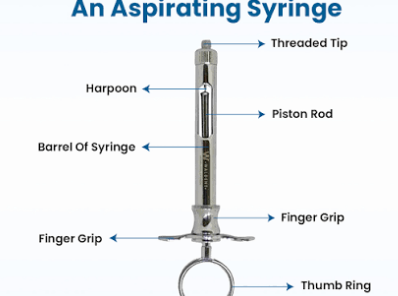
What does the harpoon do?
Hooks into the rubber stopper to allow aspiration.
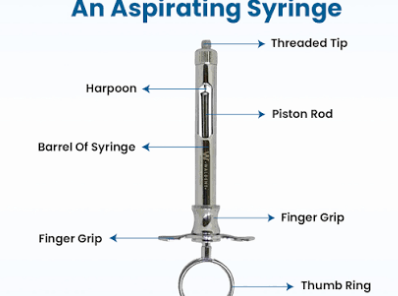
What does the piston rod do?
Pushes the stopper to release anesthetic.