physiology day 1 notes: body systems, homeostasis, feedback systems

0.0(0)
Studied by 0 people
call kaiCall Kai
Locked
learnLearn
examPractice Test
spaced repetitionSpaced Repetition
heart puzzleMatch
flashcardsFlashcards
GameKnowt Play
Card Sorting

1/61

encourage image

There's no tags or description

Looks like no tags are added yet.

Last updated 12:18 PM on 9/12/26
Name
Mastery
Learn
Test
Matching
Spaced
Call with Kai
Chat

No analytics yet

Send a link to your students to track their progress

62 Terms

1
New cards

anatomy and physiology

2 branches of science that deal with body parts & functions

2
New cards

anatomy

science of body structures & relationships

first studies done by dissection

imaging techniques

3
New cards

physiology

science of body functions

4
New cards

structure and function of body

structure of a part of the body allows performance of certain functions

ex: bone of skull provides protection for the brain, thin air sacs of lungs permit movement of oxygen

5
New cards

6 main levels of structural organization

chemical, cellular, tissue, organ, system, organismal

<p>chemical, cellular, tissue, organ, system, organismal </p>
6
New cards

chemical level

atoms: carbon, hydrogen, oxygen, nitrogen, phosphorus —> molecule DNA

7
New cards

cellular level

ex: smooth muscle cell

8
New cards

tissue level

ex: smooth muscle tissue

9
New cards

organ level

ex: stomach

10
New cards

system level

ex: digestive system

11
New cards

organismal system

ex: human

12
New cards

11 systems of human body

integumentary

skeletal

muscular

nervous

endocrine

cardiovascular

digestive

urinary

lymphatic

respiratory

reproductive

13
New cards

integumentary system components

skin and structures associated with it (hairs, nails, sweat glands, oil glands)

<p>skin and structures associated with it (hairs, nails, sweat glands, oil glands)</p>
14
New cards

integumentary system functions

protects body

regulates body temperature

eliminates waste

helps makes vitamin D

detects sensations such as touch, pain, warmth, & cold

15
New cards

skeletal system components

bones and joins of the body and their associated cartilages

<p>bones and joins of the body and their associated cartilages </p>
16
New cards

skeletal system functions

 supports & protects body

provides a surface areas for muscle attachments

aids body movements

houses cells that produce blood cells

store minerals and lipids (fats)

17
New cards

muscular system components

muscles composed of skeletal muscle tissue (which is usually attached to bones)

<p>muscles composed of skeletal muscle tissue (which is usually attached to bones)</p>
18
New cards

muscular system functions

produces body movements (ex: walking)

stabilizes body position (posture)

generates heat

19
New cards

nervous system components

brain, spinal cord, nerves, & special sense organs (ex: eyes, ears)

<p>brain, spinal cord, nerves, &amp; special sense organs (ex: eyes, ears)</p>
20
New cards

nervous system functions

generates action potentials (nerves impulses) to regulate boy activities

detects changes in the body’s internal and external environments

interprets changes and responses by causing muscular contractions or glandular secretions

electrical communication

21
New cards

endocrine system components

hormone-producing glands (pineal gland, hypothalamus, pituitary gland, thymus, thyroid gland, parathyroid glands, pancreas, ovaries, and testes) and hormone-producing cells in several other organs 

<p><span style="background-color: transparent;">hormone-producing glands (pineal gland, hypothalamus, pituitary gland, thymus, thyroid gland, parathyroid glands, pancreas, ovaries, and testes) and hormone-producing cells in several other organs&nbsp;</span></p>
22
New cards

endocrine system functions

regulates body activities by releasing hormones, which are chemical messengers transported in blood from an endocrine gland or tissue to a target organ, hormones transported through blood & specific receptors for each chemical

23
New cards

cardiovascular system components

blood, heart, & blood vessels

<p>blood, heart, &amp; blood vessels </p>
24
New cards

cardiovascular system functions

heart pumps blood through blood vessels

blood carries oxygen and nutrients to cells and CO2 and wastes away from cells

helps regulate acid-base balance, temperature, and water content of body fluids

blood components help defend against disease & repair damaged blood vessels

25
New cards

digestive system components

organs of GI tract, a long tube that includes the mouthn, pharynx (throat), esophagus, stomach, small & large intestines, and anus

accessory organs that assist in digestive processes such as the salivary glands, liver, gallbladder, & pancreas

26
New cards

digestive system functions

achieves physical & chemical breakdown of food

absorbs nutrients

eliminates solid wastes

<p><span style="background-color: transparent;">achieves physical &amp; chemical breakdown of food</span></p><p><span style="background-color: transparent;">absorbs nutrients</span></p><p><span style="background-color: transparent;">eliminates solid wastes</span></p>
27
New cards

urinary system components

kidneys, ureters, urinary bladder, & uretha

<p>kidneys, ureters, urinary bladder, &amp; uretha </p>
28
New cards

urinary system functions

produces, stores, & eliminates urine

eliminates wastes & regulates volume and chemical composition of blood

helps maintain the acid-base balance of body fluids

maintains body’s mineral balance

29
New cards

lymphatic system functions

lymphatic fluid (lymph) and vessels; spleen, thymus, lymph nodes, & tonsils 

30
New cards

lymphatic system components

returns proteins and fluid to blood

carries lipids from gastrointestinal tract to blood

includes structures where lymphocytes that protect against disease-causing microbes mature and proliferate 

<p><span style="background-color: transparent;">returns proteins and fluid to blood</span></p><p><span style="background-color: transparent;">carries lipids from gastrointestinal tract to blood</span></p><p><span style="background-color: transparent;">includes structures where lymphocytes that protect against disease-causing microbes mature and proliferate&nbsp;</span></p>
31
New cards

respiratory system components

lungs & air passageways such as the pharynx (throat), larynx (voice box), trachea (windpipe), and bronchial tubes leading into & out of lungs

<p>lungs &amp; air passageways such as the pharynx (throat), larynx (voice box), trachea (windpipe), and bronchial tubes leading into &amp; out of lungs </p>
32
New cards

reproductive system components

gonads produce gametes (sperm/oocytes) that unite to form a new organism

release hormones that regulate reproduction and other body processes

associated organ transport and store gametes

33
New cards

external environment

surrounding the body

34
New cards

internal environment

the environment in which the cells of the body actually live

35
New cards

types of body fluids

intracellular (ICF), extracellular (ECF)

36
New cards

types of ECFs

interstitial fluid, plasma

37
New cards

interstitial fluid (IF)

fluid outside the cells

38
New cards

plasma

fluid portion of blood

39
New cards

body’s internal environment

80% made of water

body cells in contact with water environment

internal environments are the fluid around the cells

<p>80% made of water</p><p>body cells in contact with water environment</p><p>internal environments are the fluid around the cells </p>
40
New cards

materials that exchange between blood and tissue

nutrients, gases, wastes

41
New cards

process of material exchange

Blood —> External Fluid —> Tissue Cells

  1. blood travels through tiny blood vessels (capillaries)

  2. the plasma (liquid part of the blood) carries nutrients, oxygen, & other materials

  3. the fluid surrounding the tissue cells is called external fluid

  4. materials pass through this fluid to get between the blood & cells

  5. nutrients & oxygen move from the blood —> external fluid —> tissue cells

  6. cells use these materials to function

  7. tissue cells produce waste (ex: CO2)

  8. waste moves from the tissue cells —> external fluid —> to blood

  9. blood carries the waste away so the body can get rid of it


<p><span style="background-color: transparent;">Blood —&gt; External Fluid —&gt; Tissue Cells </span></p><ol><li><p>blood travels through tiny blood vessels (capillaries) </p></li><li><p>the plasma (liquid part of the blood) carries nutrients, oxygen, &amp; other materials </p></li><li><p>the fluid surrounding the tissue cells is called external fluid </p></li><li><p>materials pass through this fluid to get between the blood &amp; cells </p></li><li><p>nutrients &amp; oxygen move from the blood —&gt; external fluid —&gt; tissue cells </p></li><li><p>cells use these materials to function </p></li><li><p>tissue cells produce waste (ex: CO2)</p></li><li><p>waste moves from the tissue cells —&gt; external fluid —&gt; to blood </p></li><li><p>blood carries the waste away so the body can get rid of it </p></li></ol><p></p>
42
New cards

homeostasis

maintenance of a stable, relatively constant, internal environment (an internal equilibrium)

43
New cards

controlled conditions in an internal environment

temperature, pH, concentration of glucose, ions, gases

44
New cards

homeostatic range

pre-set limits of these controlled variables

45
New cards

dynamic condition

always responding to environmental conditions

46
New cards

every cell/organ/system in the body contributes to homeostasis

knowt flashcard image
47
New cards

homeostasis as a dynamic condition (external & internal)

external: blood temperature

  • too hot: sweat

  • too cold: shiver

internal: concentration of blood glucose

too high: release insulin

too low: release glucagon


48
New cards

3 components of homeostatic control feedback system

receptor: sensory neuron

control center: brain

effector: muscle gland

49
New cards

receptor

body structure that monitors changes in a controlled condition, sends an input to the control center (brain)

50
New cards

types of receptors

thermoreceptors (in the skin): for temperature

baroreceptors (in blood vessel wall): for pressure

chemoreceptors (in blood vessel wall): for different levels of atoms/chemicals

osmoreceptors (in hypothalamus): detects changes in osmosis/water diffusion


51
New cards

control center

brain

52
New cards

brain function in feedback systems

sets range of values that need to be maintained (depends on DNA)

evaluates input received from receptors & generates output command

output command is mediated by nerve impulses and/or hormones

53
New cards

effector

muscle gland

54
New cards

muscle gland role in feedback systems

receives output from control center

produces a response/effect that changes the controlled condition

55
New cards

negative feedback systems

opposes a change in the original stimulus

returns to homeostatic conditions

body typically operates on negative feedback system

ex: blood sugar regulation, blood pressure regulation

56
New cards

positive feedback loop

amplifies original stimulus

ex: cut, needs to start sending signals for blood clotting, increases blood clotting to stop bleeding

ex: childbirth, contractions → more oxytocin → stronger contractions → more oxytocin (oxytocin causes uterus to contract)

57
New cards

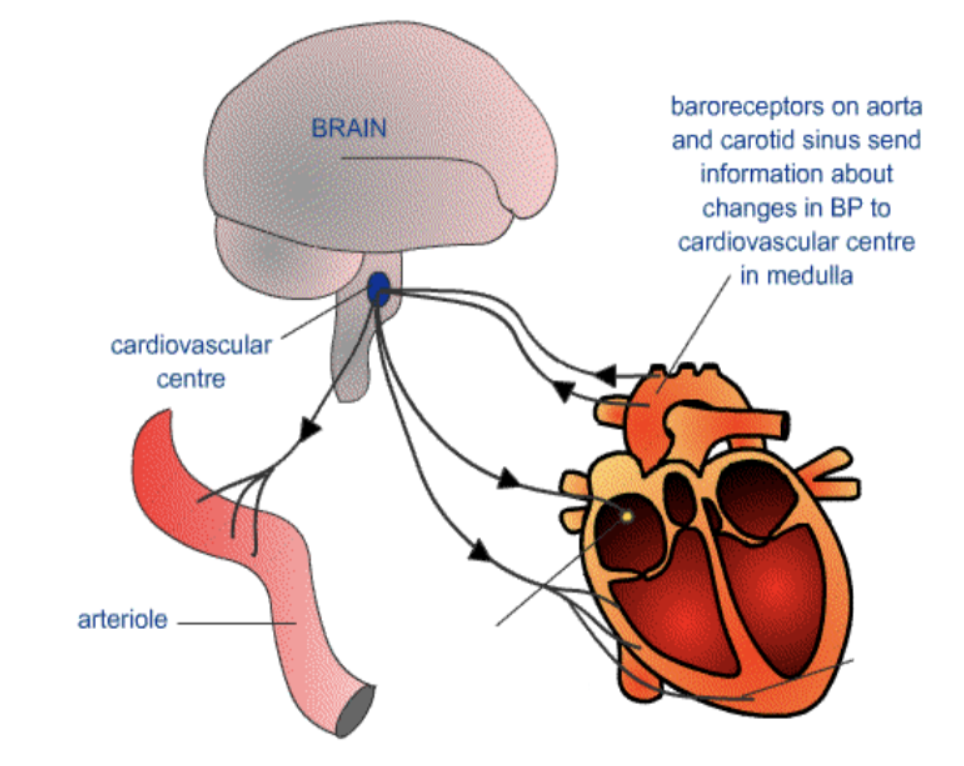
baroreceptor reflex

regulation of blood pressure, negative feedback loop

58
New cards

blood pressure

force exerted by blood as it presses against the walls of the blood vessels

59
New cards

receptors in regulation of blood pressure

baroreceptors (pressure sensitive)

60
New cards

control center in regulation of blood pressure

cardiovascular (CV) system of the brain

61
New cards

effectors in regulation of blood pressure

heart & blood vessels

62
New cards
<p>baroreceptor reflex process in regulation of blood pressure </p>

baroreceptor reflex process in regulation of blood pressure

stimulus causes a decrease in BP

baroreceptors - detect drop in BP

sends a message (neurons) to the control center (CV center of brain)

sends a message (neurons) to the effectors

heart = increases force & rate of heart contraction

blood vessels = vasoconstriction (get smaller, reduce blood flow, and increase pressure)

result: BP increased to homeostatic levels

  • process also works to decrease BP


<p>stimulus causes a decrease in BP</p><p>baroreceptors - detect drop in BP</p><p>sends a message (neurons) to the control center (CV center of brain) </p><p>sends a message (neurons) to the effectors </p><p>heart = increases force &amp; rate of heart contraction</p><p>blood vessels = vasoconstriction (get smaller, reduce blood flow, and increase pressure)</p><p>result: BP increased to homeostatic levels </p><ul><li><p>process also works to decrease BP </p></li></ul><p></p>