L4 Ecological Features

0.0(0)
Studied by 0 people
call kaiCall Kai
learnLearn
examPractice Test
spaced repetitionSpaced Repetition
heart puzzleMatch
flashcardsFlashcards
GameKnowt Play
Card Sorting

1/18

encourage image

There's no tags or description

Looks like no tags are added yet.

19 Terms

1
New cards

What is a Lotic Ecosystem

running water → rivers, streams, springs (e.g. Congo River)


Chracteristics

  • source - linked to catchments

  • flow in continuous and unidirectional

    • direct → often fast (10 to >100 cm sec-1 )

    • indirectly → current velocity or flow rates inluences substrate

  • stability of materials

  • types of organisms and why

  • impact of physicochemical variables

    • temp, light, nutrients, substrate, depth


2
New cards

Describe the gradients in streams and rivers: erosion systems

• Light: Photic zone, throughout water column

• Zone difference: Distinction between littoral and central zone is little

• Allochthonous > autochthonous input

• Biotic community: epibenthic algae (as high flow prevents rooted macrophytes and phytoplankton); benthic macroinvertebrates; fish

• Sediment: course so oxic and hence aerobic community

• Habitats: riffles and pool


<p><strong>• Light</strong>: <strong>Photic zone,</strong> throughout water column</p><p><strong>• Zone difference</strong>: Distinction between littoral and central zone is little</p><p>• Allochthonous &gt; autochthonous input</p><p><strong>• Biotic community</strong>: epibenthic algae (as high flow prevents rooted macrophytes and phytoplankton); benthic macroinvertebrates; fish</p><p><strong>• Sediment:</strong> course so oxic and hence aerobic community</p><p>• Habitats: riffles and pool</p><p></p><p></p>
3
New cards

Describe the gradients in streams and rivers: depositional systems

  • flow = low and unable to transfer materials

  • light: photic zone throughout water column

  • distinction between littoral and central zone

    • pronounced, emergent macrophytes in littoral zone

  • temperature: increases with removal of riparian corridor

  • organic matter: allonchthonous input is <= autochthonous

  • benthic community

    • rooted marophytes

    • neuston community at littoral zone

  • sediment: fine

    • anoxic conditions and anaerobic heterophs > few mm
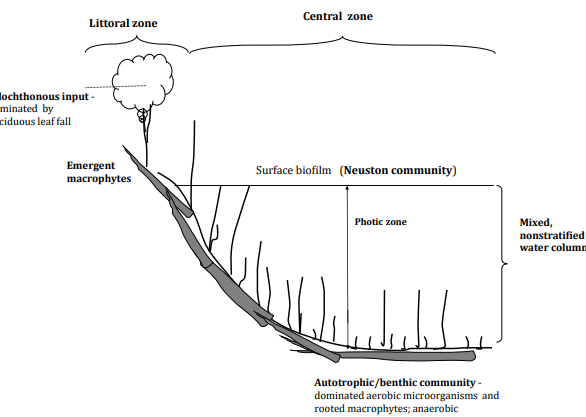

<ul><li><p><strong>flow</strong> = low and unable to transfer materials</p></li><li><p><strong>light: photic zone</strong> throughout water column</p></li><li><p>distinction between littoral and central zone</p><ul><li><p><strong>pronounced</strong>, emergent macrophytes in littoral zone</p></li></ul></li><li><p><strong>temperature</strong>: increases with removal of riparian corridor</p></li><li><p><strong>organic matter:</strong> allonchthonous input is <strong>&lt;=</strong> autochthonous </p></li><li><p><strong>benthic community</strong></p><ul><li><p>rooted marophytes</p></li><li><p>neuston community at littoral zone</p></li></ul></li><li><p><strong>sediment</strong>: fine</p><ul><li><p>anoxic conditions and anaerobic heterophs &gt; few mm</p></li></ul></li></ul><p></p>
4
New cards
<p>What is the diversity of macroinvertebrates in<strong> headwaters</strong></p>

What is the diversity of macroinvertebrates in headwaters

more organisms adapted to high flow and high oxygen levels

erosional systems

5
New cards
<p>What is the diversity of macoinvertebrates in <strong>river mouths</strong> like</p>

What is the diversity of macoinvertebrates in river mouths like

organisms adapted to low flow and low oxygen levels

depositional systems

6
New cards

What are physical conditions biological communities have to adapt to

  • substrate type

  • velocity

  • strategies to avoid predators

  • body shapes


7
New cards

What are chemical conditions biological communities have to adapt to

  • dissolved ions → calcium, magnesium, oxygen

  • nutrient availability


8
New cards

Physical adaption to substrate type

coarse substrate (large particles = boulders and stones)

  • attract assemblages of predators

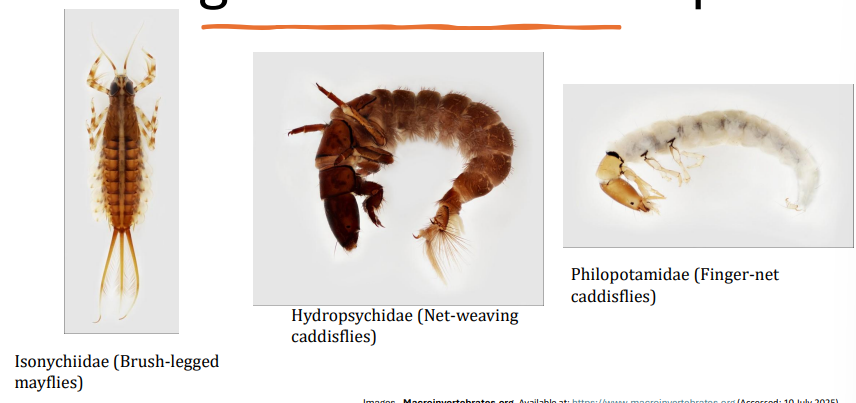
    • Plecoptera → stone flies

    • Trichoptera

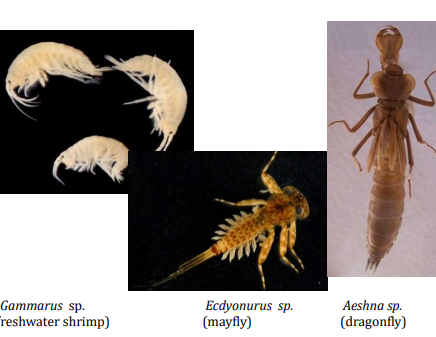
  • attract glazing Ephemeroptera (e.g. mayflies)


<p>coarse substrate (large particles = boulders and stones)</p><ul><li><p>attract assemblages of predators</p><ul><li><p>Plecoptera → stone flies</p></li><li><p>Trichoptera </p></li></ul></li><li><p>attract glazing Ephemeroptera (e.g. mayflies)</p></li></ul><p></p>
9
New cards

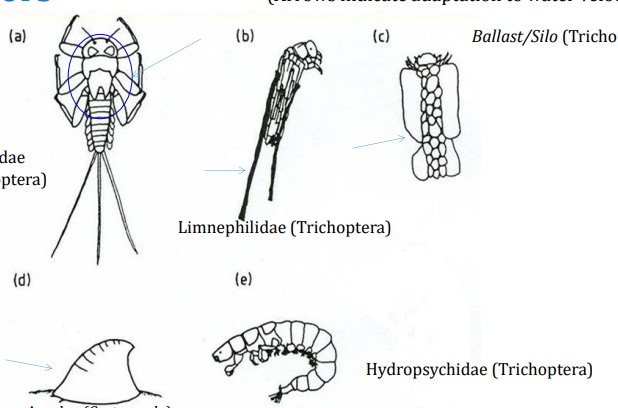
Physical adaptions to current velocity and protection from predators

  • flattened body

  • orientation to flow → ‘ruddder’ stability against flow

  • silos

    • distinct food chains with little mixing

  • streamlining

  • hooks on limbs/ other areas on body

    • acts as an anchor


<ul><li><p>flattened body</p></li><li><p>orientation to flow → ‘ruddder’ stability against flow</p></li><li><p>silos</p><ul><li><p>distinct food chains with little mixing</p></li></ul></li><li><p>streamlining </p></li><li><p>hooks on limbs/ other areas on body</p><ul><li><p>acts as an anchor</p></li></ul></li></ul><p></p>
10
New cards

Adaption to chemical conditions such as calcium and magnesium in hard water

hard water communities

  • Crustaceans → amphipods, isopods and crayfish

  • molluscs → snails, bivalves


they need Ca and Mg … hard>soft water


<p>hard water communities </p><ul><li><p>Crustaceans → amphipods, isopods and crayfish</p></li><li><p>molluscs → snails, bivalves</p></li></ul><p></p><p>they need Ca and Mg … hard&gt;soft water</p><p></p>
11
New cards

What do macroinvertebrates eat → FFGs

  • prey → other mac.inv

  • Course Pariculate Organic matter (CPOM)

    • >1mm → leaves, twigs, barks, wood, plants, macrophytes (big plants)

  • Fine Particulate Organic Matter (FPOM)

    • <1mm → CPOM broken down particles

  • Periphyton → algae and microbes on rocks and detritus

  • Detritus → dead organic matter and microbia


12
New cards

How are FFGs for macroinvertebrates categorised

  • morphology → mouthpart structure

  • feeding behavious (shredder, scrapers, grazers, collectors, predators)


13
New cards
<p>What are the adaptions and ecological role of<strong> shredders (herbivores)</strong></p>

What are the adaptions and ecological role of shredders (herbivores)

adaption → chewing and gripping mouthparts to shred plant material from CPOM into FPOM

live in plant beds in streams/lakes and contributes to FPOM production (herbivorous niche)

help drive decomposition and nutrinent cycligng

14
New cards

What are the adaptions and ecological role of Gathering Collectors

location → at sediment

  • pools, slow-flowing depositional areas


eat → settled FPOM from sediment (sweep/scoop material)


roles

  • recycle fine organic detritus

  • stimulate microbial activity

  • support benthic food webs


<p>location → at sediment</p><ul><li><p>pools, slow-flowing depositional areas</p></li></ul><p></p><p>eat → settled FPOM from sediment (sweep/scoop material)</p><p></p><p>roles</p><ul><li><p>recycle fine organic detritus</p></li><li><p>stimulate microbial activity </p></li><li><p>support benthic food webs</p></li></ul><p></p>
15
New cards

What are the adaptions and ecological role of Filtering Collectors (suspension feeders)

location → in flowing water

fast flowing riffles, runs or lake zones → strong wave action


eat → trap FPOM suspened in water


roles

  • filter partiles in water

  • maintain water clarity

  • contribute to nutrient cycling


<p>location → in flowing water</p><p>fast flowing riffles, runs or lake zones → strong wave action</p><p></p><p>eat → trap FPOM suspened in water</p><p></p><p>roles</p><ul><li><p>filter partiles in water</p></li><li><p>maintain water clarity</p></li><li><p>contribute to nutrient cycling</p></li></ul><p></p>
16
New cards

What are the adaptions and ecological role of Scrapers (grazers)

location → rifle, runs, lake shorelines, aquatic plant beds

wherever periphyton (algae, cyanobacteria, etc) live


eat → dependent on autochtonous production

  • periphyon algae and microbes on rocks (biofilm) and other surfaces

  • live plant tissue


adaption → rasping mouthpart

  • scraoe biofilm + inject FPOM


roles

  • line producers (algae auto.) to detritus-based food webs

  • regulate algal growth

  • contribute to enger flow through grazing


<p>location → rifle, runs, lake shorelines, aquatic plant beds</p><p>wherever periphyton (algae, cyanobacteria, etc) live</p><p></p><p>eat → dependent on autochtonous production</p><ul><li><p>periphyon algae and microbes on rocks (biofilm) and other surfaces</p></li><li><p>live plant tissue</p></li></ul><p></p><p>adaption → rasping mouthpart</p><ul><li><p>scraoe biofilm + inject FPOM</p></li></ul><p></p><p>roles </p><ul><li><p>line producers (algae auto.) to detritus-based food webs</p></li><li><p>regulate algal growth</p></li><li><p>contribute to enger flow through grazing</p></li></ul><p></p>
17
New cards

What are the adaptions and ecological role of Predators

location → all freshwater env where prey is sufficient


eat → living animal tissues


adaptions

  • grasping limbs

  • large eyes for hunting

  • fast legs to aid prey catching

  • flattened limbs (swimming/ ambushing)


roles

  • maintain trophic structure and ecologica balance

  • infuence prey diversity and community dynamics

  • regulate other inv. populations


<p>location → all freshwater env where prey is sufficient</p><p></p><p>eat → living animal tissues</p><p></p><p>adaptions</p><ul><li><p>grasping limbs</p></li><li><p>large eyes for hunting </p></li><li><p>fast legs to aid prey catching</p></li><li><p>flattened limbs (swimming/ ambushing)</p></li></ul><p></p><p>roles</p><ul><li><p>maintain trophic structure and ecologica balance</p></li><li><p>infuence prey diversity and community dynamics</p></li><li><p>regulate other inv. populations</p></li></ul><p></p>
18
New cards

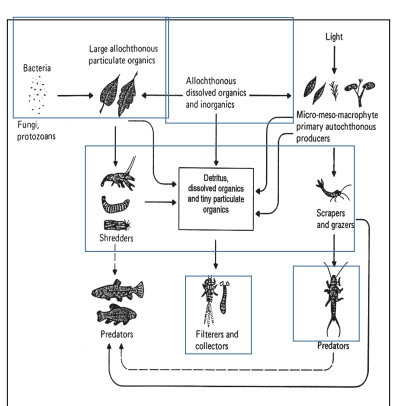
desribe energy flow in flowing waters due to FFGs

CPOM (allochthonous particles) provide nutrients

  • broken down by shredders

  • colonised by bacteria and fungi

  • detritus from dead macrophytes, algae, small protozoans

FPOM available to:

  • filters (water column)

  • collectors (sediment)

Scrapes and grazers

  • eat benthic algae (on substrate and macrophytes (epiphytic algae))

<p><strong>CPOM (allochthonous particles) </strong>provide nutrients</p><ul><li><p>broken down by shredders</p></li><li><p>colonised by bacteria and fungi</p></li><li><p>detritus from dead macrophytes, algae, small protozoans</p></li></ul><p><strong>FPOM </strong>available to:</p><ul><li><p>filters (water column)</p></li><li><p>collectors (sediment)</p></li></ul><p><strong>Scrapes and grazers </strong></p><ul><li><p>eat benthic algae (on substrate and macrophytes (epiphytic algae))</p></li></ul><p></p>
19
New cards

What is the River Continuum Concept

energy transfer occurs throughou river column with CPOM at source and FPOM throughout channel

<p>energy transfer occurs throughou river column with CPOM at source and FPOM throughout channel</p>