Balance Wk3 CBL Hypertension
 Call Kai
 Learn
Learn Practice Test
 Spaced Repetition
 Match
Match Flashcards
 Knowt Play
1/112

There's no tags or description
Looks like no tags are added yet.
Name | Mastery | Learn | Test | Matching | Spaced | Call with Kai | Chat |
|---|
No analytics yet
Send a link to your students to track their progress
113 Terms
What is essential hypertension?
Answer: Chronic hypertension without a single identifiable secondary cause.
Extra Information:
Essential hypertension is also called primary hypertension.
It results from interacting genetic, environmental, renal, neural, hormonal, vascular, and immune mechanisms.
What equation provides the basic hemodynamic framework for essential hypertension?
Answer: Blood pressure = cardiac output × total peripheral resistance.
Extra Information:
Sustained hypertension requires increased cardiac output, increased total peripheral resistance, or both.
Why are the kidneys especially important for long-term blood-pressure regulation?
Answer: They regulate long-term sodium and extracellular-fluid balance.
Extra Information:
- Renal sodium handling determines how much arterial pressure is required to maintain sodium balance.
What is pressure natriuresis?
Answer: Increased arterial pressure causes increased renal sodium excretion.
Extra Information:
- Water follows sodium, decreasing extracellular-fluid volume.
- The resulting fall in venous return and cardiac output helps lower blood pressure.
How is pressure natriuresis altered in many forms of essential hypertension?
Answer: The pressure-natriuresis relationship is shifted to a higher arterial pressure.
Extra Information:
- The kidneys require a higher BP to excrete enough sodium to maintain sodium balance.
Trace how impaired renal sodium excretion can raise blood pressure.
Answer: Na⁺ retention → H₂O retention → ↑ ECF volume → ↑ blood volume → ↑ Pms → ↑ venous return → ↑ preload → ↑ cardiac output → ↑ BP.
Extra Information:
- This connects renal sodium handling directly to the Guyton venous-return framework.
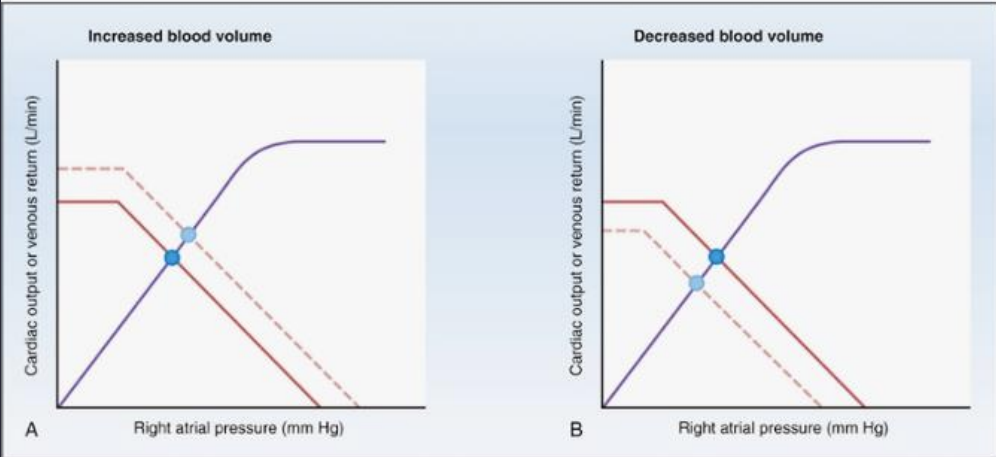
How does increased blood volume affect the venous-return curve?
Answer: It increases mean systemic filling pressure and shifts the venous-return curve right and upward.
Extra Information:
Venous return and cardiac output consequently increase.
Why can hypertension persist even if cardiac output later becomes relatively normal?
Answer: Vascular autoregulation and remodeling can increase total peripheral resistance.
Extra Information:
- Long-term hypertension therefore may become increasingly resistance-dependent.
What type of genetic disorder is essential hypertension?
Answer: It is polygenic.
Extra Information:
- Many genetic variants each contribute relatively small effects.
- There is not one single hypertension gene responsible for most essential hypertension.
What physiologic systems can genetic variation alter in essential hypertension?
Answer: Renal sodium transport, sympathetic activity, RAAS, vascular tone, and endothelial function.
Extra Information:
- Genetic susceptibility interacts strongly with environmental exposures.
How does β₁ sympathetic stimulation of the heart increase blood pressure?
Answer: It increases heart rate and contractility, increasing cardiac output.
Extra Information:
- Increased cardiac output raises BP when other variables are unchanged.
How does α₁ stimulation of arterioles increase blood pressure?
Answer: It causes arteriolar vasoconstriction and increases total peripheral resistance.
Extra Information:
- This acts on the resistance side of BP = CO × TPR.
How does α₁ stimulation of veins increase blood pressure?
Answer: Venoconstriction decreases venous capacitance and increases mean systemic filling pressure and venous return.
Extra Information:
- Increased venous return increases preload and can increase cardiac output.
How does sympathetic stimulation activate RAAS?
Answer: β₁ stimulation of juxtaglomerular cells increases renin release.
Extra Information:
- Renal sympathetic nerves also promote renal vasoconstriction and tubular sodium reabsorption.
How can excessive angiotensin II contribute to essential hypertension?
Answer: AT₁ activation causes arteriolar vasoconstriction and increases total peripheral resistance.
Extra Information:
- Angiotensin II also promotes sympathetic activity and vascular remodeling.
How does excessive RAAS activity increase blood volume?
Answer: Angiotensin II increases aldosterone, increasing distal Na⁺ reabsorption and water retention.
Extra Information:
- Increased blood volume can increase cardiac output.
Does essential hypertension always cause a high plasma renin level?
Answer: No.
Extra Information:
- Essential hypertension is heterogeneous.
- Salt-sensitive and volume-dependent hypertension can occur with suppressed circulating renin.
How can obesity contribute to essential hypertension?
Answer: Through sympathetic activation, altered renal Na⁺ handling, RAAS or mineralocorticoid activity, and metabolic and vascular abnormalities.
Extra Information:
- Obesity-associated sodium retention can shift pressure natriuresis toward higher pressures.
How can obstructive sleep apnea contribute to hypertension?
Answer: It can increase sympathetic activation.
Extra Information:
- Obstructive sleep apnea is frequently associated with obesity.
How does endothelial dysfunction increase blood pressure?
Answer: Reduced nitric-oxide bioavailability decreases vasodilation and increases relative vasoconstrictor tone.
Extra Information:
- The result is increased systemic vascular resistance.
- Oxidative stress and inflammation can worsen endothelial dysfunction.
How does vascular remodeling contribute to hypertension?
Answer: Arteriolar wall thickening and luminal narrowing increase vascular resistance.
Extra Information:
- Chronic pressure and neurohormonal signaling promote remodeling.
What relationship explains why small decreases in arteriolar radius greatly increase resistance?
Answer: Resistance is proportional to 1 divided by radius to the fourth power.
Extra Information:
- Small reductions in radius can therefore markedly increase resistance.
How does large-artery stiffness affect blood pressure?
Answer: It particularly increases systolic blood pressure and pulse pressure.
Extra Information:
- Arterial stiffness becomes increasingly important with aging.
What major lifestyle factors contribute to essential hypertension?
Answer: High sodium intake, excess body weight, physical inactivity, excessive alcohol, and unhealthy dietary patterns.
Extra Information:
- These factors interact with underlying genetic and physiologic susceptibility.
Trace the integrated pathogenesis of essential hypertension.
Answer: Genetic and environmental factors → renal, sympathetic, RAAS, and vascular abnormalities → volume retention and vasoconstriction → ↑ CO and/or TPR → hypertension.
Extra Information:
- Vascular remodeling and renal adaptation then help sustain hypertension.
What is uncontrolled hypertension?
Answer: Blood pressure that remains above the patient's treatment goal.
Extra Information:
- Uncontrolled hypertension does not automatically mean resistant hypertension.
What is apparent resistant hypertension?
Answer: Hypertension that appears resistant before nonadherence and white-coat effect have been adequately excluded.
Extra Information:
- True resistance cannot be established until pseudoresistance is addressed.
What is resistant hypertension?
Answer: BP above goal despite at least 3 antihypertensive classes at maximally tolerated doses, generally including a diuretic.
Extra Information:
- The traditional American Heart Association definition also includes controlled BP requiring at least 4 medications.
What is secondary hypertension?
Answer: Hypertension caused by an identifiable underlying disease or process.
Extra Information:
- Renovascular hypertension is one form of secondary hypertension.
What is renovascular hypertension?
Answer: Secondary hypertension caused by reduced renal arterial perfusion activating pressor mechanisms, especially RAAS.
Extra Information:
- It describes a physiologic consequence rather than merely an anatomic stenosis.
What causes of pseudoresistance should be excluded before diagnosing resistant hypertension?
Answer: Incorrect BP measurement, medication nonadherence, white-coat effect, and inadequate doses or regimen.
Extra Information:
- Excess sodium, obesity, interfering medications, and secondary hypertension should also be investigated.
How does resistant hypertension differ from uncontrolled hypertension?
Answer: Uncontrolled hypertension simply means BP is above goal, while resistant hypertension persists despite an adequate multidrug regimen after excluding pseudoresistance.
Extra Information:
- Therefore, not every patient with uncontrolled BP has resistant hypertension.
What does the Cockcroft-Gault equation estimate?
Answer: Creatinine clearance, not true GFR.
Extra Information:
It remains commonly encountered for medication dosing.
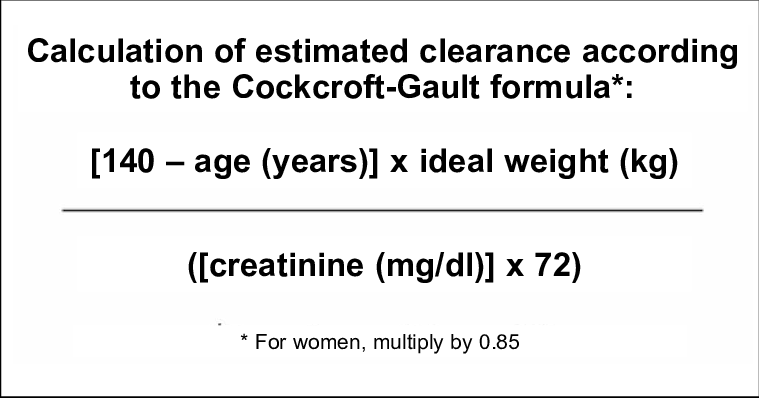
What is the Cockcroft-Gault equation for serum creatinine in mg/dL?
Answer: CrCl = [(140 − age) × weight in kg] ÷ [72 × serum creatinine].
Extra Information:
The resulting units are mL/min.
![<p>Answer: CrCl = [(140 − age) × weight in kg] ÷ [72 × serum creatinine].</p><p>Extra Information:</p><ul><li><p>The resulting units are mL/min.</p></li></ul><p></p>](https://assets.knowt.com/user-attachments/790fb140-0412-48d9-8561-cfd9600c9a84.png)
What historical sex adjustment is applied to Cockcroft-Gault?
Answer: Multiply the calculated value by 0.85 for females.
Extra Information:
This is the historical Cockcroft-Gault adjustment used in the provided material.

What are important limitations of Cockcroft-Gault?
Answer: It was derived from a small, predominantly White male population and estimates creatinine clearance rather than true GFR.
Extra Information:
- Modern race-free eGFR equations are generally preferred for GFR assessment.
Why is Cockcroft-Gault still clinically encountered?
Answer: It is commonly used for drug dosing when medication labeling or trials used creatinine clearance.
Extra Information:
Its clinical role differs from modern equations used to assess GFR.

What equation calculates measured creatinine clearance?
Answer: CrCl = urine creatinine concentration × urine flow rate ÷ plasma creatinine concentration.
Extra Information:
Urine flow rate must be expressed in mL/min.

How is urine flow rate calculated from a 24-hour urine collection?
Answer: Twenty-four-hour urine volume in mL divided by 1440 minutes.
Extra Information:
- This converts total daily urine volume into mL/min.
Why does creatinine clearance slightly overestimate true GFR?
Answer: Creatinine is freely filtered and also slightly secreted by proximal tubules.
Extra Information:
- Creatinine is not significantly reabsorbed.
What can a properly collected 24-hour urine be used to measure?
Answer: Creatinine clearance and total urinary excretion of protein, albumin, or other solutes.
Extra Information:
- It can also help when serum-based kidney-function estimates are unreliable.
What is a major limitation of a 24-hour urine collection?
Answer: Collection error.
Extra Information:
- Missing urine makes measured excretion and clearance inaccurate.
Differentiate Cockcroft-Gault from 24-hour measured creatinine clearance.
Answer: Cockcroft-Gault estimates CrCl, while urine creatinine plus serum creatinine and urine flow calculate measured CrCl.
Extra Information:
- Neither method literally provides a direct measurement of GFR.
Why does increased dietary sodium have the potential to increase blood pressure?
Answer: Sodium retention causes water retention, expanding extracellular-fluid and blood volume.
Extra Information:
- The effect is strongest when renal Na⁺ excretion does not appropriately match intake.
Trace the hemodynamic effect of sodium retention on blood pressure.
Answer: Na⁺ retention → H₂O retention → ↑ ECF → ↑ blood volume → ↑ Pms → ↑ venous return → ↑ preload → ↑ cardiac output → ↑ BP.
Extra Information:
- This links sodium balance directly to the venous-return framework.
What is salt-sensitive hypertension?
Answer: Hypertension in which blood pressure responds particularly strongly to changes in sodium intake.
Extra Information:
- Salt sensitivity reflects differences in how the body handles sodium and volume.
Why can peripheral resistance become important after initial volume expansion?
Answer: Chronic hypertension can produce vascular adaptation and increased resistance that helps maintain elevated BP.
Extra Information:
- Hypertension can therefore persist even if cardiac output is no longer markedly elevated.
What major nonpharmacologic interventions lower blood pressure?
Answer: Weight reduction, DASH-style diet, sodium reduction, physical activity, adequate potassium when safe, and limiting excessive alcohol.
Extra Information:
- These strategies address modifiable contributors to hypertension.
When is increasing dietary potassium appropriate for BP reduction?
Answer: When it is safe given the patient's renal function and medications.
Extra Information:
- Potassium recommendations should account for hyperkalemia risk.
What is the role of smoking cessation in hypertension management?
Answer: It primarily reduces overall cardiovascular risk rather than producing a major chronic BP-lowering effect.
Extra Information:
- It remains an important nonpharmacologic cardiovascular intervention.
How does dietary sodium reduction shift the Guyton venous-return relationship?
Answer: Lower volume decreases Pms and shifts the venous-return curve left.
Extra Information:
Venous return, preload, cardiac output, and BP subsequently decrease.

What RAAS laboratory pattern may occur in renovascular hypertension?
Answer: Increased renin and increased aldosterone.
Extra Information:
- Reduced renal perfusion stimulates renin, which activates angiotensin II and aldosterone.
Why is hyperaldosteronism from renal artery stenosis considered secondary hyperaldosteronism?
Answer: Aldosterone rises in response to increased renin and angiotensin II.
Extra Information:
- The adrenal gland is responding appropriately to an upstream stimulus.
How do renin levels distinguish primary hyperaldosteronism from renovascular hypertension?
Answer: Primary hyperaldosteronism has high aldosterone with low renin, while renovascular hypertension can have high renin and high aldosterone.
Extra Information:
- Renin suppression is a key distinction in primary hyperaldosteronism.
What electrolyte abnormality can aldosterone excess cause in renovascular hypertension?
Answer: Hypokalemia.
Extra Information:
- Aldosterone increases renal K⁺ secretion.
- Normal potassium does not exclude renovascular hypertension.
What acid-base disturbance can aldosterone excess cause in renovascular hypertension?
Answer: Metabolic alkalosis.
Extra Information:
- Aldosterone promotes H⁺ secretion in addition to K⁺ secretion.
What renal-function abnormalities can reduced renal perfusion produce?
Answer: Increased serum creatinine and decreased estimated GFR.
Extra Information:
- Persistent renal ischemia can impair renal function.
What BUN-to-creatinine ratio may support acute prerenal physiology?
Answer: Greater than 20 to 1.
Extra Information:
This finding is not specific for renal artery stenosis.

What fractional excretion of sodium may support acute prerenal physiology?
Answer: Less than 1%.
Extra Information:
This finding can support reduced renal perfusion but is not specific for renal artery stenosis.

Why can ACE inhibitors or ARBs reveal clinically important renal artery stenosis?
Answer: Blocking angiotensin II dilates the efferent arteriole and can substantially decrease GFR when renal perfusion is compromised.
Extra Information:
This is particularly concerning with bilateral stenosis or stenosis to a solitary functioning kidney.

Why does angiotensin II help maintain GFR during renal artery stenosis?
Answer: It constricts the efferent arteriole and helps preserve glomerular hydrostatic pressure.
Extra Information:
- This compensatory mechanism becomes important when afferent perfusion is reduced.
What change after starting or increasing RAAS blockade should prompt evaluation for causes of declining renal perfusion?
Answer: A greater than 30% decline in GFR.
Extra Information:
- Evaluate volume depletion, NSAIDs, low-output states, and possible bilateral renal artery stenosis.
What are the three major physiologic triggers of renin release?
Answer: Decreased renal perfusion pressure, decreased macula-densa NaCl delivery, and increased β₁ sympathetic stimulation.
Extra Information:
- These signals indicate a need to preserve pressure or circulating volume.
How does decreased renal perfusion pressure stimulate renin?
Answer: Reduced pressure is detected by the juxtaglomerular apparatus and promotes renin secretion.
Extra Information:
- Renal artery stenosis is a classic example.
How does the macula densa regulate renin release?
Answer: Decreased tubular NaCl delivery to the macula densa increases renin.
Extra Information:
- Macula-densa NaCl delivery reflects upstream tubular flow and filtration.
How does the sympathetic nervous system stimulate renin release?
Answer: β₁ stimulation of juxtaglomerular cells increases renin secretion.
Extra Information:
- This links sympathetic activation directly to RAAS.
Trace the RAAS pathway beginning with renin.
Answer: Renin → angiotensinogen to angiotensin I → ACE → angiotensin II → AT₁ receptors.
Extra Information:
- AT₁ activation produces vasoconstriction and promotes aldosterone effects.
What are the major blood-pressure effects of angiotensin II in the RAAS pathway?
Answer: Vasoconstriction and increased aldosterone-mediated sodium retention.
Extra Information:
- These increase total peripheral resistance and blood volume.
How does renal artery stenosis initiate renovascular hypertension?
Answer: Renal artery narrowing decreases renal perfusion pressure, stimulating juxtaglomerular renin release.
Extra Information:
- Renin then activates the RAAS cascade.
Trace RAAS activation from renal artery narrowing to angiotensin II.
Answer: Renal artery narrowing → ↓ renal perfusion → ↑ renin → ↑ angiotensin I → ACE → ↑ angiotensin II → AT₁ activation.
Extra Information:
- This is the central pathway connecting renovascular disease to hypertension.
How does angiotensin II increase total peripheral resistance in renovascular hypertension?
Answer: AT₁-receptor activation causes arteriolar vasoconstriction.
Extra Information:
- Increased TPR directly increases BP.
How does RAAS activation increase cardiac output in renovascular hypertension?
Answer: Aldosterone increases Na⁺ and water retention, increasing blood volume, Pms, venous return, and preload.
Extra Information:
- Increased preload can increase cardiac output.
How can renovascular hypertension increase both components of the BP equation?
Answer: Angiotensin II increases TPR while aldosterone-mediated volume retention can increase cardiac output.
Extra Information:
- Therefore both CO and TPR can contribute to the elevated BP.
Why are ACE inhibitors useful in renovascular hypertension?
Answer: They decrease angiotensin II generation, reducing vasoconstriction and aldosterone-mediated volume retention.
Extra Information:
- This lowers both vascular resistance and volume-related pressure effects.
Why are ARBs useful in renovascular hypertension?
Answer: They block AT₁ receptors, reducing angiotensin II-mediated vasoconstriction and aldosterone effects.
Extra Information:
- Their downstream hemodynamic goal resembles ACE inhibition.
Why must kidney function be monitored during ACE-inhibitor or ARB therapy in renal artery stenosis?
Answer: Efferent dilation can lower intraglomerular pressure and GFR.
Extra Information:
- Risk is particularly important with bilateral stenosis or a solitary functioning kidney.
What laboratory values should be monitored during RAAS blockade in renovascular disease?
Answer: Serum creatinine and potassium.
Extra Information:
- RAAS blockade can reduce GFR and alter potassium handling.
What are the two major causes of renal artery stenosis?
Answer: Atherosclerotic renal artery stenosis and fibromuscular dysplasia.
Extra Information:
They differ in typical patient population, vascular location, and imaging appearance.

Where does atherosclerotic renal artery stenosis usually occur?
Answer: At the ostium or proximal renal artery.
Extra Information:
- It is typically associated with older patients and generalized atherosclerotic risk factors.
How does atherosclerotic renal artery stenosis cause hypertension?
Answer: Plaque narrows the renal artery, reducing renal perfusion and activating renin and RAAS.
Extra Information:
- The resulting hypertension is secondary hypertension.
What can persistent renal ischemia from renal artery stenosis cause?
Answer: Ischemic nephropathy, renal atrophy, and declining renal function.
Extra Information:
Persistent hypoperfusion can therefore damage the affected kidney.
What is fibromuscular dysplasia?
Answer: A nonatherosclerotic, noninflammatory arterial disease.
Extra Information:
It can narrow renal arteries and activate RAAS.
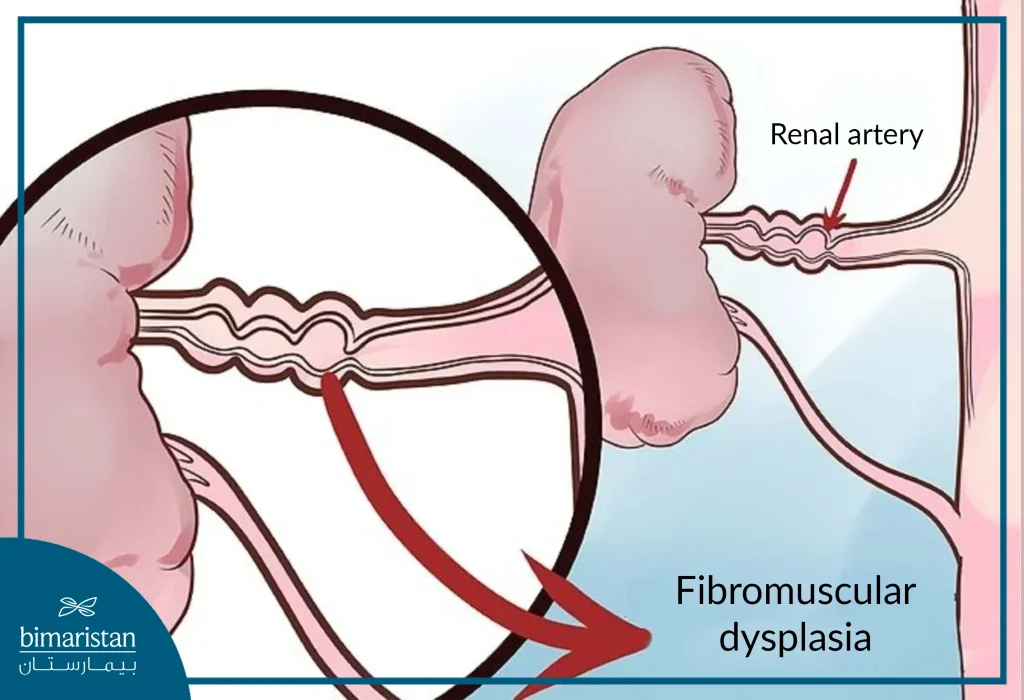
Where does renal fibromuscular dysplasia classically occur?
Answer: In the middle or distal renal artery segments.
Extra Information:
This contrasts with the ostial or proximal location typical of atherosclerosis.
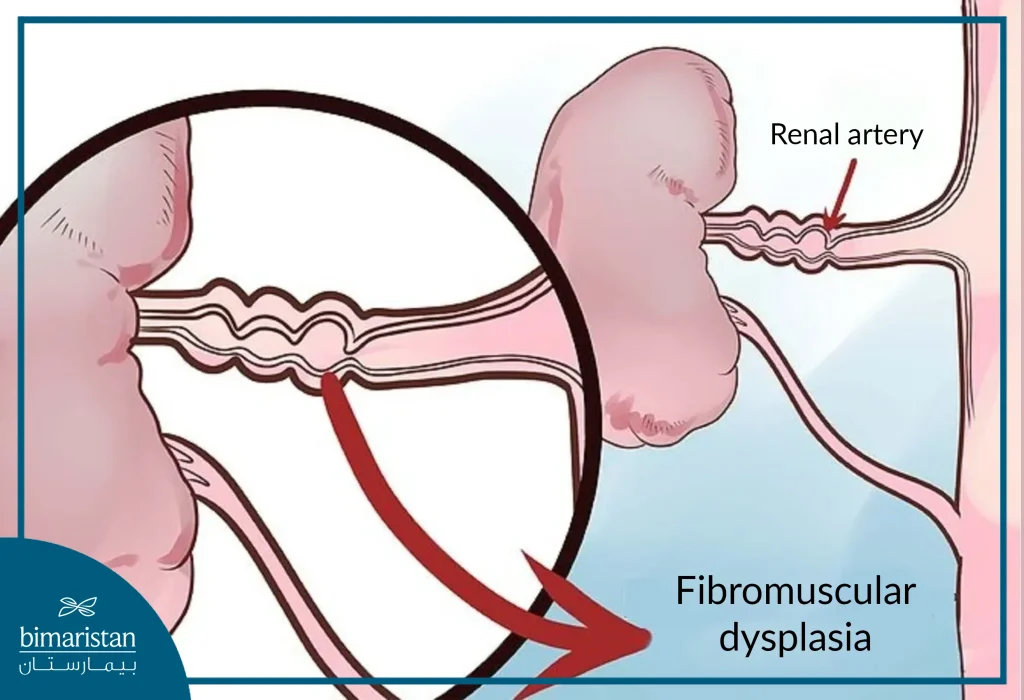
What angiographic appearance is characteristic of fibromuscular dysplasia?
Answer: A string-of-beads appearance.
Extra Information:
- It reflects alternating areas of arterial narrowing and dilation.

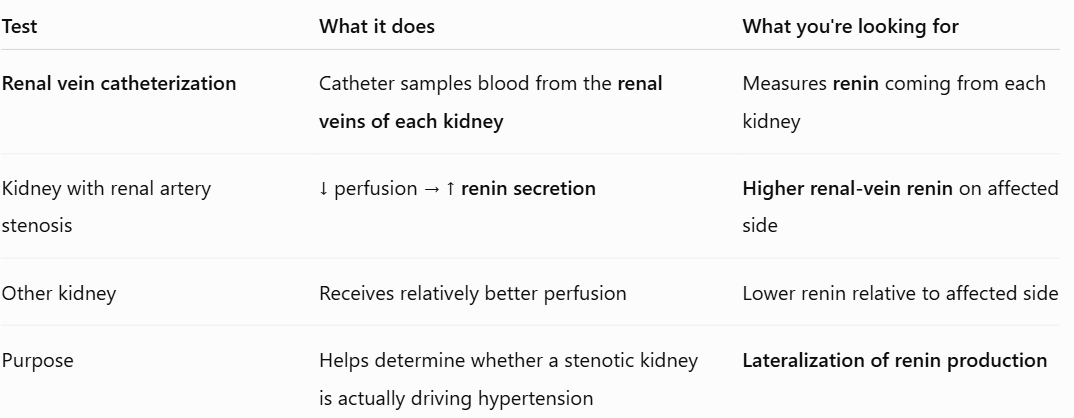
What is the difference between renal artery stenosis and renovascular hypertension?
Answer: Renal artery stenosis is an anatomic lesion, while renovascular hypertension is hypertension physiologically caused by impaired renal perfusion.
Extra Information:
- Imaging evidence of stenosis does not prove that the lesion is driving the hypertension.
What does duplex Doppler ultrasonography evaluate in suspected renal artery stenosis?
Answer: Renal arterial blood-flow velocities.
Extra Information:
- Increased peak systolic velocity across a stenosis supports significant narrowing.
What peak systolic velocity commonly suggests significant renal artery stenosis on Doppler?
Answer: Approximately 180 to 200 cm/s.
Extra Information:
Exact thresholds vary by laboratory and technique.

What are advantages of duplex Doppler ultrasonography for renal artery stenosis?
Answer: It is noninvasive and uses neither iodinated contrast nor radiation.
Extra Information:
- It can also assess the renal-to-aortic velocity relationship.
What are important limitations of renal duplex Doppler ultrasonography?
Answer: It is operator dependent and can be limited by obesity, bowel gas, and difficulty visualizing accessory vessels.
Extra Information:
Technical quality therefore affects diagnostic usefulness.

What does CT angiography provide in suspected renal artery stenosis?
Answer: Detailed visualization of the renal arteries, aorta, and location and severity of stenosis.
Extra Information:
Important disadvantages are ionizing radiation and iodinated contrast.

What does MR angiography provide in suspected renovascular disease?
Answer: Detailed vascular anatomy without ionizing radiation.
Extra Information:
- Contrast-enhanced studies require consideration of renal function and the gadolinium agent used.
When is catheter angiography particularly useful for renal artery stenosis?
Answer: When noninvasive testing is inconclusive or intervention is being considered.
Extra Information:
It provides high-resolution anatomy and can measure pressure gradients.
It is invasive and is generally not used merely for screening.
How do imaging patterns distinguish atherosclerotic RAS from fibromuscular dysplasia?
Answer: Atherosclerosis usually causes ostial or proximal narrowing, while FMD causes mid-distal irregularity with a string-of-beads appearance.
Extra Information:
- Location and morphology can therefore suggest the underlying etiology.
What is the usual first-line approach to stable atherosclerotic renal artery stenosis?
Answer: Medical therapy.
Extra Information:
- Finding renal artery stenosis on imaging does not automatically mean the lesion should be stented.
What did the CORAL trial show about routine stenting of atherosclerotic renal artery stenosis?
Answer: Adding stenting to medical therapy did not significantly reduce cardiovascular or renal clinical events.
Extra Information:
- The systolic BP difference was modest.
- The study included 947 patients.
When can revascularization be considered in atherosclerotic renal artery stenosis?
Answer: When clinically consequential disease persists despite medical treatment.
Extra Information:
- Important scenarios include refractory hypertension, worsening renal function, and acute or intractable heart failure.
What pulmonary complication can support consideration of renal revascularization?
Answer: Clinically important recurrent pulmonary edema.
Extra Information:
This suggests hemodynamically consequential renovascular disease.

How is renal-artery fibromuscular dysplasia commonly revascularized?
Answer: Percutaneous balloon angioplasty.
Extra Information:
- It may markedly improve or sometimes resolve hypertension.
Is a stent automatically required when treating renal fibromuscular dysplasia?
Answer: No.
Extra Information:
- Balloon angioplasty can be effective without routine stenting.
What high-yield rule distinguishes revascularization strategies for stable atherosclerotic RAS and FMD?
Answer: Stable atherosclerotic RAS is treated medically first, while FMD-related hypertension may respond particularly well to angioplasty.
Extra Information:
- Revascularization for atherosclerotic disease is reserved for selected clinically consequential cases.