Core 1, Unit 2 - FR
 Call Kai
 Learn
 Practice Test
 Spaced Repetition
 Match
 Flashcards
 Knowt Play
1/51

Earn XP
Description and Tags
FR - Ch.22: Trade Receivables, Ch.65: Related Party Transactions
52 Terms

FR Ch.12 Summary Card
(FR Ch.22) Recording an AR Discount - Gross Method
Records A/R and revenue at full invoice value
If invoice paid within discount period, discount reduces revenue recorded (using contra revenue account)
(FR Ch.22) Recording an AR Discount - Net Method
Records the A/R and Revenue, assuming discount will be taken
If not, forfeited discount is recorded as interest revenue and recorded at that time
(FR Ch.22) NRV of A/R
Net amount that an organization expects to collect from its trade receivables
(FR Ch.22) AFDA - A/R should be adjusted to the highest of: (3 options)
a) PV of cash flows expected to be generated by holding the receivable or group of A/R
b) The amount that could be realized by selling the A/R or group of A/R at the balance sheet
c) Amount that is expected to be realized by exercising the holder’s right to any collateral held to secure repayment of the A/R or group of A/R - net of all costs necessary to exercise those rights
(FR Ch.22) A/R Impairment is called:
Bad Debt Expense, AFDA is the loss allowance
(FR Ch.22) Determining A/R Loss Allowance - Aging of Accounts (Balance Sheet Method)
Used for A/R due in less than one year
Uses percentage of aged A/R outstanding at YE to determine AFDA
(FR Ch.22) Determining A/R Loss Allowance - Percentage of Credit Sales (Income Statement Method)
Bad debt expense calculated based on percentage of credit sales
(FR Ch.22) Derecognition - Three Reasons:
1) Collected in the normal course of business
2) Written off
3) Sold or transferred to third party (factoring)
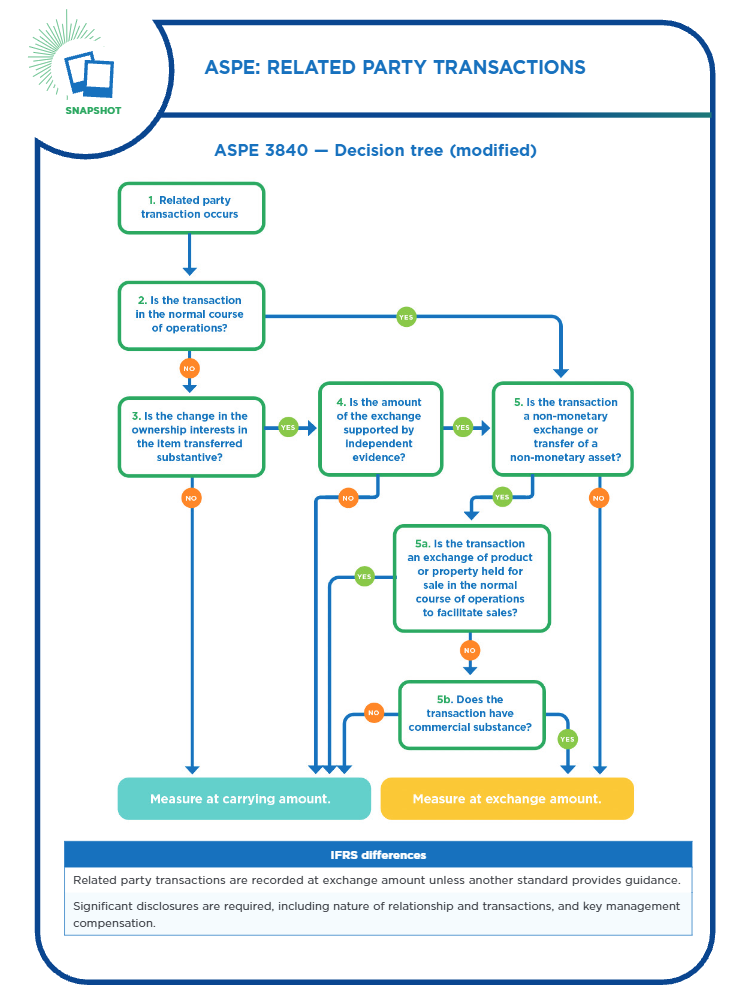
FR Ch.65: Related Party Transactions Summary Card (ASPE)
(FR Ch.65) Related Party Transactions (RPT) Definition:
Exchanges that occur between parties that are “related”
(FR Ch.65) Related Parties exist when…
One party is able to significantly influence or control the decisions of another party
(FR Ch.65) Related Parties include:
any party over which the entity exercises direct or indirect control, joint control or significant influence
any party that can exert direct or indirect control, joint control or significant influence over the entity
Parties subject to common control, joint control or common significant influence
members of immediate family of an individual who is a related party
(FR Ch.65) RP - Carrying Amount
Amount the item was recorded at by the transferor (book value)
(FR Ch.65) RP - Exchange amount
consideration paid or received as agreed to by the related parties (sales price)
For non monetary transactions: exchange value is the amount the parties agree to, which may or may not be equal to fair value
(FR Ch.65) RPT’s Accounting Treatment (Measured by Carrying Amount)
Differences booked and charged to contributed surplus
(FR Ch.65) RPT’s Accounting Treatment (Measured by Exchange Amount)
Differences booked and charged to Income gain/loss
(FR Ch.65) RPT Decision Tree - Step 1
Has a RPT occurred?

(FR Ch.65) RPT Decision Tree - Step 2
Is the transaction in the normal course of operations?
(FR Ch.65) RPT Decision Tree - Step 3
Is the change in ownership interests in the item transferred substantive?
i.e. item is considered to occurred when a transaction in unrelated parties having acquired or given up at least 20% of the total equity ownership interest in the item or service benefits, unless persuasive evidence exits to the contrary
(FR Ch.65) RPT Decision Tree - Step 4
Is the amount of the exchange supported by independent evidence?
Should include:"
Independent appraisals, valuations or approvals used to determine the exchange amount
comparable recently quoted market prices
comparable independent bids on the same transaction
comparable amounts of similar transactions actually undertaken with unrelated parties
(FR Ch.65) RPT Decision Tree - Step 5
Is the transaction a non-monetary exchange or transfer of a non-monetary asset?
(FR Ch.65) RPT Decision Tree - Step 5a
Is the transaction an exchange of product or property held for sale in the normal course of operations to facilitate sales?
(FR Ch.65) RPT Decision Tree - Step 5b
Does the transaction have commercial substance?
When future cash flows are expected to change significantly as a result of the transaction
(FR Ch.65) Diferences of IFRS and ASPE
RPT’s recorded at exchange amount unless other guidance contradicts
IFRS and IAS 24 requires more disclosure
(FR Ch.65) IAS 24 requires disclosure of:
Nature of RPT, regardless of whether or not they were involved in a transaction during the period
name of the entity’s parent company as well as its ultimate controlling party
Key management compensation, in total and for each of the following categories
ST employee benefits
post-employment benefits
other LT benefits
termination benefits
SBC

FR Ch. 27: Understanding Investments Summary Card Pt1
Pt2

(FR Ch.27) Non-strategic Investments - Cost Method
Entity does not update the carrying value (book value) to fair value
Bonds: Recording investment at amortized cost
Amortized Cost = Initial cost of investment ± adj. for discounts/premiums
(FR Ch.27) Non-strategic Investments - Fair Value Method
Investment updated to fair value
Results in unrealized gain/loss
(FR Ch.27) Non-strategic Investments - IFRS
Short term > FVTPL
Not short term > FVOCI

FR Ch.28: Passive Investments Summary Card
(FR Ch.28) FVPL includes:
Assets not qualified to be classified at amortized or FVOCI
Assets classified as held for trading
Assets designated on initial recognition as FVPL
(FR Ch.28) Held for Trading Asset criterea:
Acquired or incurred principally for selling or repurchasing in near term
on initial recognition, part of portfolio of identified financial instruments for short-term profit
derivative (instrument that derives its value base don underlying asset or benchmark
(FR Ch.28) FVOCI includes:
Equity investments designated as FVOCI-elect
Debt instruments with cash flows that are solely payments of principal and interest
(FR Ch.28) Initial Measurement at…
Fair value
(FR Ch.28) Treatment of Transaction Costs - FVPL
Expensed in P&L when incurred
(FR Ch.28) Treatment of Transaction Costs - Amortized Cost
Capitalized as part of the cost of the investment
(FR Ch.28) Treatment of the Transaction Costs - FVOCI
Capitalized as part of the cost of the investment
(FR Ch.28) Subsequent Measurement - FVPL
Measured at FV with gains/losses posted to P&L
Interest income are earned dividends
Determined using stated rate (Not effective rate)
(FR Ch.28) Subsequent Measurement - Amortized Cost
Measured at Amortized cost using effective interest method
Effective Interest Method
Exactly discounts estimated future cash payments/receipts through expected life

(FR Ch.28) Subsequent Measurement - FVOCI Equity
Record at face value, adjusted at YE and income/loss posted to OCI
(FR Ch.28) Subsequent Measurement - FVOCI Debt Investments
Interest income determined using effective interest method and recognized in P&L
(FR Ch.28) Subsequent Measurement - Impairment
Entity must recognize an allowance for expected credit losses on investments in debt instruments at amortized cost and at FVOCI
(FR Ch.28) Subsequent Measurement: Impairment - FVPL
As investments are adjusted to fair value in each reporting period, impairment losses and recoveries are not separated from overall change in fair value during the reporting period
(FR Ch.28) Subsequent Measurement: Impairment - Amortized Cost
When PV of estimated future cash flows, discounted using the asset’s original effective interest rate, is less than the asset’s carrying value
Loss recorded in P&L, carrying value of asset is reduced
Can be reversed up to amount of amortized cost that would have been recorded if no impairment recognized
Flows through P&L
(FR Ch.28) Subsequent Measurement: Impairment - FVOCI
Reported in P&L
Equity investments classified as FVOCI are adjusted to FV each reporting period
Losses may be reversed in full or part subject to financial situation of investee. Remaining measured in accordance with IFRS 9
(FR Ch.28) Reclassification

(FR Ch.28) Derecognition of Investments - FVPL
Difference between carrying value and consideration received is recognized in P&L

(FR Ch.28) Derecognition of Investments - Amortized Cost
Gain/Loss is the difference between the carrying value of the asset and consideration received. No gain/loss (generally) if bond matures

(FR Ch.28) Derecognition of Investments - FVOCI
Difference between carrying value and consideration received is recognized in OCI
Equity:
Gain/loss in OCI is not recycled to profit or loss. AOCI balance transferred to SHE account
Debt
All unrealized gain/loss transferred to profit or loss
(FR Ch.28) Differences between IFRS and ASPE
