PHYSL 212 Lecture 13: Autonomic Nervous System (Question)
 Call Kai
 Learn
 Practice Test
 Spaced Repetition
 Match
 Flashcards
 Knowt Play
1/25

There's no tags or description
Looks like no tags are added yet.
Name | Mastery | Learn | Test | Matching | Spaced | Call with Kai | Chat |
|---|
No analytics yet
Send a link to your students to track their progress
26 Terms
Autonomic Nervous System
Automatic division of the nervous system that carries out involuntary functions of homeostasis, emergency and stress response, and energy and housekeeping function
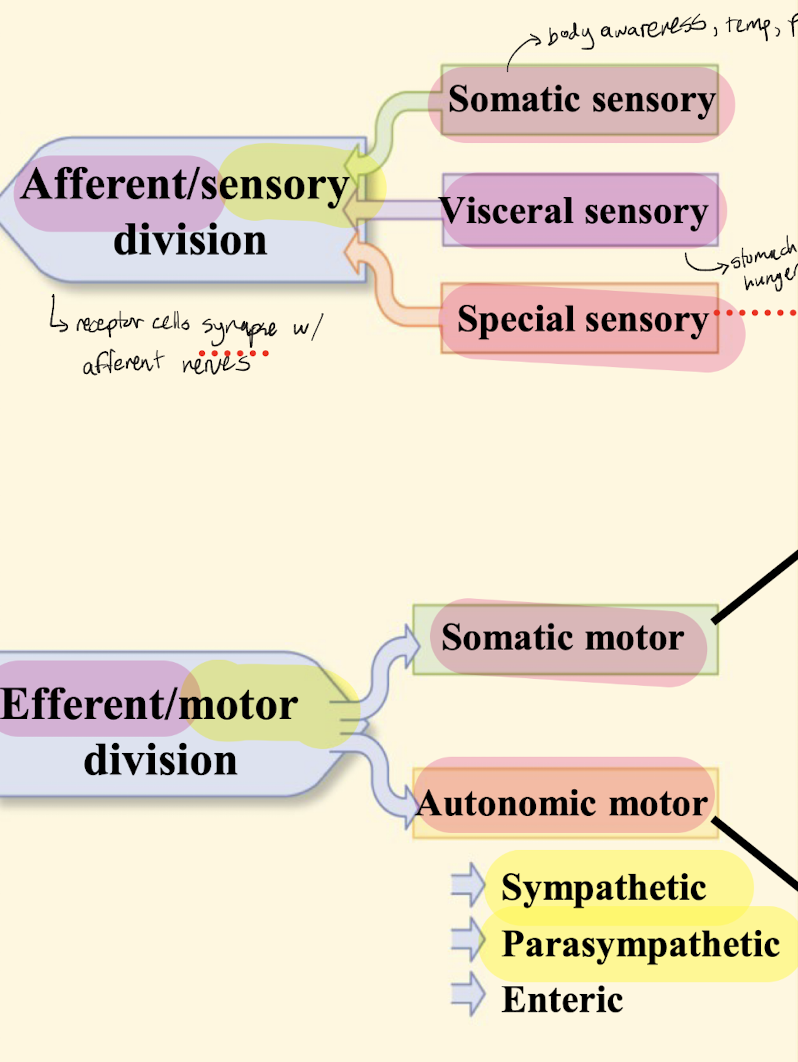
Describe the divisions of the peripheral nervous system.
Afferent/sensory divison, efferent/motor divison.
Afferent: somatic, visceral, special sensory
Efferent: somatic and autonomic motor (sympathetic, parasympathetic, enteric)
What are the different divisions of the sensory and motor divisions of the PNS responsible for/synapse with?
Somatic, visceral, and special sensory → detection of stimuli
Somatic motor → skeletal muscle (voluntary)
Autonomic motor → smooth and cardiac muscle, glands (uncontrollable)

There are ___ pairs of cranial nerves, attached at the ___. Would they be classified as afferent or efferent?
12, brain. Contain both afferent and efferent fibres (both sensation and motor)
There are ___ pairs of spinal nerves, connected at the ___. Would they be classified as afferent or efferent?
31, spinal cord. Contain both afferent and efferent fibres (both sensation and motor)
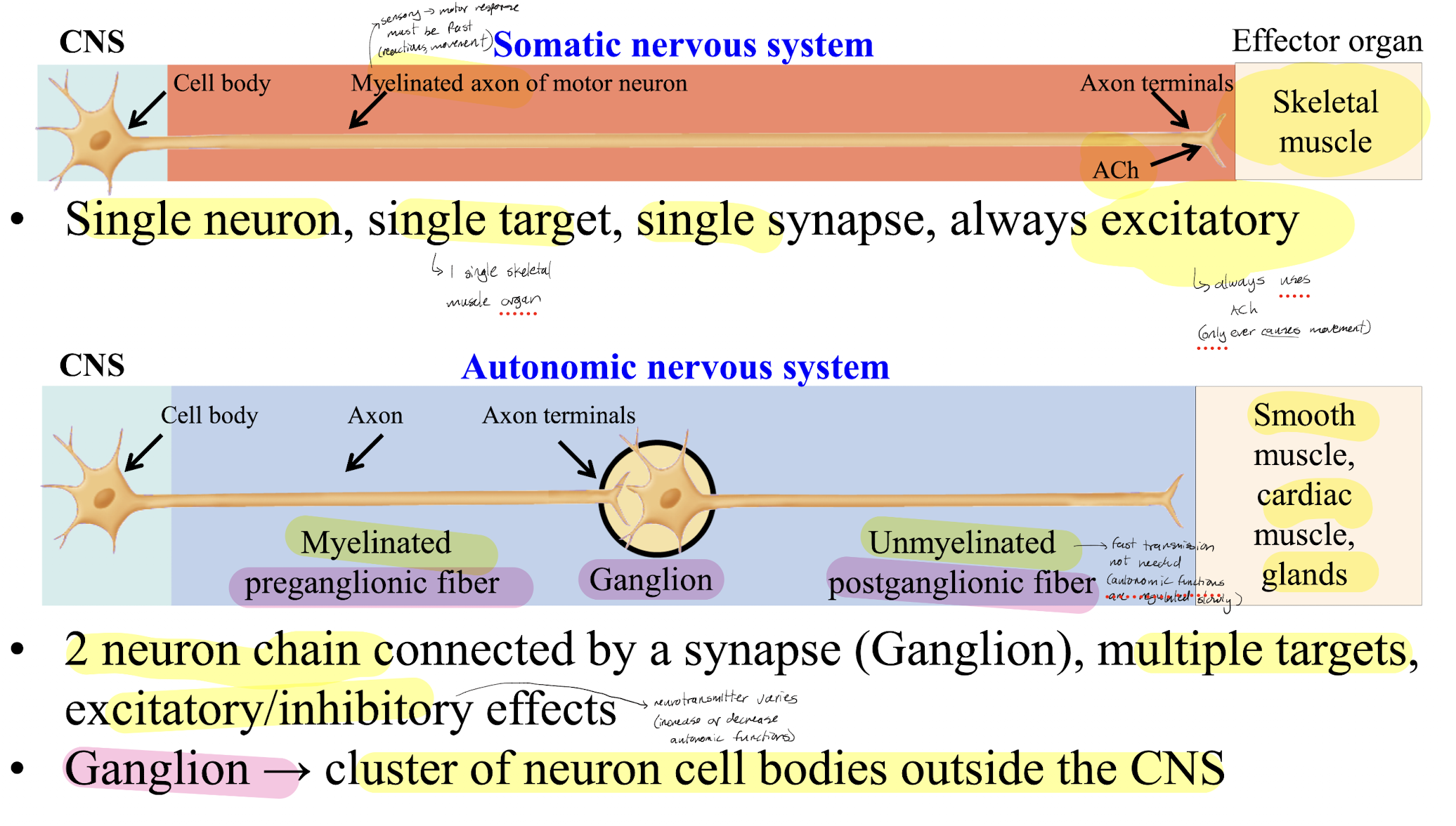
Compare signal transmission from CNS to effector in the somatic and autonomic nervous system, including number of neurons, targets, and effect on the membrane of the effector.
Somatic: single neuron, single target (specific), single synapse, always excitatory
Autonomic: 2 neuron chain connected by synapse at a ganglion, multiple targets (broad effect), 2 synapses, excitatory or inhibitory effects
What neurotransmitters are used by somatic nervous pathways and autonomic nervous pathways? Which fibres are myelinated? Explain, with reference to their functions.
Somatic: always ACh (always excitatory). Will only ever cause movement or action, not inhibit it. Motor neuron axon is myelinated: somatic senses must be quickly transmitted upon receiving a signal
Autonomic: variety of neurotransmitters. Needs to be able to inhibit bodily function (ex. produce less fluid) or activate it (ex. increase heart rate).
Preganglionic fibre is myelinated: signal must be quickly transmitted to the ganglion
Postganglionic fibre is unmyelinated: autonomic function is regulated or returned to baseline slowly, does not need fast transmission
Compare signal transmission from CNS to effector in the parasympathetic and sympathetic nervous system in terms of neuron length. Explain with regards to function.
Parasympathetic: long presynaptic fibre, short postsynaptic fibre. Proximity to the target tissue is more important than proximity to the CNS signal (effect is prolonged)
Sympathetic: short presynaptic fibre, long postsynaptic fibre. Proximity to the CNS signal is more important than proximity to the target tissue (danger response must be transmitted very fast)
Describe the locations of sympathetic and parasympathetic presynaptic cell bodies with regards to the nerves, including the numbers of the nerves. Explain with regards to function.
Sympathetic: thoracic (T1-T12) and lumbar (L1-L2) concentration is high (clustered at centre of spine). Quick receiving of information to allow limb and trunk movement is crucial
Parasympathetic: cranial (3, 7, 9, 10) and sacral (S2-S4) concentration is high (clustered at ends of spine). General targeting of body parts, and control of genitals/extremities in parasympathetic

Compare the two types of ganglia in the sympathetic nervous system, including: location, paired or unpaired, and structure.
Trunk/chain: paravertebral region (on either side), paired, connected in a chain column structure
Collateral: prevertebral region (in front of the vertebral column), unpaired, found in ball cluster structures at various regions on the spinal column
What are the three neural pathways that the sympathetic division neurons can take on the way to an effector, where do they synapse?
Spinal nerve axon synapses directly with a postganglionic neuron in a paravertebral ganglion (column) upon arrival
Spinal nerve axon does not immediately synapse at the first paravertabral ganglion it arrives in, and may move up or down the chain to synapse with neurons at other ganglia
Spinal nerve axon will pass directly through all paravertebral columns and move out, extending outwards to synapse at the collateral (prevertebral) ganglia as splanchnic nerves
Explain the functions of the sympathetic nervous system on the corresponding organs: eyes, cardiovascular, blood vessels, lungs, digestive tracts, endocrine and medulla glands, exocrine and sweat glands, salivary glands, bladder, and genitals. Provide a short explanation for each.
Eyes: dilate pupils. allow for more light to enter, far vision.
Cardiovascular: increase contraction of cardiac muscle. More blood flow needed to provide oxygen to body parts
Blood vessels: constrict. Need to maintain blood pressure
Lungs: bronchi dilate, inhibition of mucus secretion. More air needs to enter the lungs for ATP synthesis, blocking the airway with mucus is not the priority
Digestive tract: inhibits digestion. Energy should not be expended on digestion
Endocrine/medulla: NE and E release. Short term stress response needed
Exocrine/sweat: sweat is produced. Body temperature regulation is needed in cases of high activity
Salivary glands: production of thick, small volume of saliva. Thick due to lacking enzymes and water (priority given to other parts), volume not needed
Bladder: release is inhibited. Priority is not to release waste
Genitals: emission in males, uterus contraction in females. Sympathetic NS has a role in reproduction and birth
The adrenal medulla is innervated by ___. What molecules do they release? How do we clasify these molecules?
Sympathetic ganglia
Epinepherine and norepinepherine. Released into the blood → hormone function, not neurotransmitter function
What is the neural pathway that the parasympathetic division neurons take on the way to an effector, where do they synapse?
Cell body on sacral region of spinal cord extends via preganglionic fibre that leaves via ventral root → synapses at terminal ganglion with a short postganglionic fibre that reaches the effector
Explain the functions of the parasympathetic nervous system on the corresponding organs: eyes, cardiovascular, blood vessels, lungs, digestive tracts, endocrine and medulla glands, exocrine and sweat glands, salivary glands, bladder, and genitals. Provide a short explanation for each.
Eyes: constrict pupils. Light and far vision not needed to relax
Cardiovascular: decrease heart rate of cardiac muscle, lowers contraction rate (atria). Blood flow not needed in extensive amounts
Blood vessels: no effect. Blood pressure not needed to be extensively maintained
Lungs: bronchi constrict, mucus secretion. does not need to be a large amount of air entering, mucus for protection becomes a priority
Digestive tract: increases digestion. Energy and time can be expended to digestion and energy stores
Endocrine/medulla: No effect. Stress hormone release not needed
Exocrine/sweat: No effect. Sweat production not needed
Salivary glands: production of thin, enzyme rich large volume saliva. Water and enzymes can be attributed to digestion
Bladder: release is promoted. Able to excrete waste
Genitals: erection (dilation of blood vessels). Relaxation promotes blood flow to less important regions
Which mentioned body parts experience dual autonomic innervation?
Everything except hormones (medulla/endocrine), sweat glands, most blood vessels
Explain the chemical transmitters involved at the parasympathetic division pre and postganglionic nerve fibres.
Preganglionic fibre (long): chloinergic (releases ACh). Postganglionic fibre: cholinergic

Explain the chemical transmitters involved at the sympathetic division pre and postganglionic nerve fibres. Specify the different ways different types of tissue is innervated.
Smooth muscle, cardiac muscle, glands: preganglionic fibre is cholinergic (ACh), postganglionic fibre is adenergic (NE)
Blood vessels in skin: preganglionic fibre is chloinergic (ACh), postganglionic fibre is adenergic (NE)
Sweat glands, blood vessels on skeletal muscle: preganglionic fibre is cholinergic, postganglionic fibre is cholinergic (NMJ)

Explain the chemical transmitters involved at the adrenal medulla fibres. Specify the different ways different types of tissue is innervated.
Smooth muscle, cardiac muscle, glands
Preganglionic fibre is cholinergic (ACh). Adrenal medulla releases NE/E into the blood stream, which then binds to hormonal receptors on tissue

Describe the cleanup and reuptake process of a cholinergic synapse. How is new neurotransmitter created or packaged?
Acetylcholinestrase breaks down ACh into choline and acetate. The individual components to create the neurotransmitter are reuptaken into the cell via choline carriers
Synthesis of acetylcholine happens within the cell using the recycled materials
Where are varicosities found? What is their purpose?
Sympathetic and parasympathetic postganglionic fibres. Neurotransmitter released simultaneously to induce a mass effect to many cells simulataneously
Where is ACh stored vs epinepherine/norepinepherine?
ACh: vesicles in cell. E/NE: vesicles in varicosities across postsynaptic membrane
Describe the cleanup and reuptake process of a adrenergic varicosity. How is new neurotransmitter created or packaged?
NE is reuptaken as a whole molecule
Tyrosine is the precursor moleclule to NE and must be transported in, forming DOPA then dopamine before finally becoming NE. Most NE is created in the cell from imported material then packaged, but some is reuptaken from synapse
Compare the excitatory/inhibitory effects of nicotinic receptors and muscarinic receptors and adrenergic receptors.
Nicotinic: ionotropic → always cause direct depolarization → always excitatory
Muscarinic: metabotropic → activate indirect G-protein mechanism → can be excitatory or inhibitory
Adenergic: metabotropic → activate indirect G-protein mechanism → can be excitatory or inhibitory
Do the sympathetic and parasympathetic nervous systems exhibit convergence or divergence? Explain why given their functions.
Sympathetic: divergence. Mass discharge of effectors must happen such that multiple organs can be kickstarted at once
Parasympathetic: convergence. Return to baseline response is not urgent or needs to be spread out, and is often more targeted/specific
Which responses do the spinal cord, medulla, and hypothalamus integrate, respectively?
Spinal cord: autonomic reflexes (urination, defection) and spinal reflexes
Medulla: ANS major reflex centers (cardiovascular, digestive, respiratory activity)
Hypothalamus: hormone regulated autonomic function, temperature regulation