Lecture 6: Teleost Fishes pt 1
 Call Kai
 Learn
 Practice Test
 Spaced Repetition
 Match
 Flashcards
 Knowt Play
1/157

There's no tags or description
Looks like no tags are added yet.
158 Terms

What is the classification of teleosts?
Osteichthyes → Actinopterygii → Neopterygii → Teleostei

What locomotor adaptation characterizes teleosts?
Multiple evolved traits facilitate maneuverable locomotion
How many bones form the teleost operculum?
Four bones
What characterizes teleost vertebrae?
Ossified but lightweight
What type of tail do teleosts have?
Homocercal tail
What supports the teleost tail?
Uroneurals, hypurals, and epurals
What scale types are mentioned for teleosts?
Cycloid and ctenoid scales
What is the swimbladder's main function?
Hydrostatic organ that provides buoyancy
What characterizes teleost fins?
Highly maneuverable; contain rays and spines
Which teleost jaw bones are movable?
Premaxilla and maxilla
What changed about the premaxilla in teleosts?
Increased prominence and functional role
What did jaw-bone dissociation allow?
More mobile feeding systems and greater dietary specialization
What are the four major teleost groups covered?
Elopomorpha, Osteoglossomorpha, Otocephala, Euteleostei

What larval form characterizes Elopomorpha?
Leptocephalus larvae
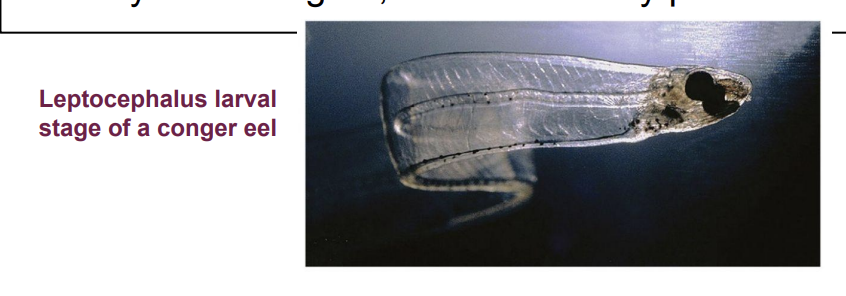
What do leptocephalus larvae look like?
Very thin and leaflike
How long can leptocephalus larvae last?
Up to 2–3 years
How many branchiostegal rays do elopomorphs have?
Approximately 10–35; more than higher teleosts
What scales are noted in the Elopomorpha lecture notes?
Heavy bony scales containing ganoine
What body plan occurs in many elopomorphs?
Elongate, snake-like body plan

Elopomorpha: Elopiformes — classification and examples?
2 families, 9 species; ladyfishes and tarpons
What distinctive bone do Elopiformes have?
Gular bone under the throat
How many branchiostegal rays do Elopiformes have?
23–35
What is distinctive about the Elopiformes maxilla?
Maxilla is included in the gape
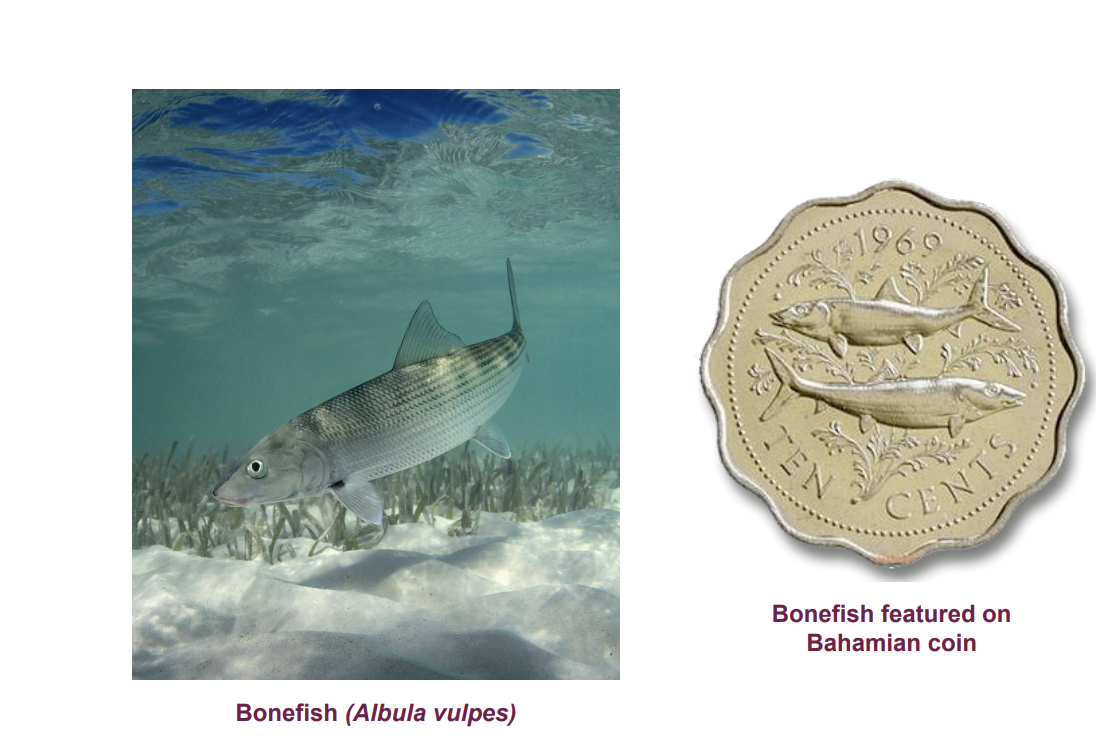
Elopomorpha: Albuliformes — classification and examples?
1 family, 13 species; bonefishes
What is the habitat and significance of bonefishes?
Mostly marine, tropical; popular gamefish

Elopomorpha: Notacanthiformes — classification and examples?
2 families, 28 species; halosaurs and spiny eels
What characterizes Notacanthiformes habitat and tail?
Marine, deep-sea; elongate, tapered tail
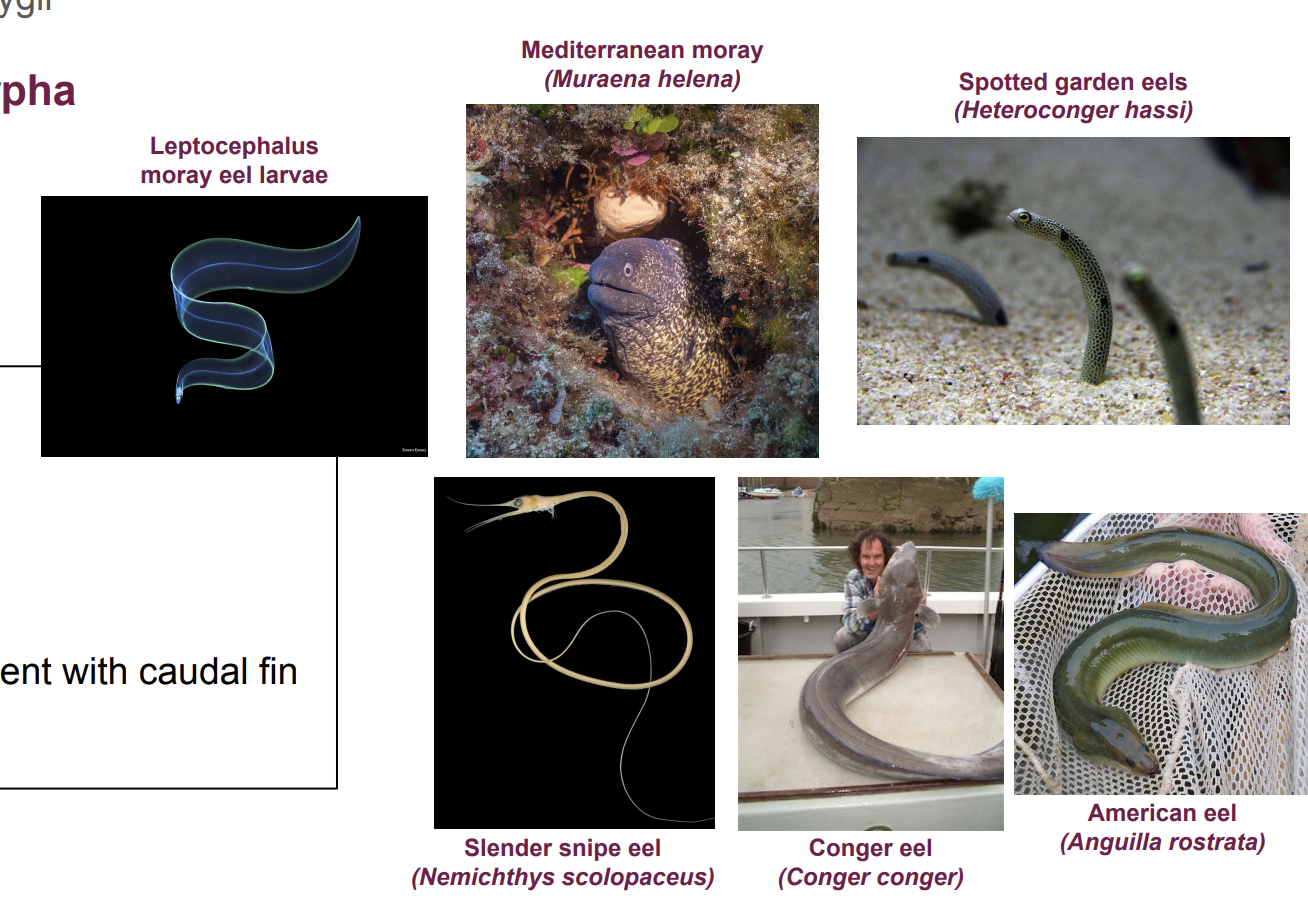
Elopomorpha: Anguilliformes — classification and examples?
16 families, approximately 1,000 species; true eels
What pelvic feature characterizes true eels?
Loss of pelvic girdle and pelvic fins
How are true eel median fins arranged?
Dorsal and anal fins are confluent with caudal fin
What happens to scales in Anguilliformes?
Scales are often absent

What does Osteoglossomorpha mean in these notes?
Bony tongues
What is distinctive about the osteoglossomorph tongue?
Well-developed teeth on the tongue, part of the anterior hyoid complex
What scales and habitat characterize Osteoglossomorpha?
Many have huge scales; freshwater, usually tropical

Osteoglossomorpha: Hiodontiformes — classification?
1 family, 2 species; mooneyes
Where do mooneyes live?
Rivers in North America
What pelvic-fin traits distinguish mooneyes?
Distinct pelvic fins with 7 rays
What additional structure do mooneyes have?
Axillary process
Osteoglossiformes — classification?
5 families, more than 250 species

Which groups belong to Osteoglossiformes?
Freshwater butterflyfish, bonytongues, featherfin knifefishes, African aba, African elephantfishes
Which family contains most Osteoglossiformes species?
Mormyridae, with more than 200 species
What is remarkable about Mormyridae brains?
Largest brain-to-body-weight ratio in fishes
What electrical abilities do elephantfishes have?
Generate and receive electrical signals
How does electrical discharge vary in Mormyridae?
Electric organ discharge varies among species and has been used to describe new species
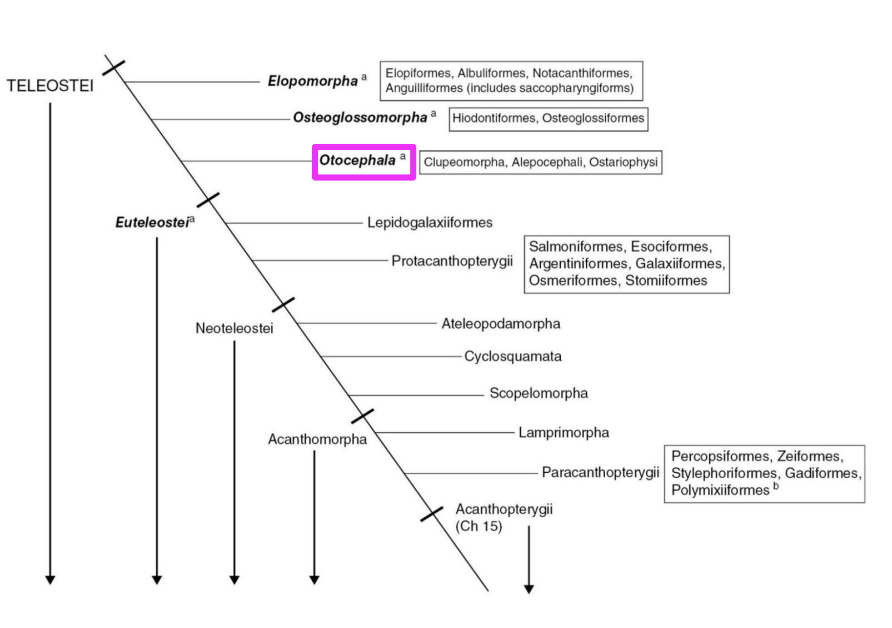
What is the next major teleost cohort?
Otocephala
Otocephala: Clupeomorpha → Clupeiformes — classification?
7 families, more than 400 species

Which fishes belong to Clupeiformes?
Herring, shad, anchovy, sardines
What characterizes Clupeiformes appearance and habitat?
Silvery bodies; mostly marine, some freshwater
What do most Clupeiformes eat?
Plankton; mostly planktivorous
What is an otophysic swimbladder?
Swimbladder that contacts the inner ear
What does the otophysic swimbladder improve?
Sensitivity to low-frequency sounds

Otocephala: Alepocephali → Alepocephaliformes — classification?
2 families, approximately 140 species

Which fishes belong to Alepocephaliformes?
Tubeshoulders and slickheads
What habitat and swimbladder trait characterize Alepocephaliformes?
Marine, deep sea; lack swimbladder
What unusual feature does Platytroctidae have?
Tubes behind head that secrete luminous fluid
How many species does Ostariophysi contain?
More than 7,000 species
What is Schreckstoff?
Fright substance; chemical alarm

What is the Weberian apparatus?
Series of bones connecting swimbladder to inner ear
What does the Weberian apparatus improve?
Low-frequency hearing
What proportion of freshwater fishes are Ostariophysans?
Approximately 64%
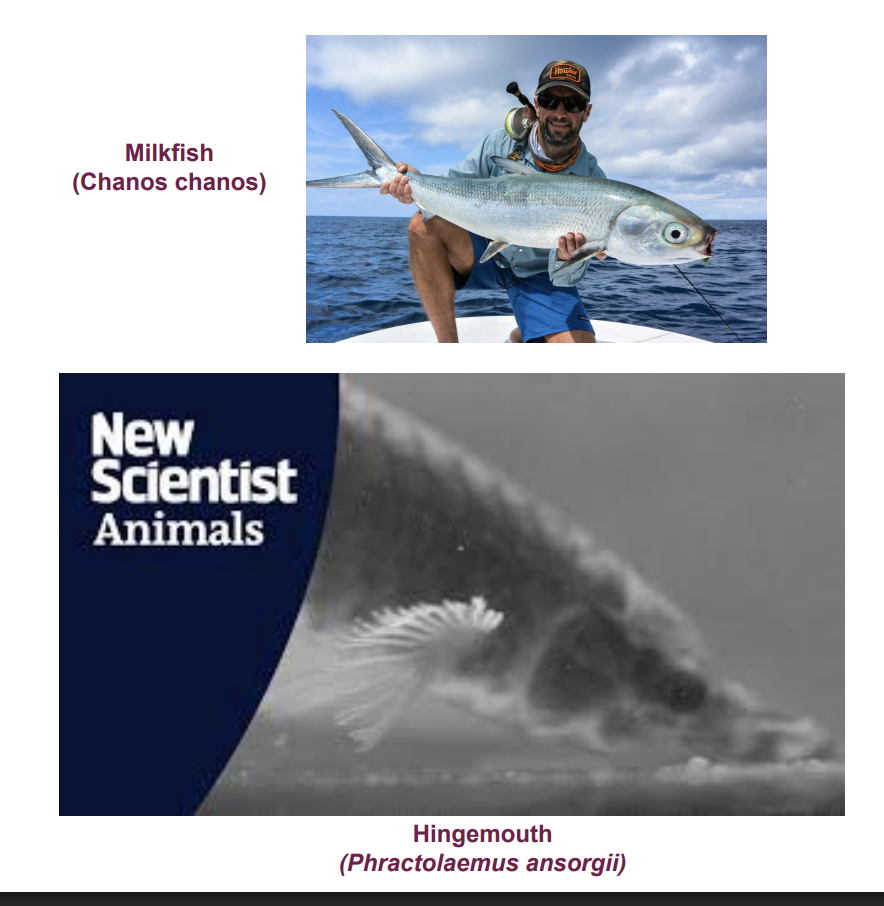
Ostariophysi: Anotophysi → Gonorynchiformes — classification?
3 families, approximately 35 species

Which fishes belong to Gonorynchiformes?
Milkfish and relatives
What Weberian trait distinguishes Gonorynchiformes?
Lack a true Weberian apparatus
Ostariophysi: Otophysi → Cypriniformes — classification?
23 families, approximately 4,500 species
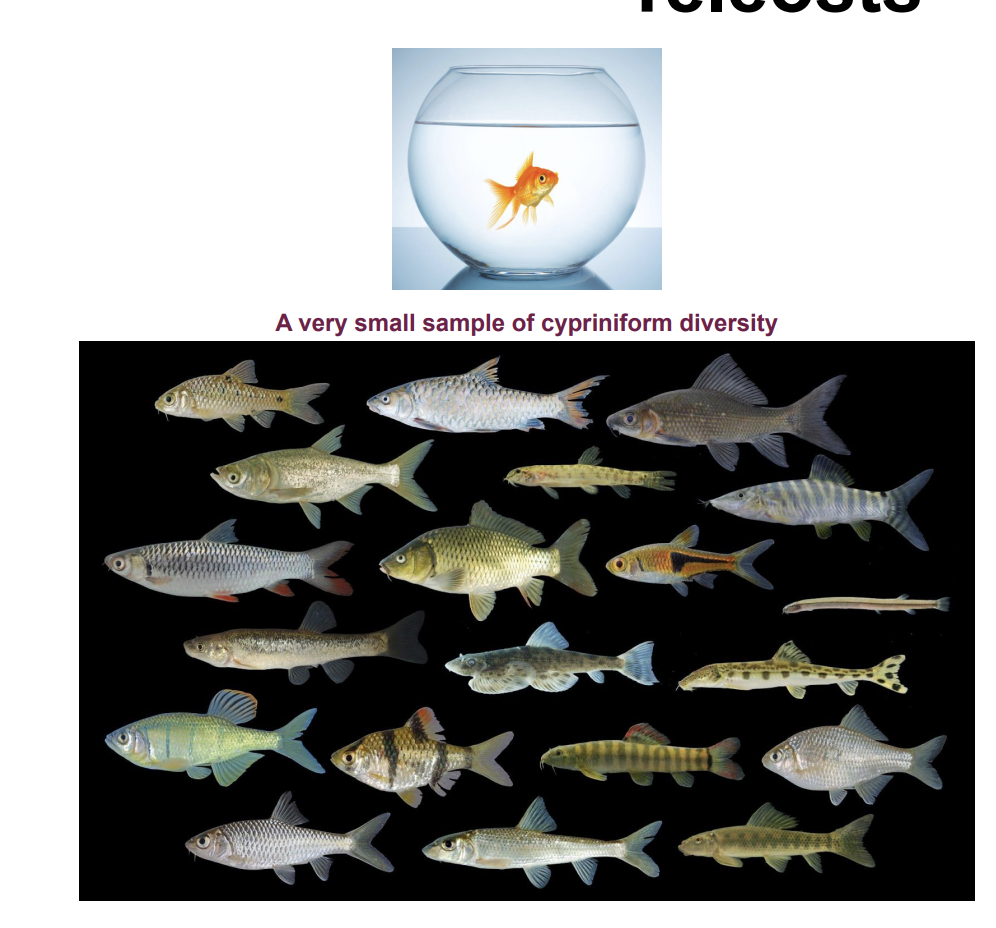
Which familiar fishes belong to Cypriniformes?
Minnows, shiners, carp, barbs, dace, goldfish, koi, zebrafish, and many others
What is the largest fish family noted in the lecture?
Cyprinidae: carps and minnows
How many species are in Cyprinidae?
Approximately 1,700 species
What body size characterizes many Cyprinidae?
Mostly small-bodied species
What evolutionary novelty first appears in Cypriniformes?
Pharyngeal jaws
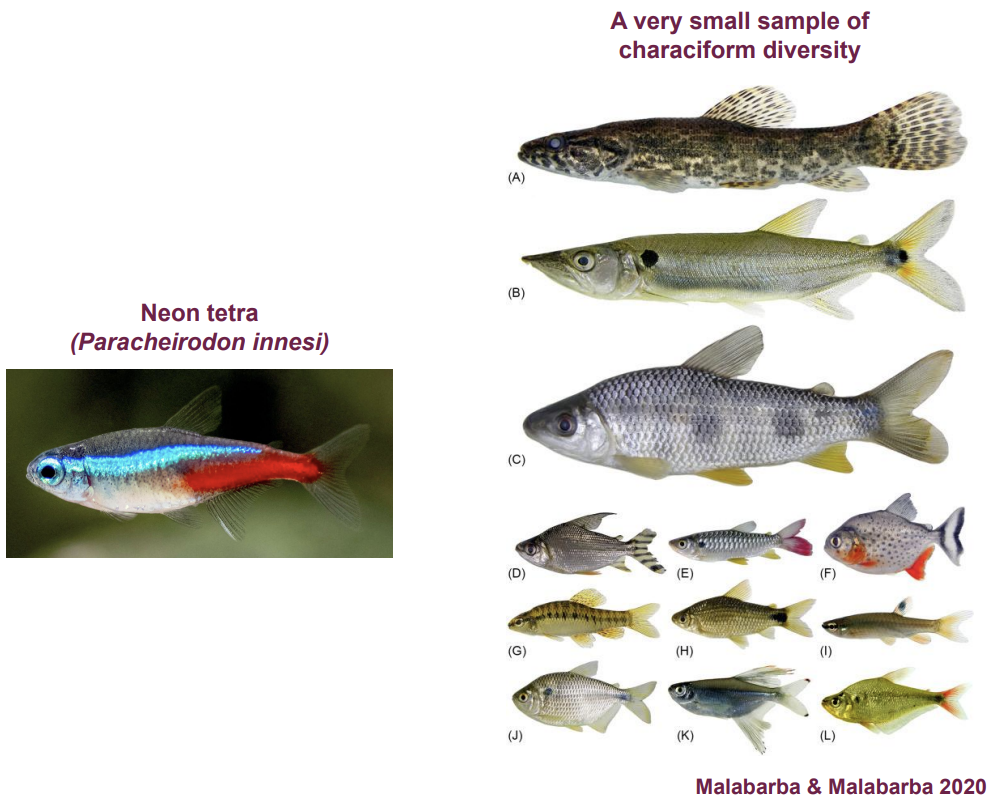
Ostariophysi: Otophysi → Characiformes — classification?
24 families, approximately 2,500 species
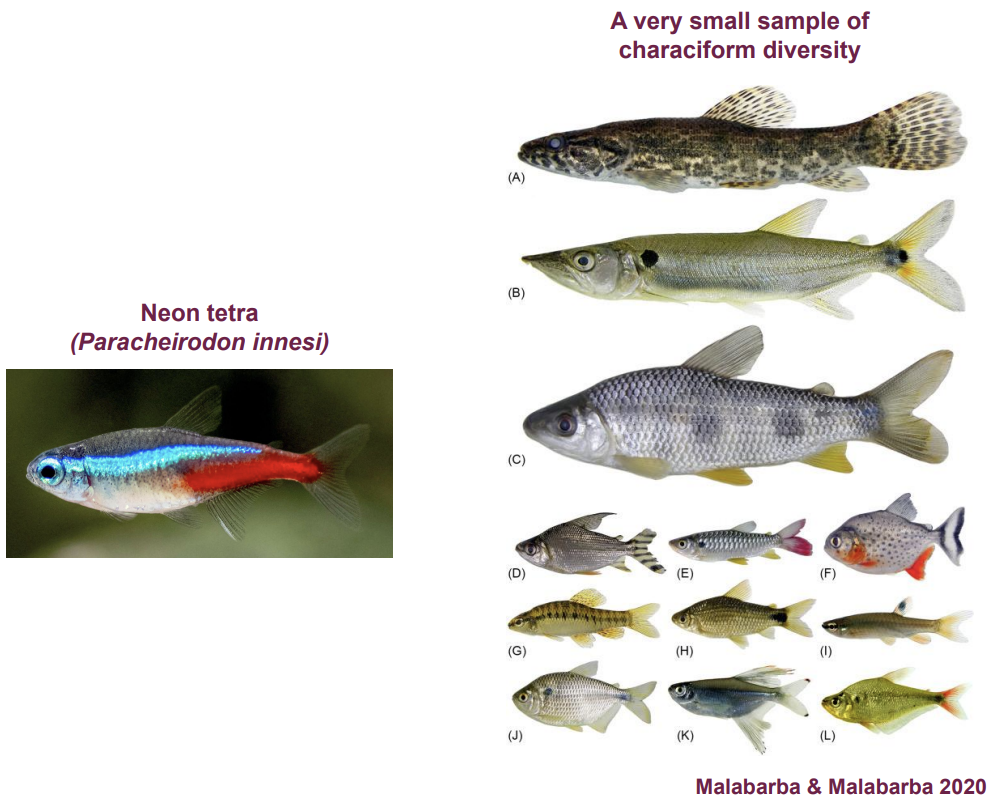
Which fishes belong to Characiformes?
Tetras, piranhas, pacus, characins, and many others
What traits are associated with Characiformes?
Adipose fin; many have sharp teeth; ctenoid scales

Ostariophysi: Otophysi → Siluriformes — classification?
39 families, more than 4,000 species

Which fishes belong to Siluriformes?
Catfishes
What fin traits characterize catfishes?
Spine-like dorsal and pectoral rays; adipose fin
What body-covering traits characterize catfishes?
No scales, but may have bony plates
What sensory structures are common in catfishes?
Barbels
Ostariophysi: Otophysi → Gymnotiformes — classification?
5 families, more than 250 species

Which fishes belong to Gymnotiformes?
South American knifefishes, including the electric eel
How are Gymnotiformes described evolutionarily?
Most derived Ostariophysans
What electrical abilities do Gymnotiformes have?
Produce and receive electrical signals
What body and fin plan characterizes Gymnotiformes?
Elongate body; long anal fin; many lack caudal and dorsal fins

What are Euteleostei?
True teleosts; fishes more modern than ostariophysans
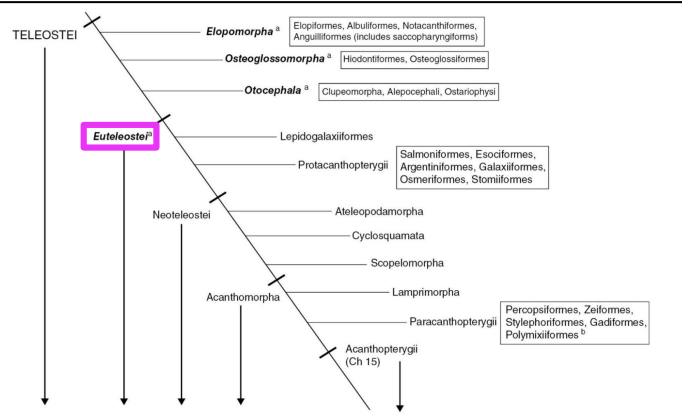
What unifies Euteleostei?
Few obvious shared traits, but genetic evidence supports the clade

What is Lepidogalaxiformes' classification?
1 family, 1 species; salamanderfish
What is unusual about Lepidogalaxiformes?
Monotypic order; sister to all other euteleosts
How does the salamanderfish survive drying water?
Buries itself as the water dries
What unusual movement can the salamanderfish perform?
It can turn its head

What is Protacanthopterygii?
Paraphyletic collection of early-diverging true teleosts
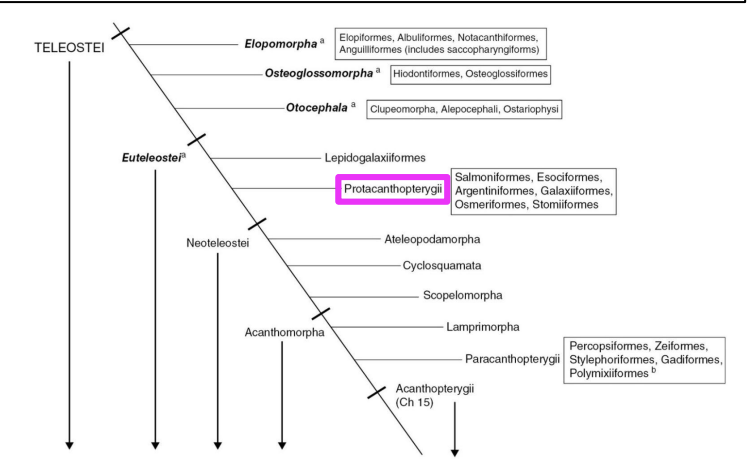
Protacanthopterygii: Salmoniformes — classification?
1 family, more than 200 species

Which fishes belong to Salmoniformes?
Salmon, trout, grayling
What habitats do Salmoniformes occupy?
Freshwater, marine, and estuarine
What migratory behavior occurs in many salmonids?
Many are anadromous; some make extensive oceanic migrations
Why are Salmoniformes important?
Ecologically and commercially important
What fin traits characterize Salmoniformes?
Adipose fin; no spines

Protacanthopterygii: Esociformes — classification?
2 families, 14 species

Which fishes belong to Esociformes?
Pikes and pickerels
What habitat and hunting strategy characterize Esociformes?
Freshwater, temperate; ambush predators
Where are Esociformes median fins positioned?
Far back on the body

Protacanthopterygii: Argentiniformes — classification?
4 families, approximately 90 species