Stroke and TBI
 Call Kai
 Learn
 Practice Test
 Spaced Repetition
 Match
 Flashcards
 Knowt Play
1/27

There's no tags or description
Looks like no tags are added yet.
28 Terms
Learning objectives
Understand mechanisms of stroke & brain injury
• Describe medical management strategies for acute stroke
• Explain how rehabilitation professionals can support stroke prevention
through risk factor management & education
• Identify stroke and brain injury level of severity
• Apply neuroscience knowledge to stroke symptoms and implicated structures
• Distinguish between primary & secondary damage in brain injury
• Explain behavioral and level of consciousness changes associated with bran
injury
• Describe the level I – VIII of the Ranch Los Amigos Scale
imaging intervention strategies for RLA levels IV-VI
Ischemic Strokes
thrombotic- forms and stays where it is
embolic- forms and travels somewhere else
medical management:
tissue plasminogen activator (TPA)
long term anticoagulation
thromboendarterectomy or graft
lifestyle change as preventative measure is preferred
Hemorrhagic stroke
hypertension
aneurysm
arteriovenous malformation
traumatic
subdural hematoma- arterial, will develop much faster
epidural- venous, develops slower
medical management:
control BP
surgical removal of clot
aneurysm clip
coil embolization of aneurysm
stereotactic microsurgery
lifestyle change as preventative measure is preferred
Stroke Risk Factors
Age
Incidence doubles with each decade after 55 years
20–54-year-old incidence rate increased 12.9% to 18.6% over 10-year period (96-06)
Biological sex
Young ages women higher incidence rate than men
Older adults men higher incidence rate than women
Race/ethnicity
Black American’s 2x higher rate of first stroke incident compared to white
Does not hold for recurrent stroke
Hispanic/Latino higher stroke burden than non-Hispanic whites
American Indians/Native Americans have higher stroke incidence than non-Hispanic whites
Genetics
Ischemic and Hemorrhagic:
• Hypertension
• Current smoking
• Waist-to-hip ratio
• Diet
• Alcohol consumption
Just Ischemic:
Physical inactivity
Hyperlipidemia
Diabetes mellitus
Cardiac causes
Apolipoprotein B to A1
Stroke Severity: Modified Rankin Scale (mRS)
0= no symptoms
1= No significant disability despite symptoms; able to carry out all usual duties and activities
2= Slight disability; unable to carry out all previous activities, but able to look after own affairs without assistance
3= Moderate disability; requiring some help, but able to walk without assistance
4= Moderately severe disability; unable to walk without assistance and unable to attend to own bodily needs without assistance
5= Severe disability; bedridden, incontinent and requiring constant nursing care and attention
6= Dead
just know modified rankin scale (mRS) measures stroke severity and the higher the score the more severe
National Institute of Health Stroke Scale (NIHSS)
measures stroke severity, more in depth
0-42; higher the score = increased severity
Recovery after Stroke
Natural recovery:
First 3-6 months after stroke
Quick changes occur
Resolution of penumbra- Area around the infarct that experiences decreased blood flow and oxygenation that may resolve after acute phase
Therapy induced recovery:
promoting restoration, teaching compensation
Vasculature
ACA- anterior medial frontal, superior medial parietal
MCA- lateral parietal, frontal, and temporal lobe
deep structures like basal ganglia via lenticulostriate branches
PCA- occipital love and inferior/medial portions of temporal lobe
ICA- supplies ACA and MCA

ACA Stroke
Body Structures→ Body Function
• Medial frontal lobe
• Medial parietal lobe
• Basal ganglia (caudate)
• Anterior fornix (brain)
• Anterior corpus collosum
• Olfactory tract
Body Functions
• Primary motor cortex in medial frontal lobe→ Contralateral movement loss (LE>UE)
• Primary motor cortex in medial frontal lobe → Contralateral pelvic floor movement loss
• Contralateral sensory loss (LE>UE)
• SMA and PMA → Apraxia
• Anosmia (smell)
• Incontinence
• Executive functioning
• Memory
• Initiation
• Emotional regulation
MCA Stroke
Body Structures
• Lateral frontal lobe
• Lateral temporal lobe
• Lateral parietal lobe
• Corona radiata
• Basal ganglia
• Internal capsule
Body Functions
• Hemiparesis contra lower face
• Contralateral movement loss (UE>LE)
• Contralateral sensory loss (UE>LE)
• Ataxia contra extremities
• Aphasia
• Hemispatial neglect
• Anosognosia (denies deficits)
• Apraxia
• Homonymous hemianopsia
• Aphasia
• Lateral prefrontal and lateral temporal → Executive function and Memory
Internal Carotid Artery Stroke
Body Structures
• ACA distribution
• MCA distribution
Body Functions
• Coma
• Death
Lucunar Syndrome
deep branches that go to basal ganglia and internal capsule
Body Structures
• Deep structures from penetrating arteries
• Internal capsule
• Corona radiata
• Red nucleus
• Basal ganglia
• Thalamus
• Midbrain
• Lateral pons
Body Functions
• Hemiparesis
• UE, LE, Trunk, Face
• Dysarthria- genu internal capsule
• Dysphagia
• Cerebellar symptoms
• Ataxia
• Clumsiness
• Lack of coordination
• Sensation impairment → posterior limb of internal capsule or thalamus
mixed motor and sensory → posterior limb
• Numbness
• Tingling
• Pain
• Burning
ataxic hemiparesis- anterior limb of internal capsule
PCA Stroke
Body Structures
• Occipital lobe
• Medial & inferior temporal lobe
• Thalamus
• Midbrain structures
• CN 3 – oculomotor
• Cerebral peduncle (crus cerebri)
Body Functions
• Homonymous hemianopia
• Cortical blindness
• Visual agnosia
• Dyslexia
• Memory deficits
• Hemisensory loss
• Thalamic pain syndrome
• Contralateral hemiparesis→ crus cerebri
Vertebrobasilar Artery Syndrome
Body Structures
• Cerebellum
• Medulla
• Pons
• Internal ear
• Multiple CN
• XII hypoglossal
• V trigeminal
• IX glossopharyngeal
• X vagus
• VI abducens
• VIII vestibulocochlear
• VII facial
Body Functions
• Paralysis
• Ataxia
• Vertigo
• Nystagmus
• Diplopia
• Dysphagia
• Dysarthria
PICA Stroke
Body Structures
• Vestibular nuclei
• Inferior cerebellar peduncle
• Spinothalamic tract
• Spinal trigeminal nucleus & tract
• Nucleus ambiguous (vagus & glossopharyngeal CN)
• Descending sympathetic fibers
Body Functions
• Contralateral trunk & extremity sensory deficits
• Ipsilateral facial sensory deficits
• Nystagmus
• Vertigo
• Ipsilateral Ataxia
• Dysphagia→ nucleus ambiguous
• Horner Syndrome
AICA stroke
Body Structures
• Vestibular nuclei
• Trigeminal primary sensory nucleus
• Facial nucleus
• Cochlear nucleus
• Spinothalamic tract
• Middle & inferior cerebellar peduncles
• Descending sympathetic tract
Body Functions
• Vertigo
• Nystagmus
• Vomiting
• Hemiataxia
• Contralateral pain & temp in body &
extremities
• Ipsilateral facial sensory loss & motor loss
• Ipsilateral loss of taste anterior 2/3 of tongue
• Hearing loss
• Tinnitus
• Horner Syndrome
Mechanisms of TBI
External forces to the head causing the brain to move (coup vs. contrecoup)
Severe acceleration/deceleration
can cause axonal twisting that is worse at the brainstem; like ringing out a washcloth→ more twisted in middle
cause mild alteration in consciousness → reticular activating system
Blast injuries
Penetrating injuries
Primary Damage TBI
Contusion
More common with occipital blow
More common where cranial vault irregular
Anterior poles
Undersurface of temporal lobes
Undersurface of frontal lobes
• Lacerations
• Epidural hematoma
• Subdural hematoma
• Diffuse axonal injury
Secondary Damage TBI
Increased intracranial pressure (ICP)
Normal (supine) 7-15 mmHg
• Cerebral hypoxia or ischemia
• Intracranial hemorrhage
• Electrolyte imbalance
• Infection
• Seizures
Behavioral Changes TBI
Medial prefrontal cortex
• Poorly modulated emotional responses
• Increased affective symptoms
• Deficits in social judgement
• Apathy
cognitively struggle to initiate tasks, different than BG
Ventral prefrontal cortex
• Antisocial behavior
• Intolerance
• Inappropriate sexual behavior
• Impulsiveness
Lateral prefrontal cortex
• Difficulty setting and pursuing goals
• Impaired selective attention
• Difficulty following rules, selecting correct action
• Fidgety/hyperactive

Changes is Consciousness
Diffusely extensive and bilateral cerebral hemispheric depression of function or direct depression or destruction of the brain stem activating system
Coma:
Paralysis of cerebral function
State of unresponsiveness
Eyes closed
No localized response to painful stimuli
Brain stem responses
Grimacing to pain
Reflexive motor response to pain
Abnormal palate or tongue movements
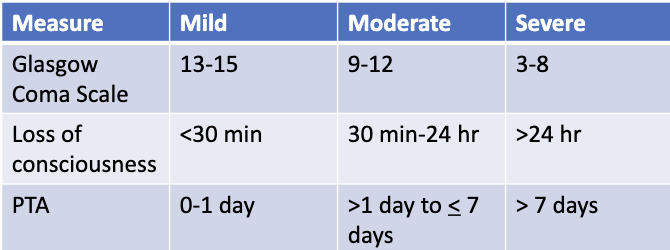
GCS- eye opening, body motor response, verbal respone
different from stroke scale because higher scores indicate better function
Amnesia:
Retrograde- Loss of ability to recall events occurring immediately proceeding the TBI incident
Anterograde- Inability to learn new information from the time of injury
Posttraumatic (PTA)- Time between TBI incident and return of memory function; Duration linked to severity of injury
important measure of brain injury severity
Persistent vegetative state:
Wakeful
Reduced responsiveness
Some eye tracking
Minimal spontaneous motor activity
Do not speak
Do not respond to verbal stimulation
Locked-in syndrome
• Has eye movement
• No other body movement
• Is conscious
• Can think
Injury severity: mild, moderate, severe
Ranchos Los Amigos Scale
Used to follow behavior and cognition progression
Used in Rehabilitation
Patients can plateau at any level
Patients typically demonstrate transitions between levels with periods of time demonstrating behaviors in both levels
Originally 8 levels adapted version now with 10
if they are showing behaviors between 4 and 5, rate them at a 4; always rate the lower level
I - No Response
II – Generalized response
III – Localized response
IV – Confused, agitated
V – Confused, inappropriate, non-agitated
VI – Confused appropriate
VII – Automatic appropriate
VIII – Purposeful appropriate
IX – Purposeful, appropriate: stand-by assistance on request *
X – Purposeful, appropriate: modified independent
Patient Management: Rancho Level IV, confused agitated
Control environment
Limit stimulation
Reassure patient
Tell patient what your relationship is to them
Monitor for physiological signs of stress
Alternate easy & pleasurable activities with difficult & unpleasant activities
Short treatment sessions
DO NOT LEAVE UNSUPERVISED
Patient Management: Rancho Level V, confused, inappropriate, non-agitated
Orient to person, time, & place at each session
• Simple concrete commands
• Set limits that you can enforce
• Follow through on all limits set
• Monitor for physiological signs of stress
• Maintain control of session by adjusting demand level before an outburst occurs
• Do not respond emotionally to inappropriate behavior
Re-direct inappropriate behavior
• State the inappropriate behavior
• Remind patient of consequences of inappropriate behavior
• Thank the patient if they modify the behavior
• Always redirect with age appropriate tone of voice and word selection
• Give patient choices for therapeutic activities
• Always thank the patient for working with you
• Let patient know when you will see them again
• DO NOT LEAVE UNSUPERVISED
Escalation to an outburst
Early stages
• Physiological signs of stress
• Refusal to participate
• Verbal challenge to caregiver
Increasing escalation
• Threats to caregiver
• Verbal tirade
Escalation complete (maximum energy expenditure)
• Physical acting out (patient is out of control)
De-escalation (energy expenditure decreasing)
• Debriefing
Outbursts in the Clinic
Early stages
• Get patient to a surface if moving around
• Therapists directed break between activities
• Initiation of therapeutic activities that the patient perceives as more pleasant or less challenging
• Re-direct inappropriate behavior
• Follow through on all therapist set limits
• Limit interaction to that which is absolutely necessary and allow processing time between each therapist initiated interaction
• If escalation stops complete therapy with one more therapeutic activity
• Give patient appropriate reward
• Thank patient for working in therapy
Increasing escalation
• Take threats seriously
• Make eye contact with support staff in clinic to have help available if needed
• Succinctly state that the threat is not appropriate
• State that therapy will not end if the patient follows through on threat
• Allow patient to burn off energy during verbal tirade if possible (patients can de-escalate at this point)
• Once energy level decreases listen for opportunity for therapist directed return to therapeutic activities
• Control environment
• Limit stimulation
Escalation complete
• Safety for patient
• Physical restraint
• Safety room
• Medication
• Guide/assist patient to a surface (bed or floor)
• Safety for therapists
• Help from other team members
• Stay beyond reach of extremities if unable to restrain extremities
• Utilize defensive techniques to release self if necessary and trained
• Limit verbal re-direction
De-escalation
• Re-engage with patient
• Re-establish therapeutic rapport
• Communicate to patient the plan for ongoing therapy
Debriefing
• Answer questions the patient has about escalation
• Accept patient apology if offered
• Reassure the patient that your therapeutic rapport with the patient is not changed
• Encourage the patient to move forward with therapy
• Support the patient in putting the event behind them
Patient Management: Rancho Level VI
Review orientation x3
• Be prepared for regression in behavior especially with new situations and more difficult activities
• Re-direct inappropriate behavior as needed
• Increase complexity of verbal directions
• Work on more multi-step commands
• Provide environmental cues to help with cognitive deficits
• Supervision still required, but can be line of sight supervision with some patients instead of direct physical presence
• Allow increased autonomy for therapeutic task completion
• Instruct patients to self monitor behavior
• Participation in group sessions can begin
Verbal interaction with confused patients
Remind patient of who you are and your relationship with them
Orientation x 3
Giving commands- Simple, Concrete, Short
Own your reality
Re-orienting
Restorative cognitive function patient
State accurate reality up to 3 times
Redirect to a different topic if the patient is unwilling to accept accurate reality
Non-restorative cognitive function patients
Operate within patient reality
Redirect to a different topic
Allow time between interactions for patient information processing
Provide information on an as needed basis
Reassure patient
Do not respond emotionally to inappropriate behavior
Re-direct inappropriate behavior
Talk in age-appropriate manner