DRM Mid-Term
 Call Kai
 Learn
 Practice Test
 Spaced Repetition
 Match
 Flashcards
 Knowt Play
1/57

Earn XP
Description and Tags
09/11/2026 - Concept List Part 1 & 2
58 Terms
Informal Approach
Drawing conclusions based on observations in daily life and personal opinions rather than standard research methods, making it flexible but vulnerable to bias
Systematic Approach
Observations based on adequate research following standard research methods according to a fixed, methodological plan
Scientific Method - Definition
A cyclical process of making observations, establishing a theoretical foundation, asking questions, designing studies, collecting and analysing data, and sharing results
Scientific Method - Steps

Fundamental Research vs. Applied Research
Fundamental research aims to explore topics and build theories to improve knowledge for its own sake, whereas applied research aims to resolve specific practical problems

Research Methods
Specific procedures, strategies, and techniques used for systematically collecting and analysing data
Research Problem
A statement pointing out an area of concern, knowledge gap, or situation needing improvement that establishes the need for an investigation
Research Objective
A practical, action-oriented statement summarizing what a research project aims to achieve
Research Question
The single overarching central question that an entire research project is designed to answer
Research Sub-questions
Secondary questions that break down a complex main research question into smaller, more manageable parts
Research Ethics
Ethical principles that guide all research
Honesty - principle of research ethics
Being truthful in your work, using reliable data, avoiding plagiarism by properly citing all your sources
Scrupulousness - principle of research ethics
Using appropriate scientific methods and designing your research carefully
Transparency - principle of research ethics
Being clear about what data you used, how you obtained it, what your results are, so that your work is verifiable, full disclosure and openness regarding potential conflicts of interest and external support so that other researchers and the public can assess the research's objectivity
Independence - principle of research ethics
Ensuring that your research process is guided by scientific considerations, not outside pressures
Responsibility - principle of research ethics
Conducting research that is relevant to society and always considering the interests and safety of your research participants, as well as other stakeholders involved, can also include informed consent and protection of participants
Data
Collection of raw facts, which on their own may not have a purpose and require processing
Information
Result of processing raw data, perception of data gained through analysis, which puts a set of data points into a context that has meaning
Fact / empirical evidence
Information that is demonstrably true and can be proven through research methods, such as observation or measurement
Theory
A logically consistent explanation about a specific behaviour or set of events based on known principles and validated by empirical evidence
Framework
A structure, model or tool providing a step-by-step approach to investigating a research problem
Cognitive Biases
Pattern of systematic errors in thinking that results in a misperception of reality
Logical Fallacies
Errors in reasoning related to making claims and constructing arguments, which may occur unconsciously or be used intentionally to mislead
Qualitative Research
Research focusing on non-numerical data about lived experiences, emotions, or behaviours to gain a deep understanding of complex social phenomena
Quantitative Research
Research focusing on numerical and statistical data that can be measured, ranked, or categorised to uncover patterns or make generalisations
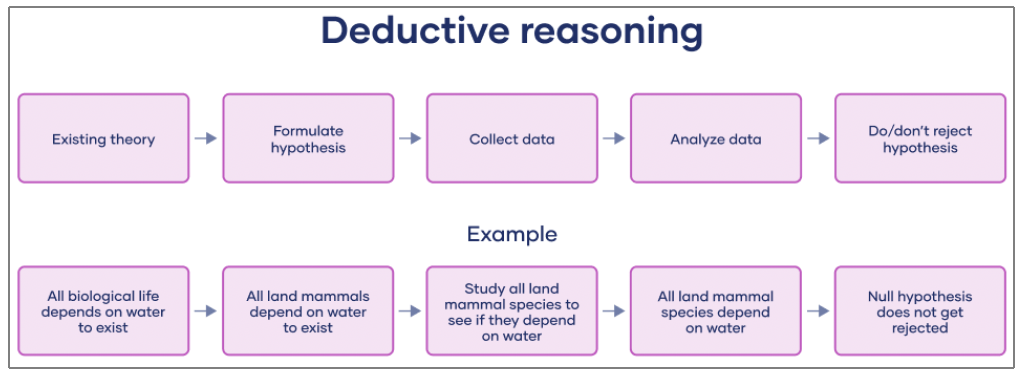
Deductive Reasoning
A top-down approach moving from a general theory or rule to formulating and testing specific hypotheses with data
Inductive Reasoning
A bottom-up approach moving from specific observations to pattern recognition and broader general conclusions or theories.

Mixed-methods Research
Research approach that combines quantitative and qualitative methods to gather and analyse data
Multi-method Research
Research approach that uses two or more methods from the same family, either multiple qualitative methods or multiple quantitative methods
Triangulation
The practice of using multiple viewpoints, data sources, or methods to cross-verify research findings and enhance reliability.
Holism
Understanding that a system is more than just the sum of its parts
Research Project
Scientific effort to answer a research question within a limited time, following a structured approach to achieve an observable result
Preliminary Research
Initial phase of any research project, where you find basic information about your topic, answering questions such as who, what, when and where
Background Research
Extensive literature research following the preliminary research phase
6W Problem Analysis Framework
A structured approach analysing a problem across 6 key perspectives: what, why, where, who, when, and which (or how)
Research Proposal
Structured, formal document that explains what you plan to research, why it is worth researching, and how you will conduct the research
Case Study
Detailed investigation of a particular problem, person, group, or event. It is like zooming in on one piece of the puzzle to understand how it fits into the bigger picture
Primary Sources
Raw data and firsthand evidence that have not been interpreted or evaluated by an outside party.
Secondary Sources
Secondhand information providing interpretations, evaluations, or analyses of primary sources.
White Literature
Traditionally published, peer-reviewed academic works
Academic articles
Formal texts, also known as scholarly articles, studies, or papers, written by experts and published in academic journals after a rigorous peer-review process
Peer-review
Formal process where experts in a field evaluate a research paper before it can be published in an academic journal
Grey Literature
Materials and research produced by organisations outside of traditional academic publishing
Ad hominem
A ad hominem fallacy is one that attempts to invalidate an opponent’s position based on a personal trait or fact about the opponent rather than through logic. Example: Katherine is a bad choice for mayor because she didn’t grow up in this town
Straw man
A straw man argument is one that argues against a hyperbolic, inaccurate version of the opposition rather than their actual argument. Example: Erin thinks we need to stop using all plastics, right now, to save the planet from climate change
Equivocation/ambiguity
An equivocation is a statement crafted to mislead or confuse readers or listeners by using multiple meanings or interpretations of a word or simply through unclear phrasing. Example: While I have a clear plan for the campus budget that accounts for every dollar spent, my opponent simply wants to throw money at special interest projects
Slippery slope
With a slippery slope fallacy, the arguer claims a specific series of events will follow one starting point, typically with no supporting evidence for this chain of events. Example: If we make an exception for Bijal’s service dog, then other people will want to bring their dogs. Then everybody will bring their dog, and before you know it, our restaurant will be overrun with dogs, their slobber, their hair, and all the noise they make, and nobody will want to eat here anymore
Hasty generalisation/anecdotal fallacy
A hasty generalisation is a statement made after considering just one or a few examples rather than relying on more extensive research to back up the claim. It’s important to keep in mind that what constitutes sufficient research depends on the issue at hand and the statement being made about it. Example: I felt nauseated both times I ate pizza from Georgio’s, so I must be allergic to something in pizza
Appeal to authority
In an appeal to authority, the arguer claims an authority figure’s expertise to support a claim despite this expertise being irrelevant or overstated. Example: If you want to be healthy, you need to stop drinking coffee. I read it on a fitness blog
Causal fallacy
A causal fallacy is one that implies a relationship between two things where one can’t actually be proven. Example: When ice cream sales are up, so are shark attacks. Therefore, buying ice cream increases your risk of being bitten by a shark
Cherry picking
Cherry picking is a logical fallacy that occurs when someone selectively presents evidence that supports their argument while ignoring evidence that contradicts it. Example: Someone claims that a particular diet works because their friend lost weight on it, without mentioning that the friend also exercised regularly and followed a strict regimen
Burden of proof
The burden of proof fallacy occurs when a person makes a claim but fails to provide evidence for it, instead shifting the responsibility to others to disprove the claim. Example: One person makes a claim, such as "Aliens exist," and then demands that others prove the claim is false instead of providing evidence for their assertion
Personal incredulity
Personal incredulity is a logical fallacy where someone dismisses a claim simply because they find it hard to understand or believe. Example: A person might say, "I can't believe we landed on the moon; it seems impossible," ignoring the extensive evidence supporting the event
Confirmation bias
Tendency to notice, focus on, and give greater credence to evidence that aligns with our existing beliefs
Availability heuristic
Tendency to use information that comes to mind quickly and easily when making decisions about the future
Cognitive dissonance
Psychological discomfort we experience when we hold two or more conflicting beliefs, attitudes, or values simultaneously. To resolve this tension, we often change, justify, or ignore the conflicting information
Social desirability
Tendency of individuals to respond to questions in a way that they believe will be viewed favourably by others, rather than providing their true thoughts or behaviours
Dunning-Kruger effect
Occurs when a person’s lack of knowledge and skill in a certain area causes them to overestimate their own competence