Survey of Invertebrates midterm 1
 Call Kai
 Learn
Learn Practice Test
 Spaced Repetition
 Match
Match Flashcards
 Knowt Play
1/197

There's no tags or description
Looks like no tags are added yet.
Name | Mastery | Learn | Test | Matching | Spaced | Call with Kai | Chat |
|---|
No analytics yet
Send a link to your students to track their progress
198 Terms
life in water vs life in Air
Life in water has high humidity, high density, high specific heat due to stable temps, low oxygen solubility, high viscosity due to it being greater that friction and high nutrients and light extinction. Life in air has low humidity, low density, low specific heat due to variable temps, high oxygen solubility, low viscosity due to it being less than friction and low nutrients and light extinction.
Reproduction in water vs air
In water it is external, gametes, embryos and larvae are protected from desiccation (drying out), and minimal nutrient investment per egg. In Air it is Internal, Gametes cannot simply be released into environment as they would dry out. Lower nutrients means adults must make a higher investment in eggs.
Respiration in water vs air
In water respiratory surfaces thin and exposed to environment, gas exchange occurs across body surface or external structures such as gills, water contains little oxygen and diffuses more slowly in water than air, need to move water over respiratory surfaces(currents assist sessile animals). In air oxygen is abundant and diffuses rapidly in the air, exposed respiratory surfaces severe water loss so respiratory surfaces are internal (trachea, lungs) or other wise protected.
excretion in water vs air
In water ammonia can be released directly in water, toxicity less problematic due to continuous dilution/flushing away, relatively simple excretion methods are effective. In air water for flushing ammonia limited, ammonia converted to less toxic urea/uric acid allows for excretion with less water, requires additional biochemical processing and energy expenditure, terrestrial animals require more complex excretory system to conserve water.
Feeding in water vs air
Feeding in water, water acts as a transport medium for nutrients and food particles, makes suspension and filter feeding possible, water currents deliver food directly to sessile organisms, high light extinction means animals far away from plants/algae(primary producers) creating food through photosynthesis. In air food generally not suspended in surrounding medium, animals must move to locate food/ have food delivered by other mechanisms, water must also be preserved during food processing.
Motility-sessile sponges phylum Porifera
Only sessile after motile, flagellated larva undergoes metamorphosis. Larva not free swimming movement (planktonic) but can control vertical moment. Environment influences dispersal and settlement, Temps, light, sediment levels, beneficial bacteria and biofilms attached to bottom of aquatic environment (benthos) effect settlement and metamorphosis. research happening to see how these factors interact/can be manipulated for sponge restoration and aquaculture. Some species can also recover and reattach if uprooted as adults.
Motility-sessile hard corals phylum Cnidaria order Scleractinian
sexual reproduction produces a motile planula larva that settles and develops into a polyp. many polyps arise asexually from existing polyps and therefore do not pass through a larval stage.
motility- sessile sea anemones
Typically sessile lifestyles attached to substrate, some species can detach and move when threatened(energetically expensive). Can anchor themselves with a sticky pedal disc (foot), some can also move along ocean ocean floor on their foot to go to a better environment.
Motility-Sedentary Feather duster worms (Phylum Annelida, class Polychaeta)
Feather duster worms are sedentary, tube-dwelling polychaetes remain in one general location but not permanently attached or immobile. Can move within tubes, extending feathery feeding crown(radioles) into water, rapidly withdrawing when disturbed, protective tubes made from secreted material combined with sand sediment and other debris. In contrast there are many other polychaetes that actively crawl, burrow, or swim from place to place. Feather duster worms illustrate distinction between sedentary (limited to one location but capable of movement) and sessile (physically attached to a substrate)
Motility-Sedentary sea scallops (Phylum: Mollusca, Class Bivalvia)
Have both a motile larval stage and motility as adults, but most of their lives spent on bottom (benthic) most bivalves do not have significant in-water motility (mussels, clams), heavy shells make mobility energetically expensive, still can move, sometimes quickly.
Motility-Motile sea stars (genus Pisaster)
Move regularly and are effective predators (moving not just for evasion, but predation), no fully attached stage, do not leave the benthos as adults.
Motility-motile Octopus (Phylum Mollusca Class Cephalopoda “head foot”)
Habitat is demersal, meaning spending most of their time near the bottom but not fully benthic (on the bottom). Octopus can swim freely, actively pursue prey through water, use multiple modes of locomotion, among invertebrates most remarkable adaptation of mobility and capacity for environmental response.
Motility-motile Nautilus (Phylum Mollusca Class Cephalopoda)
Habitat fully pelagic, despite being shelled, meaning open water from surface to around 2600m. do not commonly touch bottom, has rare ability to with stand being brought to surface from deep habitats without suffering apparent barotrauma, if brought up slowly due to chamber shells allowing them to adjust amount of fluid and gas in shells internal chamber with a tube called a siphuncle this is how they naturally adjust buoyancy.
Take home point for motility
There are three categories(Sessile, Sedentary, Motile), but there is a lot of behavioural and ontogenetic (origin and development of organism throughout lifespan) transition between the definitions.
Aquatic Habitat- Benthic
Living in or closely associated with the bottom of an aquatic environment (sea stars, clams, many worms, corals)
Broken up into two categories Epibenthic (on the surface) and Infaunal (in the substrate). Microfauna, meiofauna, and macrofauna defined by size. Microfauna <0.4mm, meiofauna (0.4-1mm), Macrofauna > 1mm.
Aquatic Habitat- pelagic
Living in the water column. Can be planktonic (drifting) or nektonic (active swimmers)
Large Pelagic Plankton
some plankton can be huge lion’s main jellyfish (Cyanea capillata) up to 120 feet in total length including bell and tentacles. Chrysaora (genus) jellyfish, AKA sea nettles (common name) Megaplankton > 20cm. named after Chrysaoar, son of Poseidon and Medusa “with golden armour”
Aquatic habitats (marine) Epidenthic
Defined as organisms that live on or just above the bottom sediments in a body of water. there organism, many of which support commercial and recreational fisheries, tend to forage on the creatures that live in or on sediments, shown on image as very thin pale layer on the benthos.
Aquatic habitats (marine) Littoral
intertidal zone, or the area on marine shores that is periodically exposed to air during low tide.
Feeding Strategies
How food is captured defines the food resource that can be accessed. Not exclusive to each-other (something can be both herbivorous and detritovore) 1. suspension feeders, 2. Detritivores, 3. Deposit feeders, 4. Herbivores, 5. Carnivores, 6. Symbiotic feeding. Note there are overlapping and fuzzy definitions of feeding methods even for a single organism, depending on species, life cycle and organism condition.
Feeding Stategies: Suspension feeders
Capture food particles suspended in the water column.
Feeding Strategies: Detritivores
fallen organic particles from water column, often non-animal. (consume debris)
Feeding Stategies: Deposit feeders
feed on mud and sand often feeding on surface films of bacteria
-selective: typically feed on sediment interface
-non selective: aka bulk deposit feeders, feed within sediments.
Feeding Stategies: Herbivores
feed only on plant material
Feeding Stategies: Carnivores
Feeds on animal tissues
-Grazing carnivores: feed sessile organisms like sponges
-Predators: pursue active motile prey
-scavengers: feed on dead organisms
Feeding Stategies: Symbiotic feeding
Long-term association between two or more species that involves a transfer of nutrition.
Suspension feeders: Larvaceans
Free swimming tunicates, in phylum Chordata, class Appendicularia. Create a large mucus “house”, which they use to concentrate target particles for more efficient feeding. Tadpole like tail used to pump water through their “house”, use filters to remove suspended particles. house can be up to 1m and are released and remade when they become clogged.
Deposit feeders: Holothurians (sea cucumber, Holothuria edulis)
Surface detritivores, ingesting large amounts of sediment. non-selective ingestion but can select areas with better sediment. There is a long standing large fishery for these organisms especially in Indonesia.
feeding can also have secondary ecosystem impacts. sea cucumbers are both deposit feeders and deposit creators, sea cucumber poop produced in large amount and helps coral reef.
Suspension feeder, predators, symbiotic feeders: Hard corals (Scleractinians)
Have obligate photosynthetic symbionts and benefit significantly from the sharing of organic material. Most polyps also able to capture prey from water column with sting cells or filtration. When obligate photosynthetic symbionts leave due to unfavourable environmental conditions (warming), the corals lose benefits from the sharing of organic material. biggest cause of coral reef death worldwide.
Detrivores Abalone (large gastropod, molluscs, family Haliotidae)
Nominal detritivores feeding on loose detached kelp pieces on the bottom. Can become active herbivores when starved, with ecosystem consequences.
Herbivores: Idotea (phylum arthropoda, family Idoteidae)
Feeds mainly on algae such such as Fucus (brown), Gracilaria (red), Cladophora, (green). Pollinator of the sea.
Life styles
Sessile: lives in one place attached to the bottom, usually for the life of the organism.
Sedentary: lives in one place not physically permanently attached, and usually can (but sometimes rarely does) move locations.
Motile: Can move across the bottom often across long distances aka mobile or vagile
Detrivores: Fiddler crabs (Phylum Arthropoda, Family Ocypodoidae)
Fiddler crabs eating sand, consuming all the organic matter (bacteria and detritus) there by cleaning the sand and turning that matter back into meat (their own tissue). Ecological importance: near the bottom of food webs, pivotal in structuring ecosystem function, indicate aquatic system wellbeing. Economic importance: food, biofouling, specialized uses like medical studies (horse shoe crabs). Biofouling us organisms growing on man made structures.
Taxonomy vs phylogeny
Taxonomy is the study of classification of organisms. Phylogeny is the study of evolutionary relation ships between organisms.
Taxonomy is structured around classical Linnean system (Carl Linnaeus, Swedish botanist) with seven divisions: Domain, Kingdom, Phylum, Class, Order, Family, Genus, Species.
Taxonomy Specifics of usage
Classical Linnean naming (‘Latin’ or ‘Scientific” names) classification of organisms. Phylum is the organizational structure of this course. Order and family are not as often used, and are some of the taxa most in flux at present. Genus and species are italicized, and are the most commonly used terms. Often Genus is used in the field, as there can be cryptic species. Species names are often used verbally in the practice as well, but are best written with the genus abreviation.
Phylogeny Origin
German zoologist Ernst Haeckel drew this first diagram representing the diversity of species in General Morphology of organisms. Built on the ideas of Charles Darwin in On the Origin of Species. Haeckel also coined terms phylogeny and ecology. Based on paleontological, embryological, and systemic data. a precursor to modern biology’s phylogenetic trees aka cladograms.
Phylogeny: Creates a diagrammatic ‘tree of life’
Also known as cladograms, a complex branching diagram that shows proposed ancestral relationships among organisms. These diagrams show hypotheses about evolutionary relationships between different branches referred to as clades. Organisms are arranged in such a way that each clade shares common traits or characteristics not shared with other clades. Can be horizontal or vertical in multiple different formats. Some recent classifications based on modern cladistics have explicitly abandoned the term kingdom, noting that some traditional kingdoms are not monophyletic, meaning that they do not consist of all the descendants of a common ancestor. Take home message: be careful of phylogenies, and know that to some extent they are in flux
Anthopleura elegantissima (common sea anemone)
Easily accessed, shallow, but still remarkable. Have symbiotic photosynthetic organisms that translocate organic carbon to the host. We are finding that nearly all organisms have symbionts, including us. Symbionts fundamentally change the phenotype of organisms, and maybe we should be characterizing organisms by species and symbiont community. This collaborative community is the holobiont, and will be mentioned in many organisms in this course.
Phenotype
Phenotype refers to an individual's observable traits, such as height, eye color and blood type. A person's phenotype is determined by both their genomic makeup (genotype) and environmental factors. Example: The shells of individuals within the bivalve mollusk species Donax variabilis show diverse coloration and patterning in their phenotypes

Cladograms
Diagram of a phylogenetic hypothesis Nested sets of sister clades, defined by nodes Evolutionary time (in this case) advances left to right, but not at same scale (be careful with this). Each branch point = node. A clade is a group of organisms that includes a single ancestor and its descendants.
Node
Clade
Evolutionary time

monophyletic clade
Phylogenetically a clade is properly called a monophyletic clade or monophyletic group. Represent unbroken lines of evolutionary descent (i.e., all descendants from a single evolutionary event). The term is not always used this way, so be careful.

Polyphyletic
Polyphyletic and paraphyletic groups do not include all the descendants of the ancestor. These group can have different names (example Reptilia, which does not include birds)

Sister clades: two descendant groupings that split from the same node.
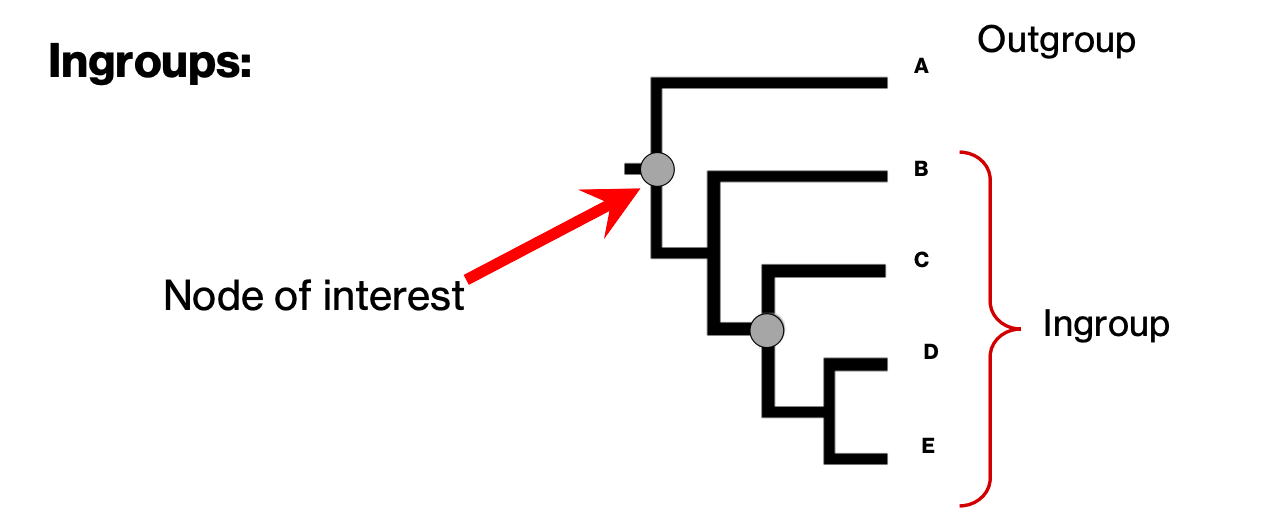
Ingroup vs outgroup: The ingroup is the group of taxa that is investigated for determining evolutionary relationships (i.e., creating a tree). They are closely related taxa or sister taxa. In contrast, an outgroup is a reference group that is outside the group of interest. The outgroup is distantly related to the ingroup. Might not include all members of a clade.

Monotypic taxon: The special case where a genus and a single species are simultaneously described. Ex. Homo sapiens (for extant species) is monotypic, with no extant species or subspecies within the genus.
Cladograms and convergent evolution
Convergent evolution: the process whereby distantly related organisms independently evolve similar traits to adapt to similar necessities. Ailurus fulgens (red panda) is a proposed monotaxon, despite similarities in the pseudo-thumb (pt), the exclusive bamboo diet like giant panda, and the cute eye shading, which are apparent synapomorphies (derived characters with same ancestors), but are in fact not homologous. Putting them together is polyphyletic grouping.
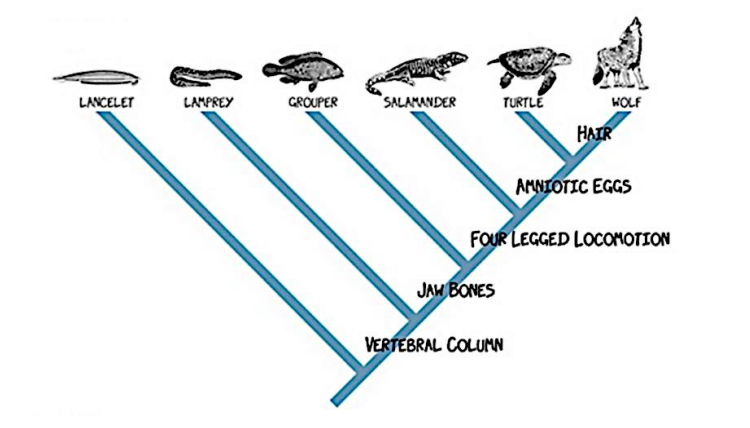
Cladogram simplification
Only groups of interest: Much complexity is lost in the typical cladogram. Remember they represent specific hypotheses, and read them for the message, not as a comprehensive diagram of the complexity of life.
Introduction to the sponges – habitat & lifestyles
both marine & freshwater, can be deep. sessile as adults. suspension feeders (with exceptions). An exception to suspension feeding (Chondrocladia grandis) Cold deep-water carnivorous sponges that prey on planktonic crustaceans, presenting large inflatable spheres attached to covered with a sticky material. Stuck prey will be surrounded by a layer of cells which digests it.
Sponge oddities
In 1964, researchers aboard the Oceanographic Research Ship the USNS Eltanin photographed this species on the seafloor at a depth of 3,904 meters. The upright antenna-like structure and precise angular geometry appeared manmade, and the organism became known as the Eltanin Antenna. The Eltanin Antenna was picked up by fringe and UFO devotees and labeled an extraterrestrial artifact. Seven years later, the object was identified as the rarely seen deep-water carnivorous sponge called Cladorhiza concrescens, having been first identified in 1888. By 1964, knowledge of the sponge had already existed for 76 years, but even to this day fringe believers interpret this shape as having complex mathematical properties not created by evolution.
Multicellularity
A condition or state of having
A condition or state of having or being composed of many cells, with more than one cell type performing differing functions.

sponge cladogram cladogram: Sponge evolution and success is the result of integrating flagellated cells (choanocytes) that produce water movement through the animal.
Choanaflagellates: precursors to Porifera
The choanoflagellates are a group of freeliving extant unicellular and colonial flagellate eukaryotes considered to be the closest living relatives of the animals (i.e. sister clade to Animalia) They are universal in aquatic environments and wet soils; abundant in polar waters, at abyssal depths of the oceans and in permafrosts. Choanoflagellates retrieved from frozen soils have been estimated to be approximately 32,000 years old!
Choanaflagellates: precursors to Porifera
Choanoflagellates have a funnel shaped collar of interconnected microvilli (microscopic cellular membrane protrusions that increase the surface area for diffusion), at the base of their single flagellum. Similar features are seen in the choanocytes of Porifera. Choanoflagellates also have some homologues for genes involved in metazoan multicellularity. The highly conserved genes defining multicellularity include those are involved with cell adhesion, intercellular communication and coordination, tissue differentiation and programmed cell death.
Multicellularity
A condition or state of having or being composed of many cells, with more than one cell type performing differing functions.
Possible evolutionary progression of multicellularity characteristics:
1. Directed cell adhesion (i.e. cells becomes selective for similarity)
2. Cell specialization & interdependence (Note: requires intercellular signaling)
3. Complex embryonic differentiation (ontogenetic development of different cell types from stem cells)
The evolution of animal multicellularity: Advantages (why did this develop)?
1.Cells can perform all life functions more efficiently due to specialization
2. Larger body sizes and more complex body types can be achieved, with a positive competitive advantage
3. This diversity of body sizes and types opened up a much larger range of habitat niches to occupy, which are not available to unicellular organisms
Metazoan Tissue Types
Epithelial tissue (cellular, polar, and avascular)
Connective tissue (abundant intracellular matrix with collagen)
Nervous tissue (excitable, linear, branching cells)
Muscle tissue (contractile and highly vascular)
Gametogenic tissue (haploid, sexually dimorphic, reproductive)
Tissue specialization: Epithelial tissue, Defining Characteristics:
Forms tight and regular cell sheets (cellularity)
Have a dictated direction (polarity)
Are a surificial layer of other cells (attachment)
Have no blood cells (avascular)
show rapid growth (regeneration)
Tissue specialization: epithelial tissue, functional importance:
Transitional covering on all internal and external surfaces of your body
Lines body cavities and hollow organs and is the major tissue in glands
Preforms protection, secretion, adsorption, excretion, filtration, diffusion, and sensory reception.
Tissue specialization: Connective tissue, defining characteristics:
-Formed by an abundant intercellular matrix with relatively few connecting cells.
-Contains collagen (the main structural protein in connective tissues, and the most abundant protein in mammals, approximately 25%-35% of whole body protein content)
Tissue specialization: connective tissue, Functional importance:
-connective tissues, binding and holding other tissues together
-supporting and protecting individual organs
-provides elasticity for movement (ex. cartilage)
Tissue specilalization: Nervous tissue, Defining characteristics:
-Rope-like linear or branching bundles in structure
-Fibers are excitable, i.e. capable of sending and receiving electrochemical signals
-comprised of neurons and neuroglial cells, with the glial cells supporting the neural structures
Tissue specialization: Nervous tissue, Defining characteristics:
-Generate and conduct sensory or motor impulses between the brain or spinal cord
-provides all parts of the body with information, and controls both voluntary (ex. movement) and autonomous body functions (ex. digestion)
Tissue specialization: Muscular tissue, Defining characteristics:
-Has special property of being able to shorten (contractile)
-Tissue os highly vascular (i.e well supplied with blood vessels)
-Often have elongated nuclei
Tissue specialization: Muscular tissue, Functional importance:
-contractions produce movement of the body parts
-must work with nervous tissue for stimulus
-Also used for heat generation and fluid distribution functions (ex. blood)
Tissue specialization: gametogenic tissue, Defining characteristics
-Haploid (n), or having one set of chromosomes (these are the only tissues that are haploid)
-produced by dedicated diploid (2n) germ cells which undergoes meiosis to form haploid cells (genetically variable)
-Typically sexually dimorphic, with male gamete smaller in size and motile and the female gamete several times bigger and non-motile.
Tissue specialization: gametogenic tissue, Functional importance:
-for reproduction only
-can generate genetic variation among offspring which may allow for faster adaptation of the population to novel and/or stressful environments.
Introduction to the sponges: Class Calcarea
Have hard spicules composed of calcium carbonate
Spicules are essentially made of concrete (CaCO3)
These show up well in the fossil record with over 100 genera identified.
Introduction to sponges: Class Hexactinella
Have hard spicules composed of silica dioxide
spicules are essentially made of glass (or quartz, or sand: SiO2)
form complex spicule ‘houses’, which can remain intact after death.
Introduction to the sponges: Class Demospongiae
Most have no spicules, all have dominant structure of spongin (protein)
most fresh water sponges are in this group
The common bath sponge also included
SPONGE HABITAT & LIFESTYLE
Both marine & freshwater. Sessile as adults, but larval as juveniles. Filtering, hydraulic suspension feeders (with exceptions – some are symbiotic and some carnivorous). Filter up to 20K times body volume/day in water. Can capture up to 90% of bacteria in water (dep. on species)
SPONGE FEEDING
Small pores lead to a complex system of channels lined with specialized feeding cells called a choanocytes or collar cells which pump the water in.
The evolution of animal multicellularity
-Directed cell adhesion (i.e. cells becomes selective for similarity) -Cell specialization & interdependence (requires intercellular signaling)
-Complex embryonic differentiation (ontogenetic development of different cell types from stem cells) but not at same

Sponge tissue
Sponges have no ‘true tissues’ which are integrated cells that share a common structure and common function and are a result of embryonic gastrulation. (infolding) Sponges are multicellular but the only metazoans without ‘true tissues’. Sponges still have a difference between inner and outer tissue, and are able to increase size through intricate branching and folding patterns.

Sponge Morphology and Tissue types
Sponges have no specialized digestive system: just interconnected system of water canals (aquiferous system). Have ‘protoepithelial’ tissue that can direct water flow with tightly packed choanocytes. Do have connective tissue, with spongin, a modified type of collagen present only in demospongiae, which cannnot be dissolved by collagenase, pepsin, alkali, or dilute acid solutions.
Sponge: missing tissue types
Sponges have no nerval tissue, muscle tissue, they have no ovaries or testes, gametes produced by choanocytes, most are hermaphrodites, and can also reproduce asexually.
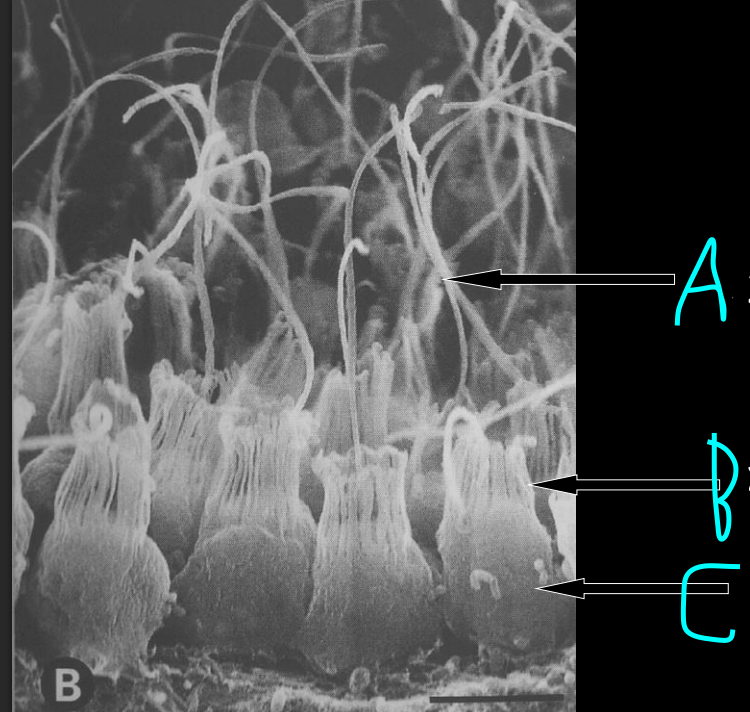
Internal sponge labeling
A. flagellum
B. collar
C. cell body
Internal sponge morphology (choanocytes)
Collars comprised of microvilli which filter water. Collars are the primary areas that nutrients are captured and absorbed. Food can be include bacteria, unicellular algae and animal-like protists. Particles then slide down into the cell for phagocytosis.

External Sponge Morphology (Pinacocytes)
Arrow shows intercellular junctions between pinacoderm cells (outer layer of cells) of a sponge. Pinacocytes form a squamous sheet on the outer surface and canals of sponges, and are almost an epithelium. Pinacocytes cab expand or contact slightly to alter the size and shape of the sponge.
Sponge Morphology: cell types summary
Choanocytes vs Pinacocytes two key differences. Choanocytes are cells with a flagellum that lines the interior of sponges, where Pinacocytes are flat cells present in the outer most cell layer of sponges. Secondly Choanocytes help to accumulate oxygen and nutrients, and Pinacocytes provide a shape to the body of the sponge.

Sponge Asconoid Body plan
Structure: The simplest and smallest body plan. sponges are tube or vase shaped and very small. Water path: Water moves directly through microscopic pores (ostia) into a large central cavity called the spongocoel. it exits through a single large opening at the top called osculum. Choanocyte location: The collar cells (choanocytes) line the intire spongocoel directly.
Sponge Syconoid Body plan
Structure: More complex and slightly larger than asconoids. The body wall is thicker and folded into radial canals. Water Path: water enters through dermal pores into incurrent canals, passes through tiny openings called radial canals, moves into the central spongocoel, and exits through a single osculum. Choanocyte Location: Choanocytes line only the radial canals, not the main spongocoel.
Sponge Leuconoid body plan
Structure: the most complex, largest, and most common body plan. The central spongocel is reduced or replaced by a network of branched canals and chambers. Water Path: water enters through ostia into incurrent canals, travels to small flagellated chambers, and exits through multiple excurrent canals and oscula. Chanocytes are confined exclusively to the numerous small flagellated chambers.
Glass sponge reefs in British Columbia
Glass sponge reefs in British Columbia: a unique and recently discovered ecosystem. Glass sponge reefs in British Columbia are under threat from commercial fishing (bottom trawl gear and prawn trap gear) Glass sponge reefs in British Columbia are now conserved by a series of marine protected areas.
More on Class Demospongiae
Class Demospongiae can contain siliceous spicules and/or extensive spongin structure. Its the largest and most diverse class in phylum Porifera around 80% of all sponge species; around 8,800 known species. Only class found in freshwater. Large range of sizes and morphologies, up to 2m wide. Commercially important fishery.
Florida’s first boom and bust fishery
Target of this fishery was Demospongiae, collecting sponges used to be a backyard cottage industry with non-industrial processing and relatively inefficient gear (only get sponges from the shallow waters of Florida). Technological revolution: introduction of diving, 1905. Greek divers arrived in Florida from Mediterranean fishery accessible depth expanded to 30-180 feet. Sponges were very profitable and central to Key West, Florida’s growth and boom time. The damage done by this fishery the sponges have still not recovered from.
Impacts of sponge removal on ecosystem
Removal of sponges reduced water filtration & benthic structure Sponges as water filters. Most efficient filter feeders on coral reefs. Sponges fished in 1 year would have removed 5,000kg of bacteria from water. Sponges as habitat: Provide structure for juvenile spiny lobster. Sponge disease in the 1990s linked to reduction in lobster recruitment
Conclusions: ecological dimensions of sponges
Sponges (and all organisms) exist in dynamic ecological and human systems. Changes to populations can alter ecology, which can further impact individual or population biology (i.e. biological function).
Members of Phylum Cnidaria
Phylum Cnidaria includes Anemones, Hydroids, Corals, Sea pens, Jellyfish
Cnidaria: Habitats and lifestyles
Aquatic: marine and freshwater. Benthic and pelagic (or often both ontogenetically). Two body forms: polyp and medusa. Solitary or colonial. They are all predators, even those that have developed symbiotic feeding.
Medusa:
Typical form of the jellyfish. Body is bell or umbrella shaped, with downward hanging tentacles, and a centre (subumbrellar) stalk like structure, the manubrium, bearing the mouth at its tip.
Polyp:
Typical form of the anemone or coral. Usually cylindrical, with upward facing mouth and tentacles. Term is also sometimes used for an individual in a colony of Bryozoans, but those are more properly termed zooids.
Phylum Cnidaria life styles
Different species can live as solitary (single polyp) or colonial. Can be a solitary polyp, a colonial polyp, a solitary medusa or a colonial medusa.

Cnidarian polyp basic form: two layers of epithelium
A. Epidermis
B. gastrodermis
C. mouth
D. Tentacle
E. GVC: gastrovascular cavity
F. body column

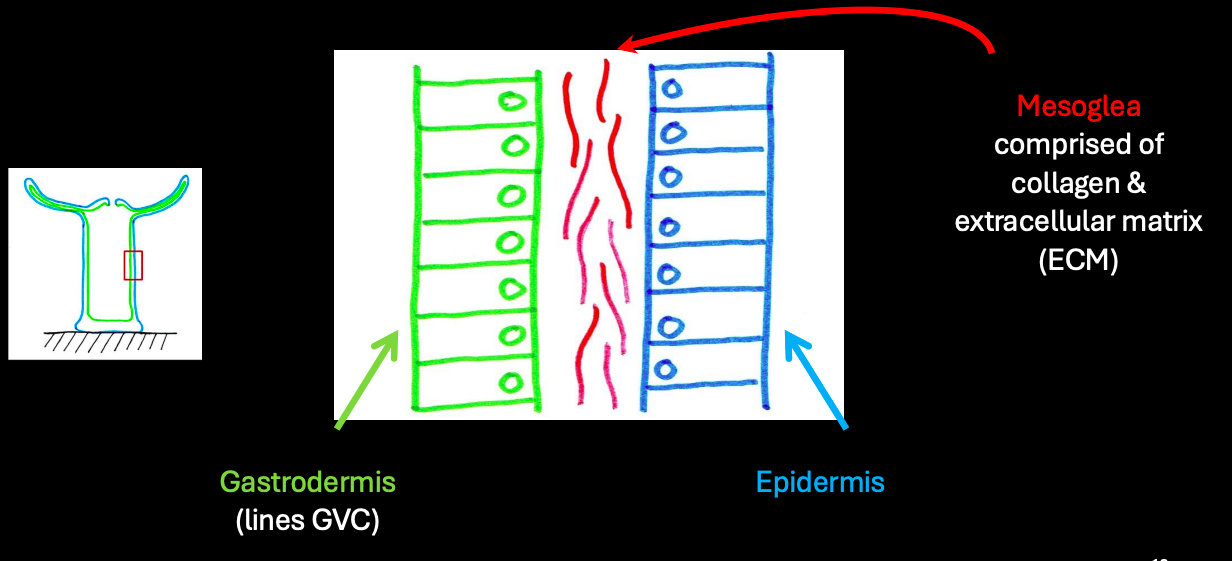
Cnidarian cell layers (section through body polyp wall)
What are the subphylum and classes of phylum Cnidaria
Subphylum Medusozoa with classes Staurozoa (stalked jellyfish), Hydrozoa (Hydroids), Scyphozoa (true jellies), and Cubozoa (box jellies). Subphylum Anthozoa with classes Octocorallia (soft corals and sea pens) and Hexacorallia (Stony corals and Anemones).
Subphylum Medusozoa, Class Staurozoa (stalked jellyfish)
Marine, from shallow (mostly) to deep. Solitary, but can be plentiful! Do not show alternation of generations. Elaborate polyp stage only. Usually sessile, but can move in a ‘looping fashion’ via attaching/detaching at basal plate and anchors on the bell; like a cartwheel!
Subphylum Medusozoa, Class Hydrozoa (Hydroids)
mostly marine, but also freshwater. Can be solitary or colonial, colonial species exhibit polymorphism, with specialized zooids. nematocysts in epidermis only. no living cells in mesoglea. alternation of generations
Subphylum Medusozoa, Class Scyphozoa (True Jellies)
exclusively marine. alternation of generations. mostly pelagic as adults. polyp (scyphistoma) generally small and polyps produce juvenile medusae (ephyrae) by strobilation. medusa typically have large, thick bells, they have rhopalia with statocysts for balance/orientation and ocelli that detect light. cnidocytes within epi- and gastrodermis - ameboid cells in mesoglea.
Subphylum Medusozoa, Class Cubozoa (box jellies)
marine, mostly tropical coastal waters. alternation of generations. box-like medusa dominated, but with a small benthic polyp stage. complex sensory structures (rhopalia) with lensed eyes. extremely potent venom