PTC Exam 2 Module 8: CBRNE Incidents and Mass Casualty Management
 Call Kai
 Learn
 Practice Test
 Spaced Repetition
 Match
 Flashcards
 Knowt Play
1/66

There's no tags or description
Looks like no tags are added yet.
67 Terms
CBRNE Stands for?
Chemical
Biological
Radiological
Nuclear
Explosive
Chemical category takes how long?
Seconds to hours
Decontamination is treatment; toxidrome recognition
Biological takes how long?
Days to weeks
Presents as an outbreak, not an incident— recognized retrospectively
Radiological takes how long?
Hours-years
Contamination is the responder hazard; irradiation alone is not
Nuclear takes how long?
Immediate + delayed
Overwhelming casualty load; conventional injury dominates early
Explosive takes how long?
Immediate; most common CBRNE event
What are the two acetylcholine receptor families? How are they triggered?
Muscarinic receptors: G-protein signaling inside the cell
Nicotinic receptors: ligand-gated ion channels
What effects do muscarinic receptors have on the body?
M2: Slows heart rate and AV conduction
M3: Increases secretions and contraction of glands and smooth muscle
What effects do nicotinic receptors have on the body?
Nm: Triggers muscle contraction in skeletal muscles
Nn: Relays signals/releases catecholamines in autonomic ganglia/adrenal medulla
Excess Muscarinic is identified by what signs
“wet/tight” signs
Excess nicotinic is identified by what signs
Weakness/paralysis
Twitching
What are the two Ach pathways inside the cell?
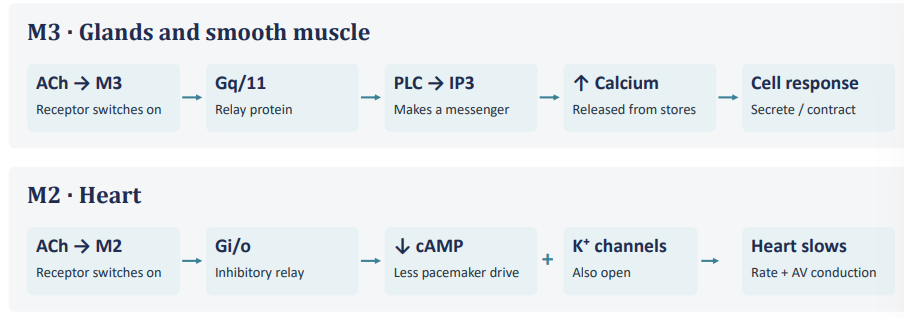
M3: Glands and smooth muscle → cell response (secrete/contract)
M2: Heart → heart slows
IP3 releases stored _________
calcium
cAMP helps drive _______________
cardiac pacemaker activity
Less cAMP, less pacemaker drive, heart rate slows
The most important chemical group for Ontario paramedics are ____________.
They are widely available in agricultural Ontario and produce the SAME toxidrome as military nerve agents.
organophosphate pesticides
What is the mechanism of organophosphate pesticides by which they produce the same toxidrome as military nerve agents?
Acetylcholinesterase inhibition
Ach accumulates at every cholinergic synapse. The result is a predictable syndrome divided by receptor type.
The SLUDGE acronym stands for what in reference to muscarinic effects of nerve agents and organophosphates
S- salivation
L- lacrimation
U- urination
D- defecation
G- GI upset
E- emesis
Also: bradycardia, bronchorrhea, bronchospasm, miosis
Bronchorrhea and bronchospasm are the two that WILL KILL
What are the nicotinic effects of nerve agents and organophosphates?
Fasciculations (muscle switches), muscle weakness→ paralysis, tachycardia, hypertension
What are the central effects of nerve agents and organophosphates?
Confusion, seizure, respiratory depression, coma
What are priorities for handling the effects of nerve agents and organophosphates as a paramedic?
Responder protection
removal from source
decon
aggressive airway/suction
antidote at appropriate scope
What does DUMBELS stand for in recognizing cholinergic excess?
D- diarrhea
U- urination
M- miosis (small pupils)
B- bronchorrhea, bronchospasm, bradycardia
E- emesis
L- lacrimation
S- salivation
Airway threats are wet and narrowed airways (bronchorrhea is excess airway secretions, bronchospasm is airway smooth-muscle contraction)
Antimuscarinic toxicity: Reduced secretions, impaired sweating, and altered cognition
Mad as a hatter:
Blind as a bat:
Hot as a hare:
Dry as a bone:
Red as a beet:
Full as a flask:
Mad as a hatter: delirium/agitation
Blind as a bat: dilated pupils/blurred vision
Hot as a hare: hyperthermia
Dry as a bone: dry skin/dry mouth
Red as a beet: flushed skin
Full as a flask: urinary retention
Also look for tachycardia and reduced bowel activity


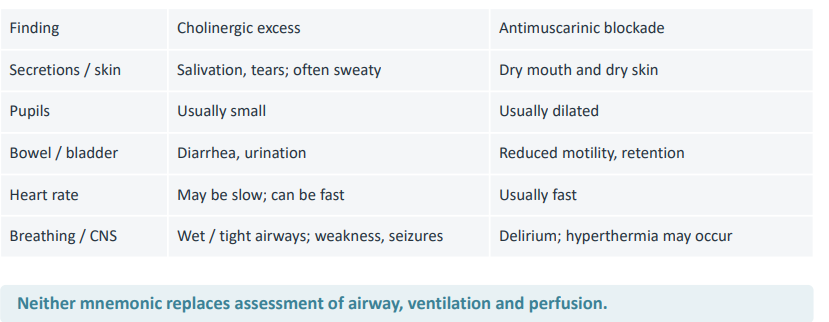
Which column is cholinergic excess and which one is antimuscarinic blockade?
Left column: Cholinergic excess
Right column: antimuscarinic blockage
_______ blocks muscarinic receptors
Atropine
A ________ is a protein that detects a chemical messenger and changes the behaviour of the cell
receptor
The term _________ describes anything related to acetylcholine
cholinergic
Muscarinic receptors are ______ receptors
G-protein-coupled
ACh does not bind to an open channel; it activates a G protein that relays the signal to enzymes and ion channels inside the cell
True or false: nicotinic is sympathetic and muscarinic is parasympathetic
False, both autonomic divisions use nicotinic receptors in their ganglia and sweat glands are the exception for muscarinic
What does acetylcholinesterase (AChE) do?
It is an enzyme that clears ACh from the synapse. It is not a receptor. When it is inhibited, ACh accumulates
Describe the M3 pathway
ACh activates M3 receptor
Switches on relay protein Gq/11
Gq11 activates phospholipase C (PLC)
This produces the second messenger: Inositol triphosphate (IP3)
IP3 releases calcium from intracellular stores
In a gland. the rise in intracellular calcium promotes secretion
In smooth muscle, it favours contraction
Airway consequences are bronchorrhea and bronchoconstriction
The calcium in this pathway is an intracellular signal. Does not signal that serum calcium rises and is not a cue to give calcium

Describe the M2 pathway
Ach activates M2
switches on the inhibitory relay protein Gi/o
Gi/o inhibits adenylyl cyclase (the enzyme that makes cyclic adenosine monophosphate [cAMP] from ATP)
In pacemaker cells, cAMP supports electrical activity that sets the heart rate, so less cAMP means less pacemaker drive
In parallel, parts of the G protein open potassium channels, which hyperpolarize nodal cells and make them harder to excite
OMG REMEMBER HYPERKALEMIA MEANS LOWER RESTING MEMBRANE POTENTIAL
These two actions act together: they slow sinoatrial firing and slow atrioventricular conduction

M3 overstimulation explains ______
M2 overstimulation contributes to ________
Sustained neuromuscular stimulation produces ________
Atropine blocks ________ receptors, including both M2 and M3.
It does not block ______________ receptors.
M3 overstimulation explains the wet, tight chest
M2 overstimulation contributes to bradycardia
Sustained neuromuscular stimulation produces fasciculations and then weakness and paralysis
Atropine blocks muscarinic receptors, including both M2 and M3.
It does not block skeletal neuromuscular receptors.
A _________ is a recognizable cluster of signs that points to a class of toxin
toxidrome
What’s the difference between SLUDGE and DUMBELS?
DUMBELS describes the same muscarinic syndrome and makes the pupil and airway findings explicit (in my opinion it’s better)
DUMBELS and SLUDGE describe _____ receptors
Fasciculations, weakness, and paralysis are _________ receptors
Seizures and depressed consciousness indicate ________ receptors
DUMBELS and SLUDGE describe muscarinic receptors
Fasciculations, weakness, and paralysis are nicotinic receptors
Seizures and depressed consciousness indicate central receptors
True or false: heart rate is the most reliable sign of cholinergic poisoning
False, it can be elevated because nicotinic ganglionic stimulation and hypoxia can raise it
True or false: bronchorrhea and bronchospasm are the findings that most directly obstruct ventilation, but are not the only mechanisms of respiratory failure. Respiratory muscle weakness and central respiratory depression also impair breathing
True
True or false: An antimuscarinic (anticholinergic) toxidrome results from blockade of muscarinic receptors. It does not imply blockade of every cholinergic receptor.
True
Central muscarinic blockade causes what?
Delirium and hallucinations
Peripheral blockade does what?
Reduces glandular secretion and sweating
impairs bladder emptying and intestinal motility
removes vagal restraint on the heart rate
reduced sweating leads to overheating
pupil dilation and impaired accommodation blur vision
Antimuscarinic toxidrome 3 causes:
Atropine
Scopolamine
Drugs with antimuscarinic properties such as some first-generation antihistamines
True or false: Findings for cholinergic excess and antimuscarinic blockade should be compared in pairs rather than relied on singly
True, and the history supplies the rest of the pattern: the agent, amount, time, and route.
True or false: atropine repairs acetylcholinesterase
False, it competitively antagonizes muscarinic receptors and so counters the secretions and bronchoconstriction produced by excess Ach
The primary goal for a paramedic dealing with cholinergic poisoning is the reversal of what?
Bronchorrhea and bronchoconstriction
This is why antimuscarinic drug can be life-saving
What does pralidoxime do?
AKA 2-PAM, is an oxime. It can reactivate organophosphate-inhibited acetylcholinesterase before the enzyme “ages” into a non-reactive form.
It also improves peripheral neuromuscular transmission.
It complements atropine and respiratory support and does not replace either.
What are the four steps in the management of cholinergic and antimuscarinic patients?
Protect and identify
Support breathing
Treat complications
Reassess and transport

Which column is cholinergic and which is antimuscarinic?
Cholinergic left, antimuscarinic right

Which of the following is NOT an intervention that begins before the exact poison is known:
Scene protection
Assessment of immediate threats
Airway and ventilation support
Appropriate oxygen
Sedatives and other drugs
All of the above
Sedative and other drugs
True or false: atropine is an antidote for antimuscarinic toxicity
False
What are indications for adults for nerve agent exposure?
Exposure to a known or suspected nerve agent AND
Signs and symptoms of cholinergic crisis
Atropine and pralidoxime are given:
orally
Intravenously
Intramuscularly
All of the above
Intramuscularly
Atropine can be repeated at a __ minute interval with a max number of doses of __
5 minutes
No max number of doses

Pralidoxime can be repeated at a __ minute interval with a max number of doses of __
15 minute
3 for moderate exposure, 2 for severe

Atropine should be administered __ airway interventions if secretions are copious
prior
Pralidoxime should be given _________ the administration of atropine
ASAP after
How does atropine administration differ from children to adults?
By the dose
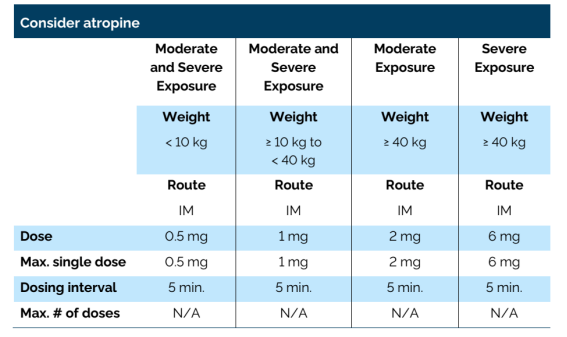
How does pralidoxime doses differ from children to adults?
By the dose and max dose in severe exposure less than 40kg

Vesicants, like sulphur mustard, produce what?
Delayed blistering
Injure eyes and airways
Pulmonary chemical agents like chlorine and phosgene produce what?
Delayed pulmonary edema
Blood agents like hydrogen cyanide do what?
Block cellular respiration by inhibiting cytochrome oxidase, producing histotoxic hypoxia
Riot control agents produce what?
intense but self-limiting irritation
managed by removal to fresh air and irrigation
True or false