MGMT 340 EXAM 2
 Call Kai
 Learn
 Practice Test
 Spaced Repetition
 Match
 Flashcards
 Knowt Play
1/133

There's no tags or description
Looks like no tags are added yet.
134 Terms
(CH.7) What is motivation?
processes that account for an individual’s intensity, direction, and persistence of effort towards attaining a goal
(CH.7) What is intensity?
concerned with how hard a person tries
(CH.7) What is direction?
the orientation that benefits the organization
(CH.7) What is persistence?
a measure of how long a person can maintain his/her effort
(CH. 7) What are Maslow’s Hierarchy of Needs?
Physiological
Safety
Love/belonging
Esteem
Self-actualization
(CH.7) What are the 3 key elements of motivation?
Intensity: concerned with how hard a person tries
Direction: the orientation that benefits the organization
Persistence: a measure of how long a person can maintain his/her effort
(CH. 7) What are physiological needs? (Level 1; basic needs)
Breathing, food, water, s$x, sleep, homeostasis, excretion
(CH. 7) What are safety needs? (L.2)
Security of body, of employment, of resources, of morality, of the family, of health, of property
(CH. 7) What are love/belonging needs? (L.3)
Friendship, family, sexual intimacy
(CH. 7) What are esteem needs? (L.4)
Self-esteem, confidence, achievement, respect of others, respect by others
(CH. 7) What are self-actualization needs? (L.5; highest)
Morality, creativity, spontaneity, problem solving, lack of prejudice, acceptance of facts
(CH. 7) What is (Herzberg’s) motivation-hygiene theory?
Job satisfaction and dissatisfaction are driven by intrinsic and extrinsic factors
Intrinsic: achievment, recognition, work itself, responsibility, advancement, growth
Extrinsic: policy and administration, supervision, relationship with supervisor, work conditions, salary, relationship with peers
to increase motivation —> increase intrinsic
to reduce dissatisfaction —> manage the extrinsic factors
(CH.7) What is self-determination?
People prefer to feel they have control over their actions.
Proposes that in addition to being driven by a need for autonomy, people seek ways to achieve competence and positive connections to others.
Autonomy ←→ Competence ←→ Relatedness
(CH.7) What is autonomy? (self-determination principles)
I prefer to feel I have control over my actions
(CH.7) What is this an example of? (self-determination principles)
This OB course (schedule, textbook, exam type, homework, etc.) was designed 100% by me.
Autonomy
(CH.7) What is relatedness? (self-determination principles)
I want to experience positive connections with other people in my job.
(CH.7) What is this an example of? (self-determination principles)
I want to get to know my students, want to have good relationships with them. So, I use my office hours or discord to freely talk with my students as much as I can.
Relatedness
(CH.7) What is competence? (self-determination principles)
I want to achieve competence (achievment) in my work.
(CH.7) What is this an example of? (self-determination principles)
I want to prove that I’m good at what I’m doing. It’s important to me. I can check this with my SOQ score. In fact, I got a really high SOQ score last year! I’m highly motivated in teaching! I want to make a good performance this semester as well!
Competence
(CH.7) What is goal-setting theory?
Employees can achieve maximum performance when they set specific and difficult goals.
cognitive approach
goals tell an employee what needs to be done and how much effort is needed
Promotion focus
Prevention focus
(CH.7) What is Promotion Focus? (goal-setting theory)
Strive for advancement and accomplishment, and approach condistions that move them closer toward desired goals
(CH.7) What is Prevention Focus? (goal-setting theory)
Strive to fulfill duties and obligations and avoid conditions that pull them away from desired goals
(CH.7) What is this an example of? (goal-setting theory)
I’m taking this course because I’m very interested in human behaviors and people dynamics in organizations. I want to be a great leader someday.
Promotion focus
(CH.7) What is this an example of? (goal-setting theory)
I’m taking this course because this is a required course. If I don’t pass the course, I can’t get a degree.
Prevention focus
(CH.7) What is self-efficacy theory?
Individual’s belief that he or she is capable of performing a specific task.
4 Dimensions:
Past accomplishment: enactive memory
Vicarious Experience (modeling): you see someone else doing the task
Verbal Persuasion: someone convinces you that you have a skill
Emotional cuse (arousal): leads to an energized state
(CH.7) What are the 4 Dimensions of self-efficacy theory?
Past accomplishment: enactive memory
ex: awarding your student when they excel so they think that they can do well in the future
Vicarious Experience (modeling): you see someone else doing the task
ex: when you ask your friends if they’ve taken a course before and they say “yes, it’s easy”; you feel like you can do it too
Verbal Persuasion: someone convinces you that you have a skill
ex: when your parents tell you that you can do it; it will increase your motivation
best way for manager to use this is through the Pygmalion effect: a form of self-fulfilling prophecy (believing in smth that can make it true)
Emotional cuse (arousal): leads to an energized state
(CH.7) What is reinforcement theory?
behavior is a function of its consequences
reinforcement conditions behvaior
behvaior is environmentally caused
behavioristic approach
Operant conditioning theory: ppl learn to behave to get smth they want or to avoid smth they don’t want
B.F. Skinner’s behaviorism
(CH.7) What is operant conditioning theory? (reinfocement theory)
ppl learn to behave to get smth they want or to avoid smth they don’t want
B.F. Skinner’s behaviorism

(CH.7) Contingencies of Reinforcement
Poisitve Reinforcement: there is a wanted outcome and incentive is added
Negative Reinforcement: there is an unwanted outcome but no consequence is added
Extinction: there is a wanted outcome and no incentive is added
Punishment: there is an unwanted coutcome and a consequence is added
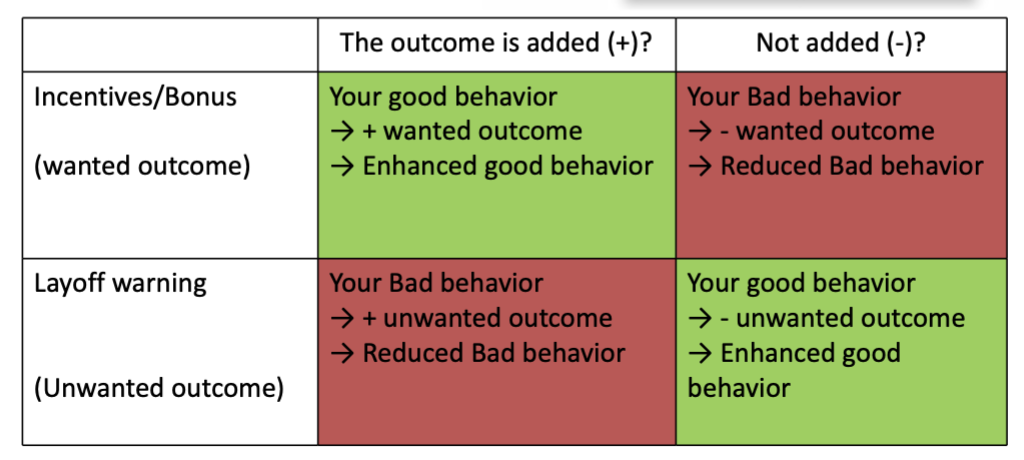
(CH.7) What is this an example of? (Contingencies of Reinforcement)
You worked hard → Received a bonus → Results in you working harder
Positive reinforcement
(CH.7) What is this an example of? (Contingencies of Reinforcement)
You worked hard → Comapny is doing layoffs but you will NOT be getting laid off → Results in you working harder
Negative reinforcement
(CH.7) What is this an example of? (Contingencies of Reinforcement)
You were being lazy → You won’t be getting a bonus this year → Results in you not being lazy anymore
Extinction
(CH.7) What is this an example of? (Contingencies of Reinforcement)
You were being lazy → You got a warning from your boss → Results in you not being lazy anymore
Punishment
(CH.7) What is equity theory?
individuals make comparisons of their job inputs and outcomes relative to those of others and then respond to any inequities
is a ratio of (Your Outcomes / Your Inputs) = (Other’s Outcomes / Other’s Inputs)
if we perceive this is equal to who we’re comparing to → state of equity exists (fairness)
if we perceive it’s unequal → equity tension exists
(CH.7) What is organization justice?
overall perception of what is fair in the workplace
3 Dimesions
Distributive Justice
Procedural Justice
Interactional Justice
(CH.7) What are the 3 dimensions of organization justice?
Distributive Justice: perceived fariness of outcome
ex: I got the pay raise I deserved.
Procedural Justice: perceived fairness of process used to determine outcome
ex: I had input into the process used to give raises and was given a good explanation of why I recevied the rasie I did.
Interactional Justice: perceived degree to which one is treated with dignity and respect
ex: When telling me about my raise, my supervisor was very nice and complimentary.
(CH.7) What is Distributive Justice? (3 dimensions of organization justice)
perceived fariness of outcome
ex: I got the pay raise I deserved. (or didn’t get a raise bc you didn’t deserve one)
(CH.7) What is Procedural Justice? (3 dimensions of organization justice)
perceived fairness of process used to determine outcome
ex: I had input into the process used to give raises and was given a good explanation of why I recevied (or did not receive) the rasie I did.
(CH.7) What is Interactional Justice? (3 dimensions of organization justice)
perceived degree to which one is treated with dignity and respect
ex: When telling me about my raise (whether you got it or not), my supervisor was very nice and complimentary.
(CH.7) What is this an example of? (3 dimensions of organization justice)
Professor gave me extra credit because I actively participated in class discussion. However, my classmate, who never talked in class, did not get any points. I feel this is fair.
Distributive Justice
(CH.7) What is this an example of? (3 dimensions of organization justice)
Our team made a great performance in our final project. We expteced A, but we got a B. We were all suprised. Professor called us and explained why we got this score with great feedback. Now, I feel this result is fair.
Procedural Justice
(CH.7) What is this an example of? (3 dimensions of organization justice)
Our team made a great performance in our final project. We expteced A, but we got a B. We were all disappointed with the result. When we asked about our score, Professor first recognized our efforts and kindly responded to our question. Regardless of the result, I feel respected.
Interactional Justice
(CH.7) What is expectancy theory?
a tendency to act in a certain way depends on an expectation that the act will be followed by a given outcome and on the attractiveness of that outcome to the individual
multiplicative concept
Individual Effort (1. effort-performance relationship) —> Individual Performance (2. performance-reward relationship) —> Organizational Rewards (3. rewards-personal goals relationship) —> Personal Goals
(CH.8) What are the 5 Dimensions of Job Characteristic Theory?
Variety
Identity
Significance
Autonomy
Feedback
(CH.8) Define the 5 dimensions of job characteristic theory.
Variety: the degree to which the job requires a variety of different activity
Identify: the degree to which the job requires completion of a whole and identifiable piece of work
Significance: the degree to which the job has substantial impact on the lives or work of other people
Autonomy: the degree to which the job provides substantial freedom, independence, and discretion to the individual in scheduling the work and determining the procedures to be used in carrying it out
Feedback: the degree to which carrying out the work activities required by the job results in the individual obtaining direct and clear information about the effectiveness of his/her performance
(CH.8) Define Variety. (5 dimensions of job characteristic theory)
the degree to which the job requires a variety of different activity
(CH.8) Define Identity. (5 dimensions of job characteristic theory)
the degree to which the job requires completion of a whole and identifiable piece of work
(CH.8) Define Significance. (5 dimensions of job characteristic theory)
the degree to which the job has substantial impact on the lives or work of other people
(CH.8) Define Autonomy. (5 dimensions of job characteristic theory)
the degree to which the job provides substantial freedom, independence, and discretion to the individual in scheduling the work and determining the procedures to be used in carrying it out
(CH.8) Define Feedback. (5 dimensions of job characteristic theory)
the degree to which carrying out the work activities required by the job results in the individual obtaining direct and clear information about the effectiveness of his/her performance
(CH.8) What is this an example of? (5 dimensions of job characteristic theory)
I’m teaching (design 2 courses, grading, making exams, etc.), research (multiple different topics), mentoring students, reviewing journals.. I can’t ever get bored with all these different tasks.
Variety
(CH.8) What is this an example of? (5 dimensions of job characteristic theory)
MGMT 340 is designed and taught by me 100%. Plus, LMX configuration theory was introduced and verified by me and my research team. Other researchers call it “Seo et al’s LMX configuration theory.”
Identity
(CH.8) What is this an example of? (5 dimensions of job characteristic theory)
Students who have some difficulties of finding their career seek my advice. When they learn something from me and when my advice is helpful to them, I feel very rewarded. In research, when my article is cited by others and changed how others view the effects of leadership, I feel great because I am making an impact to society.
Significance
(CH.8) What is this an example of? (5 dimensions of job characteristic theory)
No one cares whether I’m on or off-campus because I have full discretion as to work location (as long as I prove my performance with me publication records).
Autonomy
(CH.8) What is this an example of? (5 dimensions of job characteristic theory)
There are so many ways to learn how I performed. For teaching, I get an SOQ score from my students, and their evaluation. For research, journal reviewers give me feedback in the review process. With these systems, I feel like I’m developing my teaching and research capabilities.
Feedback
(CH.8) What is Job Rotation?
periodic shifting from one task to another
this is to redesign repetitive jobs
(CH.8) What are the strengths and weaknesses of Job Rotation?
Strengths
reduces boredom
increases motivation
helps employees better understand their work contributions
Weaknesses
creates disruptions
requires extra time for supervisors addressing questions and training time
reduces efficiences
(CH.8) What are the 5 Variable-Pay Programs (for employee motivation)?
Piece-rate plans
Merit-based pay
Bonuses
Profit sharing
Employee stock ownership plans
(CH.8) Define the 5 Variable-Pay Programs.
Piece-rate plans: provides no base salary and pays the employee only for what he/she produces
limitation: not a feasible approach for many jobs
marin concern: financial risk
Merit-based pay: allows emplpyers to differentiate pay based on performance
creates perceptions of relationships between performance and rewards
limitations: based on annual performance, merit pool fluctuates based on economic conditions, union resistance
Bonuses: annual bonus is a significance component of total compensation for many jobs
includes lower-ranking employees; many companies now reward bonuses when profits improve
limitation: employees pay is more vulnerable to cuts
Profit Sharing: organization-wide programs that distribute compensation based on some established formula centered around a company’s profitability
positive effects on employee attitudes at the organizational level; feeling of psychological ownership
Employee Stock Ownership Plans (ESOP): a company-established benefit plan in which employees acquire stock, often at below-market prices, as part of their benefits.
Increases employee satisfaction and innovation
Employees need to psychologically experience ownership
Can reduce unethical behavior
(CH.8) What are Piece-rate plans? (5 Variable-Pay Programs)
provides no base salary and pays the employee only for what he/she produces
limitation: not a feasible approach for many jobs
marin concern: financial risk
(CH.8) What is Merit-based pay? (5 Variable-Pay Programs)
allows emplpyers to differentiate pay based on performance
creates perceptions of relationships between performance and rewards
limitations: based on annual performance, merit pool fluctuates based on economic conditions, union resistance
(CH.8) What are Bonuses? (5 Variable-Pay Programs)
annual bonus is a significance component of total compensation for many jobs
includes lower-ranking employees; many companies now reward bonuses when profits improve
limitation: employees pay is more vulnerable to cuts
(CH.8) What is Profit Sharing? (5 Variable-Pay Programs)
organization-wide programs that distribute compensation based on some established formula centered around a company’s profitability
positive effects on employee attitudes at the organizational level; feeling of psychological ownership
(CH.8) What are Employee Stock Ownership Plans (ESOP)? (5 Variable-Pay Programs)
a company-established benefit plan in which employees acquire stock, often at below-market prices, as part of their benefits.
Increases employee satisfaction and innovation
Employees need to psychologically experience ownership
Can reduce unethical behavior
(CH.8) What are flexible benefits? (turning benefits into motivators)
Flexible benefits : individualize rewards
allow each employee to choose the compensation package that best satisfies his or her current needs and situation.
today, almost all major corporations in the United States offer flexible benefits.
(CH.8) What are employee recognition programs?
Organizations are increasingly recognizing that important work rewards can be both intrinsic and extrinsic
Rewards are intrinsic in the form of employee recognition programs and extrinsic in the form of compensation systems.
(CH.8) What is this an example of?
I didn't expect to be nominated as Employee of the Month! I simply worked hard and helped others, and I ended up winning this award! I'm so happy—I am going to work even harder!
Reinforcement Theory
(CH.9) What is a Group?
2 or more individuals interacting and interdependent, who have come together to achieve particular objectives
(CH.9) What are Formal Groups?
those defined by the organization’s structure
(CH.9) What are Informal Groups?
alliances that are neither formally structured nor organizationally determined
(CH.9) What is Social Identity Theory? (why ppl form groups)
helps us understand who we are and where we fit in with other people
ppl have emotional reactions to the failure or success of their group bc their self-esteem gets tied into the performance of the group
(CH.9) What is Ingroup Favoritism and Outgroups?
Ingroup Favoritism
occurs when we see members of our group as better than other people, and ppl not in our group as all the same
Outgroup
when there is ingroup, there is outgroup; sometimes everyone else, but is usually an identified group known by the ingroup’s members
(CH.9) Define Ingorup Favoritism
occurs when we see members of our group as better than other people, and ppl not in our group as all the same
(CH.9) Define Outgroup
when there is ingroup, there is outgroup; sometimes everyone else, but is usually an identified group known by the ingroup’s members
(CH.9) What are the 5 Group Development stages in order?
Forming: members try to get a feel for what is expected of them. What type of behaviors are out of bounds, and who’s in charge.
Storming: members remain committed to ideas they bring with them to the team
Norming: members realize that they need to work together to accomplish team goals, begin to cooperate with one another
Performing: members are comfortable working within their roles, and the team makes profress toward goals
Adjourning: members experience anxiety and other emotions as the disengage and ultimately separate from the team
(CH.9) What is the Forming stage? (5 Group Development stages)
members try to get a feel for what is expected of them. What type of behaviors are out of bounds, and who’s in charge.
(CH.9) What is the Storming stage? (5 Group Development stages)
members remain committed to ideas they bring with them to the team
(CH.9) What is the Norming stage? (5 Group Development stages)
members realize that they need to work together to accomplish team goals, begin to cooperate with one another
(CH.9) What is the Performing stage? (5 Group Development stages)
members are comfortable working within their roles, and the team makes profress toward goals
(CH.9) What is the Adjourning stage? (5 Group Development stages)
members experience anxiety and other emotions as the disengage and ultimately separate from the team
(CH.9) What is Punctuated Equilibrium?
once the goal is set, the direction becomes “written in stone” and is unlikely to be re-examined throughout the first half of the group’s life
ex: like if you’re in a group and assign roles but nothing gets done until last minute
(CH.9) What is Role?
a set of expected behavior patterns attributed to someone occupying a given position in a social unit
(CH.9) What is Role Perception?
one’s perception of how to act in a given situation
(CH.9) What are Role Expectations?
how others believe one should act in a given situation
psychological contract: an unwritten agreement that exists between employees and their employer
(CH.9) What is Role Conflict?
a situation in which an individual faces divergent role expectations
when compliance with one role requirement may make more difficult the compliance with another
(CH.9) What is this an example of?
University: He will show a good performance and work ethics in our organization.
Him: My organization will evaluate me fairly and recognize my contribution!
Psychological Contract
(CH.9) What is this an example of?
Jaime! Could you please work overtime today? We need to complete this project ASAP.
Role Expectation
(CH.9) What is this an example of?
Sigh… I’m facing divergent role expectations.
Role Conflict
(CH.9) What is Status?
a socially defined position or rank given to groups or group members by others
(CH.9) What is Status and Norms?
high status individuals often have more freedom to deviate from norms
(CH.9) What is Status and Group Interaction?
high status people are often more assertive
(CH.9) What is Status Inequity?
perceived inequity creates disequilibrium and can lead to resentment and corrective behavior
(CH.9) What is Status and Status Stagmatization?
(aka) stigma by association: the status of the people with whom you are affiliated can affect how others view you
(CH.9) What is Social Loafing?
the tendency for individuals to expend less effort when working collectively than alone
occurs when there is a larger size group (pro: good for gaining diverse inputs)
for small groups: better doing smth with input (not related to social loafing)
(CH.9) What is group cohesiveness?
the degree to which members are attracted to each other and are motivated to stay in the group
important because it’s related to the group’s productivity
(CH.9) How can you encourage group cohesion?
Making the group smaller
Encouraging agreement with group goals
Increasing the time members spend together
Increasing the status of the group and the perceived difficulty of attaining membership in the group
Stimulating competition with other groups
Giving rewards to the group rather than to individual members
Physically isolating the group
(CH.9) What are the strengths and weaknesses of group decision making?
Strengths
More complete information and knowledge
Increased diversity of views
Increased acceptance of solutions
Weaknesses
Time consuming
Conformity pressures
Dominance of a few members
Ambiguous responsibility
(CH.9) What are the side effects of group decision making?
Groupthink
situations in which group pressures for conformity deter the group from critically appraising unusual, minority, or unpopular views
is a disease that attacks many groups and can dramatically hinder performance
Groupshift
group polarization
the initial positions of individual members of a group are exaggerated toward a more extreme position
(CH.9) HOW TO make group decision making more effective?
Interacting groups
Brainstorming
Nominal group technique
(CH.9) What is Groupthink?
situations in which group pressures for conformity deter the group from critically appraising unusual, minority, or unpopular views
is a disease that attacks many groups and can dramatically hinder performance
ex: when you don’t like an idea but you agree anyways because you don’t want to be isolated from the group