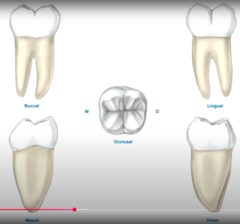
DHYG 110 Tooth ID
 Call Kai
 Learn
 Practice Test
 Spaced Repetition
 Match
 Flashcards
 Knowt Play
1/13

There's no tags or description
Looks like no tags are added yet.
14 Terms
Maxillary central incisor
-mesial incisal angle is the sharpest of any of the incisors
-mesial is sharper than the distal
-cingulum shifts to the distal from incisal view
-greatest curvature of CEJ of any tooth in the dentition on mesial aspect
-imprecation lines on the cervical 1/3 of the facial aspect
-triangular in shape from proximal view
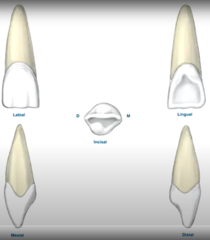
Maxillary lateral incisor
-mesial and distal incisal angles, both are more rounded than central, especially distal
-crown all over is smaller than central
-cingulum is centered from incisal view
-CEJ curvature more on mesial than distal
-most variable tooth in dentition besides third molars

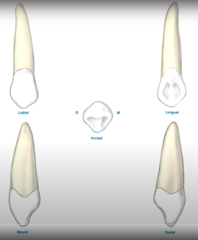
Maxillary canine
-only tooth that has one cusp
-very prominent facial ridge in the middle developmental lobe
-cingulum is centered
-only tooth that has the lingual ridge right in the middle of the lingual aspect
-significant concavity on distal root
-side with the greater curvature is trying to touch or meet the premolar that sits next to it
-straighter side it trying to touch the lateral incisor that is sitting next to it
Mandibular central incisor (will not me on tooth ID)
-mesial incisal angle is sharper than distal incisal angle
-cingulum is centered
-most symmetrical tooth in dentition
-prominent mesial/distal root concavities

Mandibular lateral incisor
-distal incisal angle a little bit closer towards the apex
-appears to be twisted distally from the incisal view
-cingulum shifted significantly distally
-significant mesial and distal root concavities
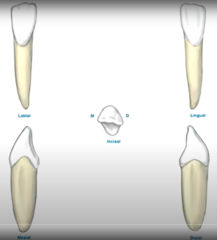
Mandibular canine
-one cusp
-central lingual ridge
-two fossae on lingual
-cingulum shifted to distal
-root apex shifts to mesial
-contact area down to the CEJ on the mesial aspect is straight

Maxillary 1st premolar
-2 roots
-2 cusps
-mesial marginal groove
-lingual cusp swings to the mesial aspect
-deep developmental groove longitudinal depression that runs from just under the contact area over the CEJ all the way down to the furcation
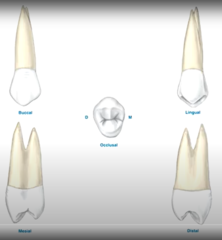
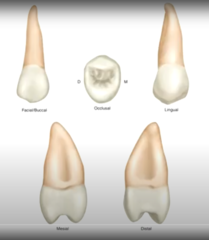
Maxillary 2nd premolar
-1 root
-2 cusps close in height
-no mesial marginal groove
-occlusal view, really wrinkled, looks like a smiley face, lots of supplemental grooves
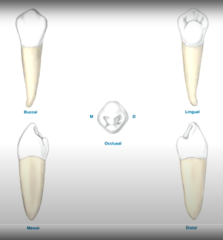
Mandibular 1st premolar
-1 root
-2 cusps
-sneak eyes
-nonfunctional lingual cusp
-mesial marginal groove
-resembles an ice-cream cone when looking at it from the proximal view
Mandibular 2nd premolar (will have 3 cusps on tooth id)
-1 root
-3 cusps
-no mesial marginal groove
-mesioingual cusp higher than distolingual cusp

Maxillary 1st molar (tooth id will be 5 cusps with cusp of Carabelli)
-3 roots
-4 cusps (5 with cusp of Carabelli)
-buccal groove is pretty close to being in the middle, in line with the buccal furcation
-mesial root is widest from the buccal toward the lingual
-shifts mesial furcation 2/3 distance toward the lingual
-only maxillary molars have an oblique ridge
-has the biggest oblique ridge
-cusp of Carabelli only sits on the mesial side

Maxillary 2nd molar (will be heart-shaped on tooth id)
-3 roots
-4 cusps
-2 buccal roots
-1 lingual root
-buccal groove is shifted more toward the distal
-mesial buccal cusp is quite larger than distal buccal cusp
-mesial root is much wider going from the buccal to the lingual
-shifts mesial furcation 2/3 distance toward the lingual
-distal view, you can see mesial root on the side of the distal root
-has oblique ridge
-can be rhomboidal or heart-shaped
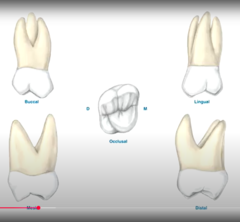
Mandibular 1st molar
-2 roots
-5 functioning cusps
-Y shaped groove pattern
-buccal aspect you can see 3 cusps
-2 buccal grooves (only molar to have two buccal grooves)
-mesial view, all cusps are tipped to the lingual aspect

Mandibular 2nd molar
-2 roots
-4 cusps equal in size and height
- + shaped occlusal pattern
-buccal groove is centered
-mesial root is wider than distal groove
-mesial view, crowns are tilted toward the lingual aspect