Drug Action Lecture 3
 Call Kai
 Learn
Learn Practice Test
 Spaced Repetition
 Match
Match Flashcards
 Knowt Play
1/19

There's no tags or description
Looks like no tags are added yet.
Name | Mastery | Learn | Test | Matching | Spaced | Call with Kai | Chat |
|---|
No analytics yet
Send a link to your students to track their progress
20 Terms
Expedited FDA Drug Development Pathways:

FDA Priority Review and Orphan Drug Designation:
Priority Review: Shortens FDA review clock from 10 to 6 months for serious conditions.
Orphan Drug Designation: Gives 7 year market exclusivity, tax credits, and fee waivers to encourage rare disease drug development (>200,000 patients in US).
Pharmacokinetics vs. Pharmacodynamics
Pharmacokinetics: ADME, movement of drug in the body.
Pharmacodynamics: Action of the drug on receptors and enacting an effect on the body.
What must the drug overcome in the cell to enact its effect, also what part of ADME is this?
Drug Activation: Drug Inactivation or alterations in drug-cell target.
Cellular Damage: Cell’s adaptive responses to the drug’s action upon it and preventing dysfunctional apoptosis, rendering the drug ineffective.
Drug Influx (Into cell): Distribution
Drug Efflux (Out of cell): Metabolism
Drug Administration in PK vs. PD
PK Phase: Dose, dosage form, frequency, and route of administration are related to drug level-time relationships in the body.
PD Phase: Concentration of the drug at site of action is related to its effect.
Absorption
Processes that lead to entry of a drug into the systemic circulation of the body (what happens to the drug after it is administered but before it reaches the circulation).
Major Considerations of absorption of a drug?
Route of administration and first-pass effect.
Distribution
Process by which the drug partitions among the numerous locations in the body (movement of a drug to and from the blood and various tissues of the body and the relative proportions).
What must the drug pass through (in the blood) to reach its target receptor in a cell? What part of ADME is this?
-Capillary Endothelium into the ECF, where it is bound to nonactive sites as well as remaining as a free drug.
-Cellular membrane into the cytoplasm where it binds to both target receptors and nonactive sites (and also exists as free drug as well).
Distribution
Metabolism
Process through which the drug is biochemically modified usually through specialized enzymatic systems.
Major site for metabolism in the body?
The liver
Biotransformation
Alteration of the chemical structure of a drug that is imposed by the life sciences. Drug metabolism often converts lipophilic chemical compounds into more readily excreted hydrophilic products.
Excretion: Definition, Major Site, Paramaters
Process through which a compound is removed from the body. Major site is the kidney. Parameters are clearance and half-life.
What makes an ideal drug candidate for PK/PD Effect:
Transported by the body fluids.
Traverse biological membrane barriers.
Escape widespread distribution.
Endure metabolic attack.
Penetrate in adequate concentration to the sites of action.
Interact in a specific fashion causing an alteration of cellular function.
Routes of Drug Administration:
Oral/Rectal: Non-invasive, great for repeated administration. Major challenge is first-pass effect.
Sublingual/IV/IM: Parenteral Route
Bioavailability vs. Bioequivalence
Bioavailability: Rate and extent to which an active drug ingredient or therapeutic moiety is absorbed from a drug product and becomes available at the site of action (*used as a parameter for intact drug that reaches the circulation).
Bioequivalence: Refers to the comparison of bio-availabilities of different formulations, drug products, or batches of the same drug product.
Plasma Concentration Time Curve Endpoints of PK:
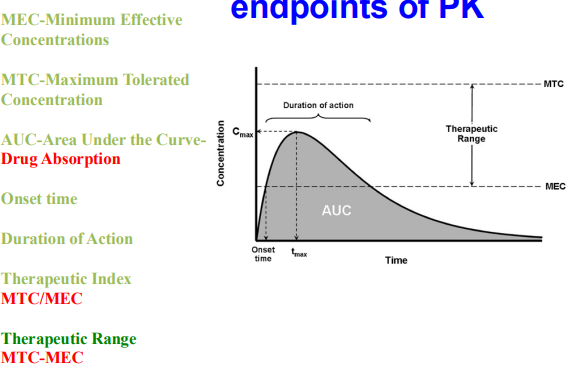
Basic Assumptions in PK:
The magnitudes of both desired response AND toxicity are functions of drug concentration at the site(s) of action.
Too low: Therapeutic failure
Too high: Toxicity
Just right: Therapeutic
What does PK/PD give you?
Effect of drug over time.
PD: Effect:Conc.(log)
PK: Conc.:Time
PK and PD Feedback Loop
→Dosage Regimen ←(PK)→ Plasma Concentration/Site of Action -(PD)→ Effects—-