Self made Metastatic Disease: Challenges to treatment
 Call Kai
 Learn
 Practice Test
 Spaced Repetition
 Match
 Flashcards
 Knowt Play
1/20

There's no tags or description
Looks like no tags are added yet.
21 Terms
Learning objectives
Explain the reason metastatic disease is so deadly. List the reasons why metastases are more difficult to treat
Understand what causes tumor heterogeneity and why it makes treating cancer so difficult
Define DTCs and explain why they pose challenges to cancer treatment
Summarize the ways cancer can evolve therapeutic resistance
Explain why the concepts above also hinder our ability to research cancer and develop new effective strategies
Why is cancer so difficult to treat
Detection is difficult
Treatments are toxic: difficult to kill cancer cells without killing normal cells
Cancer pateints are sick and more susceptible to toxic therapies
Compliance: patience dont want a treatment with bad side effects
Poor drug delivery because
Excessive ECM deposition hinders drug diffusion
Drug uptake by cancer cells often not efficient
Cells get rid of drugs quickly
Why are metastases more deadly than primary tumors?
Primary tumors are typically:
A single tumor in a single organ (easy to remove/treat)
Often in less essential organs (skin, prostate, breast)
Easier to detect with routine exams (colonoscopy, mammogram, pap smear)
Less aggressive cells (more weaknesses)
More responsive to therapies
Metastases are typically:
Multiple tumors in multiple organs
Form in essential highly vascularized organs (lung, liver, brain, bone marrow)
Harder and more expensive to detect
Metastatic cells are typically more aggressive cells (less weaknesses)
Frequently resistant to therapies
Do stromal cells play a role?
Stromal cells impact primary tumors and metastasis
Either inhibit or promote tumor progression and metastasis
Influence the effectiveness of therapies
Secrete cytokines, growth factors, and ECM that protect tumor cells from chemotherapy and radiation
Influence tumor cell dormancy
Secrete ECM that reduces drug delivery
Stromal cells can be targeted by treatment
Causes side effects/tpxicity (bad)
Immune and anti-angiogenic therapies (good)
Therapies targeting tumor cells can also kill protumor stromal cells (good) or anti-tumor stromal cells
Brief impact of the immune system on cancer (1 sentence)
the immune system can be both pro and anti cancer and can influence and be influenced by therapies
Targeted therapies (definition, examples of therapies, and downsides)
This treatment targets specific molecules required for growth, survival, or spread
For example, fusion proteins, mutated or upregulated proteins, pathways activated in cancer cells
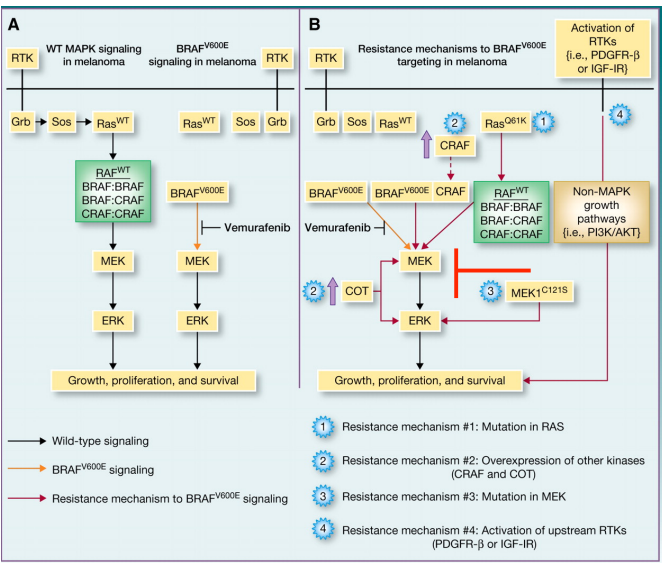
Examples: Herceptin® (HER2), Vemurafenib (mutant BRAF-V600E), BCR-ABL (Gleevec), EGFR inhibitors, ALK inhibitors, monoclonal antibodies
Negatives
Can have adverse side effects
Cancer is highly variable with diff driver mutations, so effective targetted therapies will not work for every patient
Can be hard to identify patients that will respond (lack adequate biomarkers)
Tumor cells evolve resistance
Tumor heterogeneity hinders the effectiveness of targeted therapies
What normal processes do cancer cells exploit
Self renewal and reduced apoptosis - hallmarks of stem cells
intravasation/extravasation - normal processes for leukocytes
EMT/invasion/migration: normal during development and tissue repair
3 types of heterogenity within a tumor
cancer types differ from each other
different driver mutations, strengths, and weaknesses
therapies effective for one cancer type may not work for another
heterogeneity between cancers of the same type
diff combinations of mutations can promote cancer progression
a therapy that effectively treats one tumor may not work on another with a different set of mutations
heterogeneity within a tumor
not all cells in a tumor have the same set of mutations
only subsets of cells may be susceptible to a treatment
Linear progression model
progression is stepwise and each mutation provides an advantage leading to expansion
tumor cells accumulate mutations that make them more agressive
metasatic cells often have greater number of mutations

Independent Clonal Evolution/Progression
numerous subpopulations within the tumor progress independently of each other
key driver mutations (oncogenes and tumor supressors) rovie a growth advantage → clonal expansion
genomic instabiliy causes rapid acumulation of additional mutations
Some mutations make cells more aggressive without providing a growth advantage-minimal clonal expansion
Multiple metastatic subpopulations with different mutations could exist

Parallel progression model
cells desseminate relatively early from the primary tumor mass and evolve independently of cells in the primary tumor

How does tumor heterogeneity impact treatment
Targeted therapies can only be used if a tumor has the alteration targeted
treatments may inhibit/target one subpopulation but not others
tumors continue to evolve, resistence
metastases have/evolve different alterations (metastases often not biopsied
How does tumor heterogeneity hinder research and drug development
Hard to identify causal mutations in a tumor that is very heterogeneous
tumor biopsies may miss the imprtant subpopulation
tumors have harmless passenger mutations that can look casual
most research models do not properly reproduce this heterogeneity
How do tumors become resistant to treatment
Advantage of heterogeneity: like antibiotics, treatment can select for existing resistant cells to take over
compensation
new mutations in the same protein rendering it resistant to the tehrapy
mutations in a different protein in the same pathway
alterations in anotehr pahway that drives sumular processes
increased expression of another protein with simular functions
What are DTCs and what happens after they seed
Disseminaed tumor cells (DTCs) are cancer cells that seed a distant organ
after seeding, DTCs can
die
persist as dormant cells
micrometastases
grow into metastesis
outgrow of dormant DTCs and micrometastes causes cancer recurrence from months to decades later
2 theraputic potentials we can learn from DTCs
activate processes that cause dormancy
inhibit pathways that promote exiting dormancy
how do DTCs evade therapeutic treatment
dormant DTCs do not divide so they are resistant to most chemotherapies
DTCs that exit dormancy are often resistant to the origonal treatment
if outgrowth is triggered by the microenvirpnment, then theres no mutation/alteration within the DTCs to target
different mechanisms govern primary vs metastatic growth
Why are therapies that prevent metastatic growth and/or dormancy exit are likely to help the most patients
primary tumors can be removed surgically easily
patients often already have metaststic disease at diagnosis
cancer cells desseminate early
preventing the spread of cancer will not help patients with existing DTCs or metastases
Additional challenges to developing effective therapies (4 with details)
clinical trials are problematic
based on mouse models that dont properly model the complexity of human cancer
hard to select appropriate patients (who will respond?)
FDA approval is expensive and time consuming
Drug development is problematic because drug companiez are buisnesses, and they must make decisions based off profit, not whats best for patients
academic research funding is limited
traditionally poor collaboration between clinicians, basic scienists, and industry
Emerging technologies that will lead to advances
Next Generation Sequencing, massspec, NMR allows omics-based analysis of cancers (genomics, transcriptomics, proteomics, glycomics, metabolomics, Lipidomics)- can reveal new targets and facilitate research
Personalized (Precision) Medicine: NGS of a patient’s cancer can be used to establish prognosis and predict susceptibilities to targeted therapies
Bioinformatics, Computing & Systems Biology to analyze big data sets
Helps identify new therapeutic targets and predict therapueitc resistance mechanisms
Biomarkers and types - what can they be used for
a biological molecule found in blood, other body fluids, or tissues that is a sign of a normal or abnormal process, or of a condition or disease
Can be proteins (normal, mutant, fusion), peptides, DNA, RNA, lipids
key to personalized medicine
can help identify heterogeneity and detect rare subpopulations
NGS, Massspec, NMR, and elisa and the ability to analyze the datasets they generate using Bioinformatics makes it easier to identify Biomarkers