Liphelo Science
 Call Kai
 Learn
 Practice Test
 Spaced Repetition
 Match
 Flashcards
 Knowt Play
1/20

There's no tags or description
Looks like no tags are added yet.
21 Terms
Force
A push or a pull exerted on an object. Gravity is a force because Yes. Gravity is a force because a force is a push or a pull.
Mass
The amount of matter in an object.
Mass is not a force, does not depend on gravity, does not change from place to place, and an object cannot become massless.
Measured using a balance/mass meter in grams (g) or kilograms (kg).
Weight
The downward force of gravity acting on the mass of an object.
Weight depends on gravity and changes as gravity changes.
Measured using a spring balance / force meter in Newtons (N)
Gravity
A non-contact attractive force that pulls objects toward one another.
Factors influencing gravity: The mass of the objects (more mass = more gravity) and the distance between them (closer = stronger pull).
Measurement on Earth: Weight (Force of gravity) is calculated as:
Fg=m×g
(Where mass is in kilograms, and acceleration due to gravity on Earth is g = 9.8m/s² or rounded to 10m/s²
Variable
Any factor that can be changed, controlled, or measured in an experiment
Independent Variable
The factor intentionally changed or manipulated by the scientist (what is tested).
Dependent Variable
The factor that is measured or observed to see the effect of the change (the data collected).
Types of Force
Contact Forces
Forces that act only when two objects are physically touching.
Applied Push/Pull
Definition: A force directly exerted on an object by a person or another object.
Example: Pushing a shopping trolley down an aisle or pulling a drawer open.
Friction
Definition: A resistive force that opposes the motion of two surfaces sliding or attempting to slide across one another.
Example: The soles of your shoes gripping the pavement so you do not slip while walking, or bicycle brake pads rubbing against the wheel rim to stop the bike.
Tension
Definition: A pulling force transmitted through a string, rope, cable, or wire when it is pulled tight from opposite ends.
Example: A rope supporting a climber or the cable holding up an elevator.
Normal Force
Definition: The perpendicular support force exerted by a stable surface against an object resting upon it.
Example: A textbook resting on a desk, where the desk pushes upward to support the book's weight.
Non-Contact (Field) Forces
Forces that act over a distance without physical contact between objects.
Gravitational Force
Definition: The attractive force exerted between any two masses in the universe.
Example: An apple falling from a tree toward the ground, or the Earth orbiting the Sun.
Magnetic Force
Definition: The attraction or repulsion between magnetic poles, or between a magnet and a magnetic material.
Example: A fridge magnet sticking to a metal refrigerator door, or two north poles of bar magnets pushing away from each other.
Electrostatic Force
Definition: The attractive or repulsive force between particles or objects carrying electric charges.
Example: Rubbing a balloon against your hair or a wool sweater so that it attracts small pieces of paper or sticks to a wall.
Newton’s 1st Law of Motion (Law of Inertia)
An object will remain at rest, or continue moving at a constant velocity in a straight line, unless acted upon by an unbalanced external force.
Newton’s 2nd Law of Motion
The acceleration of an object depends on the net force acting upon it and the mass of the object:
F=m×a
(Force in Newtons, mass in kg, acceleration in m/s²
Newton’s 3rd Law of Motion (Action & Reaction)
For every action, there is an equal and opposite reaction (when object A exerts a force on object B, object B exerts an equal force in the opposite direction on object A).
Acid
A chemical compound containing hydrogen ions (H+) that donates H+ ions when dissolved in water, having a pH of less than 7.
Properties: Soluble in water, tastes sour, feels rough on skin, corrosive, turns blue litmus paper red.
Base
A chemical compound containing hydroxide ions (OH−) that accepts hydrogen ions (H+) when dissolved in water.
Properties: Neutralizes acids, feels slippery/soapy, turns red litmus paper blue. A soluble base is called an alkali.
Neutral Substance
A substance with a pH of exactly 7 (e.g., pure water) that is neither acidic nor basic.
Test for Neutrality: Must show no colour change on both types of litmus paper (red stays red, blue stays blue).
Neutralisation
chemical reaction between an acid and a base (or alkali) that cancel each other out to produce a neutral solution (pH 7), forming a salt and water.
Word equation:
Acid+Base→Salt+Water
What happens chemically:
The hydrogen ions (H+) from the acid combine with the hydroxide ions (OH−) from the base to form neutral water (H2O).
The remaining ions combine to form a salt.

pH Scale
A numeric scale (from 0 to 14) that measures the relative acidity or alkalinity (strength of an acid or base) of a substance.

Universal Indicator
Paper strips or solution calibrated to a colour-coded chart linked to the pH scale, showing not only if a solution is an acid or base, but its relative strength.
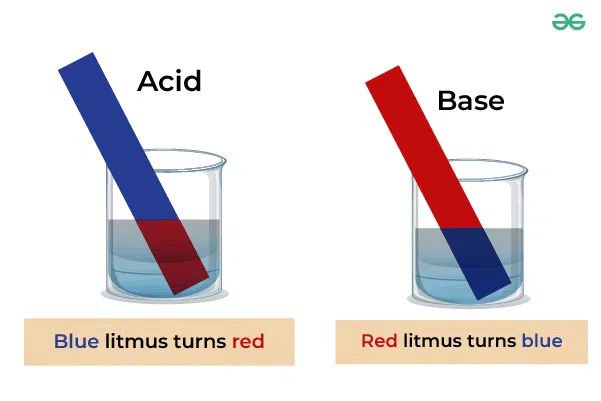
Litmus Paper
An indicator strip that indicates acidity or alkalinity via a binary colour change (Red litmus turns blue in a base; Blue litmus turns red in an acid)
Atomic Structure & The Periodic Table
Atom: The basic building block of all chemical matter.
Protons: Positively charged particles in the nucleus.
Neutrons: Neutral particles (no charge) in the nucleus.
Electrons: Negatively charged particles arranged in energy levels / shells around the nucleus.
Atomic Number: The number of protons located in the nucleus of an atom (identifies the element on the periodic table).
Atomic Mass (Mass Number): The total combined number of protons and neutrons in the atom’s nucleus.
Number of Neutrons=Atomic Mass−Atomic Number
Periods (Horizontal Rows) and Groups (Vertical Columns)
Tell us the number of electron shells (energy levels) an atom possesses. (elements in the same period have the same number of shells, not different)
Columns containing elements that share similar chemical/reactive properties because they have the same number of outer-shell valence electrons.
Mendeleev’s Gaps:
Dmitri Mendeleev left gaps in his periodic table because he predicted the existence of elements that had not yet been discovered and left space for them until they were found