LM-Operant Conditioning
 Call Kai
 Learn
 Practice Test
 Spaced Repetition
 Match
 Flashcards
 Knowt Play
1/43

There's no tags or description
Looks like no tags are added yet.
44 Terms
What is Operant Conditioning?
The process whereby organisms learn to make or to refrain from making certain responses to obtain or avoid certain outcomes
What did Thorndike do?
Tried to systematically explore how animals learn new behaviors
How cats learned to escape from puzzle boxes
What is the three-part association of Operant conditioning?
IN the presence of a discriminative stimulus (S^D), a particular response (R) may lead to a particular outcome (O)

What do discriminative stimuli do?
Help the learner identify the conditions in which a response will be followed by a particular outcome

How is a response defined?
By the outcome it produces
What are two operant condition training behaviors?
shaping and chaining
What is shaping?
An operant conditioning technique in which successive approximation to the desired response are reinforced
Like teaching a dog how to roll, you teach one step at a time, until it learns the complete roll.
What is chaining?
An operant conditioning technique in which organisms are gradually trained to execute complicated sequences of discrete responses
Multiple individal techniques are learned to produce a chain in order like a dog learning how to fetch.
What is a reinforcer?
A consequence of behavior that leads to increased likelihood of that behavior in the future
What is a punisher?
A consequence of behavior that leads to decreased likelihood of that behavior
What is the difference between reinforcement and punishment?
Both are the process of providing outcomes, but one leads to increase probability of a behavior (reinforcer) and one leads to decreased probability of a behavior (punisher)
What are some examples of primary reinforcers?
Food, Water, Sleep, Comfortable Temperatures, and Sex
What is Clark Hull’s drive reduction theory?
Proposed that all learning reflects the innate, biological need to obtain primary reinforces
What is the negative contrast effect?
A normally acceptable reinforcer evokes less responding if a preferred reinforcer is expected
If you are expecting to get GTA 6, but you get GTA 5 instead. Both are reinforcers, except GTA 5 is less preferred so you would do less work to try and get that game
What are secondary reinforcers?
A reinforcer that initially has no biological value but that has been paired with (or predicts the arrival of) a primary reinforcer
MONEY - Money cannot satisfy food or thirst because it is just an object, but this is paired with things so it becomes a secondary reinforcer
What is Token Economy?
Secondary Reinforcers
An environment (such as a schoolroom) in which tokens function the same way as money does in the outside world

What are some examples of punishers?
For animals: Pain, Confinement, and Exposure to Predators
For Humans: Monetary fines, social disapproval, and prison
Is punishment as effective as reinforcement at controlling behavior?
Punishment is less effective
What is differential reinforcement or alternative behaviors (DRA)?
Instead of delivering punishment each time an unwanted behavior is exhibited, one can reward preferred alternative behaviors
Lets say a student always gets all Cs, the parents have to award the child for getting an A because it is good
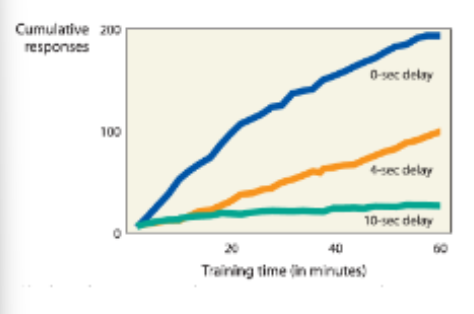
What are the effects of delay between a response and an outcome?
The longer the delay, the less responses were available
What is positive reinforcement?
A type of operant conditioning in which the response causes a reinforcer to be “added” to the environment, over time, the response becomes more frequent
What is a positive punishment?
A type of operant conditioning in which the response causes an undesirable element to be “added” to the environment, over time, the response becomes less frequent
What is a negative reinforcement?
A type of operant conditioning in which the response causes an undesirable element to be “subtracted from” the environment, over time, the response becomes more frequent
What is a negative punishment?
A type of operant conditioning in which the response causes a desirable element to be “subtracted from” the environment, over time, the response becomes less frequent
What are some example of The Operant Conditioning Paradigms

What are some questions to ask when determining the operant conditioning paradigms?
What is the behavior?
Is the outcome added or taken away? (Positive or Negative)?
Is the behavior likely to decrease or increase? (Reinforcement or punishment)?
What is the differences between classical and operant conditioning?
In classical conditioning, organisms experience an outcome (the US) whether or not they perform the conditioned response (CR)
In Operant Conditioning, the outcome depends on whether the organism performs the response
Both Operant and classical Conditioning show extinction
What are reinforcement schedules?
The rules determining how and when outcomes are delivered in an experiment
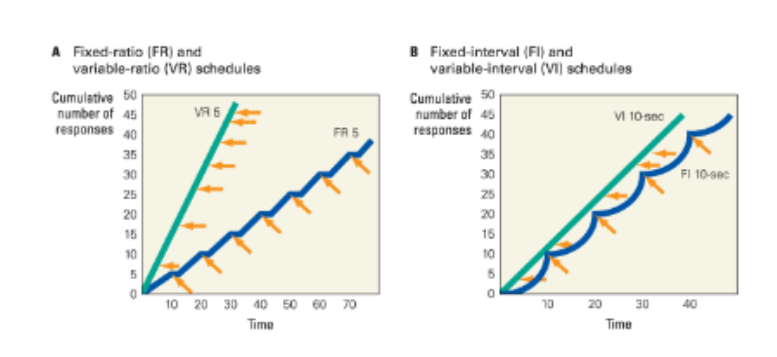
What is a fixed-ratio (FR) schedule?
A reinforcement schedule in which a specific number of responses must occur before a reinforcer is delivered; this, FR 5 means that reinforcement arrives after every fifth response
Like a rat clicking a button 5 times to get the final product
What is a fixed-interval (FI) schedule?
A reinforcement schedule in which the first response after a fixed amount of time is reinforced, this, FI 1-min means that reinforcement follows the first response made after a 1-minute interval since the last reinforcement
Changes the time in between a lever is activated and a result is produced.
What is a variable-ration (VR) schedule?
A reinforcement schedule in which a specific number of responses, on average, must occur before a reinforcer is delivered, thus, VR 5 means that, on average, every fifth response is reinforced
Happens under an unpredictable number of responses, a rat being trained to get food after clicking a lever random times, so it spam clicks
What is a variable-interval (VI) schedule?
A reinforcement schedule in which the first response after a fixed amount of time, on average, is reinforced, this VI 10min means that reinforcement follows the first response made after a 1-minute interval, on average, since the last reinforcement
Food is available after unpredicted amount of time after clicking lever, so the rat clicks the lever at a steady rate because it does not know what time it will come out
Correlation of FR VR and FI VI schedules
Rate of schedules?
VR schedules tend to produce higher rates of responding than FR schedules
VI schedules tend to produce higher rates of responding than FI schedules
What are some questions to ask regarding reinforcement schedules?
Fixed or Variable? Look for key words “every, average, about”
Ratio or Interval? Look for units of time “hour, minutes, days, months vs. # of times”
What is delay discounting?
The progressive reduction of the value of a reward the longer it is delayed
Example: It is easier to convince a student to put off fun to study if the exam is coming up tomorrow, but it is harder if the exam is in 5 weeks
What was the delay discounting experiement?
Rats were given two levers: one that delivered a small immediate reward and one that delivered a larger reward. If the delay was short, the rats would choose the big prize. If delay was long, rats chose the small prize.

What is self-control?
An organism’s willingness to forgo a small immediate reward in favor of a larger future reward
Are the locations of learning the same?
No.
Parts of the brain that link stimuli with response (S^D to R learning) are different from the parts of the brain that learn about the expected outcomes of those responses (R to O)
What are the two key brain substrates to know?
Dorsal Striatum (S^D to R)
Orbitofrontal Cortex (R to O)
How does dorsal striatum and stimulus-response learning work?
Info from the sensory cortex to motor cortex can also travel by an indirect route (Basal Ganglia)
One part of that Ganglia is the striatum
Plays a critical role in operant conditioning, specifically the ability to learn associations based on feedback about reinforcement and punishment
How do the orbitofrontal cortex and prediction outcomes work>
The prefrontal cortex has the orbitofrontal cortex, which lies at the underside of the front of the brain - it predicts outcomes
It receives inputs that convey the full range of sensory modalities plus visceral sensations
Outputs travel to brain areas, including the striatum, where they can help determine which motor responses are executed
What is a pathological addiction?
A strong habit (or compulsion) that is maintained despite known harmful consequences and has significantly disrupted a person’s life
What is behavioral addiction?
Addictions to behaviors that produce reinforcements or highs, as well as cravings and withdrawal symptoms when the behavior is prevented
(GAMBLING, EXERCISE, INTERNET GAMING)