Chapter 2: Application Layer -- N&DP
 Call Kai
 Learn
Learn Practice Test
 Spaced Repetition
 Match
Match Flashcards
 Knowt Play
1/71

There's no tags or description
Looks like no tags are added yet.
Name | Mastery | Learn | Test | Matching | Spaced | Call with Kai | Chat |
|---|
No analytics yet
Send a link to your students to track their progress
72 Terms
Middleware is the software that sits between the application software on the client and the application software on the server.
True
All three parts (request line, request header, request body) of an HTTP request from a web browser to a web server are required when a request is made.
False
A "thin client" approach places most of the application logic on the client.
False
A "thin client" architecture approach:
places all or almost all of the application logic on the server
In a client-server network, ___ gets software from different vendors to work together
middleware
With the two-tier client-server architecture, the client is responsible for the logic.
Presentation
When adopting a cloud-based architecture, what are the main differences between the private, public, and community cloud deployment models?
The programming languages and frameworks supported by the cloud provider
The level of control, security, and investment required for the organization
The number of users and the volume of data to be processed
The physical location of the cloud infrastructure and data centers
The level of control, security, and investment required for the organization
In a client-server architecture, what is the main reason for separating the presentation logic on the client and the data access/storage logic on the server?
To improve the scalability and reliability of the system
What is the key difference between a thin client and a thick client architecture in a client-server system?
Thin clients perform most processing on the server, while thick clients perform most processing on the client
How does the number of tiers in a client-server architecture affect the distribution of processing and logic?
A two-tier architecture has a client and a server, while a three-tier architecture adds a separate application server
Network applications are software packages that run in the application layer and the only real reason for having a network is to enable these applications
true
Application architecture
The way functions of the application layer software are distributed among clients and servers.
The work done by any application program is divided into what five general functions?
1) Data storage
2) Data access logic
3) Application logic
4) Presentation logic
5) Services logic
What is the data storage function?
Application programs require data to be stored and retrieved
What is the data access logic function?
Processing required to access data
What is the application logic function?
Referred to as business logic
What is the presentation logic function?
How infomration is presented to the user and the acceptance of the user’s commands
What is the services logic function?
like the user interface but rather than users making requests, other application software can make requests.
What are the four fundamental application architectures used today?
1) host-based
2) client-based
3) client-server
4) cloud-based
Host-based architecture
A very simple architecture where the server (host computer) performs all the work

Client-based architecture
A very simple architecture where the client computer performs most of the work and the server usually only has a data storage function.
Clients and servers are usually personal computers on the same network (LAN)

Client-server architecture
The work is shared between clients and servers. Complicated and expensive to deploy
Cloud-based architecture
The cloud provides services to the client
What are the three types of cloud computing deployment models?
1) Private cloud
2) Public cloud
3) Community cloud
Private cloud
Created and exclusively used for a single private organization
Public cloud
Used by multiple organizations that share the same cloud resources
Community cloud
A subset of public cloud; used by organizations that have a common purpose
What are the two fundamental problems with host-based architectures?
1)Server must process all messages (slower)
2) Higher cost to upgrade
What is the fundamental problem in client-based networks?
All data on the server must travel to the client for processing (slow)
What is the greatest strength of client-server networks?
They enable software and hardware from different vendors to be used together which is rather difficult without middleware
Middleware and what it does
Software that sits between the application software for the client and the application software for the server.
1) Provides a standard way of communication between softwares
2) Manages the message transfer so clients don’t need to know what server has the application data
What are the most important standards for middleware our of the dozens there are?
1) Distributed Computing Environment (DCE)
2) Common Object Request Broken Architecture (CORBA)
3) Open Database Connectivity (ODBC) which provides standards for data access logic
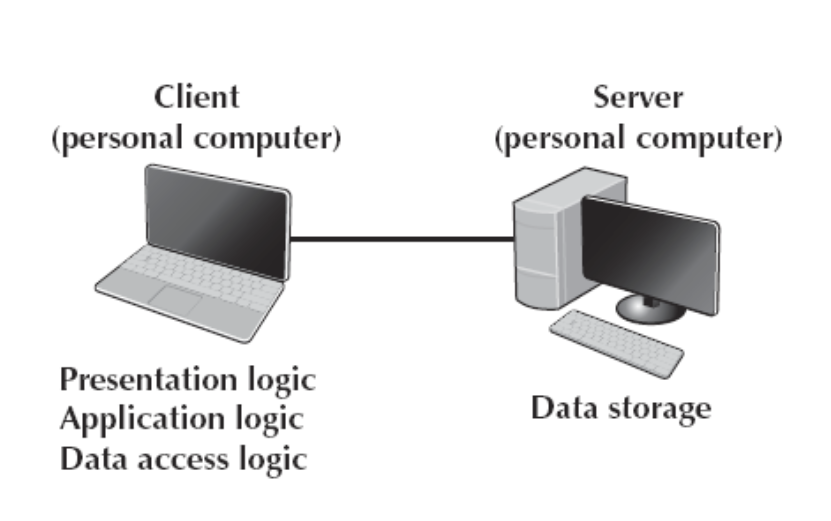
Two-Tier Architecture
Most common architecture that uses only two computers
Client: Presentation logic, Application logic, Data access logic
Server: Data storage
Three-tier architectures
Uses three computers
Client: Presentation logic
Server: Services logic, Application logic
Database server: Data access logic, data storage

n-tier architectures
3+ computers
Client: Presentation logic
Web server: Application logic
Application server: Services logic, Application logic
Database server: Data access logic, Data storage

What are the advantages and disadvantages of n-Tier architectures?
Advantages: It’s more scalable because it separates the processing so much to better balance it.
Disadvantages: 1) A greater load on the network
. 2) Much more difficult to program and test software
Thin-client architecture
places little or no application logic on the client and are easier to manage
Enables cloud-based architecture
Thick-client architecture
places all or almost all of the application logic on the client
There is a direct relationship between think and thick clients and two-, three-, and n-tire architectures
False
What are the three common cloud-based architecture models that an organization can choose from:
1) Infrastructure as a service
2) Platform as a service
3) Software as a service
Software as a service (SaaS)
organization outsources the entire application to the cloud provider and then uses it through a browser (thin client)
Ex: email or customer relationship management (CRM)
SaaS is built on…
multitenancy: there is only one application everyone shares but they can customize it to their individual needs
Platform as a service (PaaS)
The organization manages the application and its own data but uses the database software (data access logic) and OS provided from the cloud provider.
For PaaS, the needed hardware and software infrastructure that is rented from the cloud provider is called the platform
True
Infrastructure as a Service (IaaS)
The cloud provider manages the hardware (servers, storage, and networking components)
The organization manages its software (OS, Database software, and its applications and data)
You don’t have to spend as much on hardware and maintenance.
IaaS is sometimes referred to as…
Hardware as a Service (Haas)
Peer-to-Peer Architectures
All computers act as both a client and a server therefore they perform all five functions.

What are the advantages and disadvantages of P2P networks
Advantages: the data can be installed anywhere on the network
Disadvantages: Poor security because of lack of authority or authentication

Almost all new applications today are ____ applications
Client-server; Most reliable, usually cheapest and enable cloud computing.
With hypertext, any document can contain a link to any other document
True
The web is a two-tier client-server architecture
True
What are the 3 parts of an HTTP request (2 required, 1 optional)
1) request line
2) request header
3) request body (optional)

What does a request line consist of in an HTTP request?
Starts with command (e.g GET), provides web page, HTTP version number the browser understands
What does a request header consist of in an HTTP request?
Random info such as the web browser being used and the date
What does a request body consist of in an HTTP request?
The optional part of HTTP request. Just information that the user has typed into form.
What are the 3 parts of an HTTP response (1 required, 2 optional)
1) response status
2) Response header
3) response body

What is in response status for HTTP response?
HTTP version the server used, status code, and reason phrase
What is in response header for HTTP response?
Server being used, the date, exact URL of the page
What is in response body for HTTP response?
The web page itself
The most commonly used standard of email is SMTP (Simple Main Transfer Protocol)
True
How is SMTP email usually implemented?
As a two-tier thick client-server architecture
Mail user agent
For SMTP email, each client computer runs an application layer software package called a mail user agent
Mail transfer agent
For SMTP email, the user agent sends the SMTP packet to a mail server that runs a application software package called a mail transfer agent.
Two most common standards for mail servers and the difference between them:
1) Post Office Protocol (POP)
2) Internet Message Access Protocol (IMAP)
Pop deletes email from server when copied to client’s computer but IMAP does not.
An email with three-tier thin client-server architecture is often called a…
Web-based email allowing you to use your browser.
An SMTP packet has two parts which consist of…
1) header: source and dest. email add. and the address of itself
2) body: the word DATA, and the message

SMTP is a simple standard that permits only the transfer of text messages and works together with MIME software
True
Telnet
lets users log in to servers; PuTTY
Videoconferencing
provides real-time transmission of video and audio to allow two people to have a meeting (desktop videoconferencing)
Webcasting
One-directional non-interactive videoconferencing sent from server to user.
One of the most commonly used business applications is an…
SQL server
One of the top three security risks on the Internet is…
SQL injection and another one is email spoofing