arguments against a configural processing account of familiar face recognition
 Call Kai
 Learn
 Practice Test
 Spaced Repetition
 Match
 Flashcards
 Knowt Play
1/8

There's no tags or description
Looks like no tags are added yet.
9 Terms
What are the 3 types of configural processing? Which type are the authors of the current investigation focusing on?
First order relations (i.e., ID the image as a face)
Holistic processing (i.e., combining the specific features to create gestalt/whole)
Second order relations (i.e., spatial arrangements w/ the face
-subtle differences in spatial arrangement between features
#3 is what researchers focusing on
The authors argue that configural theories are under specified. In providing their rationale, the authors discuss:
Variability both between and within individuals
Metric distances

Explain author argument in regard to each of the two points they discuss how they relate to figures 1 and 2.
It is true that variability exists between individuals. However, that fact alone does not mean that specific metric distances are unique to a given person. This is because there is also within-person variability—and that is a problem. This means that there range of facial metrics associated with one person could overlap w those of another person. And if that is the case, it is impossible for “metrics” alone to be the crucial factor in indentifying a specific face.
The authors argue that large changes in configural processing can leave recognition unharmed. What evidence do they provide?
Linear transformations: stretching image on x or y axis does not influence recognition or reaction time.
What circular argument do the authors discuss?
Perhaps in the above scenario, people resize the face and then recognize it. But how can you resize the face to its correct measures if you haven’t yet recognized the face!!!
Describe the logic/evidence from studies asking participants to resize familiar and unfamiliar faces
>Given wrong aspect ratio of faces, familiar or unfamiliar, ask to fix, equal or worse performance w familiar
>if the metrics of previously known faces are stored in memory, it should be easier to resize distorted faces of famous people than novel people.
→Data suggests this is not the case.
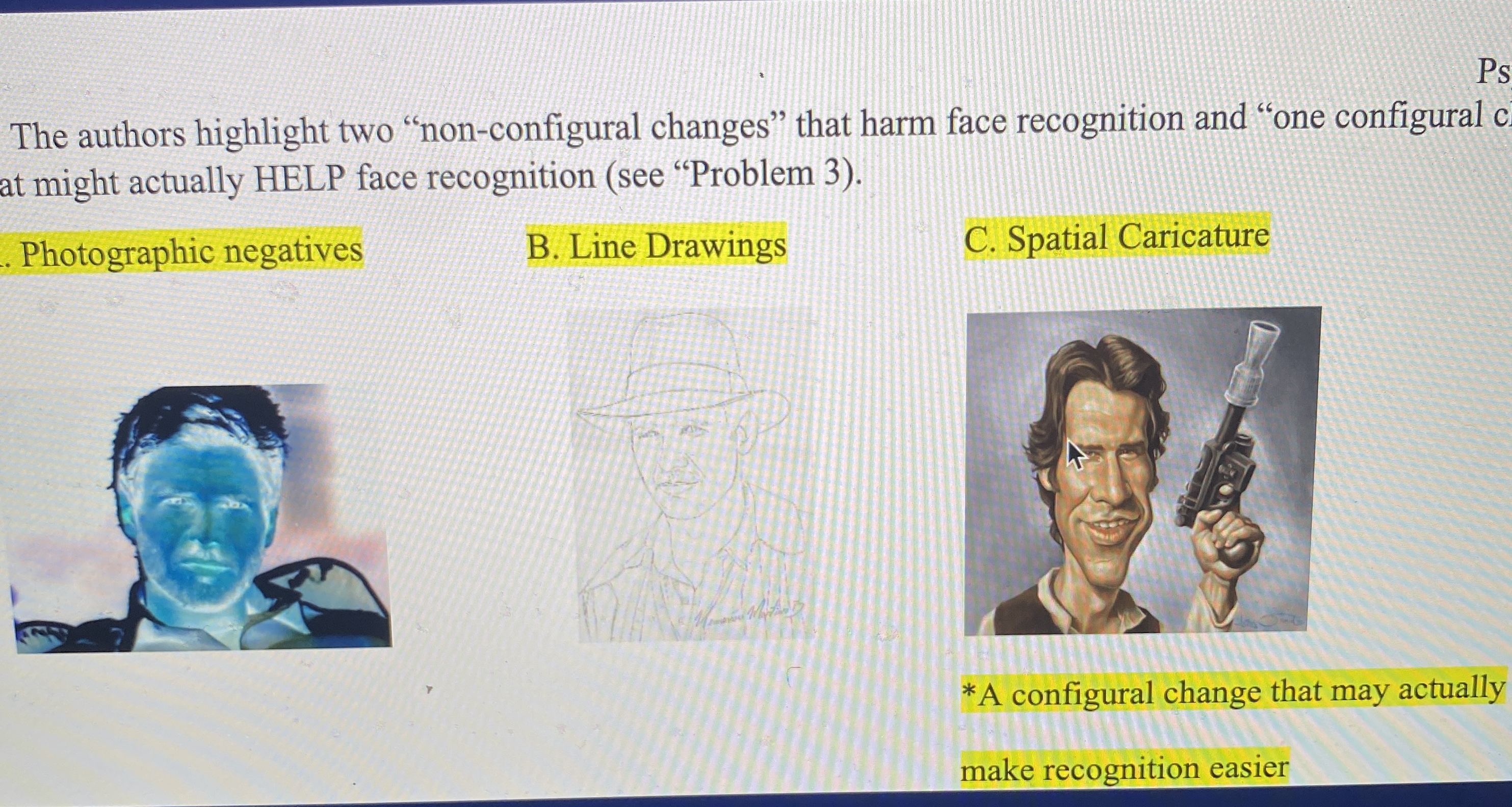
The authors highlight two “non-configural changes” that harm face recognition and “one configural” change that might actually HELP face recognition (see Problem 3).
A. Photographic negatives
b. Line drawings
C. Spatial Caricature *A configural change that may actually make recognition easier

Explain what the authors are attempting the illustrate in Figure 4.
These are faces of famous celebrities that have had their skin stretched over a generic face structure (in other words, inaccurate metric information about the location of the features—but the texture is still accurate). However, having incorrect metrics—it is still easy to identify the celebrities.
Thus, texture is more important than metrics distanced when recognizing familiar faces.
In the “resolution” section, what do the authors conclude about how face recognition works (familiar vs unfamiliar faces)?
For familiar faces , the representations that underlie recognition are likely more abstract / robust and do not rely on configural processing (i.e., metric distances).
For unfamiliar faces , perhaps configural processing (and thus metric distances) plays a role