Bio of Fish exam 1
 Call Kai
 Learn
Learn Practice Test
 Spaced Repetition
 Match
Match Flashcards
 Knowt Play
1/71

There's no tags or description
Looks like no tags are added yet.
Name | Mastery | Learn | Test | Matching | Spaced | Call with Kai | Chat |
|---|
No analytics yet
Send a link to your students to track their progress
72 Terms
Dermal, becomes bone without passing through the cartilage stage. Endochondral, initally formed within a cartilaginous matrix
Identify the two types of bone found in fishes and list two ways in which they differ?
Kingdom, Phylum, Class, Order, Family, Genus, Species
What are the seven obligatory levels in Linnaean classification?
Cycloids (smooth, flat, and circular) and ctenoids (rounded, have teeth-like edges, rough)
What are the two types of elasmoid scales? Describe them.
58.2% are marine, 41.2% are freshwater, 6% are both
Considering all species of fishes, what percentage are marine and what percentage are freshwater?
Apomorphic
Trait that is different from the ancestral form
Poikilotherms
An animal whose internal body temperature changes based on the temperature of its surrounding environment.
Physostomous fish have a gas bladder connected to the gut by a tube, while physoclistous fish have a completley closed gas bladder system
PHYSOSTOMOUS fish and a PHYSOCLISTOUS gas bladder
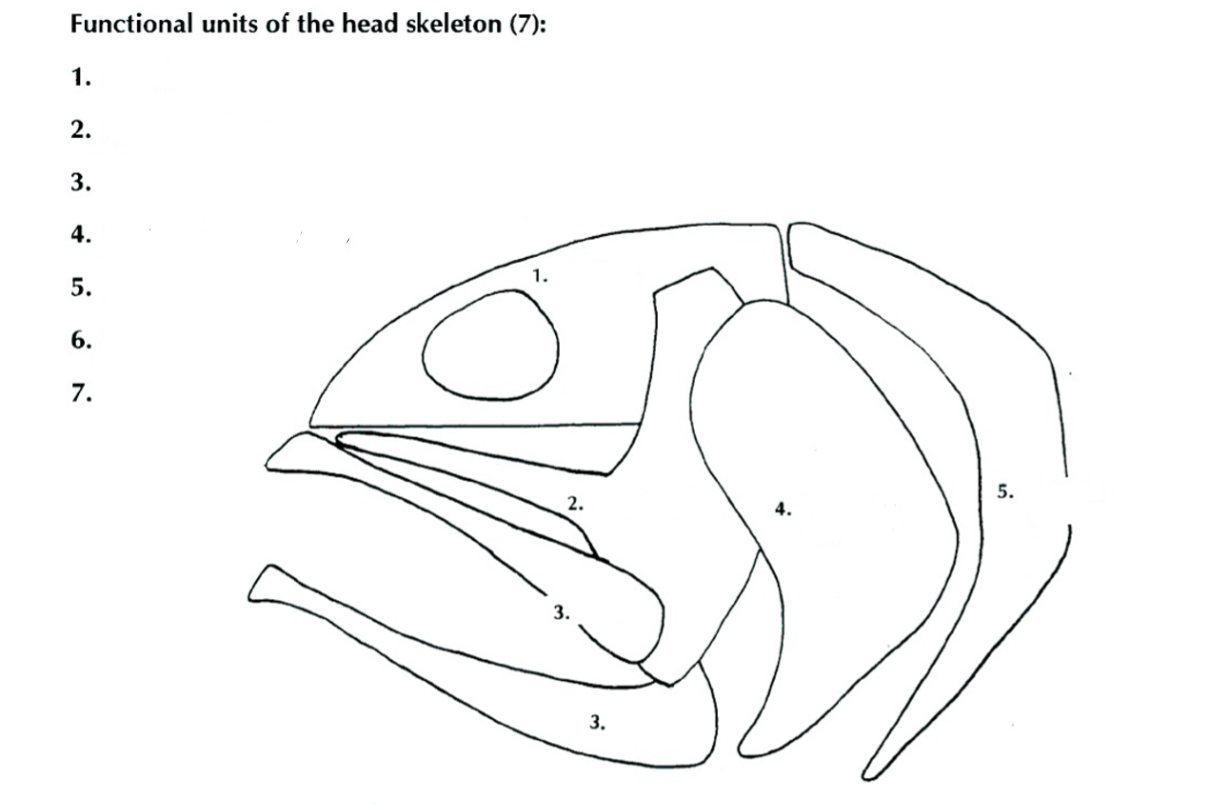
Cranium, 2. Suspensorium, 3. Jaws, 4. Opercular Apparatus, 5. Pectoral girdle.
Identify the following five elements of the head skeleton?
Abdominal extends from the back of the head, or gill cover, to the anus, the caudal extends from the anus to the tip of the caudal fin.
Explain the difference between the ABDOMINAL and CAUDAL vertebrae?
Buoyancy regulation, Respiration, Sound production and reception
List three functions of gas bladders in fishes.
glycoproteins within the bloodstream of Notothenoids (arctic fishes)
Use as an antifreeze to prevent freezing.
Live their lives in water, Respire by means of gills, have scales, have fins, cold-blooded
What are the five main traits that define most fish?
fusiform
usual body shape of sharks
cartilage
The skeletons of sharks and sting rays are composed of ______, which is lighter than bone.
Fish is the plural of the same species, while fishes is multiple of multiple species.
What is the difference between fish and fishes?
Pharyngeal openings, notochord, dorsal hollow nerve cord, post-anal tail.
Phylum Chordata charteristics
Rover-predators, Lie-in-wait predators, surface-oriented fish, bottom fish, deep-bodied fish, Eel-like fish.
What are the six categories of fish based on shape?
No gill slits, fused tooth plates, No placoid scales
List three characteristics of Chimeras (Subclass Holocephali)
Suspensorium, jaws, opercular apparatus, cranium, Pectoral girdle.
List the functional units of the fish cranium.
60,000 vertebrates, ~30,000 are fish.
how many vertbrates, how many are fish
Elasmobranchii (Sharks, Skates, Rays), Holocephali (Ratfish)
What subclasses are included in Class Chondrichthyes and what are their "common names".
reflective layer of tissue inside the retina that helps some animals see better in the dark.
Define Tapetum Lucidum
mating ritual, avoiding predators, losing parasites.
What are 3 possible reasons that manta rays leave the water?
Diadromous fish
Fish that migrate between fresh and salt water
Squalamine
A natural chemical compound found in the stomach and liver of the spiny dogfish. Used as part of their immune system.
The lateralis system helps fish sense movement and vibrations. It has sensory organs called neuromasts, covered by a jelly-like cupula, in mucus-filled canals. Water movement pushes the cupula, helping fish detect changes in water movement.
Describe the lateralis system. Use and define the words “neuromast”, “cupula”, “mucous”, and “canal” in your answer.
When larger or stronger developing embryos consume their smaller sibling or unfertilized eggs inside the mother’s uterus.
What is intrauterine canabalism and how does this occur in sharks
Viviparous.
live-bearing
Oviparous
egg laying
Lightning strike, heart attack, death from bee stings
Name three things more likely to result in human death than shark attack?
lower legs, 32% of bites
Where are you most likely to be bitten by a shark?
Surfing
What aquatic sporting activity is most likely to result in shark attack?
2%
Since the year 2000, roughly what percentage of shark attacks are fatal?
head is moving back and forth, the pectoral fins are dropped, and the back is hunched.
Describe the threatening posture displayed by sharks?
Sharks have seperate unattached pectoral fins, skates and rays have large pectoral fins that are fused to the sides of their head.
Sharks vs rays/skates based on pectoral fins
Palatoquadrate
What is the name of the upper jaw in sharks?
Meckels Cartilage
What is the name of the lower jaw in sharks?
Claspers
In male sharks the basal skeleton of the anal fins extend backward into the paired copulatory organ of sharks called ______________________?
Whale shark, 41-46 ft and 47-66,000 pounds.
What is the largest Shark species (which also happens to be the largest non-mammalian vertebrate)?
Bonus Question: What is the max weight and length of this species of shark?
Whale, Basking, Megamouth
Name three species of sharks that are filter feeders?
20-21 ft
What is the maximum size of a Great White Shark?
Squalamine
natural chemical compound was first discovered in the tissues of the spiny dogfish shark. Antiviral and Antibacterial.
It is a unique way of feeding that leaves round holes in larger animals.
From what activity does the cookie cutter shark derive its name?
Sawfishes have gill slits on the underside of the body. Sawsharks have gill slits on the side of the head.
How can you distinguish a member of the Pristiformes (Sawfish) from a member of the Pristiophoriformes (Saw sharks)?
More rods which allows them to see in low light.
Does the shark eye have more rods or cones and what is the significance of this?
Gill slits, cardiovascular system, no jaws, cranium, braincase with sense organs, neurocrest cell.
subphylum Craniata
heterocercal tail is asymmetrical with an elongated upper lobe, homocercal tail appears symmetrical with equal upper and lower lobes.
heterocercal tail vs homocercal
Partially cartilaginous skeleton, heterocercal tail, reduced scales, intestinal spiral valve.
4 charteristics of modern chondrosteans
Ray-finned appendages, bony endoskeleton, operculum
What are 3 characteristics of Actinopterygii?
Teleostei
What division contains approximately 95% of all living fishes?
Weberian apparatus
________________________ is the direct connection between the gas bladder and the ear.
gill-filaments
gill arch
gill-rakers
Draw a single gill arch, with gill rakers and gill filaments. Label these items.

photophores
Lantern fish have numerous light producing cells. What are they called?
Species that live entirely in underground caves and dark subterranean water, never coming to the surface or seeing daylight.
Some fish species are troglobitic. What does this mean?
The solubility of oxygen in the water decreases as both tempature and salinity increase
How does the solubility of oxygen in water vary with temperature and salinity?
Facultative: only use air-breathing organs when environmental oxygen levels in water drop. Obligatory: must breathe air at regular intervals.
Describe and distinguish between facultative and obligatory air breathing in fishes. Which one can drown?
labyrinth organ, swim bladder/lungs, skin, gut epithelium
Identify 4 air breathing organs other than gills found in fishes.
High energy efficiency at high speeds,
mandatory continous swimming
List one benefit and one cost of ram ventilation?
bony fish
What does the name Osteichthyes actually mean?
Lungs first evolved in early bony fishes over 400 million years ago to help them breathe air in shallow, low-oxygen water. Lungfish show that lungs could be useful before vertebrates fully moved onto land.
Discuss the evolution of lungs. Include in your discussion the relevance of lungfish (dipnoi) to this discussion.
Draw a diagram of a heterocercal tail and a diagram of a homocercal tail. Indicate with arrows and an explanation how the primary force vector differs between these two.
Low oxygen concentration, high density which needs more energy, very slow diffusion rates.
What are three major problems with breathing underwater?
lobed fleshy fins, two dorsal fins, enamel on teeth, ancestry of tetrapods.
Sarcopterygii
Actinopterygii
99% of the 30,000 species of fish belong to which Class?
Amiiformes
Bowfins
Buoyancy regulations, respirations, sound production, and reception.
What are the primary functions of the gas bladder?
Trait that is from the old ancestral state.
Plesiomorphic.
Homeotherms
Animals that keep their core temperature stable using internal mechanisms.
Endotherms
Animals that use energy from food to produce metabolic heat.
Ectotherms
An animal that gets their heat from the external environment.
Uusally dorso-ventrally flattened bodies.
What is the usual body shape for skates and rays?
ovoviviparous
eggs form in the mother, but live birth