Eye Anatomy
 Call Kai
 Learn
Learn Practice Test
 Spaced Repetition
 Match
Match Flashcards
 Knowt Play
1/29

There's no tags or description
Looks like no tags are added yet.
Name | Mastery | Learn | Test | Matching | Spaced | Call with Kai | Chat |
|---|
No analytics yet
Send a link to your students to track their progress
30 Terms
Conjunctiva
Lines inside of eyelids and connects to front of eye; produces mucus

Lacrimal apparatus/gland
Produces tears which protect, moisten, and lubricate the eys

Extrinsic eye muscles
Responsible for rotating the eyeball

Sclera
Makes up most of the fibrous layer; white

Cornea
Clear anterior portion of fibrous layer

Choroid
Posterior portion of vascular layer; nutrient-rich

Ciliary body
A circular muscle that relaxes or tightens to change the shape of the lens.

Iris
Circular and radial muscles that adjust the size of the pupil

Optic disc
Where the optic nerve leaves the eye; aka "blind spot"

Rods
photoreceptive cells that are adjusted for dim light; perceive gray tones
Cones
photoreceptive cells that are adjusted for bright light; perceive colors
Fovea centralis
Part of retina with only cones; greatest visual acuity here
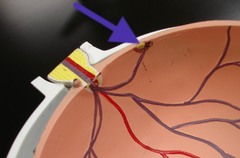
Cataracts
When the lens becomes hard and opaque

Aqueous humor
Between cornea and lens; supplies nutrients and maintains pressure

vitreous humor
Gel-like, between lens and posterior; maintains eye shape

Bipolar neurons and ganglion cells
Provide a pathway for visual information from photoreceptors to brain

Eyelashes
Located on the margin of the eyelids. Prevent foreign substances from entering the eye.
Macula
Area surrounding the fovea near the center of the retina in the eye, which is the region of keenest vision.
Glaucoma
a condition of increased pressure within the eyeball, causing gradual loss of sight.
Myopia
Difficulty focusing distant objects (nearsightedness)
Hyperopia
Difficulty focusing nearby objects (farsightedness)
emmetropia
normal condition of the eye.
normal, perfect vision
Rhodopsin
Light sensitive molecule/ pigment found in the rods and cones of the retina
Suspensory Ligaments
Long, thin fibers which connect the crystalline lens to the ring of ciliary muscles.
astigmatism
defective curvature of the cornea or lens of the eye
lacrimal fluid
tears; maintains moisture on the anterior surface of the eyeball
nasolacrimal duct
empties lacrimal fluid into the nasal cavity
fibrous tunic
sclera and cornea (outermost layer)
vascular tunic
choroid, ciliary body and lens, iris (middle layer)
Sensory tunic
Retina (Innermost layer)