Language in Ordinary and Institutional Settings
 Call Kai
 Learn
 Practice Test
 Spaced Repetition
 Match
 Flashcards
 Knowt Play
1/14

Earn XP
Description and Tags
Study of social psychological phenomena in real life contexts, discursive psychologist and conversation analysis, people doing things in ordinary/institutional settings
15 Terms
Describe the nature of how people sue language
Interactional (taking turns)
Active (people do things with language)
What is discursive psychology and conversation analysis?
Investigating what people are doing when they use language in real contexts → analysis of naturally occurring talk + text
How + when psych terms are made relevant in real contexts + for what purposes
How people construct their views as factual
How people perform discursive actions relevant to social psych (e..g initiating convos)
Patterns of interactions + breaches
Focus on analysis of language as more than the expression of thought (Billig, 1996)
People do things with language (e.g. perform actions → discursive actions)
What type of research is discursive psychology and conversation analysis?
Qualatative
How are conversations analysed?
Analysis of when + how together with non-verbal cues (forms of delivery)
Use of Jefferson’s transcription conventions

How are textual interactions analysed?
Analysis of when + how
No specific transcription needed
How did Stokoe (2019) study opening conversations in ordinary settings?
Openings across diff forms of communication (face-to-face, phone calls etc)
Identification of interaction rules/systematic patterns of actions (+ breaches)
Analysis of ordinary phone calls (also institutional phone calls)

What did Antaki (1994) discover about use of explanations in ordinary settings?
Explanations either created by 1 speak for another 1 OR brought up by speakers themselves as when declining an invitation or disagreeing

What did Pomerantz (1986) discover about complaining in descriptions in ordinary settings?
Data from ordinary (+ institutional) interactions
Producing a description of the event using extreme case formulations )’all’) that enables the speaker to defend against or to counter challenges to the legitimacy of complaints
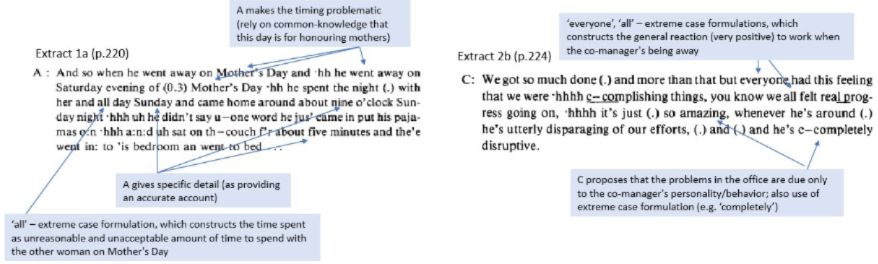
What did Pomerantz (1984) and Potter, Hepburn and Edwards (2020) study (in ordinary settings)?
Affiliation (+ disagreement) → how do people affiliate with each other?

How did Stokoe (2019) study openings of conversations in institutional settings?
Analysis of institutional phone calls
Identification of interactional rules/patterns + breaches

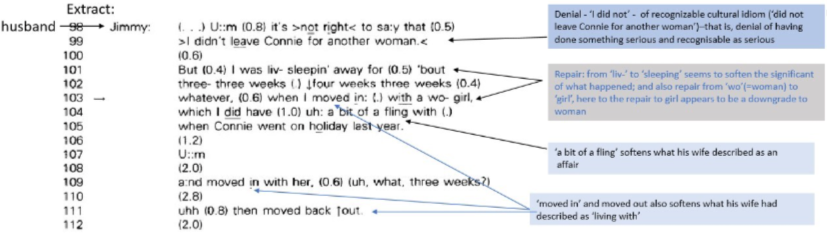
How did Edwards (1998) study therapy sessions?
Case study of a married couple in couples counselling sessions
Wife + husband deny + minimise the seriousness of the other’s accusations
How did Benneworth (2012) study police interviews?
11 police interrogations of arrested men suspected of sexually abusing children (8-12 yos) in the UK
Recorded + transcribed police interviews
Analysis examined relation between answers + types of question
Distinguished between open + closed qs
Depending on how police interrogators phrased qs
Did these types of questions affect answers of suspects?
Results
In closed police interrogations, suspect didn’t admit the crime (only denies police’s account)
In open-ended interrogations, suspect provides an account that leads to self-incrimination

How did Drew (1992) analyse courtroom examinations?
Analysis of cross-examination of an alleged victim in a rape trial
Descriptions produced by both defence lawyer + alleged victim about the evening of the attack + the attack
Results
Both produced different versions of the same event (evening of the attack) that have implications for understanding how the alleged attack should be characterised + explained
Rather than neutral, the versions are contestable → concerned with establishing the guilt (blaming) or innocence (exoneration) of the defendant

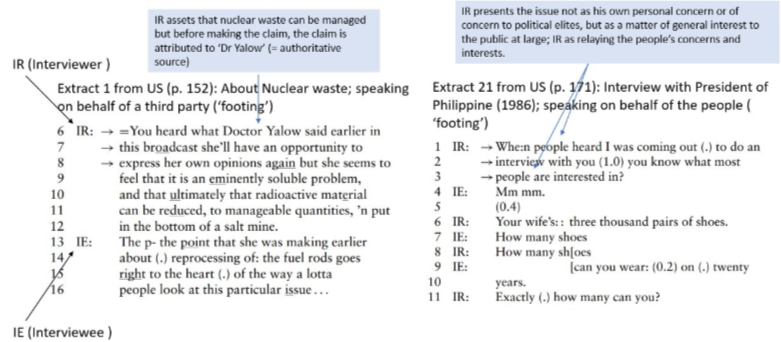
How did Clayman and Heritage (2002) study news interviews?
Analysis of news interviews in Britain + US
How do interviewers manage to assert themselves in an adversarial manner while maintaining a formally impartial or naturalistic posture?
Rules: taking turns + doing news interviews talk
Q-A sequence diff from ordinary convos
Predetermined agenda BUT interview produce of how PPTs deal with each other in the moment-by-moment
News interviewer as professional journalist (not a partisan advocate or celebrity entertainer) + interviewees are related to news events as primary source (as members of gov) or informed commentators (as experts)
News interviewer expected to adhere to basic standards of professional conduct (e.g. objective → factual accuracy, balance between opposing views + neurality) → often requires taking adversarial approach while maintaining neutrality
How did Billig and Marinho (2023, 2024) study diplomatic language?
How can political manipulation of stats be prevented?
Case study of exchange of open letters between UK PMs + gov ministers + UK stats authority + press coverage of the exchange
UKSA intervenes with recs to correct/improv production + presentation of stats either made in private or by issuing a public letter (usually last resort) → so limited power of UKSA
