BI 461 Herpetology - Salamandar Identification

0.0(0)
Studied by 0 people
call kaiCall Kai
learnLearn
examPractice Test
spaced repetitionSpaced Repetition
heart puzzleMatch
flashcardsFlashcards
GameKnowt Play
Card Sorting

1/16

encourage image

There's no tags or description

Looks like no tags are added yet.

17 Terms

1
New cards

Caudata/Urodela (Salamandars!)

Domain: Eukarya

Kingdom: Animalia

Phylum: Chordata

Class: Amphibia

Order: Caudata/Urodela

66 genera, 676 species, Five families in MI: Proteidae, Sirenidae, Salamandridae, Ambystomatidae, Plethodontidae

2
New cards

Vocab: Costal grooves/folds

knowt flashcard image
3
New cards

Proteidae

Mudpuppies

Neotonic - stay in larval stage (axolotl!)

Aquatic with external gills

One MI species

4
New cards

Necturus maculosus (Common Mudpuppy) - Proteidae

Bushy red gills (smaller in cold water)

Four toes on all feet

8-13” long (1ft+)

<p>Bushy <strong>red gills</strong> (smaller in cold water)</p><p>Four toes on all feet</p><p>8-13” long (1ft+) </p>
5
New cards

Sirenidae

Eel-like

Neotonic

External gills

Only two tiny front feet

One MI species

6
New cards

Siren intermedia (Lesser Siren) - Sirenidae

Tiny front legs with four toes each

Bushy red gills

Loooong (7-20”) (1.5ft+)
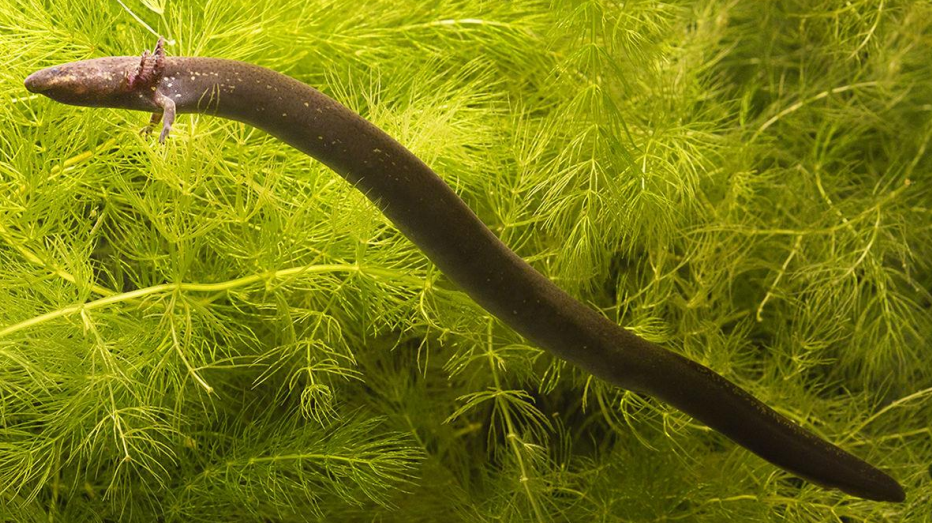
<p><strong>Tiny front legs</strong> with four toes each</p><p>Bushy <strong>red gills</strong></p><p><strong>Loooong </strong>(7-20”) (<strong>1.5ft+</strong>)</p>
7
New cards

Salamandridae

Newts

Lack costal grooves

Rough skins

Often poisonous

Often have terrestrial juvenile stage called an eft

One MI species

<p><strong>Newts</strong></p><p><strong>Lack costal grooves</strong></p><p>Rough skins</p><p>Often poisonous</p><p>Often have<strong> terrestrial juvenile stage called an eft</strong></p><p><strong>One MI species</strong></p>
8
New cards

Notophthalmus viridescens (Eastern Newt) - Salamandridae

Seen herping!!! :)

Dull skin

Efts are red or orange

Adults are olive with yellow bellies

May have red spots and dark eye stripe

<p><u>Seen herping!!! :)</u></p><p>Dull skin</p><p>Efts are<strong> </strong><span style="color: rgb(0, 0, 0);"><strong><mark data-color="red" style="background-color: red; color: inherit;">red or orange</mark></strong></span></p><p>Adults are <strong>olive </strong>with <strong>yellow bellies</strong></p><p>May have <strong>red spots</strong> and<strong> dark eye stripe</strong></p>
9
New cards

Ambystomatidae

“Mole” salamanders

Prominent costal grooves

Medium to large

Unisexual polyploid populations

Five MI species

10
New cards

Ambystoma maculatum (Spotted Salamander) - Ambystomatidae

Dark with yellow spots on back

11-13 costal grooves

4-9”
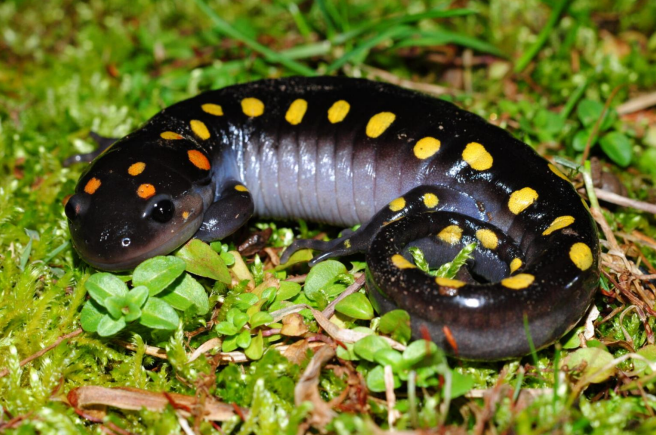
<p>Dark with<strong> yellow spots on back</strong></p><p>11-13 costal grooves</p><p>4-9”</p>
11
New cards

Ambystoma laterale (Blue-spotted Salamander) - Ambystomatidae

Seen herping!!! :)

Black with blue flecks along sides

12-14 costal grooves

3-5”
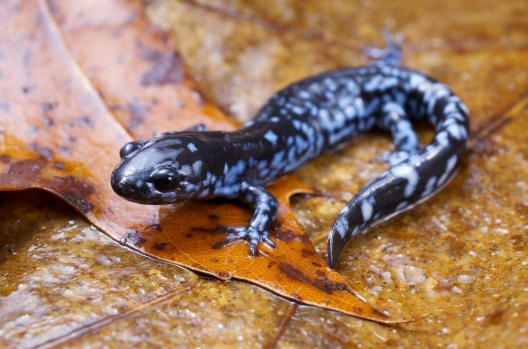
<p><u>Seen herping!!! :)</u></p><p><strong>Black with blue flecks</strong> along sides</p><p>12-14 costal grooves</p><p>3-5”</p>
12
New cards

Ambystoma texanum (Small-mouthed Salamander) - Ambystomatidae

Small head with short blunt snout

Brown/Gray with white flecks

4-7”

14-16 costal grooves

<p>Small head with <strong>short blunt snout</strong></p><p><strong>Brown/Gray with white flecks</strong></p><p>4-7”</p><p>14-16 costal grooves</p>
13
New cards

Ambystoma opacum (Marbled Salamander) - Ambystomatidae

Black/grey with white marbling

11-13 costal grooves

3-5”

<p><strong>Black/grey with white marbling</strong></p><p>11-13 costal grooves</p><p>3-5”</p>
14
New cards

Ambystoma tigrinum (Eastern Tiger Salamander) - Ambystomatidae

Largest terrestrial sallie in MI (7-13”) (1ft+)

Black/gray with yellow/tan blotches

Yellowish belly

12-13 costal grooves

Five toes on back and four in front

<p><strong>Largest terrestrial sallie in MI</strong> (7-13”) (1ft+)</p><p><strong>Black/gray with yellow/tan blotches</strong></p><p>Yellowish belly</p><p>12-13 costal grooves</p><p>Five toes on back and four in front</p>
15
New cards

Plethodontidae

Lungless salamanders

Largest salamander family

Usually very small and slender

Breathe only through skin

Nasolabial groove

Two MI species

<p><strong>Lungless </strong>salamanders</p><p>Largest salamander family</p><p>Usually very small and slender</p><p>Breathe only through skin</p><p><strong>Nasolabial groove</strong></p><p><strong>Two MI species</strong></p>
16
New cards

Plethodon cinereus (Eastern Red-backed Salamander) - Plethodontidae

Seen herping!!! :)

Tiny (2-5”)

Red backed and lead backed

17-22 costal grooves

Five toes in back and four in front

“Salt and pepper” belly

No aquatic larvae

<p><u>Seen herping!!! :)</u></p><p>Tiny (2-5”)</p><p><strong>Red backed and lead backed</strong></p><p>17-22 costal grooves</p><p>Five toes in back and four in front</p><p><strong><u>“Salt and pepper” belly</u></strong></p><p>No aquatic larvae</p>
17
New cards

Hemidactylium scutatum (Four-toed Salamander) - Plethodontidae

Tiny (2-4”)

Four toes on front and back feet

Reddish-brown or greyish brown

Sides are gray and may have blue flecks

White belly with black spots

13-14 costal grooves

<p>Tiny (2-4”)</p><p>Four toes on front and back feet</p><p><strong>Reddish-brown or greyish brown</strong></p><p>Sides are gray and may have blue flecks</p><p><strong><u>White belly with black spots</u></strong></p><p>13-14 costal grooves</p>



