Biology chapter 5
 Call Kai
 Learn
 Practice Test
 Spaced Repetition
 Match
 Flashcards
 Knowt Play
1/75

There's no tags or description
Looks like no tags are added yet.
76 Terms
Bioluminescence
energy-converting reactions that produce light by turning chemical energy into visible light
Cell membranes
Composed of a bilayer of phospholipids with embedded and attached proteins in a structure called a fluid mosaic
Phospholipids
unsaturated fatty acids with kinks in their tails that prevent them from packing together too tightly and becoming solid
What do animal cell membranes use cholesterol for?
stabilize membranes in warm temps
keep the membrane fluid liquid at cool temps
Functions of membrane proteins (6)
Maintain cell shape and coordinate changes inside and outside of the cell
Receptors for chemical messengers from other cells
Enzymes
Cell-cell recognition
Intercellular junctions
Selective permeability
What do glycoproteins do in the cell membrane?
Perform cell-cell recognition
What do Intercellular junctions do?
Attach adjacent cells together
Selective permeability
Allowing some substances to cross a cell membrane easier than others
Membrane proteins that span the entire membrane
Integral or transmembrane proteins
Membrane proteins that temporarily stick on the sides of the membrane
Peripheral proteins
The formation of phospholipids was a critical step in ______
the evolution of the first cells
Diffusion
The tendency of particles to spread out evenly in an open space
Particles diffuse ___ their ________
down; concentration gradient
Equilibrium
concentration of particles the same throughout
Osmosis
The diffusion of water across a semipermeable membrane
What happens if a water molecule can pass through a semipermeable membrane but the solute cannot?
water crosses the membrane, moving down its own concentration gradient until the solute concentration is equal on both sides

Tonicity
the ability of a solution to cause a cell to gain or lose water
Isotonic solution
Solute concentration the same on both sides
Hypotonic solution
Solute concentration is lower outside the cell
Hypertonic solution
Solute concentration is higher outside the cell
Osmoregulation (like in different -tonic solutions)
The control of water balance
How do hypotonic solutions affect cells?
Animal cell - Lysed (bad) could burst
Plant cell - Turgid (normal)

How do isotonic solutions affect cells?
Animal cell - normal
Plant cell - Flaccid (not ideal)

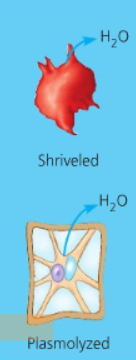
How do hypertonic solutions affect cells?
Animal cell - Shriveled (bad)
Plant cell - Plasmolyzed (bad)
Hydrophobic substances _____ diffuse across a cell membrane
easily
Polar or charged substances (ions) _____ diffuse across cell membranes
do not easily
Facilitated diffusion
Transportation across the cell membrane that does not require energy and relies on the concentration gradient. Uses transport proteins to move polar or charged substances that cannot easily cross on their own.
2 types of transport proteins
Channel proteins - work as a hydrophilic tunnel
Carrier proteins - bind to the passenger, change shape, and release the passenger on the other side

Transport proteins are ___ to the ___ they transport
specific; substrate
Aquaporin
a protein channel that can be used to diffuse water more rapidly than usual
Active transport
Transportation where energy is used to move a solute against its concentration gradient
What happens when phosphate attaches to ADP?
It is phosphorylated and becomes usable ATP energy
Exocytosis
Exports bulky molecules such as proteins or polysaccharides, uses ATP
Endocytosis
Imports substances useful to the livelihood of the cell, uses ATP
Phagocytosis
the engulfment of a particle by wrapping cell membrane around it, forming a vacuole, type of endocytosis

Pinocytosis
the engulfment of a fluid by wrapping cell membrane around it, forming a small vesicle, type of endocytosis

Receptor-mediated endocytosis
uses receptors in a receptor-coated pit to interact with a specific protein, making a vesicle

____ is the capacity to cause change or perform work
Energy
Kinetic energy
energy of motion
Potential energy
stored energy
Heat
aka thermal energy, type of kinetic energy associated with random movement of atoms or molecules
Light
Type of kinetic energy that can be harnessed to power photosynthesis
Chemical energy
the potential energy available to release in a chemical reaction. It is the most important type of energy for living organisms to power the cell
Thermodynamics
the study of energy transformations that occur in a collection of matter
First law of thermodynamics
energy in the universe is constant
Second law of thermodynamics
energy conversions increase the disorder of the universe
Entropy
the measure of disorder or randomness
What happens to stored chemical energy in cellular respiration?
It is converted to a form that the cell can use to perform work
Exergonic reactions
Reactions that release energy in covalent bonds of the reactants. The products have less energy than the reactants. Ex. cellular respiration

Endergonic reactions
Reactions that require an input of energy and yield products rich in potential energy. They begin with reactant molecules with relatively low potential energy but end with products that contain more chemical energy. Ex. photosynthesis

Photosynthesis
An endergonic reaction that uses energy-poor reactants CO2 and water. Energy is absorbed from sunlight and energy-rich sugar molecules are produced
What is a metabolism?
the total of an organism's chemical reactions
Metabolic pathway
A series of chemical reactions that either builds a complex molecule or breaks down a complex molecule into simpler compounds
Energy coupling
uses the energy released from exergonic reactions to drive essential endergonic reactions, usually using energy stored in ATP molecules
ATP
(adenosine triphosphate) powers nearly all forms of cellular work
ATP consists of…
the nitrogenous base adenine
the five-carbon sugar ribose
three phosphate groups
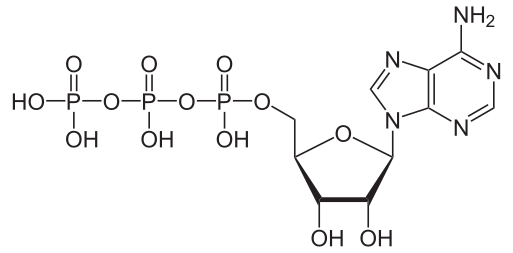
How does the hydrolysis of ATP work?
It releases energy by transferring its third phosphate from ATP to some other molecule through a process called phosphorylation
After phosphorylation, ATP becomes ____
ADP (adenine diphosphate)
Three main types of cellular work
Chemical (make proteins and break down carbs)
Mechanical (using muscles)
Transport (ex. moving oxygen with blood)
The release of potential energy is _____
not spontaneous
What must be overcome before a chemical reactions can happen?
An energy barrier made of energy called activation energy (EA)
EA (activation energy)
The amount of energy needed for a reactant molecule to move “uphill” to a higher energy so the “downhill” part of the reaction can begin
Enzymes
Biological catalysts that function by lowering the amount of activation energy needed
Reusable
Are usually proteins, but can be RNA
Selective in reactions it catalyzes
Substrate
The specific reactant that an enzyme acts on
Active site
The region of an enzyme that a substrate fits into

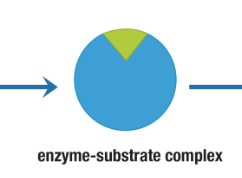
Enzyme-substrate complex
The enzyme and substrate after bonding
What is an enzymes optimal temperature?
The temperature that an enzyme produces the highest rate of contact between the reactants and the enzyme’s active site
The optimal pH for most enzymes is ______
near neutrality
Cofactors
Non-protein helpers for enzymes that bind to the active site and function in catalysis. Some are inorganic, like zinc or iron, and some are organic.
Coenzyme
An organic cofactor (ex. vitamins)
Inhibitor
A chemical that interferes with an enzyme’s activity. Important in regulating the cell’s metabolism
Competitive inhibitors
block substrates from entering the active site and reduce an enzyme’s productivity

Noncompetitive inhibitors
bind to the enzyme somewhere other than the active site and change the shape of the active site. Prevents the substrate from binding

Feedback inhibition
The product Acts as an inhibitor of one of the enzymes in the pathway that produced it

An example of enzyme inhibitors that are seen everyday are…
Drugs like ibuprofen, antidepressants, etc.
How can enzyme inhibitors work as pesticides and deadly poisons for chemical warfare?
They can block the ability to make ATP through carbonmonoxide