math equations
 Call Kai
 Learn
 Practice Test
 Spaced Repetition
 Match
 Flashcards
 Knowt Play
1/40

There's no tags or description
Looks like no tags are added yet.
41 Terms
surface area prism
2(base area)+(length)(base perimeter)
binomial (success/failures)

distance from point and line
point (x0,y0) and line ax+by+c=0
|ax0+by0+c|/(sqrt(a²+b²))
distance from point and plane
point (x0,y0,z0) and line ax+by+cz+d=0
|ax0+by0+cz0+d|/(sqrt(a²+b²+c²))
lateral surface area of cylinder
2(pi)rh
surface area of cylinder
2(pi)r²+2(pi)rh
SA square pyramid
B+P(slant height)/2
cone surface area
(pi)r²+(pi)r(slant height)
sphere surface area
4(pir)r²
simple interest
I = Prt
amount with simple interest
A = P + Prt or P(1+rt)
compound interest (annual)
A = P(1+r)^t
solve for rate (compound)
r = (A/P)^(1/t)-1
linear scale factor
new length/og length
perimeter scale factor
same as linear
ex. scale factor is 4/3. small perimeter is 12. big perimeter is 12(4/3)=16
area scale factor
(linear scale factor)²
volume scale factor
(linear scale factor)³
side ratio to area ratio
1) square the side length ratio
2) set area ratio equal to area1/area2
pereimeter to linear factor
simply numerator and denominator
area using adjacent side vectors
|uxvy-uyvx|
rhombus area
d1d2/2
find second endpoint from midpoint and first endpoint
(2Mx-x, 2My-y)
rectangle has opposite vertices (a,b),(c,d) sides axis parallel. find the area
length: |a-c|
width: |b-d|
find perpendicularity with dot product
A(x1,y1), B(x2,y2), C(x3,y3)
vector AB: <x2-x1, y2-y1> = <A,B>
vector BC: <x3-x2, y3-y2> = <C,D>
AC-BD=0 then perpendicular
find fourth vertice
xD=A+C-B
equilateral triangle area
(s²sqrt(3))/4
diagonal length
sqrt(l²+w²+h²)
inscribed angle
(intercepted arc)/2
exterior angle from two secants

(far arc-near arc)/2
intersecting chords (length of each)

two secants (length of each line)
external(whole)=external(whole)

tangent-secant (length of each line)

c²=a(a+b)
in an inscribed square (square in circle), what is the diameter equal to
the square’s diagonal
angle of 2 intersecting chords
(arc1 + arc2)/2
at most k successes
add P(0)+P(1)+…+P(k)
at least k success
1-P(0)-P(1)…-P(k)
all successes
p^n
no successes
(1-p)^n
theroem for side lengths when circle is inscribed triangle
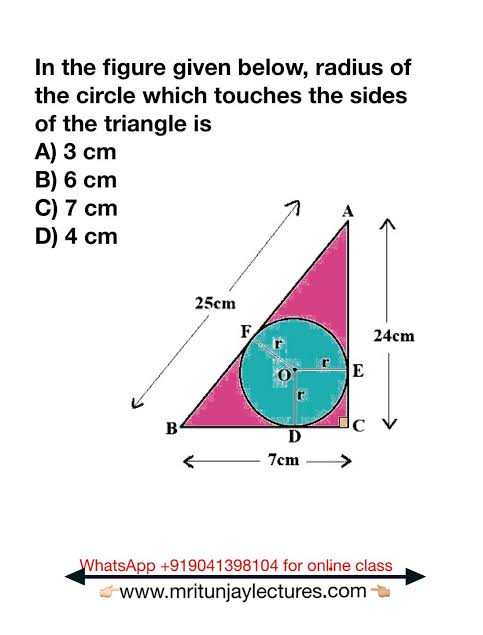
AF=AE
BF=BD
DC=CE
number of diagonals
n(n-3)/2
sum of interior angles
180(n-2)