Attributes and Explanations
 Call Kai
 Learn
 Practice Test
 Spaced Repetition
 Match
 Flashcards
 Knowt Play
1/37

Earn XP
Description and Tags
Attribution theory (people as naive statisticians), applying attribution theory to sport and relationships, biases in attribution (people as cognitive misers), attributions and explanations in talk (discursive psychology)
38 Terms
What is attribution?
Process of assigning a cause to one's own behaviour or that of others
What are Heider’s (1958) basic principles of attributions?
Natural tendency to look for causes of behaviour, occurrences, experiences (make causal attributions) → makes our world predictable
Believe own behaviour is motivated, not random → seek motives for others’ behaviour
Look for stable, enduring properties → control environment
2 key types of causal attributions → locate the cause within the person (internal) or within the situation (external)
E.g. 2026 US midterms → because of trump (internal) vs because the people on the ballots were unpopular (external)
Internal → are hidden + should only be inferred when external causes are absent BUT people are biased towards making these even when external evidence exists
People = naive psychologists in their rational, scientific, cause + effect approach to understanding + predicting behaviour (common-sense causal theories)
What is ones and Davis’ (1965) theory of correspondent inference?
How people infer that a specific behaviour corresponds to an underlying disposition or personality trait
People prefer these inferences because dispositional causes are stable + make the world predictable
Have cues for making correspondent inferences
What are the cues for making correspondent inferences?
Freely chosen behaviour → without external threats or constraints is more indicative of disposition
Non-common effects → behaviour that produces unique effects (rather than effects common to many actions) reveals more about disposition
People assume actors are aware of these unique outcomes (outcome bias)
Social desirability → socially undesirable/counter-normative behaviour provides a stronger basis for inference than socially desirable behaviour (which may just follow norms)
Hedonic relevance → behaviour with important direct consequences for the observer leads to more confident inferences
Personalism → behaviour that appears specifically intended to benefit or harm the observer leads to stronger inferences
What are the weaknesses of the correspondent inferences theory?
Relies heavily on the attribution of intentionality → unintentional acts (e.g. carelessness) can also lead to dispositional inferences
Non-common effects is flawed → people often don't attend to non-occurring behaviours (accurate computation of effect commonality is difficult)
Correspondent inferences are often automatic → correcting for situational factors is a deliberate process
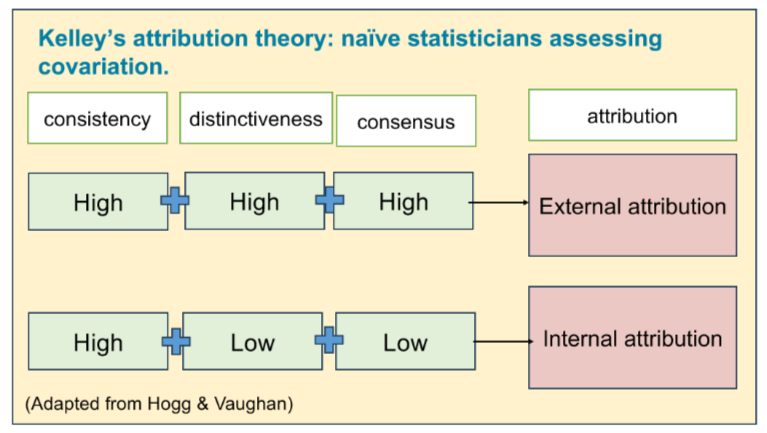
What is Kelley’s (1967,73) covariation model for attribution theory (ANOVA model)?
Act like statisticians by decide whether the cause of a person’s behaviour is an internal/external factor → look for 3 kinds of info see how they covary with the target behaviour
Consensus → the extent to which others react in the same way to stimulus x
High = external
Distinctiveness → whether a person’s reaction occurs only with 1 stimulus or is common to many stimuli
High = external
Consistency → whether behaviour y always co-occurs with stimulus x
High = stable cause
Low = potential cause is discounted (look for alt factors)
What are the strengths of Kelley’s covariation model?
Attribution theory became popular in social psych→ esp:
The idea that we seek causal attributions for behaviour + occurrences
Identifiable types of info influence our attributions in ways that could be specified
McArthur (1972) → PPTs given scenarios with consensus, consistency + distinctiveness info about a range of behaviours
Asked to make internal/external attributions → findings support model
BUT people under-use consensus info
What are the limitations of Kelley’s covariation model?
People don’t/can’t seek the info required by the model
May not have access to multiple observations of target behaviour
People under-use consensus info (McArthur, 1972)
E.g. false consensus effect → don't use observations about what other people are doing
Identifying causes only as internal/external is often insufficient (Malle, 2011)
Often need to know more about the cause → is it ability or lack of effort? (both internal but have different implications)
Fails to reflect what we do → e.g. don’t spontaneously seek covariation info when trying to explain behaviour (Lalljee, 1984)
People didn’t ask about consistency, distinctiveness, consensus → people are messier in their attributions
May attribute causality based on salience or similarity rather than actual covariance
Utility + accuracy of the concept of naive statistician was questioned
What is a potential response to the criticism of Kelley’s model that it requires multiple observations?
Causal schemata (1972b)
Preconceived beliefs acquired from experience about how certain causes interact to produce effects
E.g. the "multiple necessary cause" schema suggests that a specific effect (e.g., a drink-driving conviction) requires the presence of at least two causes (alcohol consumption and vehicle control)
Helps resolve attribution problems with limited data
BUT faced criticism + not universally accepted without reservation (Fiedler, 1982)
How did Weiner (1985) extend and apply attribution theory?
Interested in attributions of achievement
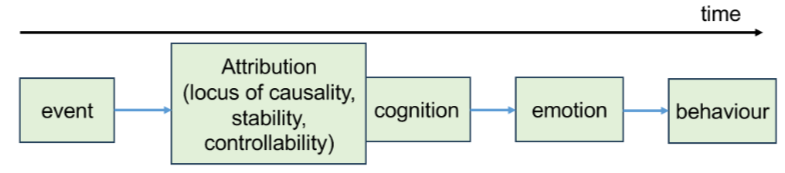
Causal attributions can be classified in terms of:
Locus (internal/external)
Stability (transient/unchanging)
Controllability (not/controllable)
Behaviour/events explained by a combination of these facts
Attributions tied to behaviour change
Attributions influence/drive motivation + emotion → impact behaviour
How can Weiner’s (1985) extension of attribution theory be applied to a tennis player who fails to win a tournament?
Lack of ability → internal stable, uncontrollable attribution
Having a poor coach → external, stable, uncontrollable
How did McAuley (1985) apply Weiner’s (1985) extension of attribution theory to gymnasts?
Successful gymnasts made more internal, stable + controllable attributions for their performance (than less successful ones)
What dimension of Weiner’s attribution theory do sports psychologists focus on? What are the implications of this?
Controllability → developed attributional retraining to encourage individuals to develop controllable explanations for performance (Perry, 2014)
Aside from sports, what has Weiner’s attribution theory be used to explore?
Role of attributions in relationships
Bradbury + Fincham (1990) → association between attributions + marital satisfactions
1992 → spouses’ maladaptive attributions were related to behaviour (e.g. less effective problem solving)
E.g. explaining lack of interest in sex as being explained by having a lot on at work vs not loving you anymore (negative attributional pattern for distressed/dissatisfied couples)
What are attributes subject to?
Bias (adaptive characteristics of everyday social perception (not just errors)) from personality, interpersonal dynamics + communication needs
What are 2 influential biases on the attribution process? What is an assumption of this approach?
Fundamental attribution error
Actor observer difference
Assumes a model of the person as a cognitive miser/motivated tactician (not naive psychologist)
What is a cognitive miser?
People take cognitive short-cuts (heuristics) to produce generally adaptive behaviour → are usually sufficient if not accurate
What is a motivated tactician?
People have multiple cognitive strategies from which they choose according to personal goals, motives + needs
What do we have a tendency to overestimate? What are some types of this bias? What is a weakness of this?
The role of personality in explaining behaviour
Correspondence bias
FAE
Related concepts
Outcome bias = assuming a person intended all outcomes of their behaviour
+ responsibility → people attribute greater responsibility to actors when the consequences of an accident are severe (e.g., oil spill vs. small spill), even if the negligence was identical
Essentialism = behaviour reflects immutable, often innate, properties (essences) of a person or group (can lead to damaging stereotypes where negative traits are seen as genetically or culturally fixed)
BUT less fundamental than o.g. thought → more dominant in Western cultures
Kids in Western cultures start with situational explanations + learn dispositional ones later → not the case for (e.g., Hindu Indian children)
W → people tend to make dispositional attributions (focusing on internal traits)
This tendency increases with age = ontogeny
NW → people are less inclined to make dispositional attributions -> attributed to:
The pervasive influence of social roles in collectivist cultures
A holistic worldview that promotes context-dependent and occasion-bound thinking
What is correspondence bias? What can this be applied to?
General tendency to see behaviour as reflecting stable underlying personality attributes
Political campaigns exploit correspondence bias by focusing on opponents' personalities (e.g. sleepy Joe, unstable narcissist) not policy
What is fundamental attribution error? What is the evidence for this?
Observers tend to attribute behaviour to the person (internal) rather than factors in the situation (external) → self-serving
Success → internal attributions
Failure → external attributions
Jones + Harris (1967) → US PPTs read speeches about Cuba’s president (Fidel Castro) written by fellow students
Pro/anti-Castro
Writers had chosen to/been instructed to write the speech
Anti-Castro attitudes were more attributes to anti-Castro debaters
Barjonet (1980) → tendency to attribute road accidents to driver (not vehicle, road conditions)
Tendency to attribute poverty + unemployment to the person (not social conditions)
How medical professional can over-simplify the cause of a medical problem by locating it within the person

How can our tendency to overestimate the role of personality in explaining behaviour be explained?
Focus of attention → the actor is salient (figure) while the situation is background; shifting attention to the situation reduces the bias
Differential Forgetting → situational causes may be forgotten faster than dispositional ones over time
Linguistic facilitation → English grammar makes it easier to describe actors and actions with the same terms (e.g., "honest person," "honest action") than to describe situations similarly
What is the actor-observer effect? What is the evidence of this?
Tendency to attribute our own behaviours to the situation + others’ behaviours to the person (Jones + Nisbett, 1972)
View others' behaviour as more stable + predictable than our own
Effect varies by valence → make more dispositional attributions for socially desirable behaviour regardless of the actor
Effect can be reversed if the actor knows their behaviour is dispositional or if POVs are swapped (actors take the observer role)
Nisbett (1977) → used dispositional items on a checklist to explain their friend’s behaviour
Used situation items to describe their own behaviour

What are the 2 main explanations for the actor-observer effect?
Informational difference → actors have more info about themselves + how the situation is impacting them (Jones + Nisbett, 1972)
Difference in perceptual focus → we blame what we see )actors see the situation, observers see the actor) (Storms, 1973)
What is the false consensus effect?
Tendency to see one's own behaviour, opinions, and beliefs as more typical (common) than they actually are
Ross, Green + House (1977) → students who agreed to wear a sandwich board estimated high peer agreement, while those who refused estimated high peer refusal
Effect is stronger for important/certain beliefs under external threat, regarding positive qualities + within minority groups
What are the explanations for the false consensus effect?
People seek out similar others
One's own opinions are highly salient, eclipsing alternatives
Motivation to validate one's own views and maintain a stable worldview
What is self-serving bias? What are some types of this?
Maintain favourable self-image
Self-enhancing bias = taking credit for successes (internal attribution)
Self-protecting bias = blaming failures on external situational factors
E.g. self-handicapping (publicly create/claim obstacles (e.g. lack of revision, hangovers) before an event) → provides ready-made external excuse for anticipated failure while allowing internal credit if they succeed despite this
Berglas + Jones (1978) → students who succeeded on unsolvable puzzles (attributing success to luck) chose performance-impairing drugs for the next task to protect their self-esteem against likely failure
Related → belief in a just world = the world is predictable and fair; good things happen to good people, and bad things to bad people
Provides illusion of control + security
BUT can lead to victim blaming to maintain this belief or self-blame (victims of trauma may blame themselves to reinstate a sense of control over a chaotic event)
What are the factors involved in self-serving bias?
Cognitive → expectation of success, association of effort with outcome
Motivational → ego protection
What are the strengths of views of bias in attributional processes?
Explain variations in how we explain behaviour + occurrences
Supported through extensive research
What are the weaknesses of views of bias in attributional processes?
Tend to employ a simple distinction (internal/external) → limited utility
Matters whether we attribute failure to lack of effort/ability (Hewstone, 1989)
Attributing responsibility may be more important for predicting future behaviour (Cheng, 2017)
What is attribution research traditionally focused on?
Internal cognitive processes
What is discursive psychology?
Concerns how people talk about causes, reasons, responsibility etc for behaviours + what is thereby achieved
How behaviour is made an accountable matter in actual talk + what these accounts achieve (e.g. denying responsibility/agency)
Focuses on sequences of actual talk in which people hold themselves/held to account
Show importance of attending to the details of how actions/events are described
Explanations/accounting has an action-orientation (e.g. deny responsibility, decline an invitation)
What was Archer and Parry’s (2019) study on blame attributions and mitigated confessions?
Studied 2 celebrity confessions → produced descriptions which:
Minimised extent/severity of transgressions
Reduced their agency
Transformed nature of transgression
Reduced their responsibility for the transgression
What was Finlay and Faulkner’s (2003) study in how University netball players talking about losing and winning?
Managed loss of face in losing talk
Accounts displayed modesty in winning talk
When we produce attributions in talk, we’re managing inferential issues our stake in what we’re explaining (alongside just explaining)
How are attributions shaped by culture? What is a weakness of this?
May make different types of attributions
May use different methods to make attributions
May approach the entire task of social explanation differently
BUT high potential for cross-cultural interpersonal misunderstanding
How are the Zande people of West-Africa an example of how attributions are shaped by culture?
Dual theory of causality
Common-sense proximal causes (e.g. physical event)
BUT these operate within a context where witchcraft is the ultimate cause
Western distinction between internal + external causes makes little sense
How are the Motumotu people of New Guinea an example of how attributions are shaped by culture?
Based on reports by Lévy-Bruhl
Attributed a Pleurisy epidemic to a combination of:
A missionary
His livestock
A portrait off Queen Victoria
Functions as a social representation
E.g. modern physics theories which postulate unobservable entities to explain the cosmos (some critics even dismiss modern physics as "science fiction with mathematics")
How did Miller (1984) provide evidence for cultural shaping of attributions?
Compares North Americans + Indian Hindus across 8, 11, 15yos + adults
Little cross-cultural difference in how 8yos explained behaviour
BUT as age increased, groups diverged significantly
North Americans → increasingly adopted dispositional attributions as they aged
By age 15 and into adulthood, they were significantly more dispositional than their Indian counterparts
Indian Hindus → didn't show the same increase in dispositional attributions + maintained a stronger focus on contextual factors
The results for contextual (situational) attributions were the reverse of the dispositional findings → Indians maintained higher levels of contextual explanation as they aged compared to Americans