astronomy ch 14, 15, 16
 Call Kai
 Learn
 Practice Test
 Spaced Repetition
 Match
 Flashcards
 Knowt Play
1/25

There's no tags or description
Looks like no tags are added yet.
26 Terms
normal heat pressure
remove heat source → gas cools down → pressure drops → gas gets denser
white dwarf in a close binary (novae)
hydrogen from its companion can fall onto the wd
matter forms a disk around it
matter falls onto it, compressing and heating to over 10 mill degrees
H fusion can begin
wd system temporarily gets much brighter 10,000x
they shrink when you add mass to them because their gravity gets stronger and they compress more
langrangian point
in between 2 objects orbiting each other, the point at which their gravitational forces can exactly cancel is the first langrangian point
matter at this point can flow both ways but will usually flow from the expanding object’s roche lobe into the other objects roche lobe
shrinkage of white dwarfs
pauli exclusion principle: electrons close together must have higher energies since lower energy states are filled
adding mass to white dwarf causes it to compress, forcing electrons into smaller space
Chandra predicted inward pull of gravity overwhelms outward pressure of electron degeneracy if white dwarf has mass > 1.4 M (chandrasekhar limit)
if mass goes above limit, electron degeneracy cannot support the star, white dwarf collapses, this raises core temp and wd explodes (white dwarf supernova)
white dwarf nova v supernova
nova: luminosity 100,000 suns, H to He fusion of a layer or clump, wd left in tact
supernova: luminosity 10 bill suns, complete explosion w nothing left
supernova
massive star supernova (type II): iron core of massive star always eventually passes chandrasekhar limit and collapses causing an explosion (single massive stars)
white dwarf supernova (type Ia): carbon fusion beings when white dwarf in a close binary system exceeds chandrasekhar limit, collapsing and exploding (low/intermediate mass stars form white dwarfs, only pass limit if companion dumps matter on them)
wd supernova fades quickly at first then more gradually, massive star supernova fades in a more complicated pattern
degenerate objects
electron degeneracy pressure: white dwarf
leftover core (always <1.4Msun) of low mass star (0.08Msun<M<8Msun)
Neutron degeneracy pressure: neutron star
leftover core (1.4Msun<Mcore<3Msun) of high mass star (M>8Msun)
neutron star
collapse of the iron core at the end of a massive star’s life, heat and energy of collapsing core breaks apart iron nuclei into protons and neutrons → electrons forced to combine w protons, making neutrons and neutrinos → dense ball of neutrons (neutron star)
very dense, very fast rotation, very strong magnetic field
pulsars
Jocelyn Bell and Anthony Hewish discover pulsar
all pulsars are neutron stars but not vice versa
synchrotron emission: light emitted by charged particles moving close to the speed of light around magnetic fields
emission concentrated at magnetic poles and focused into a beam, whether we see them depends on viewing angle

matter falling onto neutron star
matter falling in forms an accretion disk
matter falls onto star by spiraling in on accretion disk
episodes of fusion of the surface lead to X-ray bursts
neutron star limit
core masses greater than neutron star limit (3Msun) no known force can resist crush of gravity
gravity crushes all the matter into a point known as singularity (a black hole)
escape velocity
minimum upward speed required to leave an object and get to infinity w zero speed
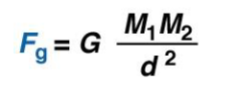
if you shrink a sphere wile holding mass constant, force at the surface increases as 1/r²
escape velocity increases as sphere of matter gets smaller
black holes
eintstein’s general theory of relativity: gravity is the warping of spacetime about an object w mass (even light is affected by gravity)
black hole’s mass strongly warps space near it
measuring of the warping of space by the sun

black hole cont.
almost any object can become a black hole if it is shrunk small enough
must consider how much matter is concentrated into a small volume
gravitational force of a body depends on how massive the body is and how compact
at some size, gravity is so great no light can escape (escape velocity equals speed of light)
surface of that object at the critical radius is called the event horizon
the radius of the object at the critical radius is the schwarzschild radius
objects w radii smaller than the schwarzschild radius can exist but they lie in th event horizon and cannot be seen
nothing can escape from event horizon, there is no contact w something that falls in, infalling objects increase black hole mass, changes spin or charge, but loses identity
black hole verification
measuring mass: use orbital properties of companion, measure velocity and distance of any orbiting gas
massive objects bend light and act as gravitational lenses
black hole magnetic field
magnetic fields generated outside the event horizon, in accretion disk
field lines thread the event horizon, magnetic field dragged inward and crosses event horizon
energy is extracted outside the horizon

dusty gas clouds
obscure view of more distant stars
these clouds are interstellar matter that make new star systems
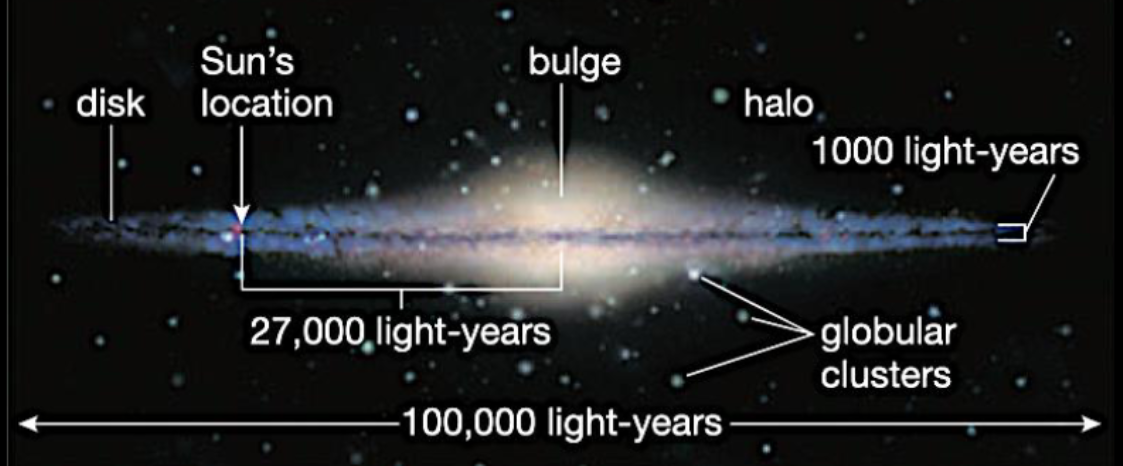
primary features of our galaxy
orbits of stars in the bulge and halo have random orientations which is why the halo is round
stars in the disk orbit in same direction w a little up and down motion
galactic recycling
gravity forms stars out of gas in molecular clouds as a part of the star-gas-star cycle

where do stars form in the galaxy
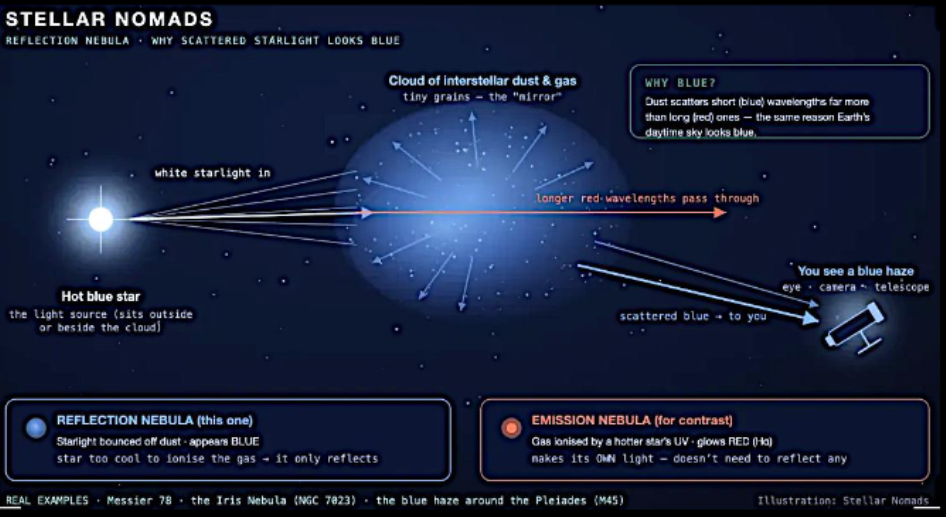
very massive stars are blue (lots of energetic photons that ionize the gas)
halo: no ionization nebulae, no blue stars, no star formation
disk: ionization nebulae, blue stars, star formation (most in spiral arms)
spiral arms: waves of star formation. gas clouds get squeezed as they move into spiral arms, squeezing of clouds triggers star formation, young stars flow out of spiral arms
spiral structure
milky way has spiral pattern
arms caused by compression waves propagating around the disk
gas orbits faster than compression waves
spiral arms appear blue compared to the bulge or gaps between arms
density/compression wave
travels through a gas but the individual particles do not move very much
compression triggers star formation
molecular clouds concentrated in arms → short live stars delineate arms and make them blue/bright → long lived low mass stars pass through arms several times in their orbits before they die
halo v disk star composition
halo: contain 0.02-0.2% heavy elements, are old stars
disk: contain 2% heavy elements, stars of all ages
therefore our galaxy probably formed from a giant gas cloud
halo stars formed first as gravity caused cloud to contract and while much of the gas was still in a sphere, remaining gas settled into a spinning disk
center of the universe
something massive is there, a black hole, orbits of stars indicate a mass of 4.3 million Msun
x ray flares from galactic center suggest that tidal forces of suspected black hole occasionally tear apart chunks of matter about to fall in