biology FINAL
 Call Kai
 Learn
 Practice Test
 Spaced Repetition
 Match
 Flashcards
 Knowt Play
1/149

There's no tags or description
Looks like no tags are added yet.
150 Terms
radiocarbon dating
known that Carbon 14 decays to form nitrogen 14 with a half-life of 5730 years.
Radiocarbon dating is a technique in which scientists compare the proportion of parent (C14) to daughter (N14) isotopes to calculate how many half lives have passed
fossilisation
Rapid burial after death = organisms dies and is buried quickly (hidden from scavengers)
Undisturbed = so that remains are intact and not broken up from scavenging animals/weather
Decomposition prevented = conditions must be such that bacteria (and fungi) that normally decompose dead tissue cannot survive
constant cold temperatures, dehydration, high acidity, lack of oxygen, darkness
Downward pressure = from layers of sediments above
symptoms of inflammation
redness - vasodilation of blood vessels, leading to red blood cells released into tissue
pain - swelling causes pressure on the surrounding tissue, which stimulates pain receptors and contributes to the pain
heat - increased blood flow
swelling - increased movement of fluid (blood & lymph) into tissues (due to increased capillary permeability) after vasodilation
function of antibodies
Agglutionation: form antigen-antibody complexes, causing the antigens to clump together and make them more recognisable to phagocytes
Neutralization: prevent binding of pathogen to self-cells to neutralise harmful effects
Opsonisation: tag pathogens for destruction (by binding to surface antigens on pathogens to form antigen-antibody complexes), activating phagocytes and complement proteins - leading the destruction of the pathogen
epidemic
sudden increase in occurrence of a disease among a specific population in a given area at a particular time
pandemic
an epidemic that has spread across multiple countries in different regions of the world
endemic
disease that is constantly present at a stable, predictable baseline level within a specific geographic area or population
relative dating
dates relative to the position of the fossil or relative to an index fossil of known age
Based on statigraphy; states that the oldest stratum is at the bottom and younger layers lie above
Faunal selection = fossils contained in sedimentary rock strata succeed one another in a predictable order, even when they are found in different places
consequence based approach
central importance on consideration of the consequences/effects of an action, aims to achieve maximization of positive outcomes/benefits and minimization of negative effects
may allow an individual to break the rules to achieve the greatest good
duty/rule based
concerned with how people act; some actions are essentially good/bad, dependent on their nature and a clear set of rules
humans have an obligation/duty to follow these ethical rules regardless of consequences that may be produced
virtue-based
- individual should be driven by their character, rather than by any fundamental rules or consequences; action can be justified simply for its virtues
- which action would a good person choose (is it of moral character to be…)
integrity/justice/beneficence/non-maleficence
honest reporting of all sources of information and communication of results, whether favorable or unfavorable
ensure that there is fair consideration of competing claims, no unfair burden on a particular group from an action & fair distribution and access to the benefits of an action - regardless of socioeconomic status
commitment to maximizing benefits and minimizing the risks/harms involved in taking a particular position or course of action.
involves avoiding the causations of harm so that the harm resulting from any position or course of action should not be disproportionate to the benefits from any position or course of action
respect
consideration of the extent to which living things have an (inherent/functional worth) intrinsic value and/or instrumental value;
valuing the differences between people in terms of their beliefs, values and freedoms.
consideration of the capacity of living things to make their own decision
biochemical pathway
series of steps (which may occur at different locations within a cell or different cells) from initial reactants to a final product and that each step is facilitated by specific enzymes and coenzymes
allows for the efficeint & controlled production of complex molecules (ATP)
enzymes
organic, protein, biological catalyst, that lowers activation energy to increase the rate of reaction within living cells without being consumed in the process
alltrostic site
a binding site (outside of the active site) on the enzyme where OTHER molecules that are not the substrate can bind
coenzymes
non-protein organic molecules that facilitate reactions by cycling as loaded or unloaded forms moving energy, protons and electrons between reactions in the cell.
Type of organic cofactor
ATP - energy transfer (carry from one site to another)
NADH/FADH2 - transfer of electrons and protons
LI stage of PS
CO2 is taken in (powered by ATP)
ATP breaks apart CO2 and NADPH unloads H+ ions
C’s, O’s, and H’s recombine into C6H12O6 (Glucose)
additional oxygen molecules from CO2 and hydrogen ions from NADPH bind together to create water
Doesn’t require light, but requires light-dependent stage
base addition/deletion
causes the reading panel of codons to change
shifting the frame either forwards or backwards by a base. Causes all subsequent codons to change.
more codons you change the more likely they code for a new amino acid and thus produce a different protein (or none at all)
genetic code
sequence of nucleotides in DNA/RNA that determines the sequence of amino acids in a protein
control group
= condition where these is the absence of the IV
acts as a point of comparison
changes in the DV can be attributed to changes in the IV and not other variables
improves validity
amino acid strucutre

sticky vs blunt ends
Sticky ends: cuts overlap (staggered cuts/not directly opposite each other) and provide complementary bases for inserting fragments in the correct position and direction.
Blunt ends: used for digesting DNA in gel electrophoresis where end sequences do not matter. If rejoined, would be randomly joined (via ligases). cuts the 2 strands at points directly opposite each other
Gel Electrophoresis:
used to separate large molecules on the basis of their size, electric charge, separates depending on
concentration of ionic buffer (conducts electricity thus higher concentration, faster moving)
Viscous - thick, resistant to flow
voltage applied (higher = faster moving)
Small fragements in gel electrophoresis
= able to better move and weave through the porous agarose gel
Vector:
a self-replicating vehicle (plasmid/viral DNA) used to transfer a gene (DNA) from one cell/organism into another
able to replicate inside their host organism (self-replicate)
1 or more recognition sites (where restriction enzyme can cut)
some kind of genetic marker - allows them to be easily identified
Small in size (easier to insert/uptake into target cell)
Recombinant plasmids:
plasmids that carry foreign DNA
Bacterial transformation:
process of inserting foreign DNA (ie. a gene of interest) into bacteria
genetically modified organism (GMO):
organism whose genetic make-up has been artificially changed, using genetic engineering
Transgenic organisms (TGOs):
any organism that possesses a ‘foreign’ gene or (segment of ‘foreign’ DNA) from another species in their genome as a result of human experimentation
Why GMO?
create pest/disease resistant plants, larger fruits, increase affinity of rubisco to carbon dioxide, and increase yield in crops and farm animals
GMO pro = Better crop productivity (more yield - more profits), more food grown w/ less land, reducing habitat loss due to land clearing + better food security
GMO con = Lose effectivness if weed or pests evolve resistance & Widespread use could result in loss of genetic diversity in crop population
Non-competitve inhibitor
increasing substrate concentration will not change this
maximum rate of reaction is decreased, when compared to inhibitor being present.
role of rubisco
enzyme that catalyzes the entry of carbon dioxide into the photosynthetic metabolism
Fixes inorganic carbon (atmospheric CO2) into organic molecules that a plant can use to produce gluscose (occurs in LI stage)
combining CO₂ with RuBP, a five-carbon molecule, to form an unstable six-carbon intermediate that splits into two molecules of GP (PGA)
Problems:
uses up already fixed carbon
wastes energy (consumes ATP)
Produces no glucose, only CO2
Reduces rate of photosynthesis IN HOT DRY CONDITIONS
Measuring rates of photosynthesis
= bubbles produced, pH change, gas displacement method
label mitochondria

improvement of photosynthetic efficiencies?
allows for the maximisation of the production of organic compounds (such as glucose)
improve the efficiency of Rubisco in carbon dioxide fixation by reducing its ability to bind to oxygen and undergo photorespiration,
advantages & disadvantages of biofuel
advantages
Carbon neutral biomass as a part of the carbon cycle. Carbon from the atmosphere is absorbed into plants during photosynthesis and when the plant decays or is burnt that carbon goes back into the atmosphere.
Biomass is cost-effective. Energy harnessed from biomass is inexpensive compared to coal and oil. Typically, its cost about one-third less than fossil fuels doing the same job.
Disadvanatges:
Requires space: big areas are required for all the different processes involved in harnessing energy from biomass. Large areas are required for storage.
balance between increased production of biofuels and food availability. Biofuels will need to be made using waste products from plants, such as corn leaves, stalks and cobs
physical barrier
intact skin is a barrier to entry of pathogens as the epidermis of the skin is composed of many layers of cells, making it difficult for pathogens to penetrate
Mucus – forms a protective layer and traps bacteria
Mucus membrane in the mouth cavity traps microorganisms
Also in lining of the nasal cavity
chemical barrier
Skin = produces chemical secretions (fatty acids/oils and sweat) that inhibit the growth of bacteria and fungi
Stomach acid = breaks down bacteria (low pH in the stomach)
stomachs acid & digestive enzymes kill pathogens that enter the digestive tract in food or water
Lysozymes (enzyme that destroys pathogens in sweat, mucus, tears, saliva)
--> destroy bacterial cell walls
phagocytosis
Pathogen englufed
Fusion with lysosome
Lysozymes start to digest and destroy pathogen - broken into small fragments
Fragments of antigens presented on cell surface, some released via exocytosis
degranulation
in NKCs & Tc cells
Release granules via degranulation, containing perforins (polymerize & form hole in the enemy cell membrane) and granzymes (enter perforin hole & degrade enemy cell enzymes) which induce apoptosis in the abnormal cell
complement proteins
= assist phagocytes to recognise foreign material
direct killing of extracellular pathogens when a MAC forms on the plasma membrane of the pathogen, which inserts into the plasma membrane of the pathogen and produces a pore that allows fluid to enter, causing the pathogen cell to swell and burst
opsonisation
interferons
type of cytokine secreted by virally infected cells into its surroundings --> induce resistance to viral infection by acting as a warning signal from the cell already infected
bind to receptors on neighboring cells, producing signals that stimulate infected and surrounding cells to produce defensive proteins (viral RNA cleaving enzymes) that inhibit translation and prevent viral protein synthesis & replication.
make the plasma membrane less fluid, making its fusion with viral particles more difficult and reducing chance of viral infection in these cells
Capillary permeability & Vasodilation of blood vessels
= access the area of infection more easily
= increase in the number of white blood cells able to access
the area infected
antigen, self vs non-self
Antigen: molecules that assist in distinguishing a substance as non-self and may trigger/elicit an immune response
Self-antigens: located on the surface of cells and mark cells of an organism as ‘self’ so that the immune system does not attack them.
Non-self-antigens: a molecule from outside the body - foreign
does not possess the MHC markers specific to self-cells, such as surface proteins - MHC I - of transplanted organs ) that is recognized by the immune system and initiates an immune response
MHCI vs MHCII
MHC I: Proteins expressed on the surface of all nucleated cells in the body, allowing cells to be recognised as 'self' to avoid attack by NKCs etc.
(excludes red blood cells which have no nucleus)
MHC II: Found on the surface of specialized cells of the immune system (specific WBCs)
APC & helper T cells --> present antigen fragments on their MHC Class II markers to T lymphocytes and other immune cells
pathogen
Pathogen = causative agent of disease
allergens.
Allergens (non-pathogenic) = an antigen that causes the immune system to produce an abnormal and inappropriate overreaction when a person is exposed to it (allergic reaction/trigger immune response)
allergic reactions = hypersensitive immune reaction to a substance that normally would be harmless and not cause an immune response (malfunction of the immune system)
allergen binds to IgE antibodies that are already bound to receptors on mast cells.
inflammatory response due to histamine release from mast cells which can vary in severity.
symptoms like inflammation/swelling, rash, sneezing, shortness of breath.
Primary lymphoid organs & examples
= provides a location for lymphocytes to be produced and mature
Bone marrow (hips, pelvis, humorous bones)
Cells of the immune system are made here from stem cells
B Lymphocytes mature here
Thymus (center of chest)
Site of T cell maturation after being released from the bone marrow
Secondary lymphoid organs & examples
= provides a site for antigen recognition by lymphocytes to trigger adaptive immune response
--> where mature B cells and T cells are activated by meeting their complementary antigens and developing into effector cells
Spleen (behind the stomach, upper left)
Filters blood passing through it, clearing it of pathogens
Contains T & B cells that detect and respond to infectious agents in the blood
Contains other immune cells, including macrophages & dendritic cells
Lymph nodes (armpit, groin, neck and abs)
site of antigen recognition, in which T and B lymphocytes come into contact with their specific antigens
Swell when infection occurs due to production of more lymphocytes (clonal expansion)
bean-shaped structure located along lymphatic vessels
Adaptive immunity =
specific response against a specific pathogen (unique receptors complementary to a specific antigen), with memory retained for future infection.
draw antibody
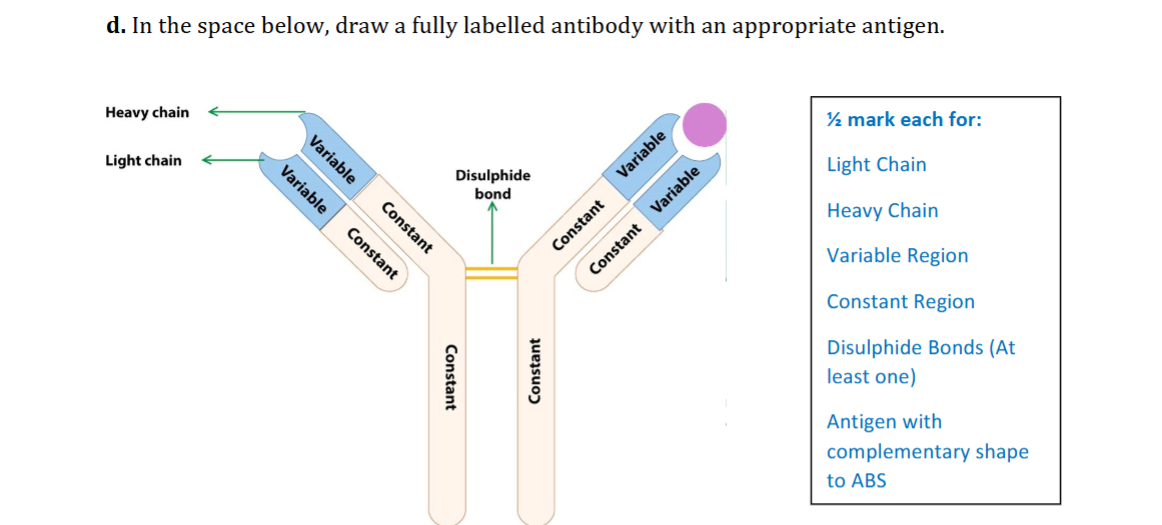
regions on antibody
Constant region: does not vary between antibodies of the same class
Variable region: differs between antibodies and is the antigen binding site
same on each side of a single antibody & specific antigen
natural/artifical & passive/active
Active immunity: antibodies are produced by a person’s own, memory
Passive immunity = transfer of antibodies directly to a person from an external source
advantage: immediate protection to the person receiving the antibodies
disadvantage: short-term as antibody levels decline quickly (2-3 weeks) and no long-lasting immunity to the receiver (less effective, no memory)
Natural = without deliberate/artificial intervention
Infectious (communicable diseases)
= can be transmitted from one individual to another; these diseases are caused by pathogenic agents.
re-emerging disease
= reappears after a significant decline in its incidence
--> were once controlled but have increased to a level that causes significant health issues
Herd immunity
Vaccination reduces the number of susceptible hosts in a population, which establishes herd immunity. This decreases the probability of contact between an infected person and a susceptible individual, thereby interrupting chains of transmission. Consequently, this leads to fewer cases and limits the spread of the pathogen
Autoimmune disease
= when lymphocytes fail to recognise self-markers and end up inducing an immune response against self-cells
for autoimmue
Antibody-dependent cell-mediated cytotoxicity (ADCC): monoclonal antibodies bind to cancer cells and interact with cells of the immune system, particularly NKCs, causing them to recognise the antibody-coated cancer cell as foreign and kill it
Conjugated monoclonal antibodies – with molecules (chemotherapy drugs or radioisotopes) attached to them
due to their specificity for cancer cell antigens, they can specifically deliver these molecules to cancer cells killing them directly and not harming other healthy cells
Suppression immunotherapies:
aim to prevent or reduce an immune response
Cytokine inhibition – Monoclonal antibodies can bind to and inhibit cytokines to reduce the immune response
B and T cell depletion and inhibition – monoclonal antibodies can bind to autoreactive B and T cells and either inhibit them or stimulate other immune cells to destroy them
Gene pool =
total sum of all the genetic information (genes & their alleles) present in a population at any one time
Mutation
= permanent alterations in the DNA of chromosomes, the source of all new alleles
nonsense vs missense
Nonsense codes for a STOP codon, producing a shorter polypeptide (hence desired protein not produced
missense changes the amino acid being added and therefore the amino acid sequence (altering shape/function of the protein)
result in small numbers of amino acids being different between species for the protein, with the remaining amino acids unaffected,
genetic drift
= random events that can change allele frequencies (and a populations overall diversity), particularly in small populations (larger change in allele frequencies)
Population bottleneck
= a sharp reduction in the size of a population due to random environmental events, disasters or human activities
small number of individuals remaining in the gene pool often not representative of the original, larger gene pool
Founder effect
= small # of individuals become isolated from their original population and are not genetically representative of the parental population
small sample of alleles from the parent population’s gene pool
evolve in a different direction than parent population due to different selection pressures in new environment
gene flow
= the movement of alleles between populations (immigration and emigration) by interbreeding
Genetic diversity
= the level of genetic variation within a gene pool, is integral for survival & evolution of a species
antigenic drift vs shift
Antigenic shift is the process that leads to the formation of a new viral subtype. It occurs through the reassortment of genetic material when two or more different strains of a virus infect the same host cell and combine, resulting in sudden, major changes in surface antigens
antigenic drift involves small, gradual point mutations in the viral genome that result in new 'strains' - changes to antgien
Transitional fossil
= provide evidence for an intermediate evolutionary form between an ancestor and its descendants (link b/w 2 species)
Exhibits common traits between ancestral group and descendant group, often providing a link between related species that appear to be very different
index fossils
= absolute age determined, used to define and identify geological periods
date relative to a known date
physically distinctive (hence, easily recognisable)
have had a large population
have existed in many geographical areas
only lived within a known short period of time
presence of index fossils in rock strata in widely separated regions of the world can identify these rocks as having the same age
mtDNA vs nuclear DNA
advantage = mutation rate in mtDNA higher than in nuclear DNA; closely related species, ensures that there are enough differences in DNA
advantage = mtDNA is only inherited from the mother, thus it remains unchanged across generations; no recombination (crossing over)--> change due to mutation --> measure # of base changes to identify point of divergenece --> more differences --> more time since recent common ancestor, easier to trace past ancestors
disadvantage = mtDNA only provides information about one lineage (the maternal line), meaning it cannot provide a complete picture of an organism’s ancestry. In contrast, nuclear DNA can trace ancestry from both parents, providing more information about evolutionary relationships.
Researchers can track unbroken female lineages (haplogroups) and definitively trace populations back to a common ancestor due to inheritance of mtDNA from the mother. Because mtDNA accumulates mutations at a relatively constant rate, it functions as a molecular clock, enabling scientists to estimate the time elapsed since the divergence of populations. Therefore we can use the timing of the major dispersal events to map migration routes
amino acid vs nucleotide sequencing
closely related species --> share very similar sequences for certain protein; nucleotide sequences, looking for silent mutations that may have accumulated without altering the amino acid sequence as the genetic code is degenerate
amino acid sequences are easier to interpret (due to less data); relatedness in more distantly related species
analogous structures
= structures that serve similar functions but are not derived from a common ancestor
vestigial structures
= degenerate structures that have lost all or most of their usefulness as a result of evolution by natural selection
Inherited from an ancestor
Homologues structures
= features present in two or more species that may look and function differently in each species, but are derived from a recent common ancestor
Physical evidence of divergent evolution (the process where 2 or more populations diverge into different species)
evidence of evolution because they indicate that the species possessing these structures inherited them from a common ancestor. The structures then evolved independently in each species fter they diverged.
mammal
Mammal classification (distinguishing mammals from other vertebrates)
Milk–producing mammary glands = mammals use the milk produced by these glands to feed their offspring
Hair/fur = whilst some adult mammals have lost their hair/fur, all mammals at some stage of their life have various amounts of hair/fur on their bodies
Three bones in the middle ear = all mammals have three bones in their middle ear to help with hearing.
One lower jawbone = the lower jawbone is one single bone that attaches directly to the skull, giving them an extremely powerful bite
primmate
Primate
Highly developed, colour, binocular vision with enclosed eye sockets in the skull
Mobile, sensitive fingers and toes with flat nails instead of claws
Opposable thumbs
Large brain relative to body size
Full rotating shoulder - arm rotation
Hominoids
Hominoids - the apes
--> orangutan, gorilla, chimpanzee, gibbons
Lack of a prehensile tail
Flattened nose (no snout)
Bony eye ridges
Brachiating (swing underneath branches)
Mainly ground dwelling and quadrupedal
Arms longer than legs (except humans)
Sensitive hands
Large brains
hominins
Bipedal with modified feet
walks with a bipedal locomotion
Large cerebral cortex (forebrain)
Position of foramen magnum is centered under the skull
Smaller jaws and teeth
Less hair (finer and shorter)
Curved lower spine
Shorter, broader pelvis
Prominent nose and chin
Reduced eye ridges (more brain space, don’t need protection from branches)
Highly sensitive skin (sense danger, etc. hot temperatures)
homo sapiens to austrolopithecus
big toe = opposable & splayed to aligned with the other toes | improving forward propulsion during bipedal walking as push off when walking - imrpoves efficieny and balance |
cranial capacity increased; indicating size of brain also increased | increased brain capacity, along w/ the greater cognitive capabilities it provides |
lengths of legs in hominins became longer in comparison to their arms | better assists with bipedal motion, preventing knuckle dragging |
Pelvis shape shorter & more bowl shaper (larger surface area for muscle attachment) Used to be long & narrow shape | Supports internal organs that stablise the body when upright |
Leg attaches to the pelvis more angled inward, (whereas earlier species had legs attached in more of a straight line) positioning knees/feet underneath the body | walk upright more easily - before had to swing their legs wide when walking which made them slower) Improved balance and more efficient gait |
Brow ridge decreased over time due to increasing size of the cranium |
|
Foramen magnum: further under the skull in its position (centered), more upright the stance of the hominin
|
|
Dental arch changed from a U-shape to a shorter V-shape
|
|
transverse arch | converts the foot into a spring allowing it to transmit the stresses of walking and improve walking efficiency |
country
= is an area traditionally owned and looked after by an Aboriginal group
Songlines =
trace the journey of ancestors of abroginial people, removes such an area of cultural improtance, forcing songlines to be modifed/altered --> preventing future generations from learning about their ancestors
Respect (rio)
= considering the cultural heritage of the individual & collective - disregarded as destroyed ancient aterfects of cultural significance to the abo people
Rio tinto destoryed = area not preserved (country define), connection more spiritual than physical
fossil record
Fossil scarcity: Hominin fossils are extremely rare, and those found are often
incomplete or highly fragmented. (1 mark) This makes precise species identification,
reliable dating, and clear tracing of evolutionary relationships difficult (and subject to
different interpretations by experts). (1 mark)
Dating challenges: Archaeological sites, especially very old ones, often have
disturbed layers or lack suitable material for accurate dating techniques (like
radiocarbon or luminescence), (1 mark) leading to wide date ranges and conflicting
results across different sites
function of CRISPR in Prokaryotes
immune defense to protect bacteria from reinfection from bacteriophage
Spacer - created using viral genome & integrated into the CRISPRE genome, acting as memory of past infection
Repeats - used to separate each viral genome (spacer)
types of bonds
Hydrogen bonds | b/w complementary nitrogenous base of 2 secondary structure (b/w amine & carboxyl group) Broken in denaturation |
Phosphodiester (covalent) | join nucleotides (sugar of one & phosphate group of another) = strong |
peptide | b/w amino acids - primary structure |
Disulfide | b/w R groups - Tertiary & quaternary structure |
Plants physical defenses
waxy cuticle forms a waterproof physical barrier over the leaf surface, preventing entry
Thick bark is an external layer of dead cells preventing entry
stomata closed to prevent entery OR sunken and sit lower down
plants chemical defenses
Defensins are antimicrobial proteins produced by plants that interfere with fungal cell membranes, inhibiting fungal growth
Saponins are plant proteins that disrupt bacterial and fungal cell membranes, inhibiting their growth
allergic reaction steps
Damaged or infected cells release cytokines to attract immune cells
Mast cells bind to release histamine, this triggers:
Vasodilation = increased blood flow
Causing redness and heat
Increased permeability of capillary walls = migration of phagocytes to site of infection
Causing swelling and pain
Return to pre-infection conditions
Zoonotic disease
Infectious diseases that are transmitted from animals to humans
CO2 affect on pH + alkaline enviorement?
lowers pH by increasing acidity
Alkaline environment = high pH (low acidity)
Cas9 vs restriction enzymes
Cas9 is guided by a gRNA (sgRNA), which determines the target sequence, whereas a restriction endonuclease cuts at a specific, fixed DNA sequence known as a restriction site.
enzyme avalibility for PS/CR…how changed?
amount of enzyme can be raised or lowered through gene regulation
affect of inhibitors? on graph

case study
Investigating a real or hypothetical situation that reflects what would be expected to happen in a real-world scenario
classification and identification
Classification = arrangement of objects, events or phenomena into specific sets
Identification = exploring of OEP belonging to particular sets or a new set.
correlation study
Conducting investigations to understand the associations that exist between variables without manipulation by the investigator
fieldwork
Making observations external to a classroom environment through the use of sampling, observations and surveys
literature review
Exploration and analysis of secondary data that usually relate to the findings and viewpoints of others