Week 10c — Language Processing: Speech Sounds (Nov 13)
 Call Kai
 Learn
 Practice Test
 Spaced Repetition
 Match
 Flashcards
 Knowt Play
1/29

There's no tags or description
Looks like no tags are added yet.
30 Terms
What is language?
An open, symbolic system with grammar for expressing ideas about distant things — arbitrary sound–meaning links, rule-based word combination.
What are the three language lectures, and what is their theme?
(I) speech sounds/perception, (II) words/sentence structure, (III) language and the brain — theme: ambiguity, resolved by context.
What are some basic facts about language?
Thousands of languages share properties; newborns detect phoneme contrasts within hours; noisy input (poverty of stimulus) means biology + experience.
What is the critical period for language, and who is Genie?
Language is easiest in early childhood; Genie, isolated until rescue, never fully acquired it despite intensive work.
What does it mean that language is productive and creative?
Infinite new utterances from finite building blocks — new words (‘Zoom’ as verb) recombine with existing rules/morphemes.
What is the hierarchy of language units?
Sentence → phrase → word (smallest free form) → morpheme (smallest meaning unit) → phoneme (smallest sound unit).
How do grammar and syntax recombine familiar units?
Same words, different arrangement, different meaning — ‘umpires talk to players’ vs. ‘players talk to umpires’.
What is the speech segmentation problem?
Speech has no gaps between words; listeners construct segmentation — one signal, heard as ‘Dan Reisberg’ or ‘Noam Chomsky’.
What is coarticulation?
A sound’s pronunciation depends on neighboring sounds — /ʃ/ in ‘the shore’ vs. ‘ashamed’.
How do dialects differ in pronunciation?
Systematic pronunciation differences (MERRY/MARY/MARRIED; Chicago vs. New York), persisting despite globalization.

What does the dialect map of American English show? [Figure: dialect-map.png]
Many regional dialects (Pacific Northwest, Upper Midwestern, Gulf Southern, etc.), each with distinct pronunciation patterns.
How do dialects differ in vocabulary?
Same object, different regional names: pop/soda, sneakers/gym shoes, bubbler/water fountain, hero/hoagie/sub.
What was the Great Vowel Shift, and what is the mouse/house riddle?
16th-century English long vowels shifted (house /hu:s/ → /haws/), so /mus/ in the /hus/ = ‘mouse in the house’.

What are illusory contours, and what do they show about perception? [Figure: illusory-contours.png]
Kanizsa square: you see edges that aren’t drawn — perception is constructive, filling in missing information.

What is phonemic restoration, and what is the Warren example? [Figure: phonemic-restoration.png]
A noise-masked phoneme is perceptually restored — cough replaced /s/ in ‘legislatures,’ yet listeners heard ‘legislators’.
What is the verbal transformation effect?
Repeating a word flips the percept (‘farewell’ ↔ ‘welfare’) though input is identical — one percept at a time.
What is the McGurk effect?
Audio /ba/ + video /ga/ → heard as /da/ (fused); eyes closed → /ba/; older adults more susceptible.
What is the difference between phonetics and phonology?
Phonetics: physical production/perception of sounds. Phonology: how a language organizes sounds into contrasts and legal sequences.
What are some examples of phonological rules?
tl’ is illegal in English (fine in Aztec); /s/ → /z/ in ‘bugs’ (voicing assimilation).
How are consonants classified by place, manner, and voicing?
Place (lips [b,p], teeth-on-lip [v,f], tongue-behind-teeth [d,t,z,s]), manner (stops vs. fricatives), voicing (voiced vs. voiceless).

What does the place-of-articulation diagram show? [Figure: place-of-articulation.png]
Bilabial [p,b,m,w], labio-dental [f,v], interdental [θ,ð], alveolar [t,d,s,z,n,r,l], post-alveolar [ʃ,ʒ], palatal [j], velar [k,g,ŋ], glottal [h].

How do speech sounds share features, and what does the feature matrix show? [Figure: feature-matrix.png]
Sounds are built from distinctive features: /t/–/d/ differ only in voicing; /b/–/t/ differ in voicing and place.

What is voice onset time (VOT)? [Figure: vot-diagram.png]
Time from stop release to voicing onset: short (~0 ms) = voiced /d/, long (~60–70 ms) = voiceless /t/.

How variable is voice onset time across repeated productions? [Figure: vot-variability.png]
/da/ 0–15 ms, /ta/ 45–70 ms, barely overlapping (boundaries ~18/35 ms): within-category variability ≪ between-category difference.
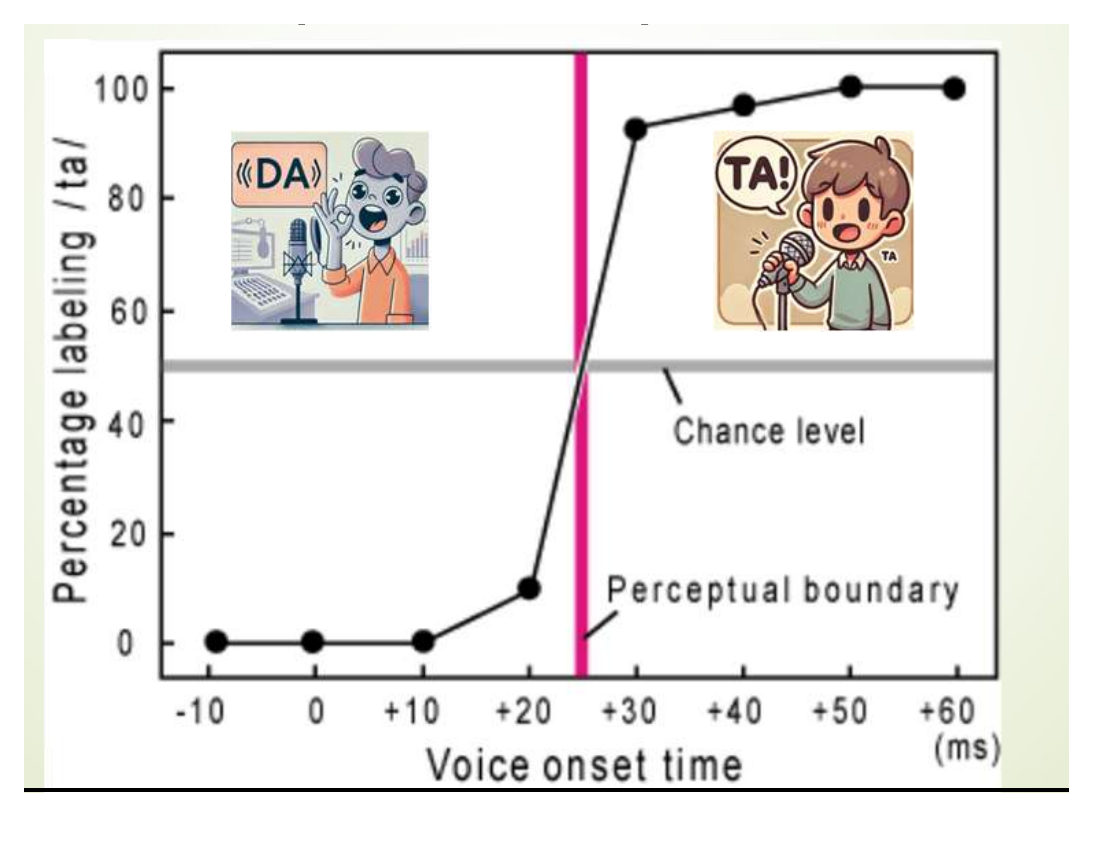
What is categorical perception, and what does the /da/–/ta/ identification curve show? [Figure: vot-identification-curve.png]
Identification switches sharply at ~+25 ms VOT (0% /ta/ below +10, ~100% by +50) despite gradual acoustic change.
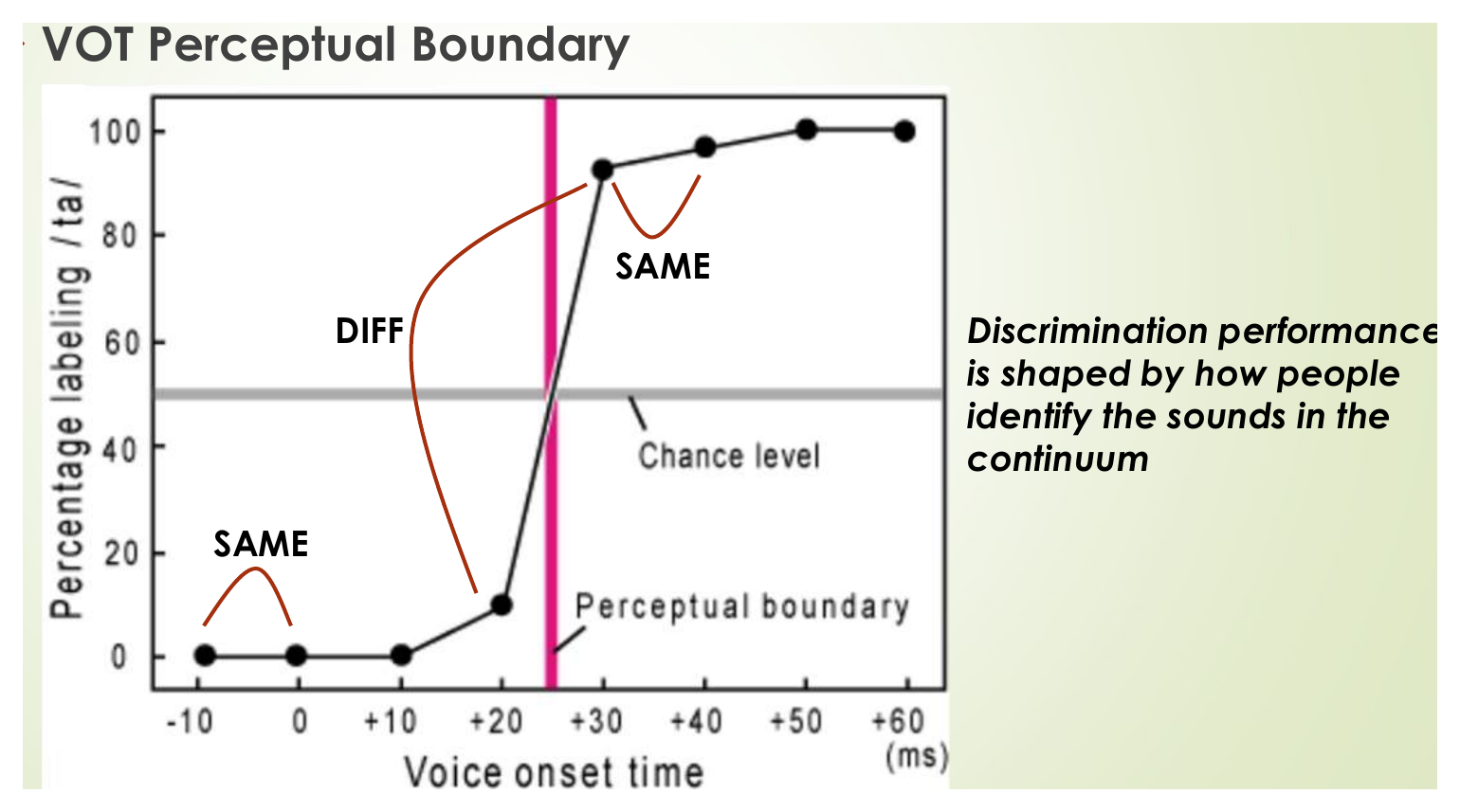
What is the same/different discrimination result for VOT? [Figure: vot-same-diff.png]
Same-category pairs judged ‘same’ despite acoustic differences; different-category pairs judged ‘different’ — discrimination follows categorization.
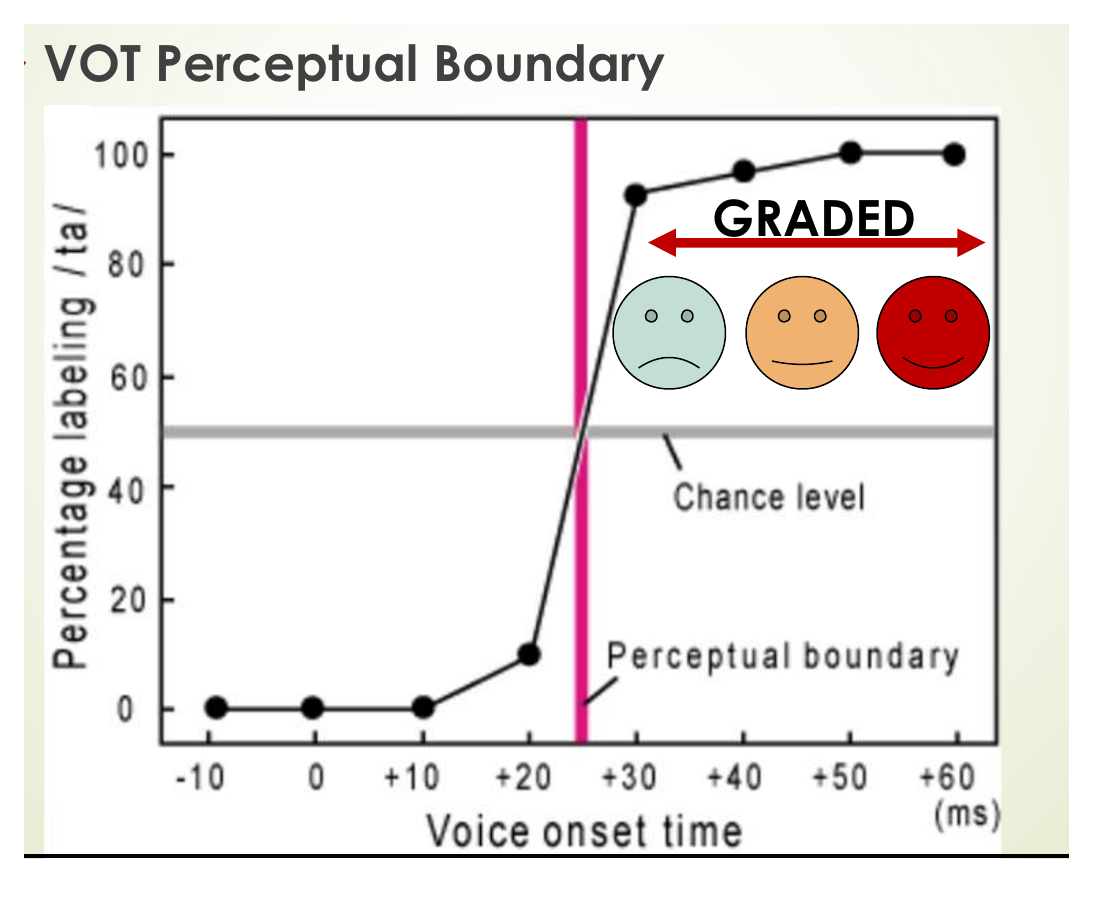
What does "graded" mean in categorical perception? [Figure: vot-graded.png]
Identification switches sharply, but within-category typicality is graded — some /ta/s are better examples, like robin vs. penguin.
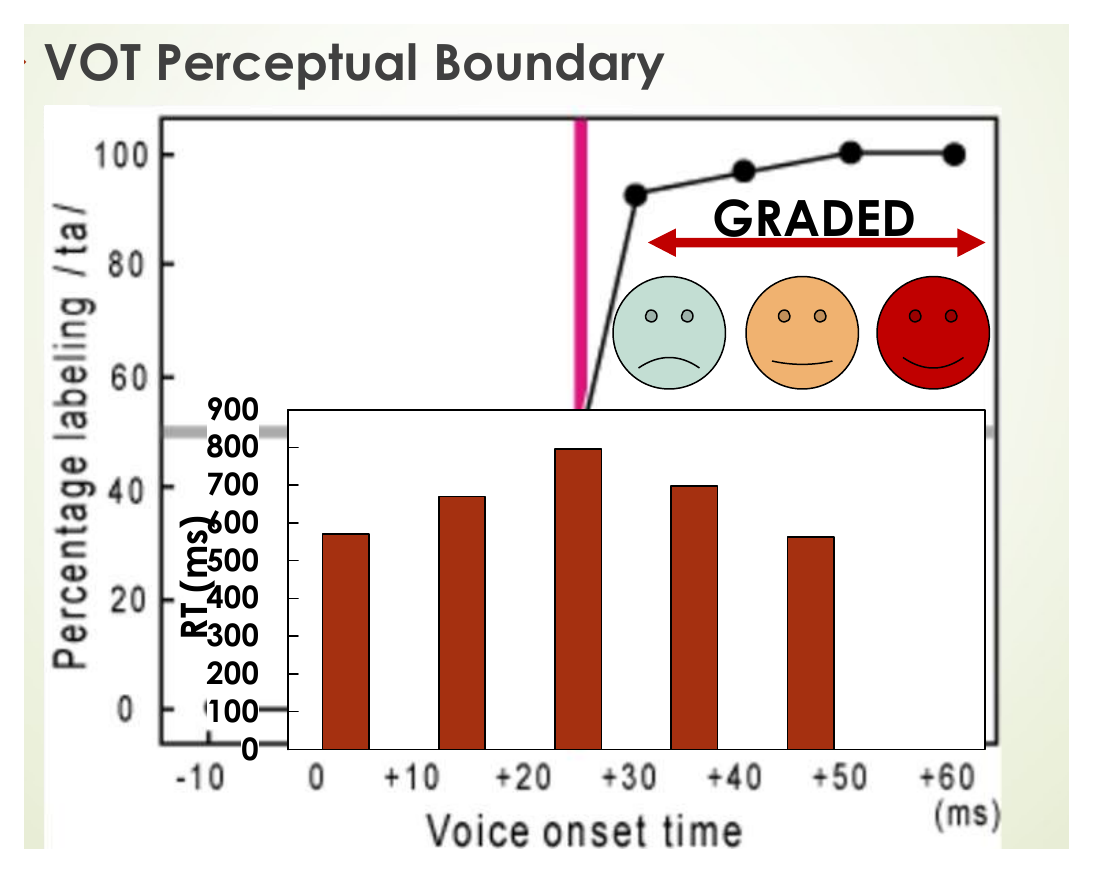
What does reaction time show about categorical perception? [Figure: vot-rt-graph.png]
Slower near the boundary (~800 ms at +25 ms), faster for clear prototypes (~550–570 ms).

How does sentence context shift speech perception? [Figure: goat-coat-context.png]
Ambiguous /g/–/k/ heard as /g/ (‘milked the ___’) or /k/ (‘sewed the ___’), but only near the boundary (~28–34 ms).
How are sound categories like object categories?
Same logic: constancy across speakers/orientations, typicality (robin vs. albatross), graded boundaries (cup/bowl), context-shifted boundaries (goat/coat).