Microbio Exam 2 (assignment q's)
 Call Kai
 Learn
Learn Practice Test
 Spaced Repetition
 Match
Match Flashcards
 Knowt Play
1/65

There's no tags or description
Looks like no tags are added yet.
Name | Mastery | Learn | Test | Matching | Spaced | Call with Kai | Chat |
|---|
No analytics yet
Send a link to your students to track their progress
66 Terms
Which of the following statements about viruses is false?
viruses use their own catabolic enzymes
Why do most scientists agree that viruses are nonliving entities?
they are not composed of cells
Which of the following is NOT used as a criterion to classify viruses?
biochemical tests
Which of the following statements about viral spikes is false?
they are found only in nonenveloped viruses
The definition of lysogeny is
phage DNA is incorporated into host cell DNA
An envelope is acquired during which of the following steps?
release
a viroid is an
infectious piece of RNA without a capsid
An infectious protein is a
prion
Which of the following is an organic growth factor?
vitamin B1
Which enzyme catalyzes the reaction: O2- + O2- + 2H+ → H2O2 + O2?
superoxide dismutase
What is an advantage of the standard plate count method?
determines the number of viable cells
What is an advantage of the direct microscopic count?
requires no incubation time
How do most bacteria reproduce?
binary fission

The figure shows a typical bacterial growth curve with the y-axis indicating the log of the number of bacteria and the x-axis indicating time in culture. In the figure, which sections of the graph illustrate a logarithmic change in cell numbers?
b and d
During which growth phase will gram-positive bacteria be most susceptible to penicillin?
log phase
Definition of generation time
the length of time needed for a cell to divide
Three cells with generation times of 60 minutes are inoculated into a culture medium. Assuming no lag phase takes place, how many cells are there after 5 hours?
96
Which of the following compounds is not an enzyme?
coenzyme A

Which of the graphs in the figure best illustrates the activity of an enzyme that is saturated with substrate?
c
ATP is a common intermediate between
catabolic and anabolic pathways
Anaerobic organisms are capable of generating ATP via
respiration
ATP can be generated by the
flow of protons across protein channels
In the conversion of isocitric acid to a-ketoglutaric acid, what compound is being reduced?
NAD+ is converted to NADH + H+
How is ATP generated in disphosphoglyceric acid —> 3-phosphoglyceric acid?
substrate-level phosphorylation
Definition of oxidative phosphorylation
A proton gradient allows hydrogen ions to flow back into the cells through transmembrane protein channels, releasing energy that is used to generate ATP
Anaerobic respiration does
require cytochromes, yields lower amounts of ATP when compared to aerobic respiration, utilizes complete Krebs cycle, generates ATP
Anaerobic respiration doesn’t
involve the reduction of an organic final electron acceptor
What is the fate of pyruvic acid in an organism that uses aerobic respiration?
It is converted into acetyl CoA.
What is produced during the Krebs cycle?
NADH, CO2 , FADH2, ATP
A bacterium that only possesses the ability to ferment obtains energy
by glycolysis only
What is required in the reactions of microbial respiration?
a source of electrons, final electron acceptor, electron transport system, cytochromes
A bacterium such as Pseudomonas uses nitrate as a final electron acceptor in an electron transport system. All the below statements are true EXCEPT
they require light
Assume you are working for a chemical company and are responsible for growing a yeast culture that produces ethanol. The yeasts are growing well on the maltose medium but are not producing alcohol. What is the most likely explanation?
oxygen is in the medium

In aerobic respiration, where is water found?
d

Where is ATP produced?
e
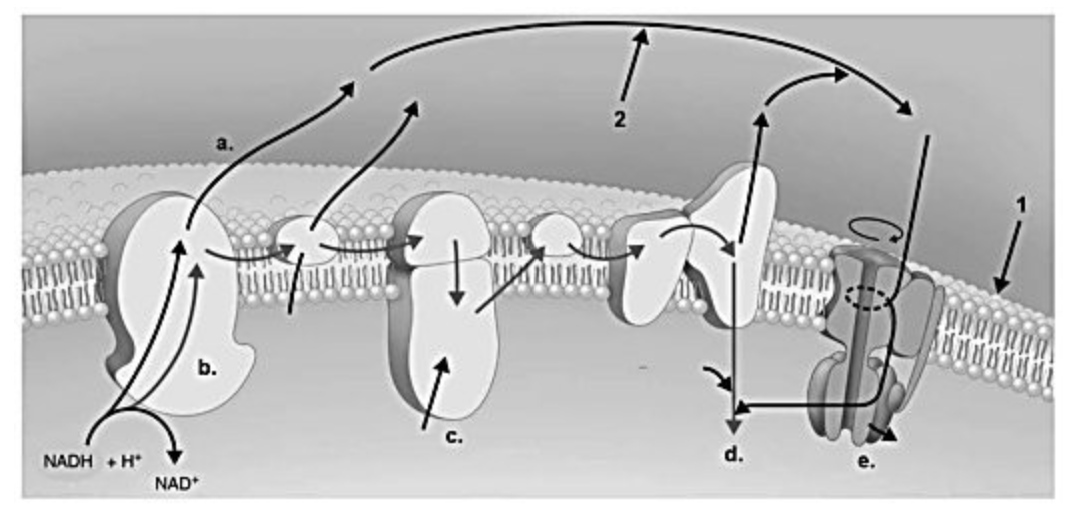
The structure labeled 1 is
the plasma membrane

The path labeled 2 is the flow of
protons
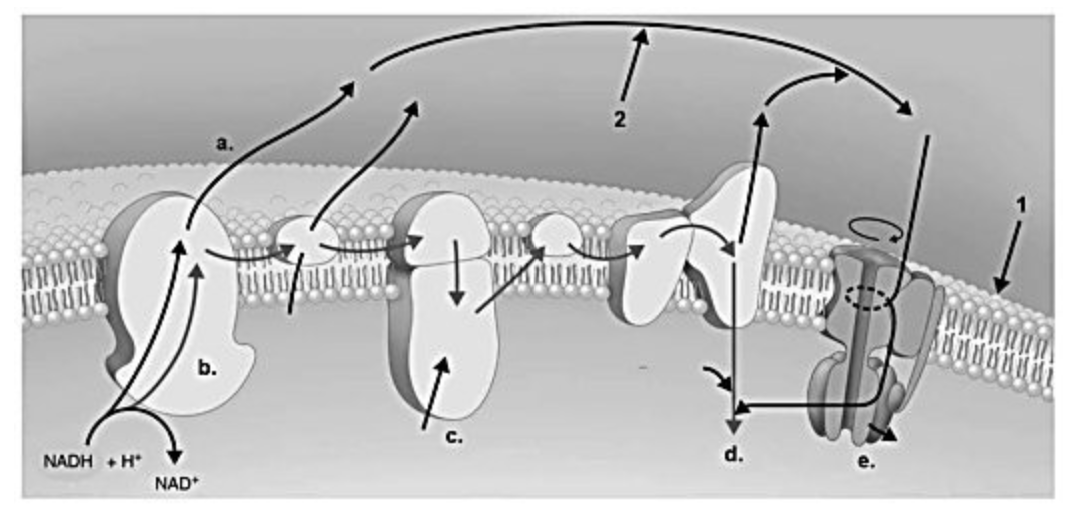
What is the most acidic place in the figure?
a
Chemoautotroph energy source
Fe2+
Photoautotroph energy source
light
photoheterotroph energy source
light
Chemoautotroph energy source
NH3
Chemoheterotroph energy source
glucose
What organism uses CO2 for carbon and H2 for energy?
chemoautotroph
What uses glucose for carbon and energy?
chemoheterotroph
Cyanobacteria are a type of
photoautotroph
Viruses are
obligate intracellular parasites, non-living, only purpose is to replicate
Why aren’t viruses living?
not cells, can only replicate inside of a host cell, no ATP generating system, no ribosomes, contain only one nucleic acid, no metabolism
What does every virus have?
nucleic acid and capsid
What is the heart of the virus?
nucleic acids
Herpes has
double stranded DNA
B19 - fifth disease has
single stranded DNA
Rotavirus has
double stranded RNA
Rhinovirus, flu virus, and SARS Cov-2 has
single stranded RNA
How do you classify viruses?
shape, size, nucleic acid type, envelope or not, virus specificity
Replication of a DNA-containing animal virus steps
attachment, entry & uncoating, viral DNA transcribed, biosynthesis, late translation, maturation, release