CSCI203 - Algorithms & Data Structures
 Call Kai
 Learn
Learn Practice Test
 Spaced Repetition
 Match
Match Flashcards
 Knowt Play
1/224

There's no tags or description
Looks like no tags are added yet.
225 Terms
What are the different tyoes of standard algorithms?
Finding the Maximum
Finding the Minimum
Linear Search
Binary Search
Binary Search with test for termination
What are the different ways to compare algorithms or find the best algorithm to use?
Fastest?
Smallest?
Most general?
Easiest to understand?
How do we compare the speed of algorithms?
Every operation takes time
More operations = more time = slower algorithms
Fewer operations = faster algorithm
More operations = slower algorithm
What is Problem Size in algorithms?
n = how many items the problem contains (number of items)
e.g.
Sort 10 numbers is n = 10
Sort 100 numbers is n = 100
What is Algorithm Complexity?
Describes how the number of operations grow as the problem size (n) increases
Measures the algorithm’s rate of growth not the exact running time
e.g.
Small increase in work = better algorithm
Large increase in work = less efficient
What are Complexity classes of algorithms and their types?
Groups of algorithms that have approximately the same rate of growth as the problem size (n) increases
Types:
Constant (1) = problem is independent of n
Logarithmic (log n) = as n grows, the number of iterations to find the item grows slowly
Linear (n) = as n grows, number of iterations grows at the same rate
Linearathmic (nlog n) = time proportional to n
Quadratic (n²) = number of iterations grows n * n
Exponential (2^n)
Factorial (n!)
What are Arrays?
Fixed number of data items of the same type
Directly accessible via an index value
Can have more than one index (multidimensional)
Initialising one takes n operations for an array of n elements
Records may appear as an element
What are Lists?
Collection of items arranged in some order
Can’t be directlya accessed via an index
Nodes (items) are recorded containing data and a pointer to the next node
May also have a pointer to the previous
Special pointers head and tail (for doubly linked lists) are maintained to point to the first and last elements
What are Stacks?
Holds multiple elements of a single type
Removed in reverse order of isnertion (Last In, First out)
Implemented with an array and integer counter to indicate the current number of elements
What are Queues?
Holds multiple elements of a single type
Removed int he order in which they were inserted (First In, First Out)
Can be implemented with an array and two integer counter to indicate the current start and next insertion positions
What are Records?
Fixed number of items
Elements may be of differing types and are named
Array may appear as a field
Addressed by a pointer
Fields are accessible via the field name
What is a Compact String Storage?
A way to store many strings of different lengths while using memory efficiently
Goals
Uses the minimum amount of storage
Allow fast access to any string
Avoid the overhead of dynamic memory allocation
What are the advantages and disadvantages of using an Array of Strings for Compact String Storage?
Advantages:
Uses the required amount of string storage
Quick access
Disadvantages:
Strings use dynamic memory
What are the advantages and disadvantages of using a 2D Character Array e.g. text[1..N, 1..L] for Compact String Storage?
Advnatages:
Quick access
Avoids dynamic memory
Disadvantages:
N x L may use much more storge than actually required
What is a String Pool?
A collection of data structures used to efficiently store a large number of strings of different lengths (variable-length strings)
Stores many strings efficiently
Different implementations have small differences but are about equally efficient
What is an Insertion Sort?
The strategy
Starts with the second element in the list
Insert it in the right place in the preceding list
Repeat with the next unsorted element
Keep going until we have placed the last element in the list
Characteristics
Sorting n elements require n - 1 iterations
In the worst case, each element may need comparison with every preceding element
Total comparisons roughly equal n² / 2
Worst-case time complexity: O(n²)
What is a Merge Sort?
The strategy
Uses a second array to hold the sort results
Works recursively by dividing the unsorted array into two parts and merging them.
Divides all the way down before merging back up so the final result is a sorted array
Characteristics
Operates on all n items in the array
As each level divides the array in two, there are log n levels.
Requires n * log n operations
What is a Heap?
A complete binary tree (all levels of the tree are filled completely except the lowest level nodes which are filled from as left as possible) with an additional property
Types:
Max
Min
Functions for management
Siftup
Siftdown
Operations
Makeheap/Heapify
We can store them in an array
Heap[1] is the root
Heap[2] and Heap[3] are the children of the root
Hence, Heap[i] has children Heap[2i] and Heap[2i+1] for root’s index is 1
What is a Max-heap?
The value in any node is less than or equal to the value in its parent node (except for the root node).
What is a Min-heap?
The value in any node is greater than or equal to the value in its parent node (except for the root node).
What is a Sift Up in Min-heap and what is its complexity?
Insert a new leaf into the correct position
Time complexity: log(n)
Strategy
Add the new leaf at the end of the Heap to preserve the binary structure
Compare it with its parent
If it is smaller than its parent, swap them
Keep swapping with the parent until it reaches the correct position (smaller numbers are above bigger numbers)
Swaps happen along one branch only
Number of swaps depends on the height of the heap
Hint: Add at the bottom → smaller value bubbles up
What is a Sift Up in Max-heap and what is its complexity?
Insert a new leaf into the correct position
Time complexity: log(n)
Strategy
Add the new leaf at the end of the Heap to preserve the binary structure
Compare it with its parent
If it is larger than its parent, swap them (larger numbers are above smaller numbers)
Swaps happen along one branch only
Number of swaps depends on the height of the heap
Hint: Bigger values bubble up.
What is a Sift Down in Min-heap and its complexity?
Insert a new root element into the correct position
Time complexity: log(n)
Move the last node to the root temporarily
Compare it with its children
If it is larger, swap it with the smaller child
Keep comparing and swapping down until the heap property is restored
Swaps occur along one branch only
Hint: Bigger value sinks down towards the smaller child.
What is a Sift Down in Max-Heap and its complexity?
Insert a new root element into the correct position
Time complexity: log(n)
Move the last node to the root temporarily
Compare it with its children
If it is smaller than one of its children, swap it with the larger child
Keep comparing and swapping down until the heap property is restored
Swaps occur along one branch only
Hint: Smaller value sinks down towards the larger child.
How does Makeheap/Heapify work in Max-heap, and what is its complexity?
Start at the last parent → Sift down → work back to the root
Time complexity: n
The strategy
Create a complete binary tree from the array
Start from the first non-leaf node at index n/2 - 1
Set the current element as the largest
Apply Sift Down
Repeat for each non-leaf node, moving back towards the root
Each non-leaf element is progressively moved into its correct position
Hint: Picks bigger child
How does Makeheap/Heapify work in Min-heap, and what is its complexity
Start at the last parent → Sift down → work back to the root
Time complexity: n
The strategy
Create a complete binary tree from the array
Start from the first non-leaf node at index n/2 - 1
Set the current element as the smallest
Apply Sift Down
Repeat for each non-leaf node, moving back towards the root
Each non-leaf element is progressively moved into its correct position
Hint: Picks smaller child
What is Heapsort and its complexity?
Uses the properties of a heap to sort an array
Time complexity: n + (n-1) * log n
The strategy
Convert the array into a heap (makeheap/heapify)
Repeatedly
Swap the first and last elements
Reduce the size of the heap by 1
Restore the heap property of the smaller heap (siftdown)
Until the heap contains a single element
Max-heap: sorts the list in asc order
Min-hep sorts the list in desc order
What is Time Effiiciency in terms of Theoretical Analysis?
It is determined by the number of repetitions of the basic operation as a function of input size
Basic operation - the operation that contributes most towards the algorithm’s running time
What is Time Efficiency in terms of Empirical Analysis?
Select a specific (typical) sample of inputs
Use physical units of time (e.g. ms) or count actual number of basic operation’s executions
Analyse the empirical data.
What is worst case in Time Efficiency?
Maximum number of basic operations over inputs of size n.
What is best case in Time Efficiency?
Minimum number of basic operations over inputs of size n.
What is average-case in Time Efficiency?
Depends on assumptions about the probability distribution of all possible inputs not simply/necessarily the average (exptected) of the best and worst cases
What is an exact formula for a basic operation count?
It gives the exact number of basic operations
C(n) = n(n-1) / 2
What is an order-of-growth formula with a specific multiplicative constant?
It shows the order of growth together with a known constant.
C(n) = 0.5^n
What is an order-of-growth formula with an unknown multiplicative constant?
It shows the order of growth using an unknown constant
C(n) = cn²
What is important about the order of growth in basic operations?
Focuses on the order of growth within a constant multiple as n → ∞
Helps determine how much longer a problem takes when the input size increases, such as when it doubles.
What is asymptotic order of growth?
A way of comparing functions that ignores constant factors and small input sizes.
What does t(n) ∈ O(g(n)) or Big-O notation mean in asymptotic order of growth?
This is the class function t(n) that grows no faster than g(n) (upper bound).
Related to the algorithm’s worst-case behaviour
Small input sizes before n0 don’t matter
Hint: no faster than
What does t(n) ∈ Ω(g(n)) or Big-Omega notation mean in asymptotic order of growth?
This is the class of function t(n) that grow at least as fast as g(n) (lower bound)
Related to the algorithm’s best-case behaviour
Small input sizes before n0 don’t matter.
Hint: at least as fast
What is Θ(g(n)) or Big-Theta in asymptotic order of growth and how is related to O and Ω?
The others are loose bounds and this is a tighter bound
It contains functions that grow at the same rate as g(n)
Related to average or typical-case behaviour
Hint: squeezed between upper and lower bound → same growth rate
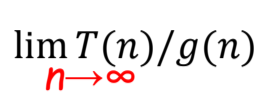
How can a limit be used to compare the order of growth (basic operations) of T(n) and g(n)?
0: order of growth of T(n) < order of growth of g(n)
Slowe
c > 0 → order of growth of T(n) = order of growth of g(n)
Constant
∞: order of growth of T(n) > order of growth of g(n)
Faster
Examples compare:
T(n) = 10n vs. g(n) = n²
T(n) = n(n+1)/2 vs. g(n) = n²
What is L’Hôpital’s rule in the order of growth (basic operations)?
If the relevant limits of f(n) and g(n) are equal and derivatives f’ and g’ exist e.g. log n vs. n

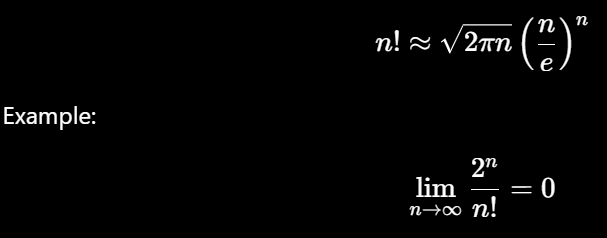
What is Stirling’s formula in the order of growth (basic operations)?
What are basic asymptotic efficiency classes?
Growth | Class |
|---|---|
(1) | Constant |
(\log n) | Logarithmic |
(n) | Linear |
(n\log n) | (n)-log-(n) / linearithmic |
(n^2) | Quadratic |
(n^3) | Cubic |
(2^n) | Exponential |
(n!) | Factorial |
What is a priority queue and how does it differ from a normal queue?
It maintains a set of elements, each with an associated key.
In this type of queue, the element with the largest key is always at the top, regardless of insertion rather than the elements being removed through the first-in-first-out order
Uses include: OS scheduling, algorithms, Huffman’s algorithm and service for VIPs.
What are the basic operations of a priority queue?
insert(pQueue, elt): insert an element and place it in the right position in the queue
remove(pQueue, elt): extract and remove the element with top priority, then adjust the queue as needed
How the queue is adjusted depends on the implementation
How is insertion implemented in a naive priority queue, and what is its efficiency?
Represent it as a linked list L
Insert simply puts a new element onto the linked list
The list does not need to bept in any order
Time efficiency: Θ(1)
How is removal implemented in a naive priority queue, and what is its efficiency?
Search through the linked list to find the maximum element
Remove the maximum element and return it
If the list contains n elements, the algorithm must iterate n times
Time efficiency: Θ(n)
Once the element is found, deleting it from a reasonably implemented linked list requires only Θ(1) work.
How does insertion work in a heap-based priority queue, and what is its efficiency?
A max heap improves the priority queue implementation because it keeps the maximum in the first element
Insert adds the new element and then restores the heap property
Restoring the heap may move an element from a leaf up to the root
Time efficiency: O(log n)
This is slower than the other version which is: O(1)
How does removing the maximum element work in a heap-based priority queue, and what is its efficiency?
Taking the first element takes O(1)
The heap property is restored using siftDown(), which takes O(log n)
Overall time efficiency: O(log n)
What is a simulation?
The production of a computer model of something, esepcially for the purpose of study.
2 types: continuous and discrete
What is a Continuous Simulation?
This is where time is broken into discrete chunks called ticks
Usually used to model a continuous process whose state changes smoothly and continuously over time
Often depends on complex mathematics and may require extreme computing resources i.e. supercomputers
e.g. missile trajectory: differential equations model the missile’s continuous motion, including factors i.e. gravity and air resistance and then the simulation calculates its position and velocity at very small, fixed time intervals.
What is a Discrete Simulation?
This is when time can take any value
Usually used to model a system as a sequence of discrete events, where the system state changes when an event occurs
Less mathematically complex and requires fewer computer resources
e.g. bank operations: customers arrive and join a queue, tellers serve customers and customers leave after being served and then the simulation can help determine optimal queue lengths, the number of tellers needed, and resource allocation
How does a single-server queue simulation work?
Customer arrives
If server is idle, teller serves immediately
If server is busy, join the end of the queue
When service finishes, customer leaves and tell serves the next customer in the queue, if any
How does a single-server simulation decide what happens next?
Compares the next arrival time and service-end time:
Next arrival first → process customer’s arrival
Service end earlier → process the service completion
Then update the system and compare the next events again
What is the basic model for a single-queue multi-server simulation?
One first-in-first-out (FIFO) queue feeds multiple identical servers at the same time
2 main events are: customer arrival and service completion
When a customer arrives:
If a server is idle, the customer is served immediately by an idle server
If all servers are busy, the customer joins the FIFO queue
When a server finishes:
If the queue is not empty, the server immediately serves the customer at the head of the queue
If the queue is empty, the server becomes idle
The simulation moves from one event to the next and can tracks things i.e. waiting time, queue length and server utilisation
Why is a heap used to manage events in a multi-server simulation?
A min-heap (priority queue) stores events according to their time, with the earliest event always at heap[0]
This lets the simulation quickly determine what happens next i.e.:
A customer arrival or
A server completing service
2 approaches for tracking servers are:
Array using busy[i] and end_time[i]: tells us which server is doing what, but finding the next event takes O(n).
Heap of end times: keeps the smallest/earliest time on top, so finding what happens next takes O(log n), but by itself does not tell us which server the event belongs to
To get both benefits, the heap can be used with a second id array:
id = 0 → the next event is a customer arrival
id > 0 → the next event is a service completion for that server
Whenever a heap entry moves, its corresponding id entry must also move so the event time and event identity stay together
Key idea: the heap makes it efficient to answer the main question in an event-driven simulation: “Which event happens earliest?“
What is a binary tree and what are its main terms?
This is a tree where each node has a max of 2 children: right child and left child.
Root = top node
Parent = node with a child
Child = node below a parent
Leaf = node with no children
Subtree = a tree rooted at a node within the main tree
Path = sequence of connected nodes
What are level, depth, height and key in a binary tree?
Level
Represents the generation of a node
Root = level 0
Child of root = level 1
Grandchild of root = level 2
Depth of a node:
Length of the simple path from the root to that node
Height of a tree:
Length of the longest simple path from the root to a leaf
Height of a node
Maximum depth within the subtree rooted at that node
Key
A node’s value sued for searching
What are the main ways to implement a binary tree?
Array
tree = array of values
Root = tree[1]
Children of tree[i] = tree[2*i] and tree[2*i+1]
Collection of dynamic records
Each node stores:
Contents
Pointer/reference to left child
Pointer/reference to right child
The tree stores a point/reference to the root
Array of records
Each record stores:
Contents
Index of left child
Index of right child
What makes a binary tree a Binary Search Tree (BST)?
This is a binary tree with an extra ordering rule.
For every non-leaf node: left child’s value <= node’s value <= right child’s value
e.g.
15
/ \
9 33
/ \ /
5 13 21
/
11
What are the basic operations performed on a Binary Search Tree?
Insert → add an element/create a tree
Find → search for an element
Delete → remove an element
Traversal → visit nodes in a particular order.
What are the type of traversals in Binary Search Trees?
Preorder: root → left → right
Pre = root comes before the children
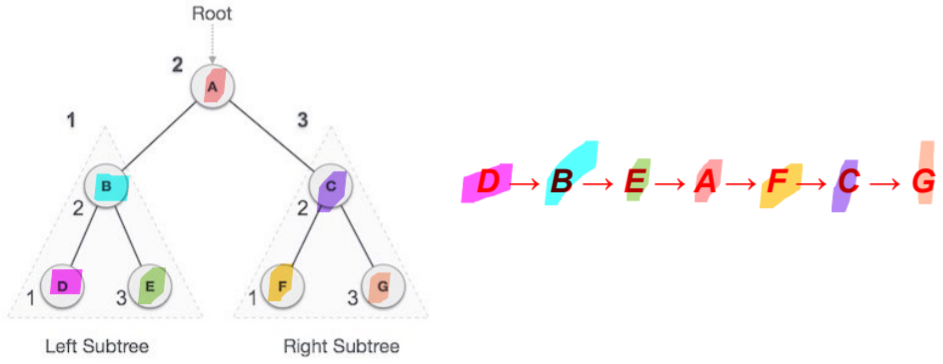
Inorder: left → root → right
In = root is in between left and right children
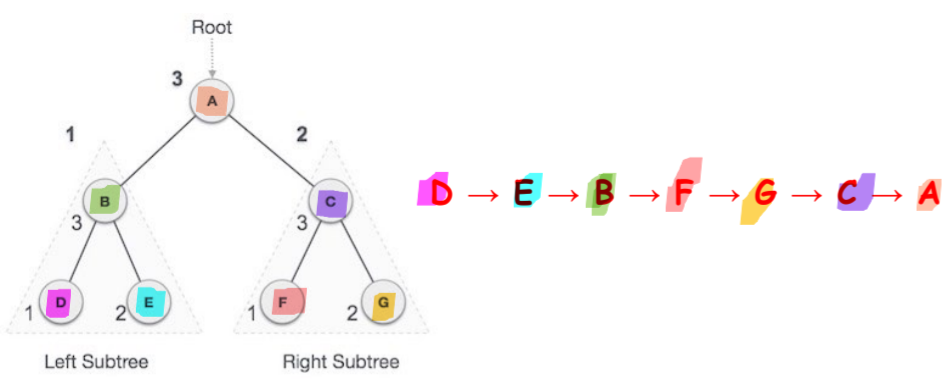
Postorder: left → right → root
Post = root comes after the children
How do you insert nodes when building a Binary Search Tree (BST)?
Nodes are added one at a time:
Search the existing BST for the value/key to insert
If the value is not found, create a new node
Compare the new value with the last valid node examined
Add the new node as the appropriate left or right child
The comparison determines which child to select
Special case — first node:
Create the first node
Make the root point to it
What is traversal in Binary Search Trees (BST)?
This is the process of visiting all nodes of a tree
It can be used to search/locate a key or print all values in the tree.
Nodes are connected by edges/links so nodes cannot be randomly accessed and need to be accessed according to the traversal types (pre, in and post)
In-order traversal can list nodes in a sorted order (sorting)
What is In-Order traversal in Binary Search Trees?
What is Pre-Order traversal in Binary Search Trees?

What is Pre-Order traversal in Binary Search Trees?
Why can an ordinary Binary Search Tree become inefficient?
The order that keys are inserted can create a severly unbalanced / skewed BST
e.g. inserting values in certain orders can make most nodes fall mainly to the left or right.
BST has the operation complexity of Θ(logn) when the tree is balanced.
So we want to adjust the BST as we operate on it to keep it more or less balanced.
What balance condition does an AVL Tree use?
This type of tree is named after Adelson-Velsky and Landis
The AVL balance rule is: “At every node, the heights of the left and right subtrees differ by at most 1“
So this is allowed: [height(left)−height(right)] ≤ 1
A tree is not AVL if even one node breaks this rule
How is the balance factor of an AVL node calculated?
Balance Factor = Height(left subtree) - height(right subtree)
The height of an empty tree is defined as: -1
For an AVL tree, every node’s balance factor must be : -1, 0 or 1
-1 = right side is one level higher
0 = both sides have equal height
1 = left side is one level higher
Any other value means the tree requires restructuring/balancing
What balancing operations can be used when an AVL tree becomes unbalanced?
If the balance factor is outside -1, 0 or 1, the tree must be restructured using rotations.
These balancing rotations are
Right rotations (RR)
Left rotation (LL)
Right-left double rotation (RL)
Left-right double rotation (LR)
What are the 4 ways an insertion can unbalance an AVL tree node β?
An insertion can occur in:
Left subtree of β’s left child → Left-left case (LL)
Right subtree of β → Left-right case (LR)
Left subtree of β’s right child → Right-left case (RL)
Right subtree of β’s right child → Right-right case (RR)
The cases are structurally related:
Cases 1 and 4 are equivalent
Cases 2 and 3 are equivalent
What is the basic process for building an AVL tree?
Initialise an AVL tree
Repeat for each key:
Create a node from the key
Insert the node into a tree
Balance the tree through right, left, right-left, and left-right rotations
Simple flow:
Create → Insert → Balance → Repeat
How can an algebraic expression be represented using a binary tree?
In an expression tree:
Internal nodes = operatores i.e. +, -, *
Leaf nodes = variables/values
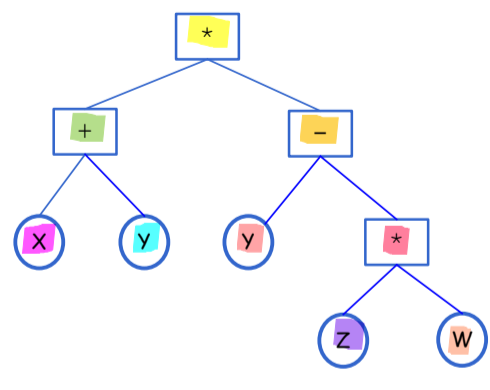
How do you evaluate an expression in a Binary Search Tree using a stack?
Start with an empty stack
Process each symbol from left to right:
If it is a letter/value → push it onto the stack
If it is an operator
Pop the top element as R
Pop the next element as L
Evaluate: L operator R
Push the result back onto the stack
Continue until the whole expression is processed

What is a Finite State Machine?
This is a reactive system whose response to an input depends on its current state
Its behaviour is described using:
A set of possible states
A set of possible inputs
The action/transition taken for a given input and current state
The new state entered
This machine is useful for processing streams of data i.e. vending machines, traffic lights etc
This is also called a finite-state automation
How is the behaviour of a system represented using a Finite State Machine?
This describes the observable behaviour of a system as a sequence of states
The current state can be determined from one or more state variables
e.g. states
q1 = waiting
q2 = reading
q3 = searching
q4 = writing
Possible sequence:
waiting → reading → searching → writing → waiting
q1 q2 q3 q4 q1
So these machines are special cases of automata (abstract machines)
The states, inputs, actions and next states can also be represented using a table
What formally defines a Finite State Machine?
Q = finite set of dates: {q0,q1,q2,…,qn}
F = subset of final/accepting states in Q
q0 = the single start state in Q
S = the input/output alphabet
δ = the transition function: Q * S → Q
It maps: current state + current input → next state
What is a state table and how do you read it?
This type of table represents the complete behaviour of an FSM in table form
Rows = current states
Columns = inputs
Each cell = the next state for that current state + input
Φ / null = there is no transition
e.g.
Current state | Input | Input |
|---|---|---|
|
|
|
|
|
|
|
|
|
e.g. (q1, a) → q2 and (q1, b) → q3
What is a 2-4/2-3-4 tree, and what node types can it contain?
This tree is a balanced search tree (BST) where all leaf nodes are at the same level
3 node types:
2-node: 1 key, 2 children
3-node: 2 keys, 3 children
4-node: 3 keys, 4 children
A k-node has k-1 keys and if internal, k children

What ordering rules must a 2-4 tree follow/
Keys inside each node are sorted smallest to largest
Every internal node has one fewer key than children
Each key lies conceptually between two consecutive children; values in the left subtree are smaller and values in the right subtree are larger
This order means an in-order traversal produces they keys in sorted
How do you search a 2-4 tree?
Compare the target value with the keys in the current node
If value = key, return its data
If value < key, search the subtree to the left of that key (recursively)
If value > key, compare the next key but if there’s no next key search the last/rightmost subtree and repeat until found or search ends
What are the basic steps for inserting into a 2-4 tree?
Find the leaf where the item is to be inserted
Insert the item
Update/rebalance the node
Insertion into a 2-node becomes a 3-node
Insertion into a 3-node becomes 4-node
Insertion into a 4-node becomes 5-node which must be repaired
What happens if insertion makes the root a 5-node?
Split the root and create a new root containing the median key of the old root
This is the worst-case insertion scenario and increases the height of the tree by 1
How does deletion work in a 2-4 tree?
Find the item
If it is an internal node, swap it with its immediate in-order successor
Repeat until the item is in a leaf
Delete it
Update/rebelance the tree
4-node becomes 3-node
3-node becomes 2-node
2-node becomes 1-node
How is a 1-node repaired after deletion?
If an immediate sibling has more than 1 key, move a sibling key up to the parent and a parent key down into the 1-node
Otherwise, remove the 1-node and move a parent key down into a sibling, which may make the parent a 1-node — repair recursively
If the root becomes a 1-node, remove it
What is the efficiency of a 2-4 tree?
Height = O(log n)
Search = O(log n)
Insertion = O(log n) because splitting is O(1) per level with at most log n splits
Deletion = O(log n) because merging is O(1) per level with at most log n merges
What is a B-tree of order m, and what properties must it satisfy?
A B-tree is an m-ary balance balanced search tree (BST) that generalises a 2-4 tree
Root: either a leaf or has at least 2 children
Other internal nodes: between ⌈m/2⌉ and m subtrees
Non-root nodes: between ⌈m/2⌉ - 1 and m - 1 keys
All leaves are at the same level
Key idea: wide + shallow + balanced

How do you search a B-tree?
Compare the target value with each key in the nodoe:
If value = key, return data
If value < key, recursively search the subtree left of that key
If value > key, compare the next key and if there is no next key, search the last subtree
Key idea: compare → choose child
How do you insert into a B-tree?
Find the leaf where the item belongs
Insert the item
If the node overflows and now has m keys, split it into 2 and move the mediak ney up to the parent
Repeat with the parent if necessary
Create a new root layer if neccessary
Key idea: leaf → overflow → split + median up
How do you delete from a B-tree?
Find the key
If it is not in a leaf, swap/move it down to a leaf
Delete it from the leaf
If the node underflows (now has [m/2] - 1 keys):
First try to borrow from a sibling with spare keys and adjust the parent
If no sibling has spare keys, merge with a sibling and reduce the parent’s key by 1
If the parent underflows, repeat the procedure upward
Key idea: leaf → underflow → borrow or merge
What is a B+ tree?
In this type of tree, the actual data associated with keys is stored only in the leaf nodes
Internal nodes contain copies of the first key of each child to guide searching
In the image shown, nodes contain between 3 and 5 keys
Key data: data only in leaves

Why are B-trees useful for data stored on disk?
Very large data may be too large to fit into memory, so only one node at a time may be loaded from disk
Disk reads/writes are expensive, so we want as few as possible
B-trees have a high branching factor, giving them a small height, so fewer nodes (and fewer disk accesses) are needed to travel from the root to a leaf.
Key idea: more children → smaller height → fewer disk reads
Why are B-trees useful in databases, and what does m = 100 show?
Databases may contain millions or billions of disk-stored records
B-trees allow access using a small number of disk reads, so they are commonly used as a database storage mechanism
If m = 100 we can store in:
Level 1 = 100 records
Level 2 = 10,000 records
Level 3 = 1,000,000 records
What is a quadtree and how is it structured?
This is a geometric/spatial data structure that is most often used to partition a 2D space.
It is a 4-way tree: every internal node, including the root has exactly 4 children, usually representing 4 regions: NW, NE, SW, SE
Key idea: exactly 4 children

What do leaf nodes represent in a quadtree?
This stores the information associated with the region/cell it represents
The leaf contains the “interesting“ info about that particular area of the 2D space
Key idea: stores info about its region
What is a Region Quadtree?
This type of quadtree recursively subdivides a 2D space into squares.
The process continues where further subdivision is needed.
Each leaf node stores info about the space/cell it represents
This type of tree are often used in image processing
Key idea: recursively split into squares

What are quadtrees used for?
Applications of geometric/spatial structures:
Computer graphics
Games and movies (mesh generation and 2D collision detection)
Computer vision
CAD
Street maps i.e. Google Maps/Earth
Image representation and processing
HCI design
Virtuality reality
Visualisation of complex functions
Key idea: spatial/image processing
What is a Point-Region (PR) Quadtree, and what node types does it use?
This quadtree type leaf cells store the point that exists within that cell
It uses 3 node types:
Point node: A leaf representing a point (point exists)
Empty node: A leaf representing a region containing no point
Region node: An internal node representing a region; it always has 4 children, which may be point, empty or region nodes (split into 4)
