Hon Molecular Exam 4
 Call Kai
 Learn
 Practice Test
 Spaced Repetition
 Match
 Flashcards
 Knowt Play
1/103

Earn XP
Description and Tags
Exam date: 12.10.26
104 Terms
mutation
permanent alternation to a DNA sequence away from normal
caused by errors in DNA replication or environemntal damage
is cytosine methylation (5mC) an example of a mutation?
no because it is a reversible alteration and mutations are permanent
what are the 5 kinds of mutations that we talked about
point mutations, deletions, insertions, trinucleotide repeat expansions, structural variations
point mutations
single base change (substitution)
what is a transition (point mutation)
concersion of A to G or C to T
purine changes to purine
pyrimidine changes to pyrimidine
what is a transversion (point mutation)
concersion of A/G to C/T
purine changes to pyrimidine or vice versa
possibilities:
A to C
A to T
G to C
G to T
T to A
T to G
C to A
C to G
what kinds of consequences can point mutations have for protein structure
synonymous (silent), missense, and nonsense
synonymous (silent) point mutations
mutations that do not change the animo acid sequence of a protein
related to degeneracy in genetic code (multiple codons for one AA)
allows proteins to be tolerant of mutations
function fo encoded protein is maintained
missense point mutations
mutations that change the animo acid seuqence of a protein
conservative: new AA encoded from mutation has simialr properties to AA from normal allele → tend to maintain protein function
i.e. swapping lyine for arginine
non-conservative: new AA encoded from mutation has different properties than AA from normla allele → may alter protein function
i.e. swapping lyine for threonine
nonsense point mutations
mutations that cause a premature stop codon in an mRNA
result in premature termination of translation and a nonfunctional protein that is rapidly degraded
i.e. changing AAG (lysine) to TAG (UGA stop codon)
insertion
addition of one or more bases
deletion
removal of one or more bases
what types of mutations cause frameshifts
indels in numbers that are not multiples of 3
what is a frameshift
alteration of the reading frame (codon sequence) of the protein, resulting in a different translation after the mutation
may result in a different animo acid sequence and introduce a premature stop codon
trinucleotide repeat expansion
sequences that are susceptible to slippage during DNA replication (repeats of a codon for a given animo acid) and expansion of the repeat
beyond a certain threshold number results in a pathogenic condition
often CAG which encodes glutamine
example of trinucleotide repeat expansion
Huntington’s disease
associated with the expansion of CAG repeats in Huntingtin protein
results in the presence of a polygutamine (polyQ) tract in the protein
PolyQ expasion in Huntingtin appears to lead to formation of toxic protein aggregates
is Huntington’s Disease the only disease caused by CAG repeat expansion?
no many other diseases are caused by CAG and other trinucleotide expansions
common theme from trinucleotide expansion-caused diseases
affect development function, degeneration of nervous or muscular system of affected individuals
muller’s morphs
Geneticist Hermann J. Muller came up with a system to describe the behavior of mutations
mutations can be classified according to their effect on the function of the gene
amorph/null
mutation that causes a complete loss of gene function
protein null: caused by disruption of translation via premature stop codon
RNA null: caused by a defect in transcription (i.e. promoter is mutated)
in a diploid organism, null mutation is usually recessive to the wild-type copy of gene
hypomorph
mutation that causes partial loss of gene function
could be due to reduction in RNA/protein level
could be due to missense mutation that reduces performacne of encoded protein
in diploid organism, hypomorph mutation is usually recessive to wild-type copy of gene
hypermorph
mutation that causes an increase in the normal function of the encoded protein
could be due to increased gene dose (duplication), increased RNA/protein expression, or increased/constitutive activity of protein
phenotype is made more severe by increasing dosage of hypermorphic allele
antimorph (dominant negative mutations)
mutation that causes the gene product to act in opposition to its normal activity
i.e. mutations of the P53 gene which is a tumor suppressor
increasing the dose of the mutant allele worsens the mutant phenotype
Antimorphic/dominant-negative mutations in P53
P53 is a transcription factor that must form a homotetramer to activate transcription
mutations cause the formation of wild-type/mutant heterotetramers that inhibit DNA binding and transcriptional activitiy
neomorph
mutation that causes the gene product to obtain a new function
often seen with enzymes in the form of altered specificity (act on a diff. substrate)
i.e. PTEN, tumor suppressor that dephosphorylates membrane lipids
neomorphic mutation in PTEN
single AA substitution in PTEN (A126G) alters the enzymatic activity of PTEN and makes it gain a new pro-tumor activity
leads to a phosphorylation cascade that promotes cell migration and may lead to metastasis (spread of tumor)
structural variations
mutations that cause large-scale alterations in chromosome structure that affect many genes
examples:
deletions → cause amorphic mutations
duplications → cause hypermorphic mutations (incereased gene dosage)
inversions → disrupt genes
DNA inserted from one chromosome to another → hypermorphic or amorphic
reciprocal fusion of pieces of chromosomes → chromosomal translocations → neomorphic fusions between two genes (often seen in cancer)
Philadelphia chromosome
reciprocal translocation between chromosome 9 and 22 in chronic myeloid leukemia (CML) fuses BCR and ABL genes → generates hybrid protein
creates constitutively active tyrosine kinase (always on) → results in uncontrolled cell division
which model of replication is correct
semiconservation
semiconservative replication
each new copy of dsDNA molecule has one strand from parental DNA and one newly synthesized strand
correct

conservative replication
one new DNA molecule has both DNA strands from the parental molecule, while the other is completely new (does not reply on strand separation)
incorrect

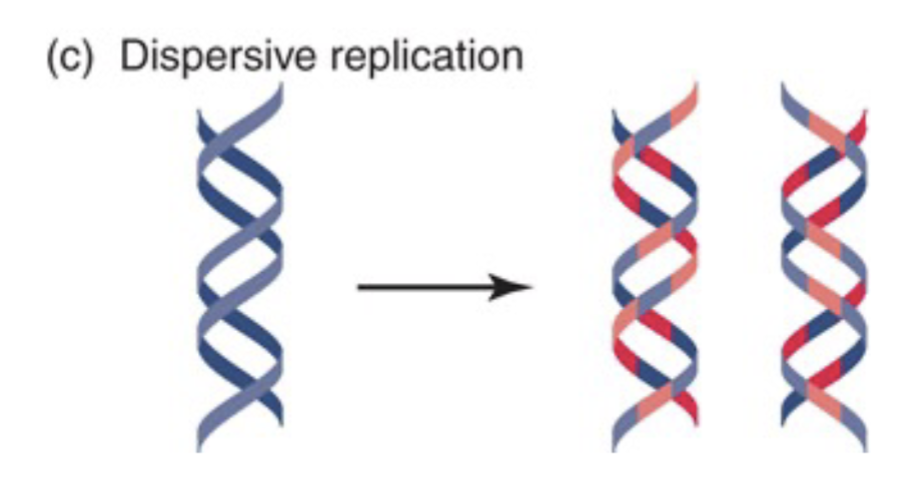
Dispersive replication
each new DNA molecule has a mixture of old and new sequences
incorrect
what was Meselson and Stahl’s experiment referred to as
“the most beautiful experiment in biology”
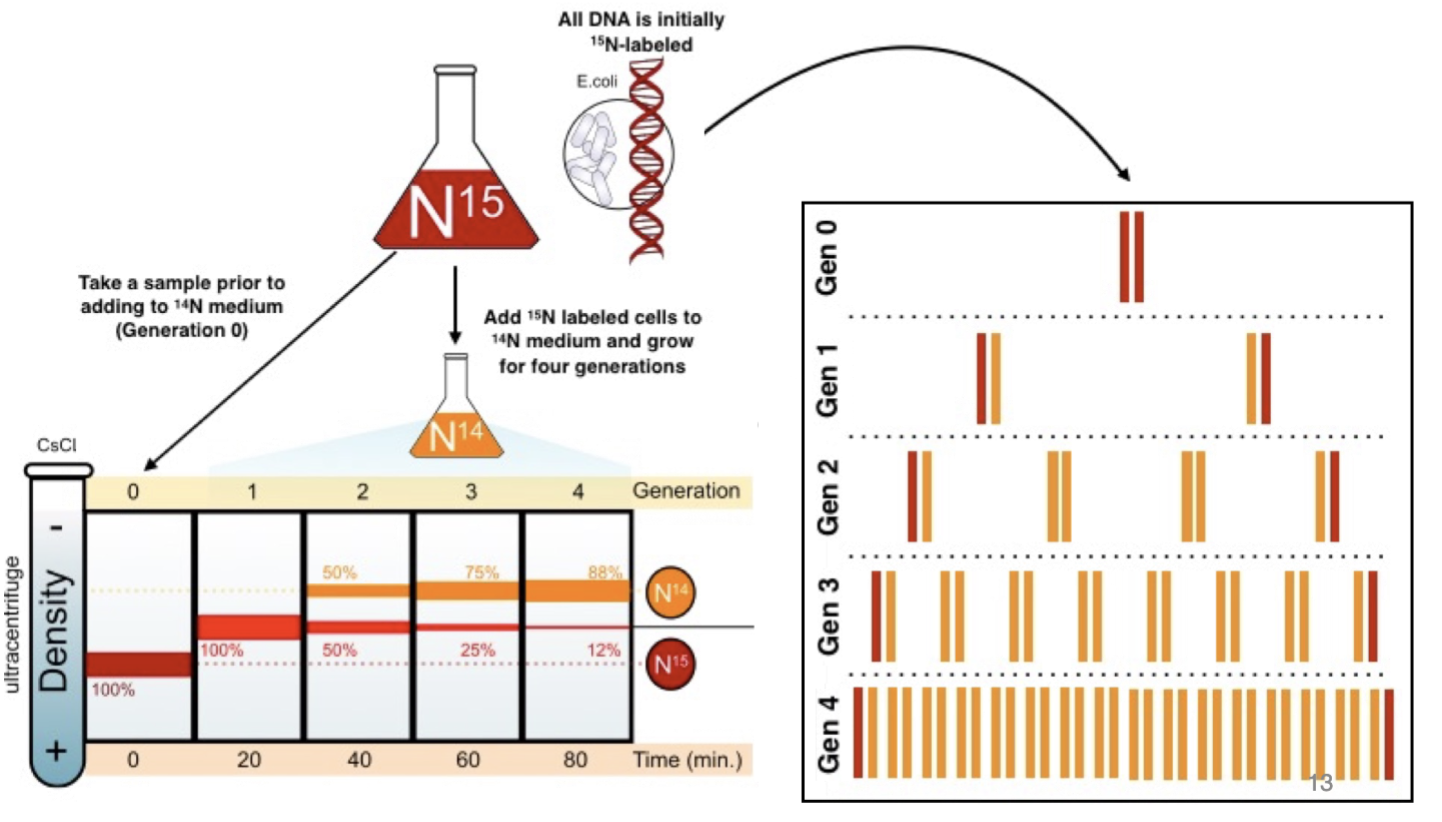
how did the Meselson and Stahl experiment work
E. coli cells were grown in the presence of heavy nitrogen (15N)
cells were then transferred to medium with light nitrogen (14N)
grew for four generations
what did the Meselson and Stahl experiment show
proved that DNA replicates semi-conservatively
each new double helix contains one original parental strand and one newly synthesized strand
what is the directionality of DNA replication
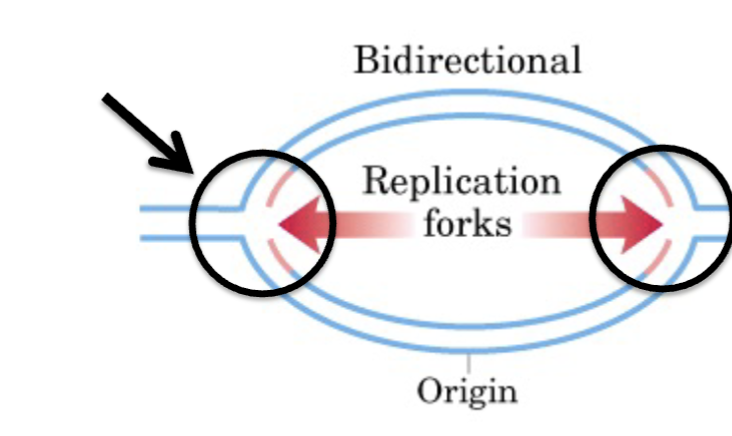
bidirectional
bidirectional
growing points of DNA move in both directions away from the initation site (replication origin)
θ structure
temporary intermediate shape formed when a circular DNA moelcule replicates
named theta because the physical structure resembled the Greek letter θ
DNA replication is ___continuous
semidiscontinuous
5’→ 3’ synthesis is continuous
lagging strand synthesis is discontinuous
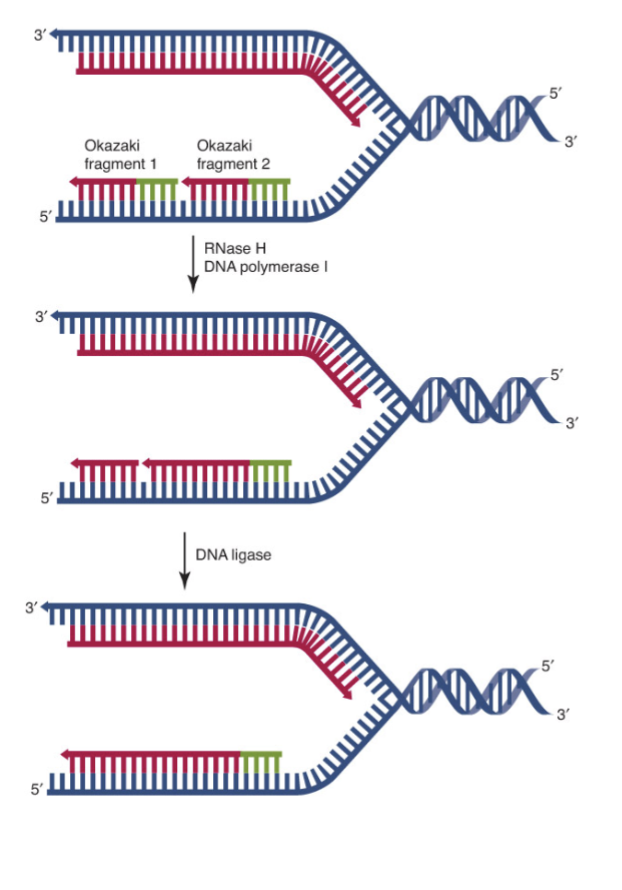
Okazaki fragments
Short fragments created by 5’→ 3’ synthesis
1000-2000 bp long
require RNA primers for synthesis
DNAP cannot initiate preplication on their own
joined by DNA ligase
difference between DNAPs and RNAPs regarding replication
RNAPS can initiate replication on their own but DNAPs cannot
Processing of Okazaki fragments (3 steps)
RNase H digests away RNA primers (specifically digests RNA in RNA:DNA hybrids)
DNAP I extends the 3’ ends of Okazaki fragments
DNA ligase joins adjacent Okazaki fragments
rate of replication in E. coli
~800-1000nt per second
genome size of E. coli
4.6 Mbps, takes ~40min to replicate
rate of error in E. coli
1 mistake for every ~107nt
what did Francois Jacob and Sydney Brenner propose
replicon model
replicon model
replication is initiated by the binding of an initiator rpotein to a specific sequence of DNA
what is the specific DNA sequence at which replication initiates called
origin of replication (ori)
how manyt ori do bacteria usually have
one
E. coli origin of replication (oriC)
E. coli chromosome is chopped into pieces by REs
each piece is cloned into a plasmid without a replication origin
only plasmids with E. coli oriC can support replication of the plasmid
allows cells to grow on plates with the antibiotic
what are the four proteins that play critical roles in the initiation of replication in E. coli
DnaA, DnaC, DnaB, DnaG
DnaA
initiator
binds to specific sequences in oriC, causing DNA to melt
DnaC
helicase loader
helps DnaB to load onto the DNA. DnaC then dissociates
DnaB
helicase
unwind more DNA in oriC, moving in opposite directions
DnaG
primase
binds to DnaB and synthesizes the primers necessary to begin replication