BIO 141 Exam 2 - ch 22,6,7,8,9 - all cards
 Call Kai
 Learn
 Practice Test
 Spaced Repetition
 Match
 Flashcards
 Knowt Play
1/94

There's no tags or description
Looks like no tags are added yet.
95 Terms
entropy of the universe
Whenever energy is transformed there is always an increase in the _____.
delta G is less than zero
An endergonic reaction has all the following characteristics, except
| |||
| |||
| |||
|
thermal energy
Which of the following forms of energy is least available to accomplish cellular work?
| ||
| ||
| ||
| ||
|
energy cant be created or destroyed
Which of the following statements best describes the first law of thermodynamics?
| ||
| ||
| ||
|
G is the change in free energy
The mathematical expression for the change in free energy of a system is ΔG = ΔH - TΔS. Which of the following statements best describes a term in this equation?
| ||
| ||
| ||
|
endergonic
Which of the following terms best describes a chemical reaction for which ΔG is positive?
| ||
| ||
| ||
|
Which of the following statements best describes a system at chemical equilibrium?
| ||
| ||
| ||
|
hydrolysis reactions are exergonic and increase entropy of the system
Which of the following statements best describes why hydrolysis reactions occur more readily in solution than dehydration reactions do?
| ||
| ||
| ||
|
ATP produces energy coupling between exergonic and endergonic reactions
Which of the following statements best describes the central role that ATP plays in cellular metabolism?
| ||
| ||
| ||
|
the released phosphate is used to form propylated intermediates that are more reactive than the original unphosphorylated substrate
Which of the following statements best describes a primary mechanism by which the energy released in ATP hydrolysis is used directly to drive endergonic chemical reactions in a cell?
| ||
| ||
| ||
|
binding of substrate to the active sit changes the shape of the active site of an enzyme
Which of the following statements best describes induced fit?
| ||
| ||
| ||
|
the catalyzed reaction will have the same G as the uncatalyzed reaction
Which of the following statements best describes how addition of a catalyst will affect a chemical reaction?
| ||
| ||
| ||
|
by changing the 3-D shape of the enzyme
A change of a single amino acid at a position distant from the active site of an enzyme can alter the substrate specificity by changing the ________.
| ||
| ||
| ||
|
temperature is usually uniform throughout a cell
Most cells cannot harness heat to perform work because
| ||
| ||
| ||
|
proteins and phospholipids
Choose the best answer. Cellular membranes are made of _______________.
| ||
| ||
| ||
|
sodium will move to the inside
If sodium is in higher concentration on the outside of a cell relative to inside the cell, which direction will sodium move if there is an open channel that allows sodium to cross the membrane.
the cell becomes lysed
If an animal cell is placed into a hypotonic solution what will occur?
| ||
| ||
| ||
|
passive and uses a channel
A process that used facilitated diffusion is best described by which of the following?
| ||
| ||
| ||
|
rough ER, cytoplasm, mitochondria
where are ribosomes present in the cell
|
What best describes one major difference between prokaryotic cells and eukaryotic cells?
digestive enzymes
Lysosomes generally have ______________ in them.
active transport
The movement of a substance across the membrane against its concentration gradient with the help of energy input is _________.
facilitated diffusion
Water moves through cellular membranes by which of the following ways?
| ||
| ||
|
lamark
The first publication on evolution was written by ____________.
paleontology
The study of fossils is called ______________.
natural selection
What is the mechanism that Darwin described as the mechanism for evolution?
catastrophism
What term described that natural disasters led to the extinction of species?
| ||
| ||
| ||
|
long pointed beak
Which of the following might be an adaptation to picking insects out of the bark of a tree?
| ||
| ||
| ||
|
radiometric dating of fossils
Which of the following was not used as support for evolution and natural selecton during Dawrwin's time (mid 1800's)?
| ||
| ||
| ||
|
entropy of the universe
Whenever energy is transformed there is always an increase in the _____.
| ||
| ||
| ||
|
metabolism consists of all the energy transformation reactions in an organism
Which of the following statements best describes metabolism in its entirety in all organisms?
| ||
| ||
| ||
|
catabolism
Which of the following terms most precisely identifies the cellular process of breaking down large molecules into smaller ones?
| ||
| ||
| ||
|
cell to cell communication
enzymatic activity
transport across membrane
what are the functions of proteins in the membrane [3]
diffusion
Oxygen travels through the membrane by ____________
active transport
Transporting Na+ ions out of most cells is done through ______
diffusion
Lipids can enter cells by ______________ process.
site of protein synthesis
what is the main function of a ribosome
semi permeable, some things get through some don’t, it protects the cell because of its control. allows for the storage of energy by moving things from one side to the other - transfer of energy
allows for molecules [enzymes, cytochromes] to be close to each other
phospholipids - polar and non polar
membrane
function
importance of location
what’s it made of
have a hydrophilic head [outside] and hydro phobic tail [inside]
they are arranged in a bilayer with the phillic heads facing out and the phobic heads on the inside
Describe the properties of phospholipids and their arrangement in cellular membranes.
they split the membrane down the middle of the phospholipid bilayer and are proteins embedded directly within the core of the membrane rather than just sitting of the surface
Explain what freeze-fracture techniques reveal about the involvement of proteins in membranes.
fluid properties have more spacing between the hydrophilic heads
they have unsaturated hydrocarbon tails -double bonds
this makes it easier for things to pass through the membrane
Describe the fluid properties of the cell membrane and explain how membrane fluidity is influenced by membrane composition.
carbohydrates are located exclusively on the extracellular side
Describe how proteins and carbohydrates are spatially arranged in cell membranes and how they contribute to membrane function.
concentration gradients - molecules want to move from high to low concentrations
ex. more Na is outside the cell so they will go in and more K is in the cell so they will go out
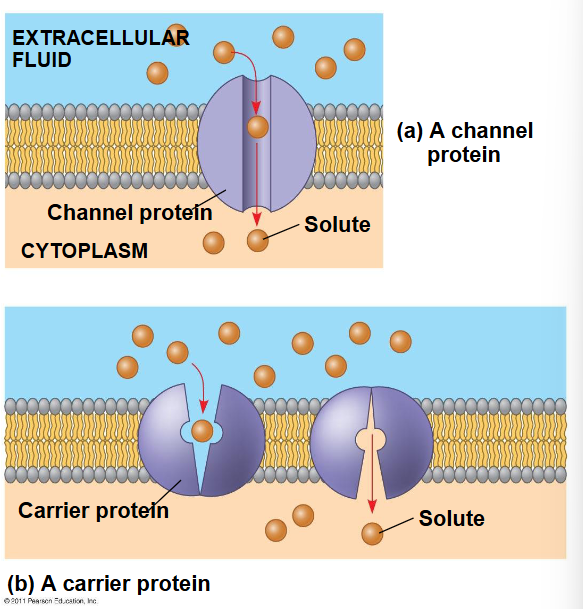
transport proteins regulate what can go in and out of the cell
protein channels are specific to what ions can pass through
Describe factors that affect the selective permeability of membranes.
they are located spanning across the membrane
integral proteins span across the membrane or peripheral proteins attach to the surface
they function as channels or carriers to help specific molecules, ions, and water cross the hydrophobic barrier
Describe the locations and functions of transport proteins.
it is the movement of particles from a high concentration to low
takes no energy
the driving force is the concentration gradient
Define diffusion. Explain what is the driving force behind diffusion.
it is regulated by the concentration gradient
have channels specific to what can pass through
it is basically diffusion with some help
no energy
Explain what regulates the rate of passive transport.
molecules naturally store energy when moved by a concentration, which is released as they flow down their gradient to perform work
Explain why a concentration gradient across a membrane represents potential energy.
hypotonic
animal = lysed - over filled
plant = turgid - normal
more water less solute inside cell
isotonic
animal = normal
plant = flaccid - under filled
hypertonic
animal = shriveled
plant - plasmolyzed
more solute less water inside cell
Distinguish between hypertonic, hypotonic, and isotonic solutions.
its the diffusion of water across a selectively permiable membrane
water moves from an area of lower solute concentration [higher water] to an area of higher solute concentration [ lower water ]
Define osmosis and predict the direction of water movement based on differences in solute concentrations.
They go across the membrane
take a certain amount of proteins across and need ATP to be phosphorylated in order to change cell shape and move contents across membrane.
Explain how transport proteins are structurally organized.

facilitated is like diffusion with some help
the ions are still moving with their concentration gradient - so its passive
the channel is specific to what can pass through
some are carrier proteins that change their shape to help the movement of a solute
[there are two types a channel type and a switch type]
Explain how transport proteins facilitate diffusion.
it requires energy because it moves substances against their concentration gradient
when ATP comes along it phosphorylates the protein - allowing it to shift
when K comes the protein dephosphorylates
for example the Na/K pump when Na attaches to the protein ATP phosphorylates, attaching a P to the protein and giving it the energy to shift and release the Na to the other side.
then K comes and attached to the pump, it can use the P again to drive the K into the cell then
Explain how active transport differs from diffusion
ion pumps [like the Na / K pump or proton pump] use ATP to actively transport ions across the membrane against their gradient, creating unequal distribution of charge and concentration
Explain what mechanism can generate a membrane potential or electrochemical gradient
in a proton pump energy is needed to get H from inside the cell [in tje cytoplasm] to outside the cell [extracellular]
once the H build up it can diffuse back into the cell and sucruse can use the H to move with it
it is using an exergonic motion to drive and endergonic
Describe the process of co-transport
dont
diffusion
facilitated diffusion
do
active transport
endo/exocytosis
what membrane processes need energy vs which dont
facilitated diffusion
diffusion
.
diffusion
aquaporins
facilitated diffusion
how do each of these move through proteins - what method of travel
carb
lipid
protein
gasses
water
ions
cell membrane made of phospholipids and has proteins
regulates things that go in and out of the cell
polar, hydrophobic tail
nonpolar, hydrophilic head
plasma membrane
location
function
mid cell
DNA, genetic information
nucleolus - where RNA is produced
chromatin - DNA and protein
nucleus
location
function
cytosol, rough ER, mitochondria
protein synthesis
ribosome
location
function
many in cell - number depends of cell needs
fat cells dont have a lot but muscle cells have a lot
where ATP is produced
mitochondria
location
function
cytoplasm
folding proteins
Rough ER
location
function
cytoplasm, near nucleus
makes lipids, detoxifies, store calcium
no ribosomes
smooth ER
location
function
near nucleus, SER, RER
modifies molecules by target and addresses them so they can be sent to the right target
golgi apparatus
location
function
cytoplasm
breakdown waste, they store stuff, break fown macromolecules into single monomers
lysome
location
function
their membrane is able to fuse with other membranes and carry things around the cell
vesicles and vacuole
function
microtubules, intermediate filaments, micro filaments
all over cell
organize, internal transport, shape of cell
cytoskeleton
3 types
location
function
catabolic breaks down complex molecules into simpler compounds
RELEASE energy
anabolic consume energy to build complex molecules from simpler ones.
NEED energy
Explain the difference between catabolic and anabolic reactions
the study of how energy flows through living organisms
What is bioenergetics
energy can be transferred and transformed but it cannot be created or destroyed
every energy transfer or transformation some energy is unusable and is often lost as heat
heat cant do any work
every energy transfer / transformation increases the entropy of the universe
Explain the two laws of thermodynamics in relation to biology
kinetic is energy associated with motion
potential is energy that matter posses because of its location or structure
Describe the two types of energy, potential and kinetic
spontaneous occurs
without energy input - can happen quickly or slowly
nonspontaneous
needs an input of energy - decrease entropy
Describe the differences between spontaneous reactions and non-spontaneous reaction
free energy is energy that can do work when temperature and pressure are uniform - its the amount of energy a cell can use
gibbs energy = H -TS
G = total energy - unusable energy
G is positive for nonspontaneous - needs energy - endergonic
G is negative for spontaneous - release energy - exergonic
more stable at low G less stable at high G
free energy
describe
equation
pos vs neg / ender vs exergonic
stable vs unstable
equilibrium is reached when forward and reverse reactions are occurring at the same rate - no work is being done
cells are constantly out of equilibrium due to the constant flow of materials in and out - they are always doing work
multiple stages of energy, each giving some power at each stage
Explain what is meant by a metabolic dis-equilibrium that is needed to maintain life
what is happening at equilibrium
why are cells in dis-equilibrium
energy coupling is the use of an exergonic process to drive an endergonic one.
most energy coupling in cells is mediated by ATP
ATP releases more energy with the loss of a phosphate than most other molecules could deliver
ATP breaks down and loses one phosphate group and becomes ADP. this releases energy. the phosphate is then transferred to another molecule, making it more reactive or easier to change.
Describe how ATP powers cellular work by coupling exergonic reactions to endergonic reactions through phosphorylation. What is phosphorylation
hydrolysis of ATP
The transition state is the level a molecule needs to get to to start the reaction
enzymes help the reactant go through its reaction by lowering its activation energy
once enzymes bind to a substrate the active site becomes unstable and the Ea is lowered, allowing for the reaction to speed up
after that the substrate becomes a product and the product is released
Describe the importance of enzymes to living system
transition state
activation energy
binding
product
The substrate is a molecule the enzyme acts on
once binded to the substrate it forms a enzyme-substrate complex
the active site the area of the enzyme where the substrate can bind
an induced fit brings chemical groups to the active site into positions that enhance their ability to catalyze the reaction. - the enzyme will change its shape to best fit the substrate
Explain how enzymes work
substrate
complex
active site
induced fit
an inhibited can black the substrate from entering the active site
completive inhibition - there is a lot of the inhibiter present and it competes with the substrate to bind to an enzyme
noncompetitive alters / changes the binding site so the substrate is unable to attach. only once the non competitive inhibiter leaves can the substrate bind
allosteric regulation is similar to noncompetitive
when an activator binds - the substrate is able to bind
but when the inhibiter the substrate is unable to bind - it makes the cell inactive
feedback inhibition
the product of an activated substrate becomes an inhibiter
this process doesn’t make waste project - it repurposes product
Explain how enzymes are regulated by several different mechanism
competitive
noncompetitive
allosteric
feedback
endergonic
energy needed
nonspontaneous
exergonic
energy released
spontaneous
endergonic vs exergonic reaction
energy
spontaneous vs non
exergonic
reactions due to their chemical structure have more energy than their products
through the progress of the reaction energy is released and G is smaller no energy input - this reaction is spontaneous
endergonic
when reactants energy is lower than the product the only way to get there is with the addition of energy
Gibbs goes up energy is added - the reaction is non spontaneous
explain this figure
free energy changes exergonic and endergonic reactions


adding ammonia to the acid converts it to glutamine
gibbs is positive = no energy added = nonspontaneous
Or you can phosphorilize ATP = attaching a phosphate to the glutamic acid and making the reactant Phosphorylated intermediate plus with P plus ADP = ammonia can be added during the reaction making the product glutamine plus ADP plus P
The coupled reaction
reactants are glutamic acid plus ammonia plus ATP = glutamine plus ADP plus P
they net G is negative = nonspontaneous
explain how hydrolysis of ATP drives chemical work when involving glutamic acid
2 ways
what’s the coupled reaction

ATP = ADP plus P
this process can be repeated through catabolism and cellular work
when ATP is used for a reaction what is it concerted to
Both catabolic [break down] pathway of making ATP
Fermentation
its a partial degradation of sugars that occurs without oxygen
Cellular respiration
includes both aerobic and anaerobic respiration
the break down of glucose and other organic molecules to produce ATP
aerobic respiration yields significantly more ATP using an ETC and oxygen as the final electron acceptor.
Distinguish between fermentation and cellular respiration.
what is the reactants and products of glucose
glucose + oxygen = CO2 + water + ATP [heat]
when oxygen is added to glucose it is able to break down. its products are CO2, water, ATP, and heat
Glucose releases energy when its bonds are broken.
Describe the summary equation for cellular respiration.
Also note the specific chemical equation for the degradation of glucose
ATP can go through hydrolysis [add water] and break down to ADP plus P
and go through cellular processes to regenerate ATP
Explain how ATP is recycled in cells.
loss of electrons = oxidation
addition of electrons = reduction
oxidation-reduction reactions = redox
Define oxidation and reduction
define redox reaction

glucose and other organic molecules are oxidized in a series of steps
each electron travels with a proton - thus as a hydrogen atom
hydrogen atoms are usually first passed to electron carriers than directly to O2
Explain why organic molecules that have an abundance of hydrogen are excellent cellular fuels.
NADplus can be reduced into NADH.
ETC accepts electrons from NADH and FADH2 and passes them through a series of protein complexes to lower energy states [ to cytochromes], ultimitly reaching oxygen. this electron flow powers the pumping of protons to establish a proton gradient
Describe the role of NAD+ and the electron transport chain during respiration
glycolysis - cytoplasm
krebs - mitochondrial matrix
ETC - inner membrane of mitochondrion
Describe the cellular regions where glycolysis, the Krebs cycle, and the electron transport chain occur
ATP is needed to break down glucose into 2 pyruvates - which starts the glycolysis stage
Explain why ATP is required for the preparatory steps of glycolysis
in glycolysis
the oxidation and reduction of NADplus to NADH occur during their energy payoff phase
substrate phosphorylation also occurs in the payoff phase when enzymes transfer phosphate groups directly from ADP to ADP
pyruvate to acetyl CoA
pyruvate is oxidized as it enters into the mitochondrial matrix, producing CO2, NADH, and acetyl CoA
Krebs link
the transition converts the end product of glycolysis - pyruvate - into acetyl CoA, which the directly enters and dives the krebs cycle
Identify where sugar oxidation, substrate-level phosphorylation, and the reduction of NAD+ occur in glycolysis,
where pyruvate is oxidized to acetyl CoA,
what molecules are produced,
and how this process links glycolysis to the Krebs cycle
as electrons exergonically move doen the ETC free energy is released and used by protein complexes to pump protons [H] across the membrane.
this creates a proton gradident that couples the rel
Explain how the exergonic "slide" of electrons down the electron transport chain is coupled to the endergonic production of ATP by chemiosmosis
chemiosmosis is the process where protons flow down their concentration gradient back into the mitochondrial matrix using ATP synthase.
the flow of protons turns the ADP back into ATP
Describe the process of chemiosmosis
protein
broken down into amino acids, remove amino groups as NH3, enter glycolysis, pyruvate oxidation, or CAC
carb
concerted into sugars that feed directly into glycolysis
fat
broken down into glycerol - which can enter glycolysis - and fatty acids - which can be broken down into acetyl CoA and enter CAC
Describe how food molecules other than glucose can be oxidized to make ATP

ATP is controlled via feedback regulation
PFK is an allosteric enzyme that acts as the pacemaker of glycolysis
where there is an abundance of ATP it can inhibit PFK by binding to it. when this happens glycolysis and cellular respiration is slowed
once ATP levels drop the inhibition is lifted and the cycle can continue
Explain how ATP production is controlled by the cell and what role the allosteric enzyme, phosphofructokinase [PFK], plays in the process
stage - 1 - glycolysis
location - cytoplasm
energy in - glucose bonds, 2ATP [ a little ATP]
energy out - 2 pyruvate bonds, NADH, ATP
brief description- glucose is stable and something has to destabilize it. adding ATP adding phosphate destabilizes it and breaks it down enough to make energy. it is a rearrangement of molecules [carbons] - which releases a little bit of NADH, and a little ATP then your up to pyruvate
Glycolysis
stage
location
energy in
energy out
brief description