Type II Diabetes
 Call Kai
 Learn
 Practice Test
 Spaced Repetition
 Match
 Flashcards
 Knowt Play
1/18

There's no tags or description
Looks like no tags are added yet.
19 Terms
Type I Diabetes
Your body doesn’t make enough insulin because your immune system destroys the cells that produce it
Type II
Your body makes insulin, but your cells don’t respond to it or your body doesn’t make enough to lower glucose levels
What causes Type II
Insulin resistance -> insulin-responsive tissues (like skeletal muscle, adipose tissue, liver) show reduced biological responses to normal or elevated insulin concentrations
Inadequeate beta-cell compensation -> pancreatic beta cells can’t sustain the extra insulin output that resistance demands, so hyperglycemia (high blood sugar) persists
Insulin responsive tissues
Skeletal muscle
Largest site of glucose disposal
Adipose tissues
Glucose uptake, lipid storage
Liver
Glucose production
beta cells release insulin (after a meal):
Glucose uptake by skeletal muscle and adipose tissue
Glycogen synthesis in muscle and liver
Glycolysis and energy storage
Suppression of hepatic gluconeogenesis and glycogen breakdown
Net blood glucose falls
Which cells release insulin
alpha cells release glycogen (during fasting)
Glycogen breakdown in liver
Gluconeogeneis
Release of glucose into the circulation
Inhibition of hepatic glycogen synthesis and glycolysis
maintains glucose
Which cells release glucagon
Downstream insulin secretion
Insulin binds its receptor on the PM
Receptor activation: The insulin receptor undergoes autophosphorylation on tyrosine residues, activating its kinase activity.
IRS phosphorylation: The activated receptor phosphorylates insulin receptor substrate (IRS) proteins.
PI3K activation: IRS recruits and activates PI3K, which converts PIP2 into PIP3.
Akt activation: PIP3 helps recruit and activate Akt (protein kinase B).
GLUT4 translocation: Akt promotes the movement of GLUT4-containing vesicles to the cell membrane, allowing glucose to enter cells.
Glucose storage: Insulin signaling also promotes glycogen synthesis and inhibits glucose production by the liver.

receptor tyrosine kinases (RTKs)
What type of receptor is an insulin receptor
PI3K-AKT pathway
What is the primary downstream intracellular signaling pathway for insulin receptors
GLUT 4 is found in primarily in skeletal muscle and adipose tissue
GLUT 2 is used by the liver for glucose uptake and release
*** skeletal muscle is the largest site of glucose uptake
Where is the primary site of insulin signaling?
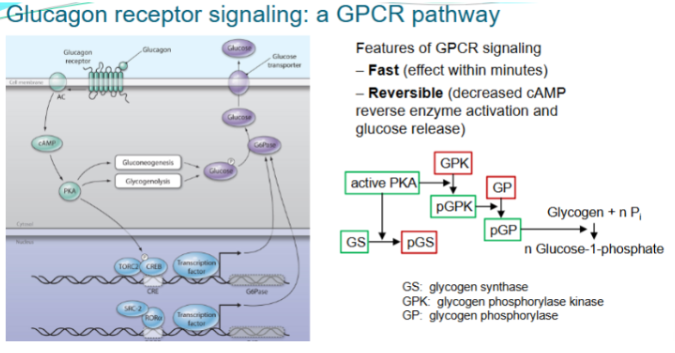
Glucagon receptors are Gs-coupled GPCRs
Which type of receptor is glucagon receptor?
Primary downstream effector: Adenylyl cyclase (which produces the second messenger cAMP).
activates adenylyl cyclase, raising cAMP and activating PKA. The primary site of glucagon signaling is the liver, where PKA stimulates glycogen breakdown and gluconeogenesis to raise blood glucose.
What is the primary downstream effector upon glucagon release?
Insulin vs. Glucagon
Insulin | Glucagon | |
Receptor | RTK | GPCR |
Main pathway | PI3K-Akt | Gs-cAMP-PKA |
Primary target | Muscle, fat, liver | Liver |
Blood glucose | Decreases | Increases |
Main effect | Glucose uptake/storage | Glucose production/release |
Exam memory trick:
Insulin = Store glucose.
Glucagon = Release glucose.
The primary site of glucagon signaling is the liver (hepatocytes).
Glucagon is released by pancreatic alpha cells when blood glucose is low. Glucagon binds a Gs-coupled GPCR on hepatocytes, raising cAMP and activating PKA, which stimulates glycogen breakdown and gluconeogenesis to raise blood glucose.
Where is the primary site of glucagon signaling?

Class experiment results
It aims to selectively inhibit mitochondrial complex I -> reduces ATP production, increases AMP -> increased aMP inhibits adenylyl cyclase, therefore, decreases cAMP production and decreases glucose production.
Also,
Increased AMP also activates AMPK (AMP- activated protein kinase), which decreases gluconeogenesis and improves insulin sensitivity
What is the target of type II diabetic medicine Metformin
Gαs- coupled GPCR expressed on pancreatic β cells
Similar to Glucagon receptor, GLP-1 receptor stimulates G proteins, Adenylyl cyclase, cAMP, and PKA.
While the glucagon receptor increases glucose production in hepatocytes, GLP-1 in β cells increases glucose-dependent insulin secretion
Benefit -> it increases insulin secretion when blood glucose levels are elevated
Which type of receptor is GLP-1 receptor?
Glucagon binds to its receptor on liver cells and activates glycogen phosphorylase.
During fasting, glucagon is released from alpha cells. How does it help maintaining blood glucose level?
Translocation of GLUT4-containing vesicles to the plasma membrane
In skeletal muscle and adipose tissue, insulin promotes glucose uptake primarily through which mechanism?