BCF - enzyme:
 Call Kai
 Learn
 Practice Test
 Spaced Repetition
 Match
 Flashcards
 Knowt Play
1/6

There's no tags or description
Looks like no tags are added yet.
7 Terms
enhancing rxn rate:
A + B → C + D — can increase rate in 2 ways:
↑ heat = increased the # of reactants (group) that can OVERCOME ACTIVATION ENERGY BARRIER (↑ kinetics to bump → t.s)
in order for a reaction to carry through → need to get to a specific energy state (transition state) — reactants can get to that state with heat
adding a catalyst → decreased activation energy barrier for reactants ஃ easier to get to state (rxn rate = ↑ by 10⁶ to 10²⁰)

enzyme = can be proteins or catalyst
enzymes = protein:
enzyme → posess 1’, 2’, 3, 4’ structures + typically soluable globular proteins (compact, amphipathic → polar OUT + np IN core)
*therefore globular structure = driven by hydrophobic effect
enzymes = catalyst ↴
enzymes can be catalyst ஃ enzymes can accelerate rxn rates
catalyst is maintained/regenerated at the end ஃ isnt USED or permanently changed in reaction process 🙂
HIGHLY specific to reactants ஃ no side reactions
DOESNT CHANGE THE FREE ENERGY — only REDUCES ∆G energy of activation state
how does enzyme ↓ free energy of high energy transition state (literally study guide verbatim twim)
Removing substrates from H2O aqueous solution (desolvation)
ஃ remove water shell = accelerates rxns, ↑ strength on polar interactions (hbonds + ionpairs) + ↓ unwanted side rxns
Proximity and orientation effects
ஃ enzyme active site → binds substrate = close together (proximity) + in the exact geometry (orientation) to react best → form product state
Taking part in the reaction mechanism (dont overcomplicate this)
ஃ catalyst → positioned functional groups near substrates in active site
allows functional groups to participate in acid/base + covalent + metal ion catalysis — groups interacting in these reactions makes the intermediate stable
enzymes utilize amino acid (offers protons) or cofactors (offers functional groups amino acids lack) to participate in reactions
Stabilizing the transition state
ஃ transition to product = easier if the transition state is stabilized !! active site binds TIGHTLY to TS to ensure this happens (MORE THAN GROUNDSTATE SUBSTRATE)

amino acid in acid-base catalysis + covalent catalysis
amino acid groups in enzyme → can preform acid/base catalysis
aspartate + glutamate histamine + lysine + cystiene + tyrosine → act in acid + base catalysis onto the substrate depending on state of protonation
covalent catalysis:
ser + tyr + cys + lys + his groups in the enzyme → can act as nucleophiles onto the substrate

enzyme nomenclature + enzyme regulation:
enzyme nomenclature → typically end in “ase”
name typically describes the process (a chemical reaction prod. a specific product)
ஃ citrate synthase + alcohol dehydrogenase + pyruvate decarboxylase
creating citrate + removing H from alcohol + removing carboxyl from pyruvate
enzyme regulation:
enzymes ≠ same as nonbiological catalyst
enzymes as proteins makes them FLEXIBLE (to an extent)
changing shape of enzyme = changes function
*ஃ shape of enzyme = relate to function
how does a rxn progress? define gib energy yk
in ALL SYSTEMS = rxn can ONLY progress if the free energy of reactants > products
∆Grxn = GP - GR ஃ results in a neg (-) ∆Grxn = spontaneous
therefore exergonic (aka exothermic but gib energy) rxn is the most thermodynamically favourable
*thermodynamically favourable ≠ mean automatically proceed in FAST rxn/measurable rate
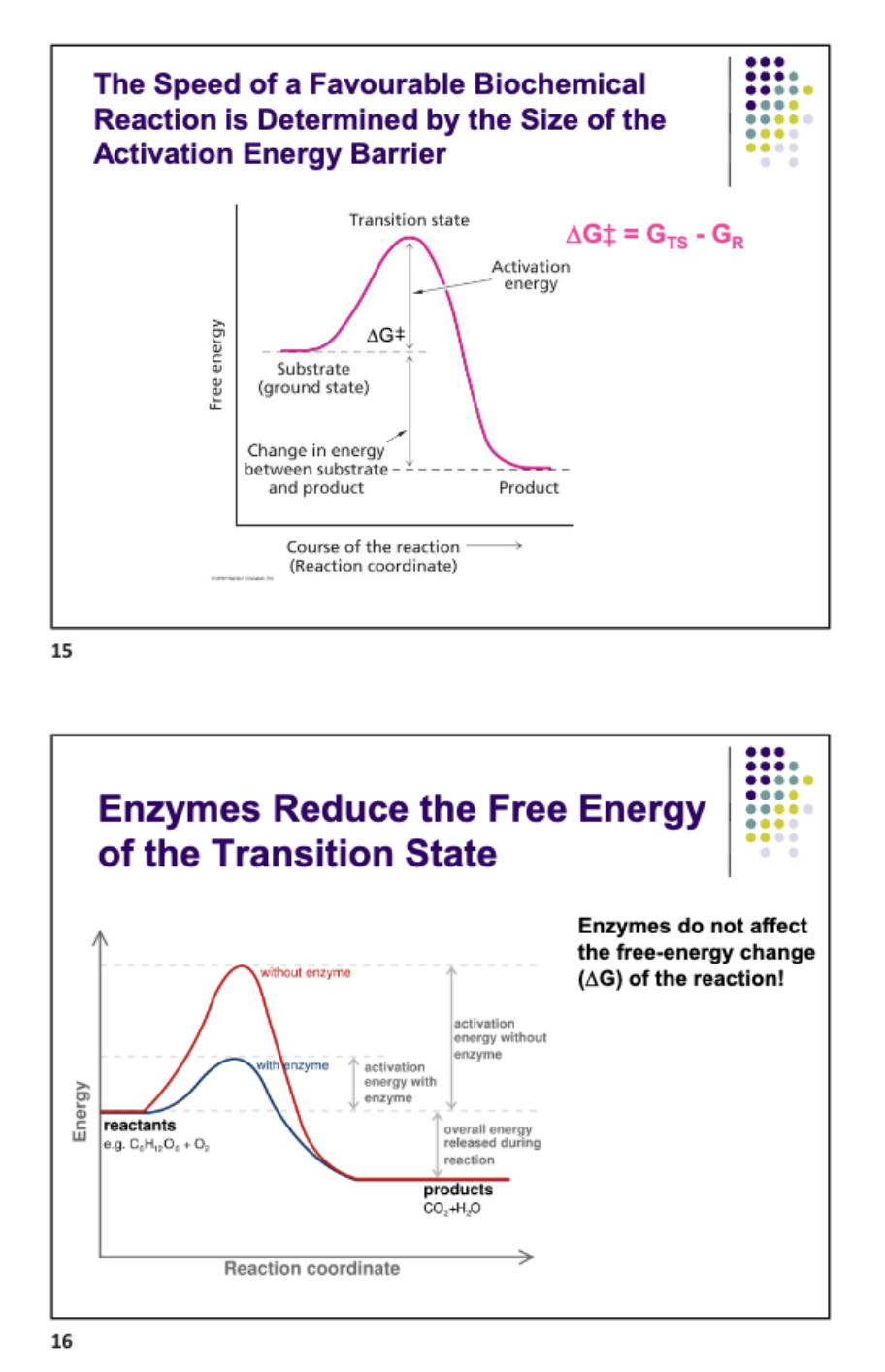
speed of favourable biochemical rxn = determined by the size of activation barrier ஃ the energy needed to take reactants → transition state
transition state = highest Grxn energy state in an exergonic rxn = unstable molecule arrangement b/w reactant + product
calulation = G transition state - G reactants = ∆G++
*therefore the smaller activation barrier = quicker the rxn
active site
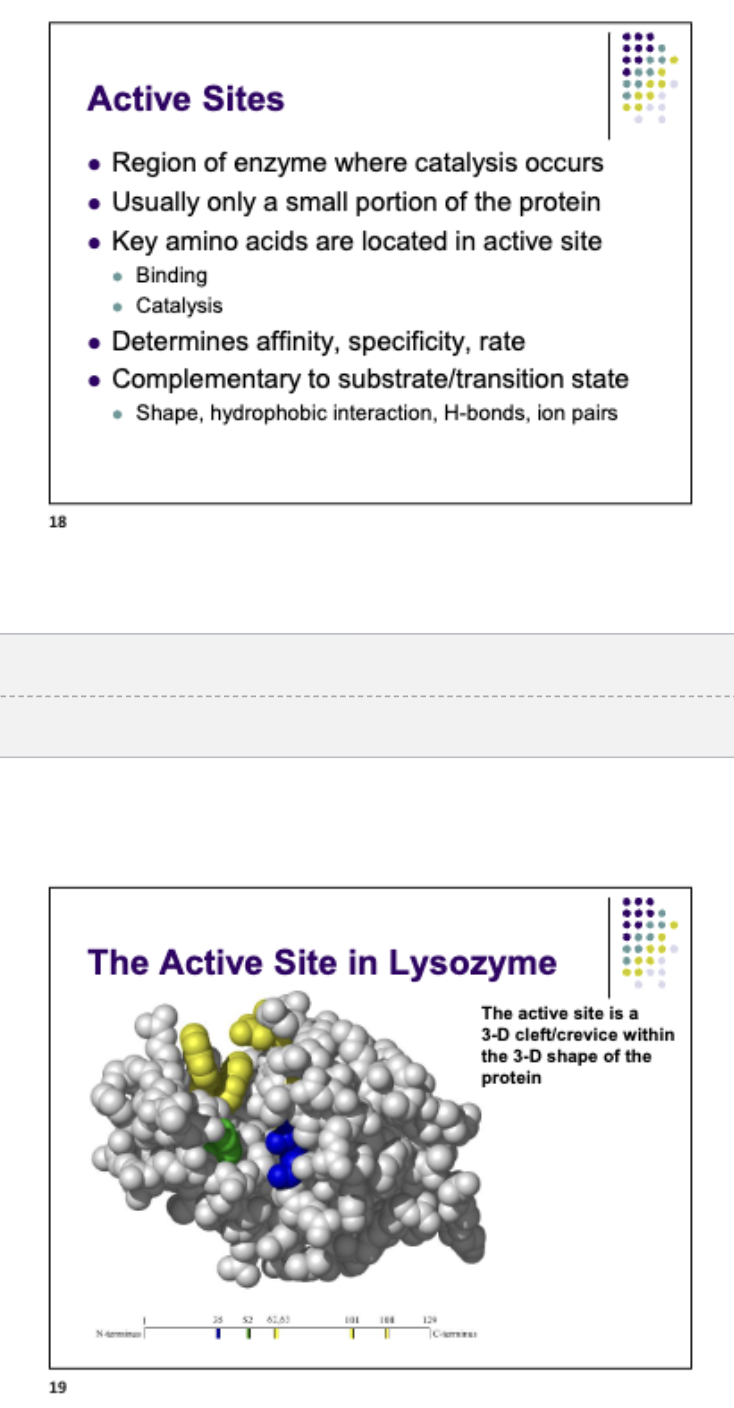
region where catalysis occurs ஃ site where catalyst does its thing lol (↓ ∆G)
region on protein = fairly small + key amino acids = located on active site → binding + affinity + specificity + catalytic rate
complimentary to substrate + ஃ TS — done via shape + hydrophobic interactions + H-bonds + ion pairs
complimentary in substrate binding = ↑ specificity ஃ ↑ affinity — can think of substrate + enzyme as a lock + key model
induced fit = substrate bind → enzymes makes a pronounced confirmation @ active site
classifcation of cofactors: