CHAPTER 1,2,3 (AP ENVIRONMENTAL SCIENCE)
 Call Kai
 Learn
 Practice Test
 Spaced Repetition
 Match
 Flashcards
 Knowt Play
1/88

There's no tags or description
Looks like no tags are added yet.
89 Terms
Natural resources
Substances and energy sources taken from the environment that organisms require for survival.
Renewable resources
- Perpetually available: sunlight, wind, wave energy
- Renew themselves over short periods: timber, water, soil
- These can be destroyed
Nonrenewable resources
- can be depleted
- Oil, coal, minerals
Tragedy of the Commons
A concept described by Garrett Hardin in which unregulated access to shared public resources leads to resource depletion
• Soil, air, water
• Resource users are tempted to increase use until
the resource is gone
Three primary solutions to the Tragedy of the Commons
Transitioning shared land or goods into private ownership
Establishing voluntary community cooperation and social norms
Enforcing top-down governmental regulations.
A scientist makes an observation and asks questions of some phenomenon
• The scientist formulates a hypothesis, a statement that attempts to explain the scientific question.
• The hypothesis is used to generate predictions, which are specific statements that can be directly and unequivocally tested.
• The test results either support or reject the hypothesis
Manipulative experiment
A controlled study where the researcher actively alters an independent variable, yielding the strongest evidence but lots of things cant be manipulated.
Natural (correlational) experiment
An observational study analyzing existing real-world variation without active intervention, capturing environmental complexity.
Results are not so neat and clean, so answers aren’t simply black and white
Cornucopians
The optimistic perspective arguing that human technological innovation and ingenuity will overcome any environmental constraints or resource shortages.
Cassandra
The perspective predicting that continuous population growth and unsustainable resource exploitation will lead to inevitable environmental collapse and disaster.
Triple bottom line
Sustainable solutions that meet
Environmental goals
Economic goals
Social goals
Matter
Any material that has mass and occupies physical space.
Chemistry
Studies the interaction of matter
Law of conservation of matter
States that matter can be transformed from one type of substance to another, but not created or destroyed.
– Matter in ecosystems constantly cycles.
– Undesirable matter, like nuclear waste and pollution,
can’t be destroyed.
Elements
Substances with specific properties that cannot be broken down into substances with other properties.
These are organized according to their properties and behavior by the periodic table of elements.
Atom
The smallest structural unit that still retains all of the chemical properties of an element.
Three subatomic particles of an atom
Protons: Positively-charged units that determine atomic number
Neutrons: Uncharged particles carrying no electrical charge
Electrons: Negatively-charged units orbiting the nucleus
Half-life
The amount of time required for half of the atoms in a radioisotope sample to decay
Ionizing radiation
The radiation energy emitted by radioisotopes, it generates ions when it hits molecules, affecting their stability.
Molecule
A chemical particle composed of two or more atoms held together by chemical bonds (e.g., O2).
Compound
A substance composed of two or more different elements chemically bonded together (e.g., H2O, CO2).
Covalent bond
Formed when atoms share pairs of electrons.
Ionic bond
The strength of attraction within a molecule is sufficiently unequal, an electron will be transferred from one atom to another.
This creates oppositely charged ions, which attract each other
Polymers
Long chains of repeated molecules
Macromolecules
Exceptionally large organic molecules like polymers and lipids.
Proteins
Polymers made of amino acids.
– They are found in skin, hair, muscles; as part of the
immune system; and as enzymes that catalyze
chemical reactions.
Carbohydrates include simple and complex sugars,
such as:
– Glucose, or blood sugar
– Cellulose, a complex carbohydrate found in leaves,
bark, stems, and roots
– Chitin, which is found in insect exoskeletons
Lipids
include a diverse group of molecules that do not dissolve in water:
– Fats and oils, which store energy
– Waxes, which are structural
– Steroids, which are part of hormones
Acidic vs. basic (alkaline) solutions
Acidic solutions: Solutions containing a higher concentration of hydrogen ions with a pH below 7
Basic solutions: Solutions containing a higher concentration of hydroxide ions (OH−OH−) with a pH above 7
Pure water: Neutral solution with a pH of 7
Potential energy
The energy of position or composition.
– For example, river water held behind a dam contains
potential energy.
Kinetic energy
The energy of motion.
– River water rushing through a dam and downstream
contains kinetic energy.
First law of thermodynamics
Energy can change from one form to another, but it cannot be created or destroyed.
Second law of thermodynamics
Energy tends to change from a more-ordered to a less-ordered state as it changes form.
Autotrophs
Use the sun’s radiation directly to produce their own food.
– They use a process called photosynthesis to transform molecules with low-energy bonds into sugar molecules with high-energy bonds.
Photosynthesis
Occurs within cell organelles called chloroplasts.
Chlorophyll
Uses solar energy to initiate a series of reactions called light reactions.
The overall process of photosynthesis can be summarized
in this reaction:
6 CO2 + 6 H2O + suns energy → C6 H12 O6 + 6 O2
Photosynthesis Converts Solar Energy to Chemical Energy
Plants take in water through their roots, absorb carbon dioxide from the air through their leaves, and harness the power of sunlight to generate sugar and oxygen.
The overall reaction for cellular respiration is the exact
opposite of photosynthesis:
C6 H12 O6 + 6 O2 → 6 CO2 + 6 H2O
Cell respiration occurs in …
All living things, both autotrophs and heterotrophs, organisms that gain energy by feeding on other organisms.
Geology
is the study of Earth’s physical features, processes, and history.
– These processes shape the landscape, lay the
foundation of environmental systems, and provide
resources like metals and fossil fuels.
At the Earth’s center is a …
Dense core made of solid iron at the center surrounded by
molten iron.
Mantle
The core surrounded by a thick layer of less dense, elastic rock
Asthenosphere
An area of the upper mantle with especially soft rock.
Lithosphere
Contains the uppermost mantle and the crust.
Crust
A thin, brittle, low-density layer of rock that covers the entire surface.
The order of the earth
Inner core → outer core → lower mantle → Asthenosphere (upper mantle) → Lithosphere (uppermost mantle) → Continental or Oceanic

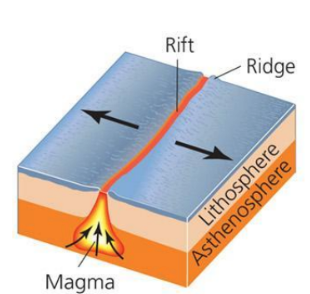
Divergent plate boundaries
Plates move apart as magma rises to the surface and cools.
Transform plate boundaries
Plates slip and grind alongside each other. This causes earthquakes.

Two possible actions may occur at convergent plate
boundaries:
Oceanic crust, which is more dense than continental crust, will dive downward in a process called subduction.
Two continental plates will crush, bend, and buckle creating mountain ranges. This is called continental collision.

Magma
Made of liquid rock that has melted at high temperatures. When it erupts and reaches the surface, it is called lava.
Igneous rock
Rock that forms when lava or magma cool
Sediment
As rock weathers from wind and water, particles come to rest downwind or downstream.
Sedimentary Rock
Sediment layers accumulate over time and are compacted as they are buried.
– Minerals may seep through them and cement particles together.
Earthquake
A sudden release of energy at a tectonic plate boundary.
– May also occur in the interior of tectonic plates due to stretching and pulling from forces within the Earth.
Volcano
Formed where molten rock, ash, or hot gas erupts through the Earth’s surface.
– Often found in subduction zones of convergent plate boundaries
Hotspots
Lava may also be emitted at this localized area where plugs of molten rock from the mantle erupt through the crust.
Mass Wasting
The downward gravitational movement that causes landslides
– Most commonly affects unstable hillsides
Tsunami
Earthquakes, volcanic eruptions, and large coastal landslides can all displace huge volumes of ocean water instantly at once
Evolution
Populations change over multiple generations as genetic
changes alter their physical and behavioral characteristics.
originates in genes and often leads to
modifications in appearance or behavior.
Convergent Evolution
Unrelated species living in similar environments
in separate locations may independently acquire similar traits.
– Similar selective pressures
Termed speciation
The process by which new species are generated
Allopatric Speciation
Occurs when populations become physically
separated over a geographic distance.
When a mutation arises in an organism of one of the
populations, it does not spread to the other.
– Eventually the populations grow so different that they can no longer mate.
Endemic to a region
Meaning the species occur nowhere else on the planet, are especially vulnerable.
– If an event affects their region, it affects all members of the species.
5 Mass extinction events
Wiped out 50–95% of Earth’s species each time, causes include volcanism, asteroid impact, methane releases, and global warming.
Ecology
The study of the interactions among organisms and with their
environments, and includes many levels.
Ecosystem ecology
Studies the flow of energy and nutrients between the living and nonliving parts.
Niche
An organism’s role in its community
– Includes resource use and interaction with other organisms
Specialists
Species with narrow niches
Random distribution
shows no particular pattern.
Uniform distribution
Has individuals spaced evenly, like penguins
Clumped distribution
occurs when individuals concentrate in certain areas.
Demographers
who study population change, track the four key population factors: Natality, Morality, Immigration, Emigration
Natality
Births within the population.
Mortality
Deaths within the population.
Immigration
Arrival of individuals from outside the Population.
Emigration
Departure of individuals from the population.
The actual population growth rate includes the effects of emigration and immigration:
(birth rate − death rate) + (immigration rate − emigration rate)
Growth rates may be expressed as percentages: growth rate x 100%
Exponential growth
When a population increases by a fixed percentage each year
When graphed, these populations produce a J-shaped curve.
Only occurs in nature when a population is small, competition is minimal, and environmental conditions are ideal.
logistic growth
Population growth slows as it reaches the carrying capacity. This produces an S-shaped curve.
Density-dependent factors
Rise and fall with population density.
– Predation, disease
Density-independent factors
Are unaffected by population density.
– Temperature extremes, catastrophic natural disasters
Type III survivorship (R-selected species)
Occur when species produce many offspring, but do not care for them.
– Survival is due to chance.
– They do well in changing and unpredictable environments.
Type I survivorship (K-selected species)
Are observed in species that have few offspring but invest heavily in their survival.
– They are found in stable environments.
Metamorphic rock
rock that has undergone intense heat and/or pressure, causing it to change form without completely melting
Lithification
The continuous process where weathering and erosion break down all three rock types into sediments, and turns sediments into sedimentary rock.
Driving force of plate tetonics
Internal heat from Earth's inner layers (convection currents in the mantle) drives plate movement
Type II survivorship
populations where the probability of dying is relatively constant at every age (e.g., many birds and small mammals).
Ecosystem services
Economically valuable services provided by natural systems that keep ecosystems productive and support human life